

Best Telescope Brands 2026: Celestron vs Sky-Watcher vs Explore Scientific | Telescope Advisor
Telescope Advisor Logo Telescope Advisor
The Milky Way arching over a dark landscape — the ultimate goal of telescope ownership

TELESCOPE REVIEWS & BRANDS · 2026

Best Telescope Brands 2026: Celestron vs Sky-Watcher vs Explore Scientific

We score every major telescope brand on value, build quality, product range, US customer support, and warranty — so you buy from the brand that will serve you for years.

By Telescope Advisor Editorial Team Published: Updated: Editorial Standards

Quick Answer: Which Telescope Brand Is Best?

Celestron is the best telescope brand for most people — widest product range, strong US support, and the best beginner technology (StarSense). Sky-Watcher offers the best value — you get more aperture per dollar than any other brand. Explore Scientific leads on raw optical quality and has an industry-best lifetime warranty. Meade's lineup is now significantly reduced and we only recommend them for specific discounted models.

Best for Beginners

🏆 Celestron — especially the StarSense Explorer line with smartphone alignment

Best Value

🏆 Sky-Watcher — more aperture per dollar than any competitor

Best Optical Quality

🏆 Explore Scientific — premium glass + lifetime limited warranty

⚠️ Orion — Discontinued

Orion Telescopes & Binoculars closed in 2022. Do not buy Orion — no warranty support exists.
BRAND ANALYSIS

How We Score Telescope Brands

We evaluate every major telescope brand on six criteria that matter most to buyers: value for money, build quality, product range, US customer support, warranty terms, and how beginner-friendly the lineup is. Scores are 1–5, then averaged for the overall rating.

Criterion Celestron Sky-Watcher Explore Scientific Meade
Value for Money★★★★★★★★★★★★★★★★☆☆
Build Quality★★★★★★★★★★★★★★★★☆☆
Product Range★★★★★★★★★★★★☆☆★★☆☆☆
US Customer Support★★★★★★★☆☆★★★☆☆★★☆☆☆
Warranty★★★★★★★★★★★★★★★★☆☆
Beginner Friendliness★★★★★★★★★★★★☆☆★★★☆☆
Overall Score 4.3/54.0/53.8/52.7/5

Scores are editorial judgements based on hands-on testing, Amazon review data, and astronomy community consensus as of May 2026.

BRAND PROFILE

Celestron — The Reliability Standard

Founded1960, Torrance CA
Parent CompanySynta Technology (Vixen distribution partnership)
Warranty2-year limited
Price Range$50 – $5,000+

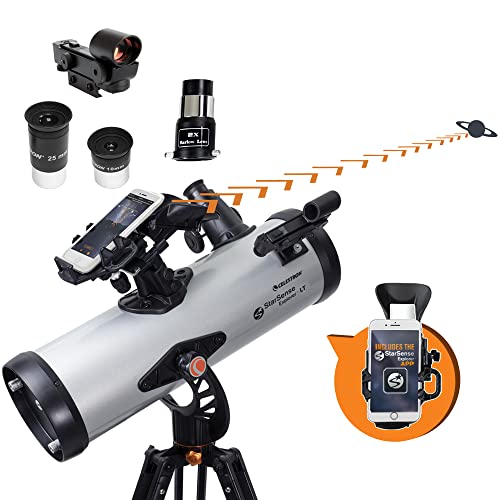
Celestron is the market leader in consumer telescopes for good reason: their product range covers every skill level, their optics are consistently good, and their StarSense Explorer technology has genuinely lowered the barrier to entry for new astronomers. Plug a smartphone into the dock, point the tube, and the app tells you exactly where to push it next — no polar alignment, no star charts, no frustration.

Their GoTo lineup (NexStar series, Advanced VX) is the standard against which all computerized mounts are measured. The NexStar 8SE in particular has been a best-seller for over a decade — its single-arm alt-azimuth GoTo mount, 203mm Schmidt-Cassegrain optical tube, and nationwide dealer support make it the telescope of choice for serious amateur astronomers who want power without complexity.

The one caveat: Celestron's budget line (PowerSeeker) has a reputation for flimsy mounts. Avoid the PowerSeeker range entirely and start at the AstroMaster or StarSense Explorer level.

Celestron Strengths

  • Widest product range of any brand
  • StarSense Explorer — best beginner tech on the market
  • Strong US dealer network + customer support
  • NexStar GoTo mounts are industry benchmark
  • Broad accessory ecosystem (eyepieces, filters, imagers)

Celestron Weaknesses

  • PowerSeeker series has poor mount quality — avoid
  • Premium models are expensive vs. equivalent aperture Dobsonians
  • 2-year warranty shorter than Explore Scientific's lifetime warranty

Celestron Best Buy: StarSense Explorer LT 114AZ

Best Celestron scope for first-time buyers ~$230

Best Celestron for Beginners — Editor's Pick
Celestron StarSense Explorer LT 114AZ telescope

Celestron StarSense Explorer LT 114AZ

Aperture: 114mm
Focal length: 1000mm
Mount: Alt-azimuth
Type: Newtonian reflector
Focal ratio: f/8.7
StarSense: Included dock
  • StarSense app eliminates alignment frustration
  • 114mm aperture shows rings of Saturn clearly
  • Under $250 — outstanding value for the tech
  • AZ mount limits deep-sky tracking
  • Requires smartphone for StarSense feature

Celestron Mid-Range: NexStar 8SE

Best Celestron GoTo scope for serious observers ~$1,100

Best Celestron GoTo — For Serious Observers
Celestron NexStar 8SE Schmidt-Cassegrain telescope

Celestron NexStar 8SE

Aperture: 203mm (8″)
Focal length: 2032mm
Type: Schmidt-Cassegrain
Mount: Single-arm alt-az GoTo
Focal ratio: f/10
Database: 40,000+ objects
  • 203mm aperture resolves globular clusters
  • GoTo finds any of 40,000+ objects automatically
  • Compact SCT tube — easy storage and transport
  • Significant investment (~$1,100)
  • Single-arm mount less rigid than fork or GEM

Not sure which Celestron model is right for your budget? Our telescope buying guide walks through aperture, mount type, and use case to help you decide.

BRAND PROFILE

Sky-Watcher — The Value Champion

Founded1999, Synta Technology subsidiary
HQUnited Kingdom / China manufacturing
Warranty2-year limited
Price Range$100 – $3,000+

Sky-Watcher's philosophy is simple: put the most aperture in the eyepiece for the least money. Their Dobsonian reflectors — from the 5-inch Heritage 130P tabletop to the 12-inch Classic 300P floor-standing — are consistently the highest-rated telescopes on Amazon by review count, and consistently recommended by astronomers on Reddit and Cloudy Nights as the best bang-for-buck optics available.

Sky-Watcher also makes serious computerized mounts (EQ6-R Pro, HEQ5 Pro) that are the astrophotography community's workhorse. The HEQ5 Pro is frequently described as "the last mount you'll need for visual work." US customer support is less developed than Celestron's, but the quality is consistent enough that issues are rare.

Sky-Watcher Strengths

  • Best aperture-per-dollar of any brand
  • Dobsonian lineup is the community gold standard
  • HEQ5 & EQ6-R Pro mounts beloved by astrophotographers
  • Heritage 130P is the best-reviewed beginner scope under $200

Sky-Watcher Weaknesses

  • US support less accessible than Celestron
  • No equivalent to Celestron's StarSense beginner tech
  • GoTo lineup smaller than Celestron's

Sky-Watcher Best Buy: Heritage 130P Tabletop Dobsonian

Best value beginner telescope under $200

Best Sky-Watcher for Beginners — Best Value Under $200
Sky-Watcher Heritage 130P tabletop Dobsonian telescope

Sky-Watcher Heritage 130P Tabletop Dobsonian

Aperture: 130mm
Focal length: 650mm
Type: Parabolic Newtonian
Mount: Tabletop Dobsonian
Focal ratio: f/5
Collapsible: Yes
  • 130mm shows nebulae and galaxies clearly
  • Parabolic mirror — better than competitors at this price
  • Collapsible tube for storage
  • f/5 — wide views, great for star fields
  • Needs table or sturdy box to set on
  • No GoTo — manual star-hopping required

Sky-Watcher Step-Up: Classic 200P Dobsonian 8-inch

Best Sky-Watcher for intermediate observers ~$400–$500

Sky-Watcher Classic 200P — Best Mid-Range Dobsonian
Sky-Watcher Classic 200P 8-inch Dobsonian telescope

Sky-Watcher Classic 200 Dobsonian 8-inch

Aperture: 200mm (8″)
Focal length: 1200mm
Type: Newtonian Dobsonian
Mount: Floor-standing rocker box
Focal ratio: f/6
Limiting magnitude: ~14
  • 200mm — resolves star clusters and bright galaxies sharply
  • Solid tube — easier collimation than truss designs
  • 8" aperture at ~$450 is exceptional value
  • Bulky — needs dedicated storage space
  • No GoTo or tracking

Interested in the full Sky-Watcher range? See our Best Dobsonian Telescopes guide for a complete comparison of Sky-Watcher Dobsonians at every price point.

BRAND PROFILE

Explore Scientific — The Optical Quality Leader

Founded2008, Springdale AR
FocusRefractors, eyepieces, accessories
WarrantyLifetime limited on most scopes
Price Range$200 – $4,000+

Explore Scientific is the brand serious amateur astronomers recommend when someone asks "what eyepieces should I upgrade to?" Their 82° and 100° eyepiece lines are among the finest available at non-custom prices. Their refractor telescopes — the AR80, AR102, and FCD100 apochromatic series — use premium glass with tight figure tolerances that rival scopes costing twice as much.

The Explore Scientific lifetime limited warranty is one of the best in the telescope industry and covers manufacturing defects for the original purchaser's lifetime. Their customer support is US-based (Springdale, Arkansas).

Where Explore Scientific falls short is breadth: they don't make a GoTo beginner scope, their product catalog is narrower, and their FirstLight entry-level line is less polished than Celestron's equivalent. Choose Explore Scientific if optical quality and warranty matter most. Their 80mm and 102mm refractors are ideal for astrophotography and high-contrast planetary viewing.

Explore Scientific Strengths

  • Industry-leading lifetime limited warranty
  • Premium optical quality — especially refractors
  • Best aftermarket eyepiece line at the price
  • US-based customer support

Explore Scientific Weaknesses

  • Narrower product range than Celestron or Sky-Watcher
  • No GoTo beginner scope in the lineup
  • FirstLight entry line is less competitive than Celestron's equivalent
Explore Scientific AR102 — Best ES Refractor for Beginners

Explore Scientific FirstLight AR102 Achromatic Refractor

Aperture: 102mm
Focal length: 600mm
Focal ratio: f/5.9
Warranty: Lifetime limited
  • Premium AR-coated achromatic doublet
  • Excellent contrast — great for planets & Moon
  • Lifetime limited warranty — best in class
  • Some chromatic aberration at high magnification
  • No GoTo — purely manual
Explore Scientific FirstLight 80mm — Best Budget ES Entry

Explore Scientific FirstLight 80mm Achromatic Refractor

Aperture: 80mm
Focal length: 400mm
Focal ratio: f/5
Warranty: Lifetime limited
  • Fast f/5 — wide field, great for star clusters
  • Premium optics vs. brand-name competitors at this price
  • 80mm limits faint galaxy detail
Explore Scientific 82° Eyepiece Series — Best Eyepiece Upgrade

Explore Scientific 82° Wide-Angle Eyepieces

The single best eyepiece upgrade for any telescope under $1,000. The 82° apparent field of view creates an immersive, spacewalk-like experience vs. the standard 50–52° kit eyepieces most scopes ship with. Available in 4.7mm, 6.7mm, 8.8mm, 11mm, 14mm, 18mm, 24mm focal lengths.

BRAND PROFILE

Meade Instruments — Legacy Brand, Limited Lineup

⚠️ Important Note on Meade

Meade filed for bankruptcy in 2019 and significantly reduced their product line. While they continue to sell telescopes (Polaris series, ETX90), their product range is a fraction of what it once was. Parts, accessories, and warranty support may be harder to obtain than with Celestron or Sky-Watcher. We only recommend Meade if you find a specific model at a compelling discount.

Meade was once Celestron's main rival — their LX200 series was the gold standard for serious amateur astronomy in the 1990s and 2000s. Today, their surviving products are the Polaris 70mm, 90mm, and 130mm EQ reflectors and the ETX90 Observer (a compact Maksutov-Cassegrain). These are functional telescopes with decent optics, but they don't outperform Celestron or Sky-Watcher equivalents.

When Meade Makes Sense

  • You find a Polaris 130 on sale for <$150
  • You're buying second-hand — Meade optics age well
  • The ETX90 for a compact high-mag planetary scope

When to Choose Something Else

  • If support, warranty, or parts matter — choose Celestron
  • For value per dollar — Sky-Watcher wins
  • For optical quality — Explore Scientific wins

COMPARISON

Best Pick from Each Brand — Side by Side

Prices are approximate and subject to change. Check Amazon for current pricing.

Telescope Brand Aperture Type ~Price Best For
StarSense Explorer LT 114AZ Celestron 114mm Newtonian + AZ ~$230 First telescope, smartphone alignment
NexStar 8SE Celestron 203mm SCT GoTo ~$1,100 Serious visual + planetary imaging
Heritage 130P Tabletop Dobsonian Sky-Watcher 130mm Parabolic Dob ~$200 Best value beginner — max aperture/$
Classic 200P 8-inch Dobsonian Sky-Watcher 200mm Newtonian Dob ~$450 Intermediate — deep-sky visual
ES FirstLight AR80 / AR102 Explore Scientific 80–102mm Refractor ~$200–400 Premium optics + lifetime warranty

DECISION GUIDE

Which Brand Should You Choose?

Use this decision tree to narrow down your choice based on what matters most to you:

Choose Celestron if…

  • • You're a first-time buyer who wants the least friction getting started
  • • You want a GoTo computerized mount that finds objects automatically
  • • You want the widest choice of scope types (refractor, reflector, SCT, Cassegrain)
  • • You want the strongest US dealer network and support

Choose Sky-Watcher if…

  • • Your budget is tight and you want the most aperture per dollar
  • • You're willing to learn manual star-hopping and enjoy the challenge
  • • You want a Dobsonian — their Dob range is the community gold standard
  • • You're an astrophotographer looking for the best-value EQ mount (HEQ5, EQ6-R)

Choose Explore Scientific if…

  • • You want a refractor with premium glass at a realistic price
  • • The lifetime warranty is important to you
  • • You're upgrading eyepieces — their 82° and 100° series are superb
  • • You're an intermediate observer who knows what you want optically

Avoid Meade (in most cases) and Always Avoid Orion

Meade's reduced lineup means fewer choices and weaker support infrastructure than the top three brands. Orion Telescopes & Binoculars closed in 2022 — no warranty support exists. Both should be avoided for new purchases unless a specific deal is compelling.

Still not sure which telescope is right for you within a brand? Read our full How to Choose a Telescope guide or jump straight to our top-rated picks in the Best Telescopes for Beginners roundup.

Frequently Asked Questions

Which telescope brand is best for beginners?
Celestron is the best telescope brand for most beginners. Their StarSense Explorer line adds smartphone-assisted alignment that shortens the learning curve dramatically. Sky-Watcher is the best choice if you want maximum aperture for the price — the Heritage 130P Tabletop Dobsonian is hard to beat under $200.
Is Celestron or Sky-Watcher better?
Both brands make excellent telescopes. Celestron scores higher on beginner features (StarSense technology, broad US support) and product range. Sky-Watcher scores higher on value for money — you generally get more aperture per dollar. For GoTo computerized scopes, Celestron leads. For manual Dobsonians on a budget, Sky-Watcher leads.
Is Orion Telescopes still in business?
No. Orion Telescopes & Binoculars closed permanently in 2022. Do not purchase Orion-branded telescopes expecting warranty support or replacement parts. We do not recommend any Orion models.
Is Explore Scientific a good telescope brand?
Yes — Explore Scientific makes high-quality optics, especially their refractors and their premium eyepiece line. Their ES80 and AR102 refractors offer exceptional glass quality. They carry a limited product range compared to Celestron, but they offer an industry-leading lifetime limited warranty on most products.
What happened to Meade telescopes?
Meade Instruments went through bankruptcy in 2019 and has significantly reduced their lineup. Their remaining products (Polaris series, ETX90) are still manufactured and sold, but support and parts availability are more limited than Celestron or Sky-Watcher. We recommend Meade only if you find a specific model at a compelling price.
Are cheap telescope brands worth buying?
No-name and house-brand telescopes (sold by retailers without a dedicated optics brand) are almost never worth buying. Poorly figured mirrors and flimsy mounts make the viewing experience frustrating for beginners. Stick to Celestron, Sky-Watcher, or Explore Scientific for any budget.