Celestron vs Sky-Watcher vs Orion: Which Telescope Brand Is Best in 2026?
Telescope Advisor Logo Telescope Advisor
Milky Way over a landscape — telescope brand comparison guide 2026

Brand Comparison · Buying Guide 2026

Celestron vs Sky-Watcher vs Orion: Which Telescope Brand Is Best in 2026?

We score Celestron, Sky-Watcher, and Meade on value, optical quality, build quality, warranty, and beginner-friendliness — and explain why Orion Telescopes & Binoculars has ceased operations and which brand to choose instead.

4

Brands Scored

5

Scoring Categories

Clear

Per-Use-Case Verdicts

2026

Pricing & Range Updated

By Telescope Advisor Editorial Team Published: Updated: Editorial Standards

Quick Verdict: Best Brand by Use Case

Best for Beginners

Celestron

The StarSense Explorer app does all the target-finding for you. No other brand makes first-night observing this painless.

Best Aperture Per Dollar

Sky-Watcher

No other brand matches Sky-Watcher’s aperture-to-price ratio. The Heritage 130P is the best $/mm of mirror at its price point.

Best Budget GoTo Dobsonian

Sky-Watcher

The Virtuoso GTi 130P is the best GoTo scope under $350. Built-in WiFi and Freedom Find encoders let you track objects manually or via the SynScan app.

Best GoTo Tracking

Celestron NexStar

The NexStar 6SE and 8SE remain the benchmark for reliable computerised GoTo pointing. Sky-Watcher’s HEQ5 leads for astrophotography.

Brand Score Matrix

Scores out of 5. Each category independently assessed against all comparable brands at equivalent price points.

Brand Value Optics Build Warranty Beginner-
Friendly
Overall
⭐ Celestron ★★★★☆ ★★★★★ ★★★★☆ ★★★★☆ ★★★★★ 4.4
Sky-Watcher ★★★★★ ★★★★☆ ★★★★☆ ★★★☆☆ ★★★★☆ 4.2
Orion (ceased operations) N/A
Meade ★★★☆☆ ★★★★☆ ★★★☆☆ ★★★☆☆ ★★★☆☆ 3.2

Scores based on independent editorial assessment. No brand paid for placement.

Celestron — Best Brand for Beginners (Score: 4.4/5)

Celestron was founded in 1960 by Tom Johnson in Torrance, California, and remains the brand most synonymous with entry-level and mid-range telescopes in the English-speaking world. Since 2005 it has been owned by Synta Optical Technology — the same Taiwanese manufacturer that makes Sky-Watcher telescopes (see The Synta Connection). Under Synta ownership, Celestron’s optical quality has improved significantly while prices have stayed competitive.

Celestron Strengths

  • StarSense Explorer — unique smartphone dock uses star-field recognition to show real-time pointing arrows on your phone. No other brand offers this for beginners.
  • Best NexStar GoTo system — the NexStar 6SE and 8SE are the most reliable beginner GoTo computerised mounts on the market, with decades of firmware refinement.
  • Widest distribution — available everywhere: Amazon, Walmart, Best Buy, dedicated astronomy shops. Easier to return or warranty-claim in any country.
  • StarBright XLT coatings — multi-layer anti-reflection coatings on most scopes deliver bright, high-contrast views even at the entry level.
  • 2-year warranty on most products, with US-based support accessible by phone and chat.

Celestron Weaknesses

  • Brand premium on price — you pay for StarSense tech and the Celestron name. Sky-Watcher gives more aperture for the same money at mid-range.
  • PowerSeeker line — the budget PowerSeeker series has weak plastic mounts and mediocre focusers. Avoid this line entirely; choose AstroMaster, StarSense, or NexStar instead.
  • No budget manual Dobsonian — Celestron doesn’t make a simple manual Dobsonian. Sky-Watcher’s Heritage 130P fills a gap Celestron leaves entirely unaddressed.

Is Celestron a good brand?

Yes — Celestron is the most recommended telescope brand for beginners and intermediate astronomers worldwide. The StarSense Explorer product line is genuinely innovative (no other brand offers real-time smartphone star-finding guidance at this price), and the NexStar GoTo series has been refined over two decades of firmware updates into the most reliable entry-level computerised mount on the market. One important caveat: avoid the PowerSeeker line entirely — weak plastic mounts and poorly-made focusers make these frustrating. Stick to AstroMaster, StarSense Explorer, or NexStar and you will get a telescope capable of years of serious observing. Celestron’s 2-year warranty and US-based customer support are the best in the consumer telescope market.

Best Celestron Pick — Editor’s Choice
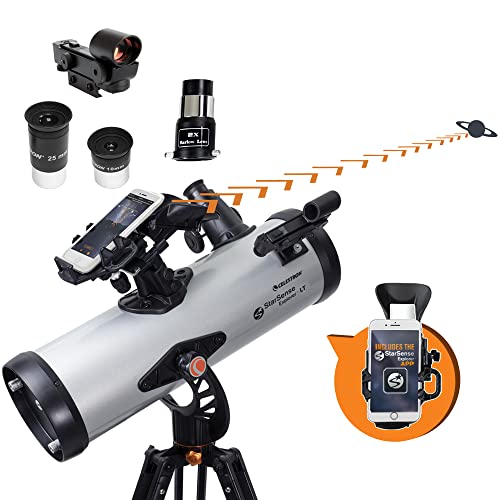
Celestron StarSense Explorer LT 114AZ — best beginner telescope 2026

Celestron StarSense Explorer LT 114AZ

114mm aperture · 1000mm focal length · StarSense app dock included

Smartphone star-finder Best beginner scope 2026 No computer required

The StarSense dock clips to your phone and uses the camera to analyse the star field, showing real-time directional arrows to guide you straight to Saturn, Jupiter, or any of 200,000+ objects. The 114mm Newtonian shows Saturn’s rings, Jupiter’s cloud bands, and the Moon’s craters sharply from the first night.

$229.99

Affiliate link — we may earn a commission at no extra cost to you.

Sky-Watcher — Best Aperture Per Dollar (Score: 4.2/5)

Sky-Watcher is the consumer brand for Synta Optical Technology — the same parent company that owns Celestron. However, Sky-Watcher is positioned differently: it focuses on maximum aperture and optical performance at the lowest possible price, targeting European and Asian markets (though widely available on Amazon.com). The Heritage 130P Tabletop Dobsonian is the single best-value telescope produced by any brand in 2026.

Sky-Watcher Strengths

  • Best aperture-per-dollar — the Heritage 130P, Heritage 150P, and Classic 200P all give more mirror for the money than any comparable Celestron product.
  • Virtuoso GTi GoTo system — built-in Wi-Fi, SynScan app control, Freedom Find dual encoders (manual override without losing alignment). Outstanding smart GoTo value.
  • HEQ5 and EQ6-R — the benchmark equatorial mounts for beginner and intermediate astrophotography. Both are class-defining platforms for the price.
  • Collapsible FlexTube Dobsonians — unique folding design lets you transport 130mm–250mm mirrors in a bag. No other brand offers this combination of aperture and portability at comparable prices.

Sky-Watcher Weaknesses

  • US support is patchy — Sky-Watcher USA operates separately from the UK distributor. US buyers sometimes find warranty claims harder to navigate than Celestron.
  • No equivalent to StarSense — the SynScan app is functional but less polished than Celestron’s StarSense Explorer tech for absolute beginners.
  • Narrower Amazon Prime availability in the US — some Sky-Watcher models ship from third-party sellers, which can affect Prime eligibility and delivery speed.

Is Sky-Watcher a good brand?

Yes — Sky-Watcher is outstanding value and is the brand recommended by experienced astronomers when aperture per dollar matters most. The Heritage 130P and Classic 200P Dobsonians are the top-recommended beginner and mid-range telescopes on virtually every major astronomy forum (Cloudy Nights, Reddit r/telescopes). For astrophotography, the HEQ5 Pro and EQ6-R Pro equatorial mounts are the community benchmark — more imaging enthusiasts use these than any competing mount at equivalent price points. The primary caveat for US buyers: Sky-Watcher’s US customer support is less accessible than Celestron’s, and some models have limited brick-and-mortar retail presence. Buy from an authorised US dealer (OPT, High Point Scientific, or Amazon Sold & Fulfilled) for the smoothest warranty experience.

Sky-Watcher Heritage 130P Tabletop Dobsonian — best value telescope

Sky-Watcher Heritage 130P Tabletop Dobsonian

130mm aperture · f/5 parabolic mirror · Collapsible FlexTube design

The Heritage 130P is the single best-value telescope from any brand. The 130mm parabolic mirror collects 3.5× more light than a 70mm refractor. No batteries, no computer — just glass and a rocker box. Folds flat for transport. The best first telescope for anyone who puts aperture and simplicity above convenience features.

$305.00

Affiliate link — we may earn a commission at no extra cost to you.

Celestron vs Sky-Watcher: Direct Comparison at Every Price Point

With Orion out of the picture, the 2026 amateur telescope market has effectively narrowed to Celestron vs Sky-Watcher for most buyers. Both are owned by Synta Optical and share manufacturing, but they are positioned differently at every price tier. Here is the clearest head-to-head breakdown available.

Budget Best Celestron Pick Best Sky-Watcher Pick Our Winner & Why
Under $150 AstroMaster 70AZ →70mm refractor Heritage 130P →130mm Dobsonian Sky-Watcher — nearly double the aperture for the same money
$150–$300 StarSense Explorer LT 114AZ → Heritage 130P or Virtuoso GTi 130P → Celestron — StarSense transforms the first-night experience; SW wins on raw aperture
$300–$700 NexStar 6SE →150mm SCT GoTo Classic 200P Dobsonian →200mm manual Dob Depends on goal — GoTo convenience: Celestron. Maximum aperture: Sky-Watcher.
$700–$1,500 NexStar 8SE →203mm SCT GoTo HEQ5 Pro mount+ 150–200mm OTA Sky-Watcher for astrophotography; Celestron 8SE for visual GoTo
$1,500+ EdgeHD 8″ or CGX mount EQ6-R Pro →+ 200mm OTA Sky-Watcher — EQ6-R Pro is the astrophotography benchmark at this payload class

Choose Celestron when you want:

  • ✓ Smartphone-guided star-finding (StarSense Explorer)
  • ✓ Reliable single-arm computerised GoTo out of the box (NexStar)
  • ✓ The easiest possible first-night experience
  • ✓ Best US customer support and 2-year warranty
  • ✓ Widest retail availability (Amazon, Walmart, Best Buy)

Choose Sky-Watcher when you want:

  • ✓ Maximum aperture per dollar (Heritage, Classic Dobsonians)
  • ✓ The best astrophotography mounts (HEQ5 Pro, EQ6-R Pro)
  • ✓ WiFi GoTo at mid-range prices (Virtuoso GTi)
  • ✓ Collapsible FlexTube Dobsonians for portable aperture
  • ✓ The best value manual Dobsonian range under $500

Celestron vs Sky-Watcher for planetary viewing

For planets, Celestron’s NexStar 6SE and 8SE (Schmidt-Cassegrain, f/10) deliver the finest detail thanks to long focal lengths (1524mm–2032mm) ideal for high magnification, with GoTo tracking keeping Jupiter and Saturn locked in the eyepiece automatically. Sky-Watcher’s Classic 200P Dobsonian matches the NexStar 8SE in aperture (200mm vs 203mm) at a lower price, but requires manual tracking. At equivalent aperture, optical performance is comparable — the Celestron NexStar makes it easier; the Sky-Watcher Dobsonian gives more aperture per dollar.

Celestron vs Sky-Watcher for astrophotography

Sky-Watcher wins clearly for astrophotography. The HEQ5 Pro (~$900) and EQ6-R Pro (~$1,400) are the community-standard equatorial mounts for long-exposure deep-sky imaging — more beginners and intermediate imagers use these than any other comparable mount. Both support ASCOM/INDI drivers for PHD2 autoguiding. Celestron’s CGX is competitive at $2,000+ but costs more for equivalent payload capacity. For a complete first imaging rig, pair the HEQ5 Pro with a Sky-Watcher 80ED Pro refractor or 130PDS Newtonian.

⚠ Ceased Operations

Orion Telescopes & Binoculars — No Longer Available

Important notice (2025): Orion Telescopes & Binoculars has ceased operations. The official website is offline and new inventory is no longer sold through any authorised channel. This section is kept for historical reference and for readers who own existing Orion equipment. Do not attempt to purchase Orion products — third-party listings may be counterfeit or unsupported stock.

Orion Telescopes & Binoculars was founded in 1975 in Santa Cruz, California, and for decades was one of the most respected independent telescope brands in the US. Unlike Celestron and Sky-Watcher, Orion was not owned by Synta Optical — it operated independently, sourcing optics from multiple manufacturers. Orion built a strong reputation for well-priced equatorial mounts, the IntelliScope digital push-to system, and reliable US-based customer support.

The brand was acquired by Imaginova (formerly Space Holdings Corporation) and faced growing competitive pressure from Synta-owned brands offering comparable optics at lower prices. By 2025 the company had ceased operations, leaving a gap in the US independent telescope market.

Orion Owner? Here’s What to Do

  • Your scope still works. Orion optical tubes are well-made and will continue to perform. Standard collimation and maintenance guides for Newtonian reflectors apply fully.
  • Eyepieces and accessories from any standard 1.25″ or 2″ supplier (Celestron, Baader, William Optics) are fully compatible with Orion telescopes.
  • Warranty claims are no longer supported. For spare parts, check eBay, Astromart, and Cloudy Nights classifieds for used Orion accessories.

Best Alternatives to Orion in 2026

For beginners (replacing StarBlast / SpaceProbe):

Celestron StarSense Explorer LT 114AZ — adds smartphone guidance and is easier on the first night than any Orion scope was.

For budget aperture (replacing SpaceProbe 130ST):

Sky-Watcher Heritage 130P — better parabolic optics, more portable, lower price.

For EQ mount (replacing SkyView Pro):

→ Sky-Watcher HEQ5 Pro — the class-leading mid-range EQ mount for visual and astrophotography use.

For GoTo Dobsonian (replacing IntelliScope):

Sky-Watcher Virtuoso GTi 130P — full motorised GoTo with WiFi SynScan app.

Meade Instruments — Niche Advanced Options (Score: 3.2/5)

Meade was founded in 1972 and was for decades Celestron’s primary rival in the premium telescope market. The brand filed for bankruptcy in 2019 and was acquired by Ningbo Sunny Electronic (a Chinese camera and optics manufacturer). Quality control has been inconsistent since the acquisition, and Meade’s formerly dominant reputation has faded significantly in the entry-to-mid market.

Where Meade still makes sense

  • LX65 ACF (8″, 10″, 12″) — Advanced Coma-Free optics for premium planetary imaging
  • LX200 series — legacy GoTo SCT still respected by experienced observers
  • • Pre-2019 used Meade optics are excellent; post-acquisition units need careful quality inspection before buying

Avoid Meade if…

  • • You’re a beginner — Celestron’s StarSense is a far better first telescope
  • • You need reliable US warranty support
  • • You’re considering the EclipseView or Infinity entry lines — these are below average for the price

We don’t currently feature Meade product cards because we can’t confidently recommend the current lineup for new buyers. For advanced buyers researching Meade’s LX series, we recommend reviewing on Cloudy Nights forums before purchase.

Which Brand for Your Use Case?

The right brand depends on what you want to do. Use this table to match your observing goal to the best manufacturer and scope.

Use Case Best Brand Recommended Scope
First-time beginner Celestron StarSense Explorer LT 114AZ →
Budget aperture (under $200) Sky-Watcher Heritage 130P Tabletop Dobsonian →
Mid-range GoTo scope Celestron NexStar 6SE GoTo SCT →
Premium GoTo SCT Celestron NexStar 8SE GoTo SCT →
Smart / WiFi GoTo Dobsonian Sky-Watcher Virtuoso GTi 130P →
Beginner astrophotography Sky-Watcher HEQ5 Pro mount + any 130–200mm OTA
Deep-sky visual (large Dob) Sky-Watcher Classic 200P Dobsonian →
Advanced premium SCT imaging Celestron NexStar 8SE → EdgeHD 8″ →

The single most important use-case split: need computerised GoTo pointing right out of the box? Celestron’s NexStar is the most polished choice in the industry. Want maximum aperture per dollar? Sky-Watcher’s Dobsonian range wins at every price tier. Planning astrophotography? Sky-Watcher’s HEQ5 Pro and EQ6-R Pro equatorial mounts are the community benchmark — no competitor at equivalent pricing comes close.

The Synta Connection: Why Celestron and Sky-Watcher Are Siblings

One of the most important — and least-discussed — facts in consumer telescopes is that Celestron and Sky-Watcher are both owned by the same parent company: Synta Optical Technology, headquartered in Taiwan and manufacturing primarily in Suzhou, China.

🏭
Shared factory — many Celestron and Sky-Watcher telescopes use identical or near-identical optical tubes, manufactured in the same facility, then branded and distributed separately under different price strategies.
💰
Different market positioning — Celestron carries higher retail margins and premium branding (StarSense, NexStar GoTo). Sky-Watcher is positioned for value and aperture-per-dollar, often sold through European distributors and online channels.
🔭
Identical optics, different accessories — a Sky-Watcher Classic 200P and a Celestron 8″ reflector of similar spec often use the same mirror blank. The eyepieces, mounts, and branding differ. This is why Sky-Watcher gives more aperture for the money: there’s less brand premium baked in.
⚠️
What this means for you — when you compare a Sky-Watcher and Celestron scope of the same aperture, the optical performance will usually be comparable. Your decision comes down to mount quality, accessories, support in your country, and whether you want StarSense technology or raw aperture for the price.

Frequently Asked Questions

Is Celestron better than Sky-Watcher?

Both brands are owned by Synta Optical, so the underlying optics are often comparable. Celestron is better for beginners who want smartphone-assisted target finding (StarSense) or a reliable GoTo system (NexStar). Sky-Watcher is better for buyers who want maximum aperture per dollar — no other brand gives more mirror for the money at entry and mid-range prices.

Which telescope brand is best for beginners?

Celestron is the best telescope brand for most beginners in 2026. The StarSense Explorer LT 114AZ uses your phone to guide you to targets with real-time directional arrows — eliminating the hardest part of amateur astronomy. Sky-Watcher’s Heritage 130P is the best choice if you prioritise aperture and simplicity over smart technology.

Is Orion Telescopes still in business?

No. Orion Telescopes & Binoculars ceased operations in 2025. The official website is offline and new inventory is no longer available through any authorised channel. Warranty claims are no longer supported. If you were considering an Orion scope, the best alternatives are the Celestron StarSense Explorer LT 114AZ for beginners or the Sky-Watcher Heritage 130P for maximum aperture per dollar. Existing Orion owners can continue using their telescopes — the optics remain fully functional.

Are Celestron and Sky-Watcher the same company?

They are owned by the same parent company (Synta Optical Technology) and share manufacturing facilities, but they are not identical products or brands. Celestron invests in proprietary software (StarSense, NexStar GoTo firmware). Sky-Watcher focuses on value: more aperture per dollar, the best budget Dobsonians, and the benchmark HEQ5/EQ6-R astrophotography mounts.

Should I avoid Meade telescopes?

Meade’s entry-level telescopes (Infinity, EclipseView) are generally below the value you get from Celestron or Sky-Watcher at the same price. The brand filed for bankruptcy in 2019 and quality control has been inconsistent since. For new buyers, stick with Celestron or Sky-Watcher. Pre-2019 Meade LX200 and LX65 optics are genuinely excellent on the used market.

Is Celestron made in China?

Yes — Celestron telescopes are manufactured in Suzhou, China by Synta Optical Technology, which has owned Celestron since 2005. This is not a quality concern: Synta operates precision optical manufacturing facilities that produce scopes for multiple premium brands worldwide. The same factory makes Sky-Watcher and many OEM products. Celestron’s US-based team handles product design, StarSense app development, quality testing, and customer support. “Made in China” for a Synta telescope is the dominant production model for virtually all consumer telescopes under $5,000 — including scopes sold by Orion, Meade, and dozens of European brands.

Which is better for viewing planets — Celestron or Sky-Watcher?

For planetary viewing, Celestron’s NexStar 6SE and 8SE are the easier choice for most observers. The Schmidt-Cassegrain design with focal lengths of 1524mm and 2032mm respectively is ideal for high-magnification planetary detail, and the GoTo tracking keeps Jupiter, Saturn, and Mars locked in the eyepiece as the sky rotates. Sky-Watcher’s Classic 200P Dobsonian matches the NexStar 8SE in aperture (200mm vs 203mm) at a significantly lower price but requires manual tracking — workable for experienced observers, frustrating for beginners. At identical aperture, optical quality is comparable between both brands; your decision comes down to tracking convenience (Celestron) vs. aperture-per-dollar (Sky-Watcher).

What happened to Orion Telescopes?

Orion Telescopes & Binoculars — founded in 1975 in Santa Cruz, California — ceased operations in 2025. The brand faced increasing competitive pressure from Synta-owned brands (Celestron and Sky-Watcher) offering comparable optics at lower prices, compounded by supply-chain challenges. The official oriontelescopes.com website is offline. No new Orion inventory is available through any authorised channel. Be cautious of third-party marketplace listings for “new” Orion stock — these may be old unsupported units or counterfeit goods. If you own an Orion telescope, it will continue to function normally; community support remains available on Cloudy Nights and Astromart forums. The best replacements: Celestron StarSense Explorer LT 114AZ for beginners, Sky-Watcher Heritage 130P for aperture-first buyers.

Is Sky-Watcher good for astrophotography?

Yes — Sky-Watcher is the most recommended brand for beginner and intermediate astrophotography. The HEQ5 Pro (~$900) and EQ6-R Pro (~$1,400) equatorial mounts are the community-standard platforms for long-exposure deep-sky imaging, with well-characterised periodic error and full ASCOM/INDI support for PHD2 autoguiding software. The HEQ5 Pro handles refractors up to ~150mm and short Newtonians; the EQ6-R Pro handles heavier imaging rigs up to ~20kg payload. No other brand matches these at comparable prices. A strong first imaging rig: HEQ5 Pro + Sky-Watcher 80ED Pro refractor or 130PDS Newtonian + DSLR or dedicated astro camera.

What is the best telescope under $300?

At $300, the top choices are: Celestron StarSense Explorer LT 114AZ (~$180–$220) for beginners who want smartphone-guided pointing with zero learning curve, or the Sky-Watcher Virtuoso GTi 130P (~$270–$300) for buyers who want a motorised WiFi GoTo Dobsonian. For maximum aperture per dollar with the simplest possible setup, the Sky-Watcher Heritage 130P (~$130–$150) gives the best value of any telescope at any price. Avoid “department store” refractors under $100 from any brand — universally mediocre optics and mount wobble are the #1 reason first-time buyers give up astronomy.


Related Guides