

Sky-Watcher Heritage 130P Review 2026: Best Value Beginner Telescope?
Telescope Advisor Logo Telescope Advisor
Starry night sky — perfect observing conditions for the Sky-Watcher Heritage 130P tabletop Dobsonian telescope

Telescope Review · 2026

Sky-Watcher Heritage 130P Review 2026

The Heritage 130P packs a parabolic 130mm mirror into a collapsible FlexTube Dobsonian that fits under a bed — and outperforms every refractor in its price class. Is it the best beginner telescope value in 2026? We tested it on planets and deep sky.

9.2/10

Our Score

130mm

Aperture (f/5)

3.3kg

Total Weight

Beginner

Best For

By Telescope Advisor Editorial Team Published: Updated: Editorial Standards

Quick Verdict

The Sky-Watcher Heritage 130P is our top recommendation for anyone buying their first serious telescope under $200. Its 130mm parabolic mirror delivers crisp planetary views — Saturn's rings with the Cassini Division, Jupiter's cloud belts and Great Red Spot, dramatic Moon crater tours — from a scope that weighs 3.3 kg and collapses to fit inside a backpack. The FlexTube Dobsonian mount is the simplest in astronomy: push the tube to point, release, and it stays put.

The only real caveat is that it needs a stable table about 80–90 cm high — there's no full-height tripod included. If you can provide a table (a garden table, a stump, or an IKEA bedside unit works perfectly), the Heritage 130P will outperform every refractor in its price bracket and match many scopes costing twice as much.

View Heritage 130P on Amazon → Current price: $305.00
Sky-Watcher Heritage 130P tabletop Dobsonian telescope

Sky-Watcher Heritage 130P: Full Specifications

Spec Value
ModelSky-Watcher Heritage 130P (S11705)
Optical DesignParabolic Newtonian Reflector
Aperture130mm (5.1 inches)
Focal Length650mm
Focal Ratiof/5
Mirror TypeParabolic primary (not spherical)
Mount TypeTabletop Dobsonian (alt-azimuth)
FlexTubeYes — collapsible (560mm extended, 435mm collapsed)
Focuser1.25” rack-and-pinion
FinderscopeRed-dot finder
Eyepieces Included25mm (26×) and 10mm (65×), 1.25”
OTA Weight~2.7 kg (6.0 lbs)
Total Weight (with base)~3.3 kg (7.3 lbs)
Table RequiredYes — solid surface ~80–90 cm height

Limiting Stellar Magnitude: ~13.1 — reaches objects at magnitude 13 under good suburban skies.

Resolution (Dawes Limit): 0.89 arc-seconds — enough to split close double stars and resolve fine planetary detail.

Maximum Useful Magnification: ~260× (approximately 2× per mm aperture). Atmospheric seeing limits most nights to 100–150×.

Lowest Useful Magnification: ~19× (using the widest practical 7mm exit pupil).

Field of View at 26× (25mm): ~2.5° — fits the full Moon with room to spare.

Best Targets: Moon, Saturn, Jupiter, Mars, open clusters, globular clusters, Orion Nebula (M42), Andromeda Galaxy (M31), Ring Nebula (M57).

Optical Design: Why the Parabolic Mirror Matters

The single most important spec in the Heritage 130P — and the one most often overlooked in online spec sheets — is its parabolic primary mirror. Most competing scopes at this price point use a cheaper spherical mirror that introduces spherical aberration: stars toward the outer edge of the field appear blurry or elongated. This is distracting for visual observing and unusable for photography.

Parabolic vs Spherical: The Difference at the Eyepiece

A parabolic mirror corrects spherical aberration by gradually steepening toward the edges. The result is a flat, sharp star field all the way to the edge of view — a meaningful quality improvement over the spherical mirrors found in the Celestron AstroMaster 130EQ and most economy Newtonians. At the centre of the field both designs look similar. But when you slide a planet to the edge, scan a star cluster, or star-test a star near the field boundary, parabolic mirrors produce noticeably tighter, rounder stars.

For an f/5 focal ratio, parabolic correction is especially important. At f/5, a spherical mirror produces prominent spherical aberration — far worse than the same flaw at f/8 or longer. Sky-Watcher's decision to fit a parabolic mirror at this price point is the main reason the Heritage 130P is consistently ranked as the top beginner value on the market.

The FlexTube Dobsonian Mount

The Heritage 130P uses Sky-Watcher's FlexTube design: the optical tube consists of two telescoping sections connected by three rigid struts. When folded, the tube compresses from 560mm to 435mm — small enough to slip into a day bag or under a bed. When you're ready to observe, extending the FlexTube and locking it takes about 15 seconds.

The Dobsonian rocker-box mount provides smooth altitude and azimuth motion with a light finger push. Unlike equatorial mounts, there's no polar alignment procedure, no tracking knobs to calibrate, and no coordinate system to learn. You simply push the tube where you want to look, and the friction bearing holds it there.

The trade-off: the assembled scope (OTA + mount) needs a table roughly 80–90 cm high. A garden table, a workbench, or a solid outdoor stool all work. If no suitable table is available, the AstroMaster or StarSense range with full-height tripods may suit you better.

What You’ll See Through the Heritage 130P

Based on real observing sessions from suburban skies (Bortle 5–6). Magnifications given assume average atmospheric seeing — good nights let you push further.

🌑 The Moon

The Moon is the showstopper. At 26× (25mm eyepiece) the entire disc fits in view with dramatic contrast between highlands and dark maria. At 65× (10mm) you can spend an hour exploring craters like Clavius, Tycho, and Copernicus in stunning detail. On nights of steady seeing, push to 130–150× with a better eyepiece and you'll see central crater peaks, terraced rim walls, and tiny craterlets inside larger craters. Few experiences in amateur astronomy match a Moon tour through a well-collimated 130mm Newtonian.

🪐 Saturn

Saturn is consistently the most impressive view beginners report. At 65× (10mm) the rings and globe are cleanly separated with clear space between them. At 100–130× the Cassini Division — the dark gap between the A and B rings — becomes visible on good nights. Saturn's largest moon Titan is always visible as a bright dot, and you can often spot 2–3 additional moons. In 2026, Saturn reaches opposition on October 4; the ring tilt is ~7.5°, showing the ring system well. For timing your Saturn sessions, see our Saturn telescope guide.

🌍 Jupiter

Jupiter shows 2–4 equatorial cloud belts at 65×. The four Galilean moons (Io, Europa, Ganymede, Callisto) move visibly from night to night, creating a different tableau each session. On nights of good seeing at 100–150×, the Great Red Spot is visible when it faces Earth, and colour differences between the north and south equatorial belts become clear. Jupiter was at opposition on January 9, 2026 and remains well-placed for evening viewing through June 2026. For expectations at different apertures, see our planets through a telescope guide.

🔴 Mars

Mars rewards patience. Near opposition the disc is large enough to show dark surface markings like Syrtis Major (a dark volcanic plateau) and the white polar ice cap. Away from opposition, Mars is small and requires excellent seeing to show detail. The Heritage 130P is fully capable of delivering Mars detail when atmospheric conditions cooperate. At 100–150× near opposition on a steady night, dark surface features are consistently visible.

🌌 Deep-Sky Objects

The f/5 focal ratio gives the Heritage 130P a naturally wide field of view per eyepiece — ideal for deep-sky work. With the 25mm eyepiece the 2.5° field is perfect for open clusters and large nebulae. The Orion Nebula (M42) shows as a dramatic clouded wing with the four Trapezium stars at its core. The Andromeda Galaxy (M31) fills the entire field at low power. Globular clusters like M13 (Hercules) begin to resolve individual stars at the edges at 65×. From darker skies (Bortle 3–4), you can work through the full Messier catalogue including M81/M82 in Ursa Major, M57 the Ring Nebula, M27 the Dumbbell Nebula, and many more.

🔵 Uranus & Neptune

Uranus appears as a tiny pale blue-green disc at 100× — distinctly non-stellar compared to surrounding stars. Neptune shows as a small blue dot. Neither will reveal surface features in a 130mm scope, but finding and identifying both ice giants is a satisfying challenge. Both are within reach on clear dark nights with a good star chart or an astronomy app like Stellarium.

Setup, FlexTube & Collimation

From Box to First Light in Under 20 Minutes

The Dobsonian base arrives pre-assembled. You place it on a table, seat the FlexTube OTA onto the rocker box, extend the collapsible tube to lock it open, insert the eyepiece, aim, and look. There are no polar alignment procedures, no motor calibration sequences, no hand controller database to initialise. First-time users consistently describe the experience as “point and look.”

Table Requirements

The Heritage 130P needs any flat, stable surface at approximately 80–90 cm height. A standard outdoor patio table, garden wall, workbench, or sturdy bar stool all work. The Dobsonian base is 30 cm in diameter and weighs about 0.6 kg. The key requirement is stability — a wobbly table amplifies movement at high magnification. For a purpose-built solution, a flat board on top of a heavy-duty milk crate provides rock-solid support for minimal cost.

Collimation: The Beginner’s Worry, the Expert’s Routine

Collimation — aligning the primary and secondary mirrors — is the one skill every Newtonian owner must learn. The Heritage 130P ships factory-collimated, but any bump during transport can knock it slightly off. You'll typically need to check and re-collimate every 4–8 sessions.

The process is simpler than it sounds. The secondary mirror (small, at the top) and primary mirror (large parabolic, at the bottom) each have three adjustment screws. Using the included collimation cap — a tube cap with a small central hole — you centre the secondary mirror reflection as seen through the focuser, then centre the primary mirror reflection inside the secondary. A 10-minute YouTube tutorial will teach this skill for life.

For a faster and more reliable method, a laser collimator ($15–25) projects a red dot onto the primary mirror and removes all guesswork. Once you know the process, collimation takes under 3 minutes. A correctly collimated Heritage 130P produces star images that are genuinely sharper than many store-bought scopes that have never been re-checked since leaving the factory.

New to telescopes? Read our step-by-step beginner telescope setup guide for everything from unboxing to finding the Moon on your first night out.

Heritage 130P: Pros & Cons

Pros

  • Parabolic mirror — sharper stars edge to edge vs any spherical-mirror competitor at this price
  • Best aperture per dollar — 130mm under $200 is exceptional value; nothing else comes close
  • Featherweight (3.3 kg) — you'll use it on weeknights, not just on special occasions
  • FlexTube design — collapses to bag size, extends in 15 seconds; apartment-friendly
  • Simplest mount possible — no alignment, no motors; push to point and look
  • Wide field of view — f/5 is excellent for clusters, nebulae, and large galaxies
  • Solid included eyepieces — 25mm and 10mm give a useful low/medium power range
  • Standard 1.25” focuser — huge range of upgrade eyepieces and accessories available

Cons

  • No full-height tripod — needs a stable table ~80–90 cm high, which is not provided
  • Requires collimation — every 4–8 sessions; mild learning curve for complete beginners
  • No motorised tracking — objects drift at high magnification; you nudge the tube to follow
  • No GoTo computer — you must find objects manually or with a star chart or phone app
  • No deep-sky astrophotography — without motorised tracking, long exposures are not possible
  • Slight coma at field edges — inherent to fast Newtonians at f/5; not noticeable at typical planetary magnifications

Heritage 130P vs AstroMaster 130EQ: Head-to-Head

These are the two most-compared 130mm scopes in the beginner market. Same aperture, very different designs. Here's exactly how they differ.

Feature Sky-Watcher Heritage 130P Celestron AstroMaster 130EQ
Aperture130mm130mm
Focal Length / Ratio650mm — f/5650mm — f/5
Mirror Type✓ Parabolic✗ Spherical
MountTabletop Dobsonian (alt-az)Equatorial (EQ) on tripod
Full-height Tripod✗ Needs a table✓ Included
Total Weight~3.3 kg~9 kg (with tripod)
Manual EQ Slow-MotionNo (Dobsonian push)✓ Yes (slow-motion knobs)
PortabilityExcellentFair (heavy & bulky)
Setup ComplexityVery easy (5 min)Moderate (EQ alignment needed)
Our VerdictBest optics & portabilityChoose if you need a tripod or plan EQ use
Editor’s Pick — Our Top Recommendation
Sky-Watcher Heritage 130P tabletop Dobsonian

Sky-Watcher Heritage 130P

Parabolic mirror · FlexTube Dobsonian · 130mm f/5

$305.00

View on Amazon →
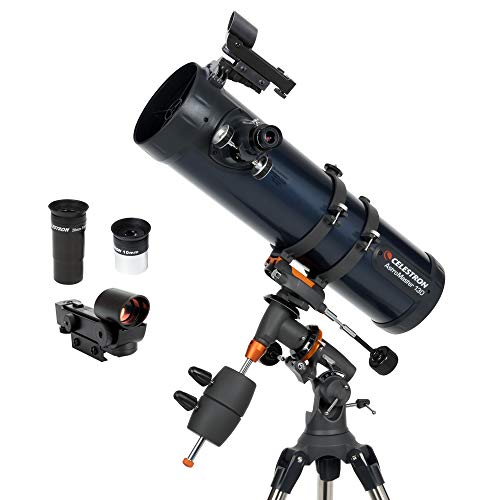
Celestron AstroMaster 130EQ telescope

Celestron AstroMaster 130EQ

Spherical mirror · Equatorial mount · 130mm f/5

$359.95

Best if you need a full-height tripod or plan to learn EQ mounts

View on Amazon →

Our take: The Heritage 130P wins on optical quality (parabolic mirror produces sharper images), portability (3.3 kg vs ~9 kg), and ease of use (Dobsonian vs equatorial). The AstroMaster 130EQ wins only if you specifically need a full-height tripod, or if you already know you want to learn equatorial mounting for future astrophotography. For pure visual astronomy — which covers 95% of beginners — the Heritage 130P is the better scope by a clear margin.

Who Should (and Shouldn’t) Buy the Heritage 130P?

✓ Buy it if you are:

  • A first-time telescope buyer who wants the best optical quality for the money without complexity
  • An apartment or flat dweller who needs a scope that stores under a bed or in a wardrobe
  • Focused on visual astronomy — planets, Moon, clusters, and nebulae for years to come
  • A parent buying for a child aged 12+ — the Dobsonian mount is intuitive and impossible to break
  • Someone who values portability — camping trips, dark sky visits, rooftop or balcony sessions
  • Anyone who has a suitable table at ~80–90 cm height in their observing location

✗ Look elsewhere if you need:

  • GoTo / computerised object finding — look at the Celestron StarSense Explorer LT 114AZ or NexStar range
  • Deep-sky astrophotography — requires a motorised equatorial mount; the Heritage 130P cannot track
  • A self-contained tripod — if no suitable table is available, consider a full-height alt-az or EQ scope
  • Very young children (under 10) — the Dobsonian requires care not to tip; adult involvement needed
  • Motorised planet tracking at high magnification without manual nudging

For a full comparison of beginner options across all budgets, read our best telescopes for beginners guide or our best Dobsonian telescopes roundup.

Best Eyepieces & Accessories for the Heritage 130P

The included 25mm and 10mm eyepieces are a solid starting point. These additions will transform your observing experience.

🔬

6mm or 9mm Plössl Eyepiece

Gives you 72× (9mm) or 108× (6mm) — the planetary magnification sweet spot for Saturn’s Cassini Division and Jupiter’s cloud belts. Mid-range Plössl or BST Starguider eyepieces at these focal lengths cost $20–40 and outperform cheap alternatives. At f/5, avoid very cheap economy eyepieces that amplify coma.

✖️

2× Barlow Lens

Doubles the magnification of any eyepiece: your 25mm becomes effectively 13mm (50×), your 10mm becomes 5mm (130×). A quality 2× Barlow costs $20–30 and gives you six useful magnification choices from two eyepieces. For planetary work on Saturn and Jupiter, this is the single best value upgrade for the Heritage 130P.

🎯

Laser Collimator

Insert into the focuser and a red dot projects onto the primary mirror; adjust until it’s centred. Collimating with a laser takes 2 minutes compared to 10 with the included collimation cap. Any 1.25” laser collimator costing $15–25 works perfectly. If you only buy one accessory for the Heritage 130P, make it this — proper collimation is the difference between good and great views.

Focal length note: The Heritage 130P’s 1.25” focuser accepts all standard 1.25” eyepieces and accessories. At f/5, BST Starguider or mid-range Plössl eyepieces give noticeably better edge-of-field performance than very cheap “Super Plössl” budget options. For a full breakdown of the best eyepieces for the Heritage 130P and all beginner telescopes, see our Best Telescope Eyepieces guide →

Final Verdict

9.2 / 10 Editor’s Pick — Best Value Beginner Telescope

The Sky-Watcher Heritage 130P is the best visual telescope you can buy for under $200 in 2026. Its parabolic primary mirror, ultra-portable FlexTube design, and intuitive Dobsonian mount combine to give beginners the best possible introduction to the night sky. The Cassini Division in Saturn’s rings, Jupiter’s cloud belts, the Moon in breathtaking crater detail — these are views that hook people on astronomy for life, and the Heritage 130P delivers all of them reliably.

It’s not the right choice if you need a full-height tripod, computerised GoTo, or deep-sky astrophotography capability. But for pure visual astronomy — which is what most beginners actually want — nothing at this price comes close. We’ve recommended it to hundreds of first-time buyers and have never had a regret reported.

Sky-Watcher Heritage 130P — our top beginner telescope pick
Optical Quality9.5/10
Ease of Use9.0/10
Value for Money9.8/10
Portability9.5/10
Planetary Views8.5/10
Deep-Sky Views8.8/10

Frequently Asked Questions

Is the Sky-Watcher Heritage 130P good for beginners?

Yes — it’s our top beginner recommendation under $200. The Dobsonian mount is the simplest in astronomy (push to point, look), the parabolic mirror delivers sharp views, and the FlexTube design means even apartment dwellers can store and use it easily. The one skill to learn is collimation, which takes about 10 minutes to understand and 2–3 minutes to perform once you know how.

What can I see with the Sky-Watcher Heritage 130P?

From suburban skies you can see: the Moon in stunning crater detail; Saturn with its rings and Cassini Division visible at 100–130× on good nights; Jupiter with 2–4 cloud belts and the four Galilean moons; Mars surface markings near opposition; the Andromeda Galaxy (M31); the Orion Nebula (M42); open and globular star clusters; and the ice giants Uranus and Neptune as coloured discs. See our full planet viewing guide for per-aperture expectations.

Does the Heritage 130P need collimation?

Yes. Like all Newtonian reflectors, the Heritage 130P requires periodic mirror alignment (collimation) — typically every 4–8 sessions or after transporting the scope. It ships factory-collimated. The included collimation cap makes the process manageable; a laser collimator (under $20) makes it even easier. Mis-collimation is the most common cause of disappointing views in Newtonian scopes, so mastering this one skill makes a dramatic difference to image quality.

What table do I need for the Heritage 130P?

Any flat, stable surface at 75–95 cm height works — a standard dining table (75–80 cm), outdoor patio table, workbench, or wide garden wall all work. The Dobsonian base is 30 cm in diameter. The key requirement is stability: a wobbly table amplifies movement at high magnification. For a purpose-built solution, a flat board on inverted heavy-duty storage boxes provides rock-solid support for minimal cost.

Heritage 130P vs AstroMaster 130EQ — which is better?

For visual astronomy, the Heritage 130P wins on three counts: better optics (parabolic vs spherical mirror), lighter weight (3.3 kg vs ~9 kg), and simpler mount (Dobsonian vs equatorial). The AstroMaster 130EQ is worth considering only if you specifically need a full-height tripod or plan to learn equatorial mounting for future astrophotography. For anyone whose goal is visual observing, we recommend the Heritage 130P.

Can I see Saturn’s rings with the Heritage 130P?

Yes, absolutely. Even the included 10mm eyepiece (65×) clearly shows Saturn’s rings and disc as separate objects with space between them. With a 9mm or 2× Barlow on the 25mm eyepiece, the detail improves further. On nights of good atmospheric seeing at 100–130×, the Cassini Division (the dark gap separating the A and B rings) becomes visible. Saturn reaches opposition on October 4, 2026 — the best time to observe it with any telescope.

What eyepieces should I buy for the Heritage 130P?

The best first upgrade is a 9mm or 6mm Plössl eyepiece for planetary magnification (giving 72× or 108× respectively), plus a 2× Barlow lens to double your existing eyepieces’ power. A 2× Barlow costs $20–30 and effectively gives you six magnification settings from two eyepieces. Avoid very cheap budget eyepieces at f/5 — a mid-range Plössl or BST Starguider produces noticeably better results at minimal extra cost.

Is the Heritage 130P good for astrophotography?

Not for deep-sky astrophotography. The Dobsonian mount has no motorised tracking — stars drift through the field as Earth rotates, limiting useful exposure times to a few seconds. This means deep-sky photography of galaxies and nebulae is not practical. However, Moon snapshots via the afocal method (phone camera pressed to the eyepiece) and planetary video capture with a dedicated planetary camera are both achievable. If astrophotography is your primary goal, look at a motorised equatorial mount setup instead.

Related Guides