TelescopeAdvisor Logo TelescopeAdvisor
Saturn and its moons captured in infrared by NASA's James Webb Space Telescope, November 2024

Saturn Guide · 2026

Saturn’s Rings Are Coming Back in 2026

The rings went edge-on in March 2025 and briefly vanished. Now they’re tilting back into view. Here’s exactly what you’ll see, which telescope to buy, and when to look.

Ring Tilt~7.5° at October opposition
OppositionOctober 4, 2026
Min. Telescope60 mm refractor
Next Max Tilt~27° in 2032
By Telescope Advisor Editorial Team Published: Updated: Editorial Standards

If you read the headlines in early 2025 about Saturn’s rings “disappearing,” you were not alone. Millions of people searched for answers. And now, in 2026, many of those same people are asking a follow-up question that no one has fully answered yet: are Saturn’s rings back?

The short answer is yes — they are returning. But the view in 2026 looks nothing like the wide-open ring photos you have seen in astronomy books or telescope advertisements. Understanding exactly what is happening, and what equipment you need, is the difference between a disappointing first look and a genuinely stunning one.

This guide covers everything: the science behind the disappearance, what the rings look like right now at 7.5° tilt, the minimum telescope size and magnification you need, which telescope to buy at every budget, and the single best night of 2026 to observe Saturn — October 4, when it reaches opposition.
Why Saturn’s Rings “Disappeared” — and What Is Actually Happening

Saturn’s rings did not go anywhere. They are still there — spanning 43,500 to 87,000 miles wide, made of billions of chunks of water ice and rocky debris ranging in size from dust grains to boulders as large as houses. What changed was our viewing angle.

Saturn’s axis is tilted 26.7 degrees relative to its orbit around the Sun. As Saturn makes its slow 29.5-year journey around the Sun, Earth’s perspective on the rings shifts continuously. Sometimes we see them from steeply above — like looking down at a vinyl record — and the full, spectacular ring system is on display. Other times, the rings align edge-on with Earth’s line of sight. Because the rings are extraordinarily thin — as little as 30 feet (9 meters) thick in some areas, despite spanning hundreds of thousands of miles in width — they effectively vanish when seen from the side.

This event is called a ring-plane crossing, and it happens roughly every 13 to 15 years.

The most recent ring-plane crossing occurred on March 23, 2025. Saturn’s rings turned edge-on to Earth and became invisible to all but the most powerful telescopes. Unfortunately, Saturn was also near solar conjunction at that time — passing behind the Sun from our perspective — so most observers never got to witness the ringless view. A second, slightly less dramatic narrowing occurred in November 2025, when the rings were again at their thinnest.

Historical note: When Galileo Galilei first observed Saturn with his telescope in 1610, he described what he saw as “ears” — lateral lobes on either side of the planet. Two years later, he looked again and was bewildered to find the ears had vanished. He wrote: “I do not know what to say in a case so surprising, so unlooked for and so novel.” What Galileo had unknowingly witnessed was the first recorded observation of a ring-plane crossing — exactly as happened in March 2025, and exactly as it will again in October 2038.

Are Saturn’s Rings Visible in 2026?

Yes — but the view is genuinely different from what most people expect.

Since the November 2025 minimum, the rings have been steadily tilting back into view as Saturn’s southern hemisphere begins to face Earth. The process is gradual: think of someone slowly tipping a dinner plate from edge-on back toward a face-on angle, one degree at a time.

At the time of Saturn’s opposition on October 4, 2026 — the best night of the year to observe the planet — the rings will be tilted approximately 7.5 degrees relative to our line of sight, showing us their southern face. That is the real number, verified against the NASA/JPL Horizons ephemeris and the US Naval Observatory. It is not nothing, but it is a far cry from the maximum.

For context: at their widest in 2017, the rings were tilted 27 degrees toward Earth — a view described by National Geographic as “the most open this side of the rings has been since 1988.” At 7.5 degrees, they appear noticeably narrower and more “compressed” than those iconic photos suggest. They look like a thin oval halo rather than the wide, dramatic disc most people picture.

What This Means for Telescope Buyers

Small telescopes struggle more than usual.

A 60 mm scope that would show obvious rings at 27° tilt may only show a faint sliver at 7.5°. More aperture compensates.

The view still rewards patience.

Even at 7.5°, Saturn through a quality 4″ or larger telescope is one of the most beautiful sights available to any backyard astronomer. The planet is unmistakably three-dimensional.

The rings will keep improving every year through 2032.

Each year, the tilt angle increases. What you see in 2026 is the narrowest it will be from here to the maximum. Buying a telescope now means watching the view get better and better for six years.

When Can You See Saturn in 2026?

Saturn is currently a morning planet, emerging from behind the Sun and becoming increasingly visible in the pre-dawn eastern sky as April and May progress.

Period Visibility Notes
Apr–May 2026 Pre-dawn, low east Challenging but observable with a clear eastern horizon. In Pisces.
Jun–Aug 2026 Morning sky, climbing higher Well-placed for observation. Viewing improves each week.
Sep–Oct 2026 All-night object Prime viewing window. Saturn rises at sunset, highest at midnight.
Oct 4, 2026 Opposition — best night Magnitude 0.3, visible all night. Any telescope finds it immediately.

What You’ll Actually See Through a Telescope in 2026

Here is what different aperture classes honestly reveal at the October 2026 opposition, taking into account the 7.5° ring tilt:

60 mm–80 mm refractor (most beginner scopes)

At 50×–75×, Saturn’s disk is clearly oval-shaped rather than circular — the flattening of the planet’s poles from its rapid rotation is visible. The ring structure is detectable as a “halo” or subtle protrusion extending from the planet’s equator, but at 7.5° tilt it is thinner than telescope marketing photos suggest. Titan, Saturn’s largest moon, appears as a faint star-like point to one side.

Honest expectation: You’ll know you’re seeing a ringed planet, but the rings will be a thin, subtle feature rather than the wide dramatic arc seen in photographs.

Telescope in this class: Celestron AstroMaster 70AZ

100 mm–127 mm telescope (strong beginner / intermediate)

At 100×–150×, the ring structure becomes unmistakable. Saturn’s disk shows visible banding — the North and South Equatorial Belts appear as dark stripes. On nights of steady seeing, the gap between the rings and Saturn’s disk becomes apparent. Titan is easily visible; with a good eyepiece, Rhea and Dione may appear as faint pinpoints.

Honest expectation: This is the aperture where Saturn starts rewarding you. The rings are clearly separated from the disk. On a good night, hints of the Cassini Division begin to appear at the ring edges.

Telescope in this class: Celestron NexStar 4SE

150 mm–200 mm telescope (6″–8″ Dobsonian or Schmidt-Cassegrain)

At 150×–200× on a steady night, this is where Saturn transforms from impressive to jaw-dropping, even at the 2026 ring tilt. The Cassini Division — the 3,000-mile-wide gap between the A and B rings — becomes visible as a dark line. Saturn’s cloud bands are clearly multi-layered. Several moons are visible simultaneously: Titan, Rhea, Dione, Tethys, and sometimes Enceladus. The planet’s shadow cast onto the rings, and the rings’ shadow on the planet, are both visible — giving Saturn a striking three-dimensional quality.

Honest expectation: This is the aperture class that makes people gasp. Even with the 2026 thin ring angle, Saturn at 150×+ in an 8″ scope is one of the most remarkable sights in all of amateur astronomy.

250 mm+ (10″ or larger)

At this aperture, the Encke Gap — a narrow division near the outer edge of the A ring — becomes accessible on excellent seeing nights. Cloud structure on Saturn’s disk shows subtle colour variations. Multiple moons can be tracked night-to-night as they orbit the planet.

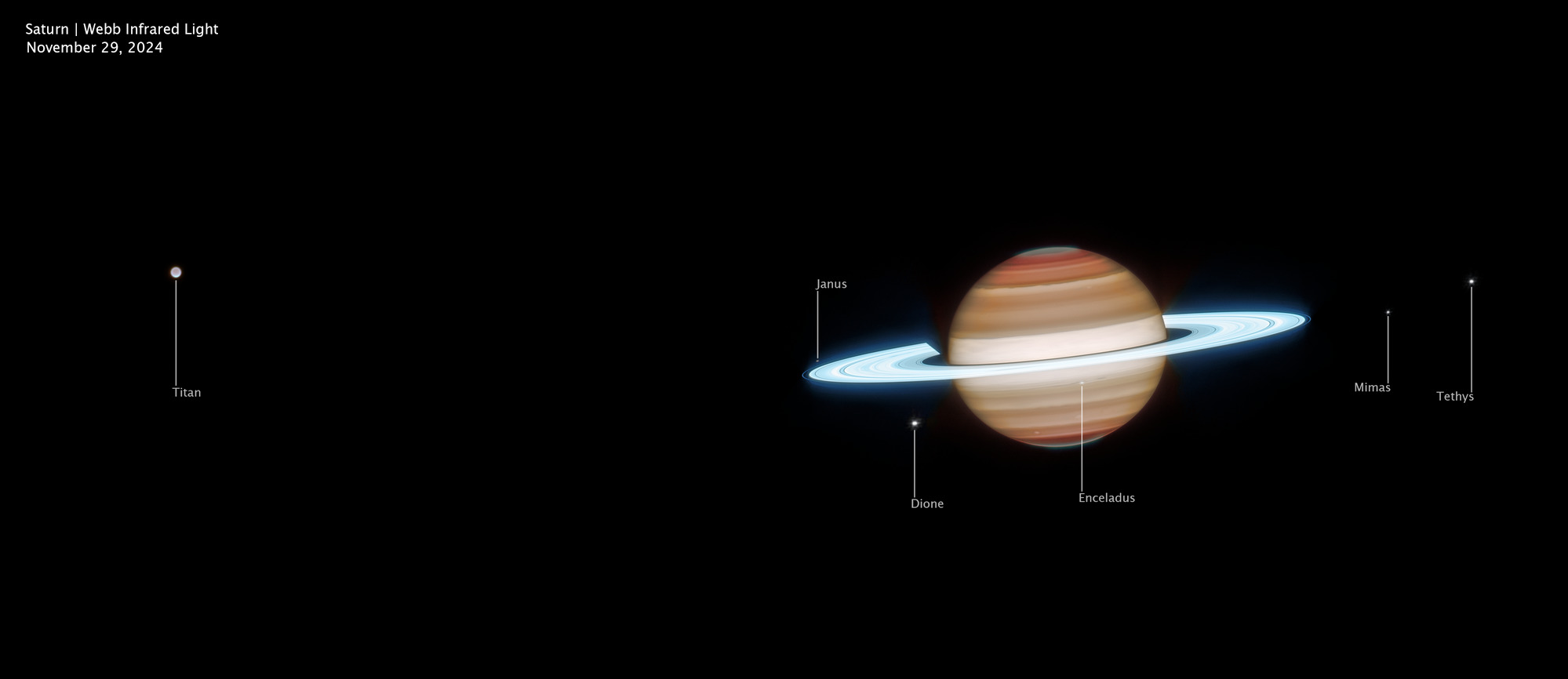
Saturn from NASA’s James Webb Space Telescope

High-resolution infrared imagery showing ring structure and moons.

Wide infrared view of Saturn showing rings and moons Titan, Janus, Dione, and Enceladus — NASA Webb NIRCam, November 2024
Saturn in infrared light (Nov. 29, 2024). Rings glow in reflected sunlight; moons Titan, Janus, Dione, and Enceladus are visible. — NASA, ESA, CSA, STScI; Image Processing: Joseph DePasquale (STScI).
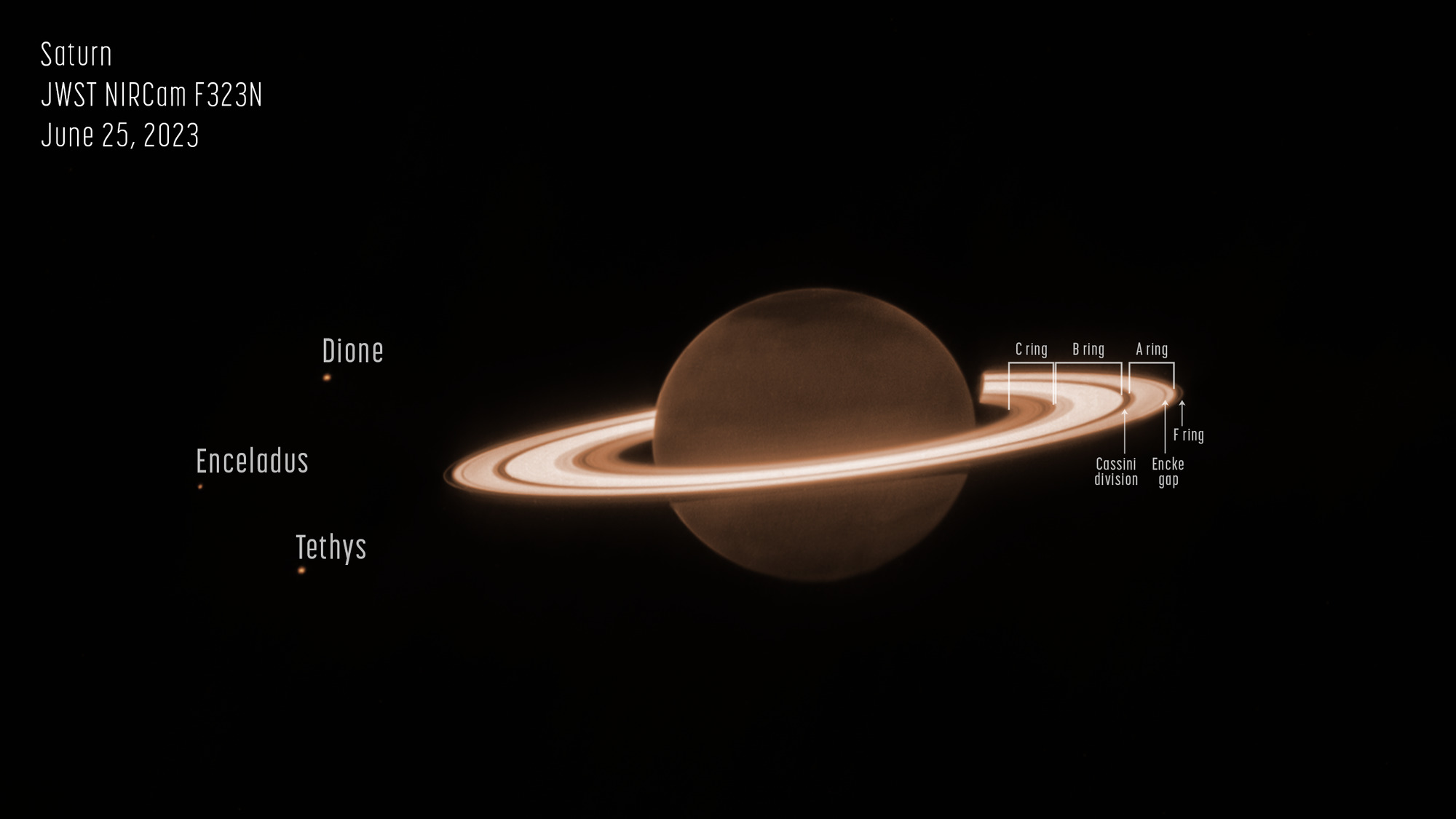
Annotated infrared view of Saturn showing ring structure including C ring, B ring, Cassini Division, A ring, Encke gap, and F ring — NASA Webb NIRCam, June 2023
Saturn’s ring structure annotated: C ring, B ring, Cassini Division, A ring, Encke gap, and F ring. Moons Dione, Enceladus, and Tethys visible. (June 25, 2023). — NASA, ESA, CSA, STScI; Image Processing: Joseph DePasquale (STScI).

Minimum Telescope Size to See Saturn’s Rings in 2026

This is one of the most-asked questions about Saturn, and the answer changes depending on the ring tilt angle. Here is a straightforward breakdown for the current 7.5° tilt:

Telescope Aperture Min. Magnification Rings Visible? Cassini Division?
50 mm 50× Barely — appears as elongated disk No
60–70 mm 50×–75× Yes — thin halo detectable No
80–100 mm 75×–120× Yes — clearly separated from disk Hints on best nights
4″ (100 mm)+ 100×–150× Yes — unmistakable ring structure Yes, on steady nights
6″ (150 mm)+ 150×–200× Yes — detailed ring layers Yes, clearly

Our recommendation: The minimum practical aperture to enjoy Saturn’s rings at the 2026 tilt angle is 60–70 mm. For a genuinely rewarding experience — where the Cassini Division is within reach and the planet looks three-dimensional — aim for a 4″ (100 mm) or larger telescope.

Entry · 70 mm

Celestron AstroMaster 70AZ

View on Amazon

Best Value · 4″

Celestron NexStar 4SE

View on Amazon

Advanced · 8″

Celestron NexStar 8SE

View on Amazon

Affiliate links — we may earn a small commission at no extra cost to you.

Best Telescopes for Seeing Saturn’s Rings in 2026 — by Budget

Given the thinner-than-usual ring angle this year, we recommend slightly more aperture than you might need in a year of wider ring tilt. Here are our top picks across three budget tiers.

Editor’s Pick for Saturn in 2026

Celestron NexStar 4SE

102 mm Mak-Cas GoTo Tracking Mid Budget

The 4″ Maksutov-Cassegrain delivers the best planetary contrast of any scope in its class. The long focal length produces crisp, high-contrast views of Saturn’s rings even at the narrow 2026 tilt. The motorized GoTo mount finds and tracks Saturn automatically — no star charts needed.

Why we picked it: Best balance of aperture, tracking accuracy, and portability for Saturn at 7.5° ring tilt. Cassini Division is within reach on steady nights at 150×.

View on Amazon

Affiliate link — we may earn a small commission at no extra cost to you.

Low Budget: Entry Level — Rings Visible, Detail Limited

At this price point and the 2026 ring tilt, manage expectations carefully: you will see the rings as a real structure, but the view will be more subtle than wider-tilt years.

Celestron AstroMaster 70AZ

A 70 mm refractor that delivers clean, sharp views of Saturn’s disk and ring structure at modest magnification. The 70 mm aperture shows the rings as clearly detached from the planet at 50× or higher. It will not resolve the Cassini Division in 2026, but it delivers an authentic ringed-planet view. Simple to set up and use.

Check Price on Amazon →

Orion StarBlast 4.5 Tabletop Dobsonian

A 4.5″ (114 mm) reflector that delivers more aperture per dollar than any refractor in this budget range. At 75×–100×, the ring structure in 2026 is clearly visible and begins to show interesting detail. An excellent first scope for Saturn.

Check Price on Amazon →

See all picks in our best telescopes under $300 guide →

Medium Budget: Mid-Range — The Sweet Spot for Saturn in 2026

This is the range where the 2026 ring tilt stops being a limitation and starts being an interesting challenge to master.

Celestron NexStar 4SE

A 4″ (102 mm) Maksutov-Cassegrain with a motorized GoTo mount that automatically finds and tracks Saturn. The long focal length delivers excellent planetary contrast. At 150× on a steady night, the Cassini Division is within reach even at the 2026 7.5° tilt. Extremely compact and portable. Our top mid-range pick for Saturn.

Check Price on Amazon →

Sky-Watcher Heritage 150P Tabletop Dobsonian

A 6″ (150 mm) Dobsonian reflector that provides more light-gathering than any refractor or Mak-Cas at this price. The manual push-to design requires learning to navigate, but the views of Saturn reward the effort immediately. On a steady night, the Cassini Division is clear and the cloud bands are well-defined. Outstanding value.

Check Price on Amazon →

Use our Telescope Finder Tool to get a matched recommendation →

High Budget: Advanced — The Full Saturn Experience

Celestron NexStar 8SE

The 8″ (203 mm) Schmidt-Cassegrain is the telescope most serious planetary observers own. At 200×, Saturn in 2026 is extraordinary: the Cassini Division is stark, cloud bands are well-defined, multiple ring layers are distinguishable, and several moons are easily tracked. The GoTo mount tracks Saturn automatically. This is a telescope for the long haul — it will serve you from 2026’s 7.5° ring tilt all the way to the spectacular 27° maximum in 2032.

Check Price on Amazon →

ZWO Seestar S50 (Smart Telescope)

A fully automated smart telescope that connects to your smartphone and captures stacked images of Saturn automatically. While it delivers a different experience than visual observing — you watch a processed image build up on your phone — the results are genuinely impressive and require no prior astronomy knowledge. Excellent for astrophotographers.

Check Price on Amazon →

Full reviews in our astrophotography guide → · Compare by aperture →

October 4, 2026: The Best Night to See Saturn This Year

Mark your calendar. On October 4, 2026, Saturn reaches opposition — the moment when Earth passes directly between the Sun and Saturn. On this date:

  • Saturn rises in the east at sunset and remains visible all night
  • It reaches its highest point in the sky (due south) at around midnight
  • It shines at magnitude 0.3 — as bright as the brightest stars, with a steady golden glow that does not twinkle
  • Its disk spans approximately 19.7 arcseconds across — the largest apparent size of the year

The nights surrounding opposition — roughly mid-September through late October 2026 — offer the best Saturn viewing of the entire year. Saturn is in the constellation Cetus during this period.

Practical Tips for Opposition Night

  1. Cool your telescope down first.

    Optical glass needs time to reach the ambient outdoor temperature. Set your telescope outside 30–45 minutes before you plan to observe. Warm optics cause heat currents that blur planetary detail.

  2. Wait for Saturn to climb.

    The higher Saturn is above the horizon, the less Earth’s atmosphere distorts the view. Observe after 10 p.m. when Saturn is well-elevated, rather than right after sunset when it is low.

  3. Use the right magnification.

    Start at 75× to find and center Saturn, then increase to 150×–200× for detail. Going too high too fast on a mediocre night produces a blurry, disappointing result.

  4. Watch multiple nights.

    Saturn’s moons — especially Titan — change position noticeably from night to night. Tracking them over several evenings is deeply satisfying and gives you a real sense of the solar system in motion.

What Else Can You See on Saturn Through a Telescope?

The rings are the headline attraction, but Saturn offers much more to a patient observer:

Titan

Saturn’s largest moon, and the only moon in the solar system with a dense atmosphere. At magnitude 8.5, it is visible in any telescope at even low magnification as a distinct point of orange-yellow light. At opposition in 2026, look for it within a few ring-widths of the planet.

The Cassini Division

Named for the Italian-French astronomer Giovanni Cassini, who identified this gap between the A and B rings in 1675. It spans approximately 3,000 miles (4,800 km). At 7.5° ring tilt in 2026, it is visible in a 4″ telescope on a good night, and clearly visible in a 6″ scope.

Saturn’s Cloud Bands

Similar to Jupiter’s but subtler in color and contrast. The North and South Equatorial Belts appear as dark stripes crossing the planet’s disk. Smaller scopes show two main belts; larger apertures reveal additional detail.

Ring Shadows

At the 2026 ring tilt, the shadow of the ring system on Saturn’s disk is visible in telescopes of 6″ or larger on steady nights. This shadow creates the three-dimensional “floating ring” illusion that makes Saturn unlike any other sight in the sky.

The Ring Tilt Timeline: 2017–2032

Understanding where we are in the Saturn ring cycle helps set expectations — and shows why buying a telescope now is a smart investment:

Year Ring Tilt What You’ll See
2017 27° (maximum) Rings wide open — spectacular in any telescope
2021 ~19° Excellent ring views, Cassini Division prominent
2025 0° (edge-on) Rings invisible — a once-in-15-years illusion
2026 7.5° Thin but visible — rings returning (you are here)
2028 ~14° Noticeably wider, much more impressive
2030 ~20° Outstanding views approaching their best
2032 27° (maximum) Full splendour returns — best views until 2047

Every year from now through 2032, the rings will open wider and the view will improve. A telescope you buy today will reward you with progressively better Saturn views for the next six years.

The Bottom Line

Saturn in 2026 is not the wide-open ring spectacle of 2017. At 7.5 degrees of tilt, the rings are thinner than what most advertising photos show. But they are there, they are visible, and they are genuinely beautiful — with the added knowledge that what you are watching will only get better every single year through 2032.

There is also something compelling about seeing the rings during this phase of the cycle. Galileo saw the rings vanish in 1612 and was baffled. You are watching them return, knowing exactly why — and that knowledge makes the view richer, not poorer.

The best single investment you can make right now is a 4″ to 6″ telescope, a clear dark night in October, and the patience to wait for a moment of atmospheric stillness. When it comes — and it will — Saturn will snap into focus through the eyepiece and you will understand why it has captivated astronomers and stargazers for four centuries.

Not sure which telescope to buy? Use our free Telescope Finder Tool — answer four questions, get a matched recommendation in under two minutes.

Frequently Asked Questions

Are Saturn’s rings visible with a telescope in 2026?

Yes. The rings are tilted approximately 7.5 degrees toward Earth in October 2026, following the ring-plane crossing of March 2025. They are visible in telescopes of 60 mm aperture and larger, though they appear thinner than the wide-open views common between 2015 and 2023. A 4″ (100 mm) or larger telescope shows the rings clearly, and on steady nights begins to reveal the Cassini Division.

What magnification do I need to see Saturn’s rings in 2026?

A minimum of 50× magnification shows the rings as a detectable structure. At 75×–100× they are unambiguous in a 4″ or larger telescope. For the Cassini Division — the gap between the A and B rings — aim for 150× or higher on a night of steady atmospheric seeing.

What is the ring tilt angle in 2026?

At Saturn’s October 4, 2026 opposition, the rings are tilted approximately 7.5 degrees south relative to observers on Earth. This compares to the 27-degree maximum tilt reached in 2017. The tilt increases each year through 2032.

When will Saturn’s rings be fully open again?

The rings will reach their next maximum tilt — approximately 27 degrees — in May 2032. Every year from 2026 to 2032, the tilt angle increases and the views improve.

Can I see Saturn’s rings with binoculars?

Standard 10×50 binoculars will show Saturn as an oval or elongated shape, but they will not clearly resolve the rings as a separate structure from the planet’s disk, especially at the thin 2026 tilt angle. A telescope is required for a proper view of the rings.

What is the Cassini Division?

The Cassini Division is a gap approximately 3,000 miles (4,800 km) wide between Saturn’s A ring (outer) and B ring (inner), first identified by Giovanni Cassini in 1675. It appears as a dark line running through the ring system. In 2026, it is visible in 4″ and larger telescopes on nights of steady seeing.

What is the best telescope for seeing Saturn’s rings in 2026?

For beginners, the Celestron NexStar 4SE (4″ Mak-Cas) or the Sky-Watcher Heritage 150P offer outstanding value for Saturn viewing. For those wanting the full experience, the Celestron NexStar 8SE (8″ SCT) is the most recommended planetary scope. Full comparisons are in our best telescopes for beginners guide and our telescope finder tool.

Why did Saturn’s rings disappear in 2025?

Saturn’s axis is tilted 26.7 degrees to its orbital plane. As Saturn orbits the Sun over its 29.5-year cycle, Earth’s perspective on the rings shifts. When the rings align edge-on with Earth’s line of sight — roughly every 13 to 15 years — they appear to vanish because they are so thin (as little as 30 feet thick in places) that the edge is nearly invisible. This is called a ring-plane crossing. The most recent one occurred on March 23, 2025. The next will not occur until October 15, 2038.

Published April 18, 2026, by the TelescopeAdvisor Editorial Team. All astronomical data — ring tilt angles, opposition dates, distances, and magnitudes — verified against in-the-sky.org, the NASA/JPL Horizons system, and the US Naval Observatory ephemeris.

Some links in this article are affiliate links. If you purchase through them, we earn a small commission at no additional cost to you. This never influences our recommendations — we only link to products our team has evaluated. See our affiliate disclosure for full details.