TelescopeAdvisor Logo TelescopeAdvisor
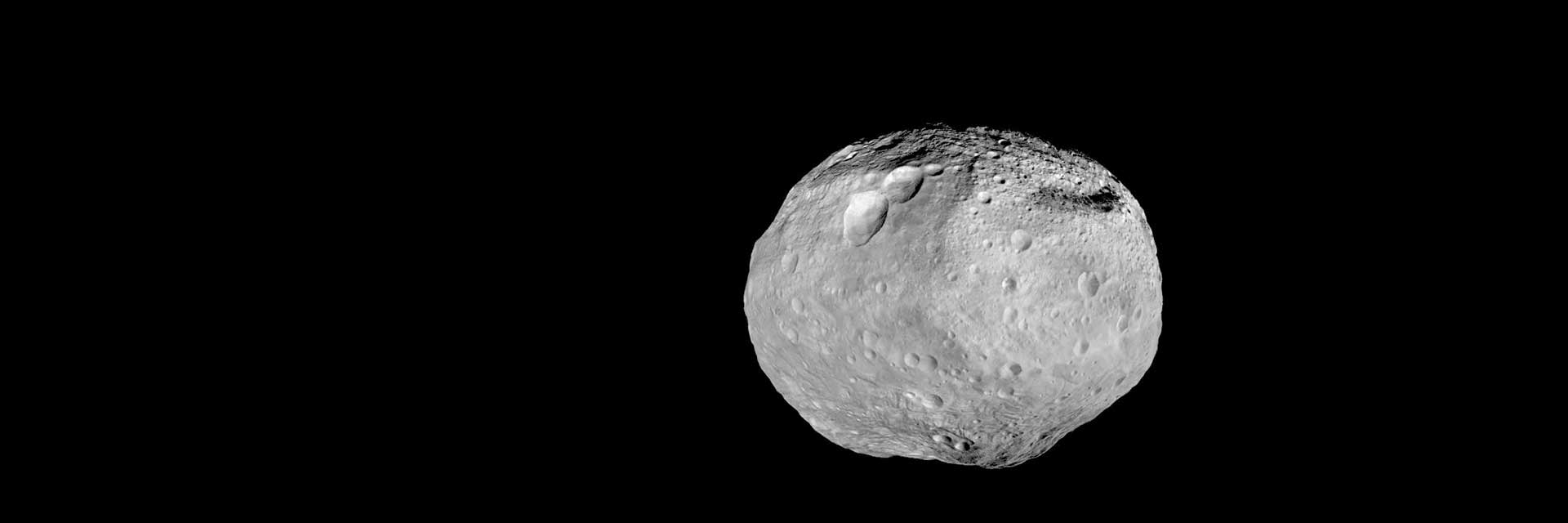
Asteroid Vesta photographed by NASA's Dawn spacecraft — color-enhanced mosaic showing varied terrain and the massive Rheasilvia basin at the south pole

Sky Event Guide · May 2026

You Can See Asteroid Vesta This Week — And Own a Piece of It for $15

Vesta reaches opposition on May 2, 2026 at magnitude 5.7 — brighter than most stars in Ursa Minor. Any pair of binoculars will find it. A small telescope will let you track its movement across Libra night by night. And the rock that fell to Earth from this exact asteroid costs about $15.

Opposition DateMay 2, 2026
BrightnessMagnitude 5.7
ConstellationLibra / Virgo border
Visible ThroughLate May 2026
By Telescope Advisor Editorial Team Published: Updated: Editorial Standards

Quick Answer: Asteroid Vesta Opposition May 2026

Asteroid Vesta is at opposition on May 2, 2026, making it one of the brightest objects in the current night sky that most people have never looked for. At magnitude 5.7, it sits right at the threshold of naked-eye visibility from a truly dark site — but is an easy binocular target from almost anywhere. Here are the key facts at a glance:

Fact Detail
Opposition dateMay 2, 2026
BrightnessMagnitude 5.7 (brighter than Polaris)
ConstellationLibra / Virgo border (tracks westward through May)
Naked eye?Dark rural skies only — not from suburbs or cities
Binoculars needed?Any pair works — even pocket 8×25 binoculars
Visible through May?Yes — brighter than magnitude 6 until late May
Best viewing timeAfter 10 PM local time, south-southeast
Second opposition 2026October 13, 2026 at magnitude 6.3

What Is Asteroid Vesta? (The Rock with Pieces on Earth)

Vesta is not a typical asteroid — and that distinction matters before you go outside to look for it. While most asteroids are irregular lumps of undifferentiated rock, Vesta behaves like a planet that never grew large enough to become one. It has a distinct iron-nickel core, a rocky mantle, and a basaltic crust — the same layered structure found in Earth, Mars, and the Moon.

With a mean diameter of about 525 km, Vesta is the second-largest body in the main asteroid belt (after dwarf planet Ceres) and accounts for roughly 9% of the total mass of all asteroids combined. It formed within 1–2 million years of the solar system's birth — early enough that short-lived radioactive elements heated its interior to the melting point, allowing it to differentiate just like a rocky planet.

Most remarkably: a collision approximately one billion years ago excavated an enormous crater near Vesta's south pole. The Rheasilvia basin is 505 km wide — some 95% of Vesta's mean diameter — with a central peak rising 22 km above the crater floor, one of the tallest mountains in the entire solar system. That collision ejected debris into space. Some of it eventually found its way to Earth. The extraordinary implication of that is covered in Section 5.

NASA Dawn spacecraft color mosaic of Asteroid Vesta — showing terrain variations, impact craters, and the southern hemisphere where the giant Rheasilvia basin lies

Asteroid Vesta — NASA Dawn Spacecraft Color Mosaic

Color-enhanced mosaic from Dawn's Survey Orbit (2011–2012), revealing Vesta's varied terrain: dark impact deposits, bright scarps, and the layered geological record of a differentiated body. Credit: NASA/JPL-Caltech/UCLA/MPS/DLR/IDA

Vesta Fast Facts

Mean diameter~525 km (326 miles)
StructureCore, mantle & crust (differentiated)
DiscoveryMarch 29, 1807 — Heinrich Wilhelm Olbers
Asteroid belt rank2nd most massive (after Ceres)
Rheasilvia basin505 km wide, 22 km central peak
NASA missionDawn spacecraft (2011–2012)
Orbital period3.63 years
Distance at opposition~1.14 AU from Earth (May 2026)
HED meteorites on EarthYes — Howardites, Eucrites, Diogenites

Why Vesta Is Exceptional Among Asteroids

Most of what we call asteroids are primitive, undifferentiated rubble — the same material throughout. Vesta is a surviving protoplanet: a body that completed planetary differentiation and then stopped growing. The Dawn mission confirmed it has an iron core roughly 110 km in radius. When you look at Vesta in binoculars on May 2, you are looking at what Earth's core is made of — at a distance of 170 million km.

When and Where to See Vesta in May 2026

Vesta reaches opposition on May 2, 2026 — the moment when Earth passes between the Sun and Vesta, putting them in a direct line. At opposition, Vesta is both closest to Earth and at its brightest for this apparition. But unlike a one-night lunar eclipse or a single peak morning for a meteor shower, this is a three-week window. Vesta remains brighter than magnitude 6 through the third week of May, giving you ample time to find it and watch it move.

May 2026 Viewing Window

April 24Magnitude ~5.9 — already visible
May 2 — OppositionMagnitude 5.7 — peak brightness
May 1–15Brighter than magnitude 6.0
Mid-to-late MayFading but still a binocular target
June 2026Magnitude 6.5+ — getting difficult

Where to Look

  • Direction: South-southeast after 10 PM local time
  • Constellation: Northern Libra, drifting west into Virgo
  • Anchor star: Zubeneschamali (β Librae, magnitude 2.6) — the brightest star in Libra and one of the few stars with a noticeably greenish tint
  • Distance from anchor: Within one binocular field of view of 16 Librae at opposition
  • Height above horizon: ~25–35° for mid-northern US latitudes at 11 PM

The Movement Trick — How to Identify Vesta

Vesta looks identical to a star in binoculars — a sharp, steady point of light. The difference is this: it moves. Vesta drifts westward relative to the background stars at about 0.7° per day near opposition (roughly one full Moon width every three days). Observe the same area of sky on two consecutive nights and sketch or photograph the star pattern. The dot that has shifted position is Vesta. This is the identical method astronomers have used since Olbers discovered it in 1807.

A free stargazing app (Stellarium or SkySafari — both iOS and Android) will show you Vesta's exact location for any date and time. Search "Vesta" in the app and it will place a marker on the chart. Cross-reference with what you see in binoculars and confirm by checking two nights in a row.

Moon Phase — Good News for May 2026

The New Moon falls on April 27, 2026 — just 5 days before opposition. On May 2 itself, the Moon is a thin 4-day-old crescent setting in the west by 10 PM, leaving the southern sky essentially dark for Vesta viewing. The first week of May offers near-ideal dark sky conditions. This is unusually favorable timing.

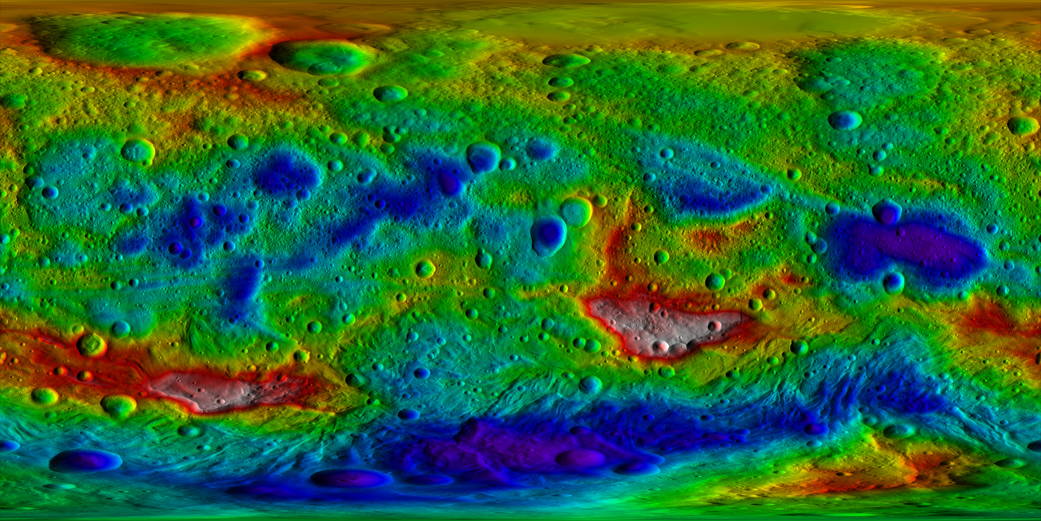
NASA Dawn spacecraft topographic map of Vesta showing elevation variations — the massive Rheasilvia basin at the south pole is the deepest feature, while the equatorial trough system Divalia Fossa circles the asteroid's midsection

Vesta Topographic Map — NASA Dawn Spacecraft

Color-coded elevation map from Dawn's High Altitude Mapping Orbit. The deep blue region at the bottom (south pole) is the Rheasilvia impact basin — the source of the HED meteorites found on Earth. The equatorial trough Divalia Fossa is larger than the Grand Canyon. Credit: NASA/JPL-Caltech/UCLA/MPS/DLR/IDA

What Equipment Do You Actually Need?

The honest three-tier breakdown — what each level of equipment actually shows, and whether it's worth the cost for this specific event:

Tier 1 — Naked Eye Free

Possible from very dark rural skies only. Magnitude 5.7 is right at the threshold of naked-eye visibility — achievable with fully dark-adapted eyes at a site with no light pollution (Bortle 3 or darker), but invisible from suburban areas. If you need to think about whether your site is dark enough, it probably isn't dark enough for this. From a rural dark-sky site — say, a state park or agricultural area well away from town — look south-southeast after 10 PM and scan patiently. You may pick up a faint star that wasn't on your mental chart.

Verdict: Worth trying from a dark site as confirmation after finding Vesta in binoculars first. Not recommended as your primary method.

Tier 2 — Binoculars (Recommended)

The ideal tool for Vesta. Through any pair of binoculars — 7×35, 8×42, 10×50, even compact 8×25 pocket binoculars — Vesta appears as a bright, sharp, slightly yellowish star-like point. The binocular field of view (typically 5–8°) is wide enough to show Vesta in context with the surrounding Libra star field, which is exactly what you need to identify it by its movement. On two consecutive nights, you'll clearly see that one "star" has moved relative to the others.

Any binoculars you already own will work. If you're looking to upgrade, see our best binoculars for astronomy →

Verdict: Best tool for Vesta viewing. Works from suburban areas. Finding Vesta in binoculars is achievable in under 15 minutes with a good star chart or phone app.

Recommended Binoculars Pick

Celestron SkyMaster 20×80 Binoculars

80mm aperture 20× magnification Tripod adaptable

80mm aperture makes Vesta noticeably brighter against the Libra star field, and 20× magnification makes its nightly movement more obvious than lower-power binoculars. Fully compatible with a standard tripod adapter for completely steady views on both consecutive nights of your confirmation observation.

View on Amazon

Affiliate link — we may earn a small commission at no extra cost to you.

$$$

Serious upgrade: Celestron SkyMaster 25×100

100mm aperture and 25× magnification — the most capable binoculars for Vesta short of a telescope. On a solid tripod, Vesta stands out clearly from all neighbouring stars and the field is rich enough to make night-to-night movement unmistakable. View on Amazon →

Tier 3 — Small Telescope (60–130mm) $100–$350

Through a telescope, Vesta appears as a pale yellow, star-like point. At opposition, its apparent disk is only 0.56 arcseconds across — far too small to resolve visually even in large amateur telescopes. No telescope shows a disk or surface detail. What a telescope adds is precision: the higher magnification makes Vesta's nightly movement against the background stars dramatically more obvious. At 100× in a 4-inch refractor, the shift from one night to the next is unmistakable.

New to telescopes? See our best telescopes for beginners →

Verdict: A worthwhile addition if you already own one. If buying specifically for Vesta, binoculars are better value for this event specifically — though the telescope will serve far more purposes over the rest of 2026.

Editor's Pick — Best for Vesta Tracking

Celestron StarSense Explorer DX 130AZ

130mm aperture Phone-assisted pointing Beginner-friendly

The StarSense Explorer uses your smartphone's camera to analyse the star field overhead and direct you to any target — including Vesta. Enter "Vesta" in the app, follow the on-screen arrows, and you'll be centred on the asteroid in seconds. At 65×, its movement from one night to the next is unambiguous. The ideal telescope for a first-time asteroid hunter.

View on Amazon See all beginner picks →

Affiliate link — we may earn a small commission at no extra cost to you.

$

Budget pick — Sky-Watcher Heritage 130P Tabletop Dobsonian

130mm parabolic mirror in a compact tabletop Dobsonian — remarkable aperture for the price. No polar alignment, no motors, no setup complexity. At 65×, Vesta's movement between consecutive nights is clear and satisfying. View on Amazon →

$$$

GoTo upgrade — Celestron NexStar 5SE

The NexStar 5SE's GoTo hand controller has Vesta in its database — align the scope once and it slews directly to the asteroid on subsequent nights without any re-finding. Tracks Vesta automatically during each session. The 5-inch Schmidt-Cassegrain also excels on Saturn (opposition October 4) and the October 13 Vesta return. View on Amazon →

Tier 4 — Smart Telescope (Unistellar, Vaonis, Celestron Origin) $800+

If you have a smart telescope, imaging Vesta is trivial. Search "Vesta" in the control app and the scope will locate it automatically, lock on, and begin live stacking. Within a few minutes you'll have a clean image of a bright star-like object against a rich background field — and over the course of an hour, the software's stacked exposures will clearly show its movement relative to the background stars. Some smart telescope apps (like Unistellar's Citizen Science mode) can even log Vesta observations and contribute them to asteroid science databases.

See our complete top smart telescopes guide →

Verdict: The most impressive way to experience Vesta if you own one. The combination of automated finding, live stacking, and movement detection makes the observation genuinely spectacular.

Best Value Smart Telescope

ZWO Seestar S50

50mm aperture App-controlled GoTo Live stacking

Search "Vesta" in the Seestar app, and within seconds it is imaging the field. Run it for 30 minutes and come back to a timestamped image sequence that clearly shows the asteroid's shift against the star background. The most accessible smart telescope for first-time asteroid imaging — and it handles the Eta Aquarid deep-sky targets (M5, M13) on the nights of May 5–6 equally well.

View on Amazon See all smart telescope picks →

Affiliate link — we may earn a small commission at no extra cost to you.

$$$

Premium: Unistellar eVscope eQuinox 2

Unistellar's Citizen Science mode lets you log Vesta observations and submit them to the international asteroid science database — your data contributes to real research. The 114mm aperture and Enhanced Vision technology produce vivid live views of the surrounding Libra star field, with Vesta clearly identified by the app. View on Amazon →

How to Actually Find Vesta: Step by Step

Follow these steps on any clear night in early May 2026. The whole process takes about 20 minutes on your first attempt.

  1. 1

    Go outside after 10 PM local time, facing south-southeast

    By 10 PM in early May, Libra has cleared the southeastern horizon and is rising into a usable position. By 11 PM it is ~25–30° above the horizon from mid-northern US latitudes — high enough for steady views. Give your eyes 10–15 minutes to dark-adapt (no phone screens or white lights during this time).

  2. 2

    Open Stellarium or SkySafari on your phone — search "Vesta"

    Both apps (free on iOS and Android) display minor planets including Vesta. Enable night mode (red screen) before going outside. Search for "4 Vesta" and the app will show its exact position on the sky chart with a marker. Note which bright star it's closest to — this will be your binocular anchor.

  3. 3

    Locate Libra using Zubeneschamali (β Librae) as your anchor

    Zubeneschamali (β Librae) is the brightest star in Libra at magnitude 2.6 — easy to spot with the naked eye in the south-southeast. It is one of the only stars in the sky with a distinctly greenish or yellowish-green tint (though this is subtle and debated). Once you have it in binoculars, you are within the right area of sky. Vesta is within one binocular field of view of the star 16 Librae at opposition.

  4. 4

    Scan the area with binoculars, compare to your star chart

    With your phone app (in night mode, held at arm's length) showing the star field, scan the same area with binoculars. You're looking for a "star" that is: (a) slightly brighter or a different shade than its neighbours, and (b) not on your printed or app-based chart. Take a mental note of its position or photograph the field with your phone through the binoculars.

  5. 5

    Observe on two consecutive nights — the dot that moved is Vesta

    This is the definitive confirmation. Return to the same area of sky the following night. Every star in the field will be in exactly the same position. One point of light will have moved westward by about 0.7° — roughly the diameter of the Moon as seen from Earth. That moving dot is Asteroid Vesta. The first time you confirm the movement, the experience is genuinely thrilling — you are watching a world in orbit.

Best Weather-Checking Tip

Use Clear Outside (clearoutside.com) or Clear Dark Sky (cleardarksky.com) — not the general weather forecast. These tools show cloud cover, atmospheric transparency, and seeing conditions at an hourly level for astronomy sites. A "partly cloudy" general forecast often means a perfectly clear astronomy window exists if you know when and where to look.

The Extraordinary Twist — You Can Own a Piece of the Asteroid You're Looking At

Once you've seen Vesta moving through Libra — confirmed its position on two consecutive nights, held binoculars on a pale point of light 170 million km away — here is the fact that reframes the entire experience:

Some of that asteroid has already landed on Earth. You can hold a piece of it in your hand.

The same two massive impacts that excavated Vesta's Rheasilvia and Veneneia craters ejected billions of tonnes of Vesta's crust and mantle into space. Over millions of years, some of that debris migrated inward on gravitational resonances, entered Earth-crossing orbits, and eventually fell as meteorites. Geochemists identified them by their unique oxygen isotope ratios and basaltic composition — a signature that only matches Vesta. These are the HED meteorites: Howardites, Eucrites, and Diogenites.

The Three Types of Vesta Meteorites

Eucrites — Vesta's basaltic crust

The most common HED type. Eucrites are basaltic rocks — the same type that forms lava flows on Earth and the Moon. They sample Vesta's outermost crust. Under a magnifier, you can see interlocking crystals of pyroxene and plagioclase feldspar. Price: approximately $4–10 per gram. A 3–4 gram piece of genuine eucrite costs about $15 from reputable dealers — less than a meal out.

Diogenites — Vesta's deep crust / upper mantle

Coarser-grained than eucrites, dominated by the mineral orthopyroxene. Diogenites come from deeper in Vesta's structure — excavated by the Rheasilvia impact that punched through the crust. Slightly rarer and typically more expensive per gram.

Howardites — Vesta's regolith (mixed surface)

Brecciated mixtures of eucrite and diogenite material — Vesta's surface soil, compacted and ejected by impacts. Named after meteorite chemist Edward Howard. Often the most visually interesting under a loupe due to the mixed clast textures.

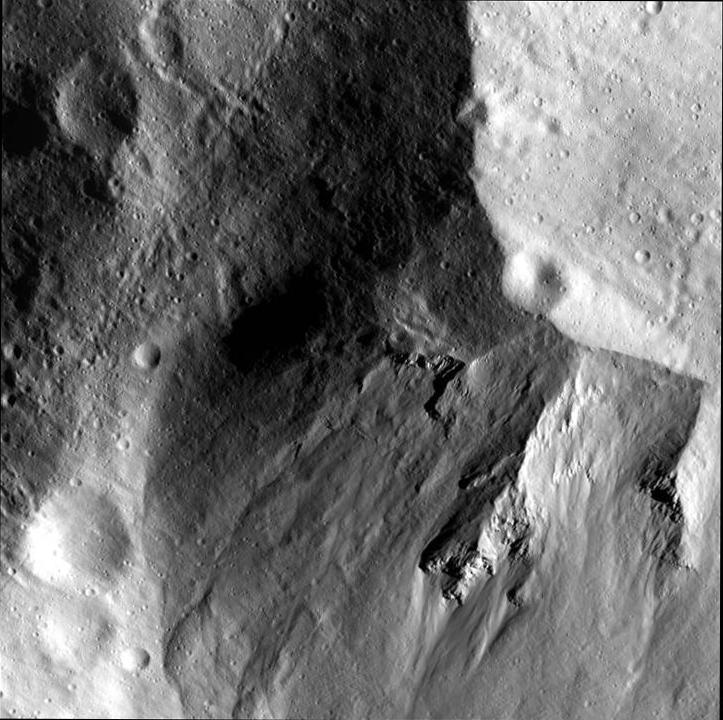
NASA Dawn spacecraft image of Vesta's south pole showing the enormous Rheasilvia impact basin — the source of the HED meteorites found on Earth

The Crater Your Meteorite Came From — NASA Dawn Image

The south pole of Vesta showing the Rheasilvia impact basin — 505 km wide with a central peak rising 22 km. This single impact, approximately one billion years ago, ejected the material that became HED meteorites on Earth. The crater accounts for nearly 1% of Vesta's total mass. Credit: NASA/JPL-Caltech/UCLA/MPS/DLR/IDA

How to Buy a Piece of Vesta Legally

HED meteorites are sold legally by reputable meteorite dealers worldwide. Look for sellers on the Meteoritical Society's recognized dealer list, or reputable auction platforms with verified certificates of authenticity. Search for "eucrite meteorite" — confirm the listing cites a known HED fall or find (e.g., Northwest Africa NWA series, Antarctica ANSMET collection, or named falls like Millbillillie, Pasamonte, or Juvinas). Always request the meteoritical classification and provenance. A 3–4 gram piece runs $12–25 from most dealers.

The Connection: Rheasilvia → Meteorite → Your Hand → Binoculars → The Crater

The NASA Dawn mission mapped Rheasilvia in extraordinary detail (see image above). When you hold a eucrite meteorite in one hand and point binoculars at Vesta with the other, you can trace the exact chain: that particular crater on that particular asteroid was punched by an impactor approximately one billion years ago — the ejecta flew into space — some of it eventually fell on Earth — it was collected, classified, and sold to collectors — you are holding a fragment of it — and the source crater is visible in the NASA image at the bottom of your screen. That chain is real, verifiable, and costs about $15 to complete.

Vesta's Two 2026 Appearances — Don't Miss October Either

Vesta's orbital period is 3.63 years, but Earth's orbital geometry means opposition years don't follow a simple pattern. In 2026, an unusual circumstance produces two Vesta oppositions in a single calendar year — one in May and one in October. If you miss the May window (or just want to look again), the second opportunity arrives in just 5½ months.

NOW

May 2, 2026 — Opposition #1

Magnitude at peak5.7
ConstellationLibra / Virgo border
Moon phaseNear new moon — excellent
Viewing windowApril 24 – late May
Best viewing timeAfter 10 PM, SSE

Brighter of the two 2026 oppositions. Near-perfect moon conditions. Act this week — the peak is already here.

COMING

October 13, 2026 — Opposition #2

Magnitude at peak6.3
ConstellationPisces
Moon phaseCheck Oct 2026 calendar
SeasonAutumn evenings (Northern Hemisphere)
Best viewing timeEvening sky, south

Slightly dimmer (magnitude 6.3 vs 5.7) but still easily a binocular object. A second chance for anyone who misses May.

October 2026: A Double Event — Vesta + Saturn

The October 13 Vesta opposition falls just 9 days after Saturn's October 4, 2026 opposition. In the same two-week period, you'll have both Vesta (magnitude 6.3, in Pisces) and Saturn (with its rings now tilting back into magnificent edge-on geometry) as premium binocular and telescope targets in the evening sky. This makes October 2026 one of the most productive two-week windows for amateur astronomers this year — a natural "double event" guide for autumn. Saturn's rings are returning to an increasingly edge-on orientation throughout 2026, making the planet's appearance through a telescope progressively more dramatic as the year progresses. See our complete Saturn 2026 rings guide → for the full October viewing plan.

May 2

Vesta at peak brightness
Magnitude 5.7

Oct 4

Saturn at opposition
Rings edge-on geometry

Oct 13

Vesta second opposition
Magnitude 6.3 in Pisces

Asteroid Vesta 2026 — Frequently Asked Questions

Can I see Vesta without a telescope?

Yes — but only from very dark skies away from light pollution. At magnitude 5.7, Vesta is right at the naked-eye limit, which requires a site with no artificial light interference (Bortle 3 or darker). From suburban areas, binoculars are essential. From a city, Vesta is simply invisible without optical aid. If you have access to a genuinely dark rural site, dark-adapted eyes should just pick it up in the south-southeast direction after 10 PM in early May — but confirm it first through binoculars by identifying its movement over two nights.

What does Vesta look like through a telescope?

Through a telescope, Vesta appears as a pale yellow, star-like point of light. At opposition, its angular diameter is only 0.56 arcseconds — far too small to resolve into a disk even with large amateur telescopes. No surface detail, no disk shape, no distinguishable features are visible through any amateur instrument. What a telescope reveals is Vesta's movement: at high magnification (100×+), its nightly shift against the background star field is dramatically obvious after just one day, making identification quick and certain.

When is the best time to look for Vesta in May 2026?

After 10 PM local time when Libra (and Vesta within it) has risen to a useful altitude in the south-southeast sky. By 11 PM, Vesta is approximately 25–35° above the horizon from mid-northern US latitudes — high enough for steady binocular views. The opposition date is May 2, 2026, but the full viewing window extends from late April through late May. An important advantage for 2026: the Moon is a thin crescent on opposition night (New Moon was April 27), creating near-ideal dark-sky conditions in the early weeks of May.

How do I know which dot is Vesta?

Observe the same area of sky on two consecutive nights. Every star will be in exactly the same position relative to its neighbours. One point of light — Vesta — will have shifted westward by about 0.7° (roughly the diameter of the full Moon as seen from Earth). That moving dot is Vesta. A free stargazing app (Stellarium or SkySafari) will show Vesta's position marked on the star chart for any date and time, allowing you to pre-identify the correct field before you even look up.

Can you really buy a piece of Vesta?

Yes — completely legally. HED meteorites (Howardites, Eucrites, and Diogenites) are confirmed fragments of Asteroid Vesta that have fallen to Earth as meteorites. They are sold by reputable meteorite dealers and are not regulated as controlled substances anywhere in the world. Eucrites (the most common HED type, sourced from Vesta's basaltic crust) typically sell for $4–10 per gram. A small 3–4 gram piece — enough to hold in your fingers and clearly see crystalline texture with a loupe — costs approximately $15. Ensure you buy from verified dealers with meteoritical classification certificates.

When does Vesta reach opposition again after May 2026?

October 13, 2026 — giving you a second opportunity later in the same year. The October opposition finds Vesta slightly dimmer at magnitude 6.3 (compared to 5.7 in May) and placed in the constellation Pisces, making it a comfortable evening-sky target in autumn. October 2026 is particularly rich for amateur astronomy: Saturn's opposition on October 4 and Vesta's opposition on October 13 provide two major targets within 9 days of each other.

Related Guides