Solar Eclipse Guide · August 2026
Total Solar Eclipse August 12, 2026
Solar Filters, Eclipse Glasses & Telescope Guide
The Moon's shadow sweeps across Greenland, Iceland, Spain, and the western Mediterranean. Here's exactly what equipment you need — from ISO-certified glasses to telescope solar filters — to watch it safely and memorably.
Eye Safety Warning
Never look directly at the Sun without ISO 12312-2 certified eclipse glasses or a telescope solar filter. Regular sunglasses provide zero protection and will cause permanent eye damage. The only safe time to remove eclipse protection is during the few seconds of totality — when the Sun is completely blocked. Outside totality (including during the partial phases), proper ISO-certified protection is mandatory at all times.
Quick Answer: What Do I Need for the August 2026 Eclipse?
| Your Situation | What You Need | Budget |
|---|---|---|
| Just watching by eye | ISO 12312-2 eclipse glasses | $1–$5 |
| Binocular viewing | Solar binoculars (built-in filter) or individual eyepiece solar filters | $40–$120 |
| Telescope — partial phases | Full-aperture solar filter for your specific OTA diameter | $20–$80 |
| Telescope — totality (unfiltered) | Remove filter during totality only; reattach immediately after | Same scope |
| Solar astrophotography | Solar filter + DSLR/mirrorless T-ring adapter for partial; remove for totality | $30–$150 |
| Year-round solar observation | Dedicated H-alpha solar telescope (see sunspots, prominences anytime) | $500–$2,000+ |
Eclipse Facts: Path, Times & Who Can See It
Path of Totality
The Moon's shadow (umbra) begins over the Arctic Ocean, crosses Greenland, sweeps southeast through Iceland, and then crosses northern and central Spain, ending over the Balearic Islands and western Mediterranean. The shadow is approximately 185 km (115 miles) wide at its widest.
Key totality cities: Reykjavík (Iceland), Bilbao, Zaragoza, Valencia (Spain). Parts of Portugal, southern France, and North Africa will see a 90–98% partial eclipse — still spectacular, but not totality.
Duration of Totality
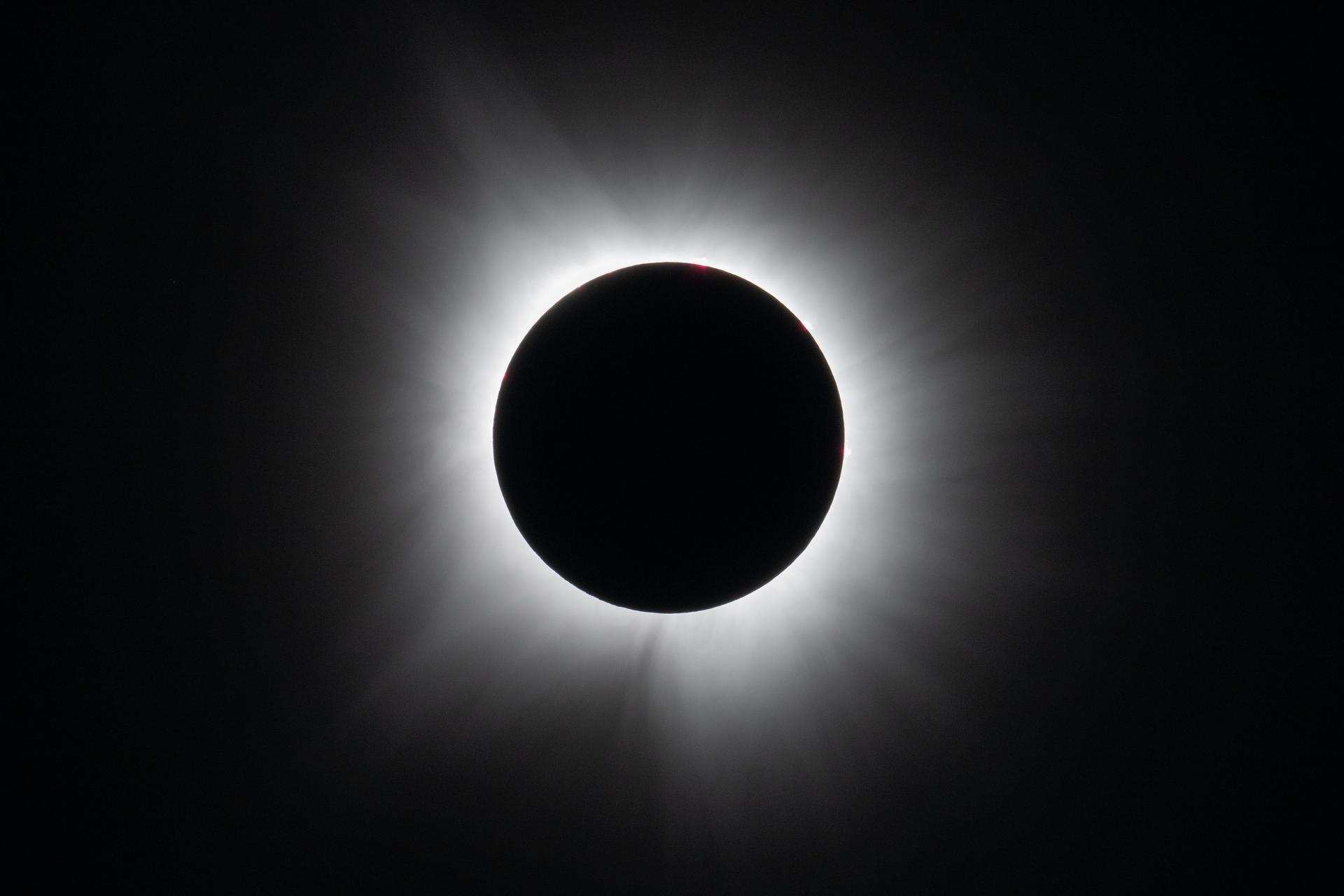
Maximum totality occurs near the Faroe Islands at 2 minutes 18 seconds. Observers along the central line in Spain will see approximately 1 min 45 s to 2 min of totality. Even 60 seconds is enough to experience the corona and prominences.
Eclipse Times (UTC, August 12, 2026)
| First contact (partial begins) | ~07:00 UTC (varies by location) |
| Greatest eclipse | ~08:12 UTC (near Faroe Islands) |
| Totality in Spain (approx.) | ~08:25–09:10 UTC (depends on location) |
| Last contact (partial ends) | ~10:30 UTC (varies by location) |
Not in the path of totality?
If you're in Western Europe, the UK, or North Africa, you'll see a deep partial eclipse — still a remarkable spectacle. Eclipse glasses are still required. A 90%+ partial eclipse noticeably dims and cools the sky but does not produce the corona.
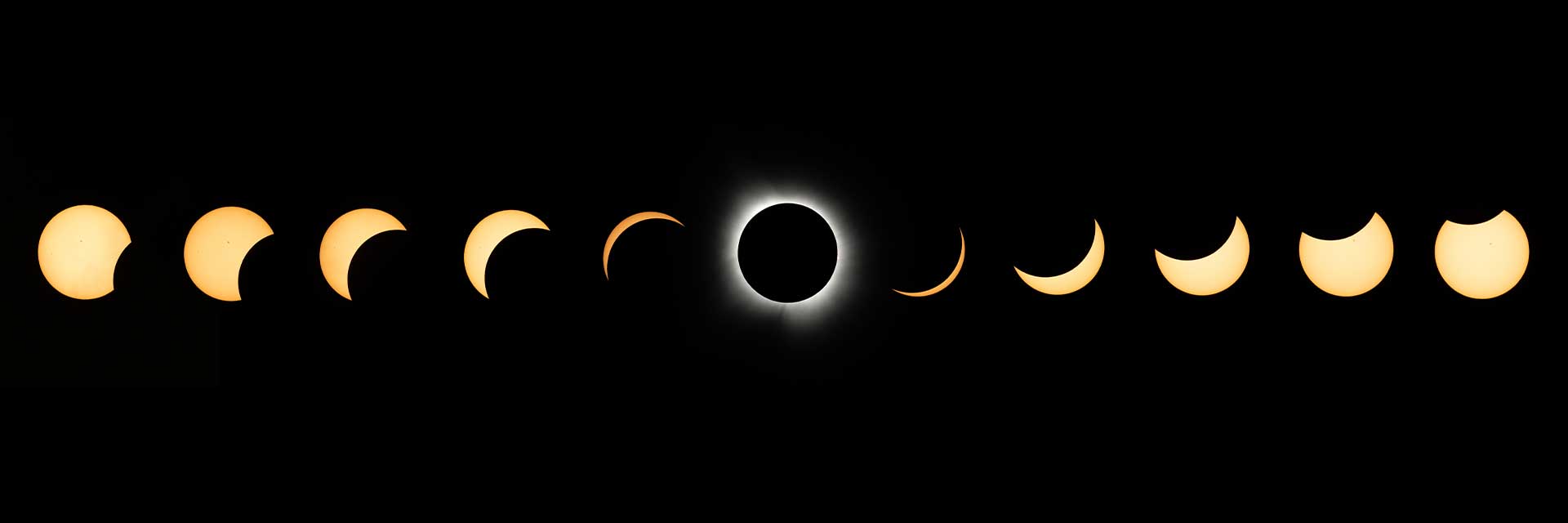
Progression of the April 8, 2024 total solar eclipse — the August 2026 eclipse will follow a similar arc. NASA/Keegan Barber
Visible in the United States as a Partial Solar Eclipse
Totality is NOT visible from any US location
The path of totality does not cross the United States. US observers in qualifying states will see a partial solar eclipse only — ISO 12312-2 eclipse glasses and telescope solar filters are required at all times. There is no safe moment to remove them during a partial eclipse.
A partial solar eclipse is visible from 27 states plus Alaska — primarily the Northeast, Upper Midwest, and Alaska. The western and southern US (California, Texas, Florida, and most of the South) do not see the eclipse at all. Coverage is modest — up to ~28% in Anchorage and ~13–22% in northeastern states — but still worth observing through filtered binoculars or a solar telescope. The Moon's dark limb creeping across the solar disc is a striking sight through any filtered optic.
Times source: timeanddate.com — Aug 12, 2026 Partial Solar Eclipse in the United States. All times shown are local time.
States Where the Partial Eclipse Is Visible
| State | Eclipse Starts (local) | Eclipse Ends (local) |
|---|---|---|
| Alaska | 7:34 am AKDT | 9:31 am AKDT |
| Connecticut | 1:02 pm EDT | 2:44 pm EDT |
| Delaware | 1:12 pm EDT | 2:34 pm EDT |
| District of Columbia | 1:17 pm EDT | 2:27 pm EDT |
| Illinois | 12:09 pm CDT | 12:44 pm CDT |
| Indiana | 1:09 pm EDT | 1:58 pm EDT |
| Iowa | 12:09 pm CDT | 12:28 pm CDT |
| Kentucky | 1:40 pm EDT | 1:45 pm EDT |
| Maine | 12:47 pm EDT | 2:52 pm EDT |
| Maryland | 1:12 pm EDT | 2:34 pm EDT |
| Massachusetts | 12:59 pm EDT | 2:49 pm EDT |
| Michigan | 12:35 pm EDT | 2:13 pm EDT |
| Minnesota | 11:28 am CDT | 12:57 pm CDT |
| Montana | 10:27 am MDT | 12:15 pm MDT |
| New Hampshire | 12:52 pm EDT | 2:46 pm EDT |
| New Jersey | 1:05 pm EDT | 2:39 pm EDT |
| New York | 12:51 pm EDT | 2:44 pm EDT |
| North Carolina | 1:30 pm EDT | 2:28 pm EDT |
| North Dakota | 11:27 am CDT | 12:36 pm CDT |
| Ohio | 1:03 pm EDT | 2:17 pm EDT |
| Pennsylvania | 1:01 pm EDT | 2:36 pm EDT |
| Rhode Island | 1:02 pm EDT | 2:46 pm EDT |
| South Dakota | 11:50 am CDT | 12:21 pm CDT |
| Vermont | 12:52 pm EDT | 2:43 pm EDT |
| Virginia | 1:16 pm EDT | 2:33 pm EDT |
| West Virginia | 1:11 pm EDT | 2:25 pm EDT |
| Wisconsin | 11:39 am CDT | 1:01 pm CDT |
Coverage by Key US City
| City | Max Coverage | Start | Max | End |
|---|---|---|---|---|
| Anchorage, AK | 27.9% | 7:36 am AKDT | 8:21 am AKDT | 9:09 am AKDT |
| Adak, AK | 12.6% | 6:35 am HDT | 7:30 am HDT | 7:50 am HDT |
| Augusta, ME | 21.3% | 12:55 pm EDT | 1:53 pm EDT | 2:47 pm EDT |
| Boston, MA | 16.0% | 1:01 pm EDT | 1:55 pm EDT | 2:46 pm EDT |
| Albany, NY | 13.0% | 1:00 pm EDT | 1:50 pm EDT | 2:39 pm EDT |
| Charleston, SC | 0.1% | 1:34 pm EDT | 1:46 pm EDT | 1:58 pm EDT |
| Bismarck, ND | 0.1% | 11:47 am CDT | 11:57 am CDT | 12:07 pm CDT |
Coverage percentages show maximum obscuration at peak. Cities not listed (e.g., New York City, Philadelphia, Chicago) have times within their state's range above. Use the interactive map for your exact city →
Best US viewing: Alaska
Anchorage sees up to 28% of the Sun covered — the best coverage of any major US city. The eclipse will be visible in the morning hours (roughly 7:30–9:10 am AKDT).
Best lower-48 viewing: Maine
Augusta, ME sees ~21% coverage — the highest in the contiguous US. Maine's entire afternoon will have a partial eclipse window from approximately 12:47 to 2:52 pm EDT.
Not visible from most of the US
California, Texas, Florida, and most of the South and West will not see any part of the August 12, 2026 eclipse. The next solar eclipse over the continental US is an annular eclipse on June 1, 2030.
Eclipse Glasses — Understanding ISO 12312-2
Eclipse glasses are the most important piece of equipment for the 2026 eclipse. Every person in your group needs a pair — including anyone watching the partial phases before and after totality.
The only safe eclipse glasses are those certified to ISO 12312-2:2015(E) international standard. This standard specifies a minimum optical density of 5 for visible light and requirements for IR and UV blocking. Do not use: regular sunglasses (even dark ones), smoked glass, CDs, photographic film, or any filter not explicitly marked ISO 12312-2.
✓ Safe filters
ISO 12312-2 eclipse glasses · AAS-approved vendors · Baader AstroSolar film (OD ≥ 5.0) · Thousand Oaks Type 2+ glass · Celestron EclipSmart film
✗ Never use
Sunglasses · CDs or DVDs · Smoked glass · Overexposed film negatives · Unbranded "solar" filters from unknown vendors
Totality exception
During total phase only — when Sun is 100% covered — it's safe to remove glasses briefly. As soon as the diamond ring appears, glasses must go back on immediately.
Helioclipse Solar Eclipse Glasses 2026 — 12-Pack
$24.95
Live price from Amazon · Updated 9:02 PM
Amazon's Overall Pick for 2026 eclipse glasses. Each pair uses a genuine black polymer solar filter that transmits a true-colour white/yellow Sun image. The 12-pack is ideal for families or groups travelling to the path of totality. ISO 12312-2 and CE certified. Includes bonus smartphone lens filter for eclipse photography.
Affiliate link — we may earn a small commission at no extra cost to you.
Premium option — Lunt Solar Eclipse Glasses, 5-Pack
$34.88Lunt Solar Systems — a respected name in dedicated solar telescopes — produces these plastic-framed eclipse glasses with ISO 12312-2 and CE certification. The hard-plastic frames survive rough handling better than cardboard alternatives, making these ideal for groups who'll use them multiple times across the partial phases. Particularly good for the 2026 eclipse in Spain where the partial phase lasts over 2.5 hours. View on Amazon →
Stock depletes rapidly as the eclipse approaches — order eclipse glasses early. AAS eclipse safety page →
Solar Binoculars for Eclipse Viewing
Solar binoculars have integrated solar filters built directly into the objective lenses — there's no risk of the filter falling off mid-session. They're the safest and most comfortable tool for watching the partial phases develop, letting you track sunspots and the Moon's encroachment over the full ~2 hour partial phase before totality. For totality itself, remove the binoculars (they're not needed — the corona is visible with the naked eye) and enjoy the spectacle directly.
Celestron EclipSmart 10×25mm Compact Solar Binoculars
$30.14
Live price from Amazon · Updated 9:02 PM
The most popular eclipse binoculars on Amazon. At 10× with a 25mm aperture, you can resolve sunspots comfortably and watch the Moon's limb creep across the solar disc during the partial phases. The compact size makes them ideal for travel to Spain or Iceland — they fit in any pocket or bag. AAS-approved for direct solar viewing. The built-in filters are fully integrated; they cannot be accidentally removed.
Affiliate link — we may earn a small commission at no extra cost to you.
Upgrade pick — Celestron EclipSmart 12×50 Porro Solar Binoculars
$99.99The 50mm aperture collects significantly more light than the 25mm version — useful for extended partial-phase sessions where subtle sunspot structure and filter granulation become visible. 12× magnification shows the Sun filling most of the field of view at roughly 2× larger than the 10×25. Best used with a tripod adapter during long partial phase sessions to prevent hand fatigue. View on Amazon →
Solar Filters for Telescopes
A telescope solar filter mounts over the front (objective) end of your telescope — never at the eyepiece end. Eyepiece-end solar filters are dangerous; the focused solar heat can crack them unpredictably. A full-aperture front filter reduces the Sun's intensity to a safe level before any light enters the optical system.
During the partial phases, keep the filter on. During totality, remove the filter to observe the corona, prominences, and chromosphere in all their glory. Reattach the filter immediately when the Sun begins to reappear — the diamond ring is your cue.
Celestron EclipSmart Universal Solar Eclipse Filter
$21.95
Live price from Amazon · Updated 9:02 PM
Celestron's universal EclipSmart filter fits a wide range of telescope objective diameters (and also works on DSLR lenses), making it the best choice if you're unsure of your exact tube diameter or plan to use it on multiple instruments. Solar Safe white-light film gives a natural yellow-white Sun image. You'll see sunspots clearly during the partial phase, and the filter comes off quickly for totality.
Affiliate link — we may earn a small commission at no extra cost to you.
For 70mm refractors — Celestron EclipSmart Solar Filter (70mm AZ/EQ)
$26.95Purpose-built for Celestron's popular 70mm AZ and EQ refractor series (AstroMaster 70, Travel Scope 70, etc). Snug-fit cardboard collar ensures the filter cannot accidentally fall off mid-session. ISO 12312-2 Solar Safe film gives white-light views of sunspot structure throughout the partial phase. View on Amazon →
For 6" SCTs and 150mm scopes — Celestron EclipSmart 94243 Solar Filter
$59.95Designed for Celestron 6" Schmidt-Cassegrain telescopes (NexStar 6SE, C6-N, etc). Fits snugly over the 6" optical tube's front corrector cell. Solar Safe film provides ISO 12312-2-compliant white-light solar views — at 150mm, sunspot groups, umbra/penumbra structure, and the lunar limb during the partial phase are clearly visible. Compatible with most 6-inch SCT designs from other manufacturers with similar tube diameters. View on Amazon →
Choosing the Right Solar Filter: Sizing Guide by Telescope
The most common mistake when buying a solar filter is getting one that doesn't fit. Solar filters must fit snugly — a filter that wobbles or can be dislodged by wind is dangerous. Always match the filter to your specific telescope's outer tube diameter (not the aperture), or use an adjustable universal filter.
| Telescope Model / Type | Aperture | Recommended Filter |
|---|---|---|
| Celestron 70mm refractors (AstroMaster 70AZ, Travel Scope 70) | 70mm | EclipSmart 70mm filter or Universal |
| Celestron 80–90mm refractors (Inspire 80AZ, Astro Fi 90) | 80–90mm | EclipSmart Universal filter |
| 5"–6" Schmidt-Cassegrain (NexStar 5SE, NexStar 6SE) | 125–150mm | EclipSmart 94243 (6") or Universal |
| 8" Schmidt-Cassegrain (NexStar 8SE, C8-A XLT) | 203mm | Baader AstroSolar DIY film (measure tube) or Universal |
| 130mm Newtonian (Heritage 130P, StarSense Explorer 130AZ) | 130mm | EclipSmart Universal or DIY Baader |
| 8" Dobsonian (Sky-Watcher FlexTube 200P, Dobsonian 8") | 200mm | DIY Baader AstroSolar cap (measure tube) |
| DSLR with 100–400mm telephoto lens | Lens-dependent | EclipSmart Universal (covers most lens filter rings) |
DIY Baader AstroSolar Film Filters
For telescopes not covered by a standard Celestron filter, Baader AstroSolar Safety Film (OD 5.0 visual density) is the professional choice. Purchase a sheet, cut to size, and mount in a cardboard cap custom-built to your tube's outer diameter. Instructions available from Baader Planetarium. The film produces a natural yellow-white solar image. Search "Baader AstroSolar Safety Film OD 5.0" on Amazon — verify the listing shows OD 5.0 (not OD 3.8, which is for photography only).
Dedicated Solar Telescopes: H-alpha & White Light
If you observe the Sun frequently — not just during eclipses — a dedicated solar telescope is worth considering. These purpose-built instruments use narrowband H-alpha or calcium K filters to reveal surface features invisible in white light: solar prominences, filaments, solar flares, and chromospheric granulation.
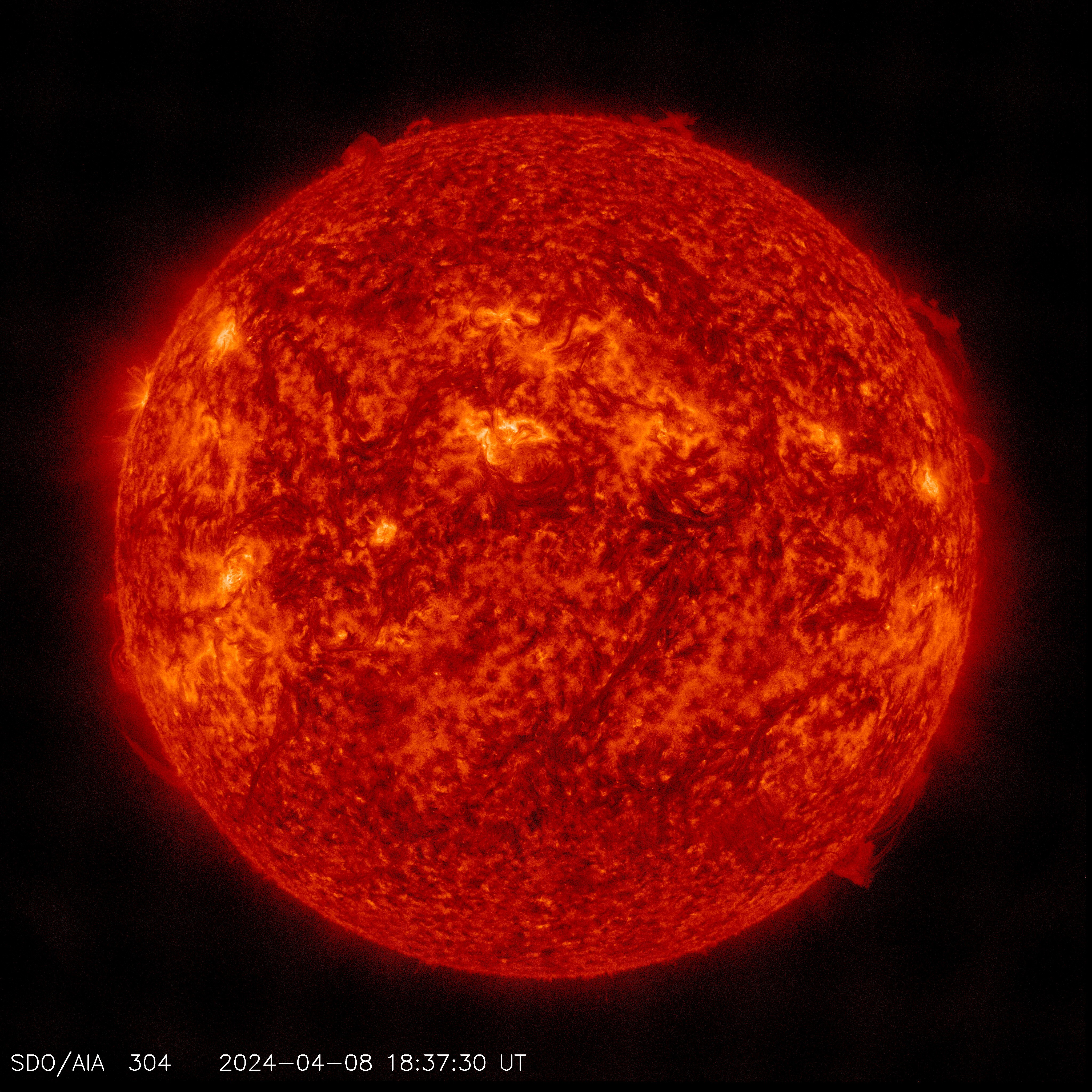
NASA's Solar Dynamics Observatory captured this extreme-UV image of the Sun on April 8, 2024 — just before totality began in Dallas. These details become visible through H-alpha solar telescopes. Credit: NASA/SDO
White-Light Solar Telescopes
White-light solar telescopes (or white-light filters) show the photosphere: sunspots, faculae, and the solar limb-darkening effect. They're ideal for the 2026 eclipse because they show the Moon's precise position and the contact events clearly. Celestron's EclipSmart filters convert any existing telescope into a white-light solar instrument.
Best for: Eclipse observation, sunspot counting, solar rotation tracking
H-alpha Solar Telescopes
H-alpha telescopes use an etalon filter to isolate a 0.5–1.0 Angstrom bandwidth of red light (the H-alpha emission line at 656nm). This reveals the chromosphere: prominences arcing off the solar limb, spicules, and active regions. For the 2026 eclipse, H-alpha shows the pink prominences visible during totality — and lets you study them any clear day.
Best for: Year-round solar observing, prominences, flares
Lunt Solar Systems LS50THa
50mm aperture H-alpha solar telescope with pressure-tuned etalon. Shows prominences, filaments, and chromospheric detail in the red hydrogen-alpha line. The LS50THa is the entry-level dedicated solar telescope recommended by the solar observing community — it's portable, well-built, and delivers views that no white-light filter can match. Available in single-stack (B600) and double-stack (B1200) configurations.
Find on Amazon →Coronado Personal Solar Telescope (PST) 40mm
The Coronado PST is the classic entry H-alpha solar telescope: 40mm aperture, 400mm focal length, etalon bandwidth <1.0 Å. Prominences, filaments, and active regions are all visible. Meade-manufactured and widely available. The PST is notably compact and the most affordable dedicated H-alpha scope. Not as high-contrast as Lunt but excellent for a first solar instrument.
Find on Amazon →Note: H-alpha solar telescopes are specialist instruments. Verify current Amazon availability and pricing as stock fluctuates before major eclipse events.
Astrophotography Setup for the August 2026 Eclipse
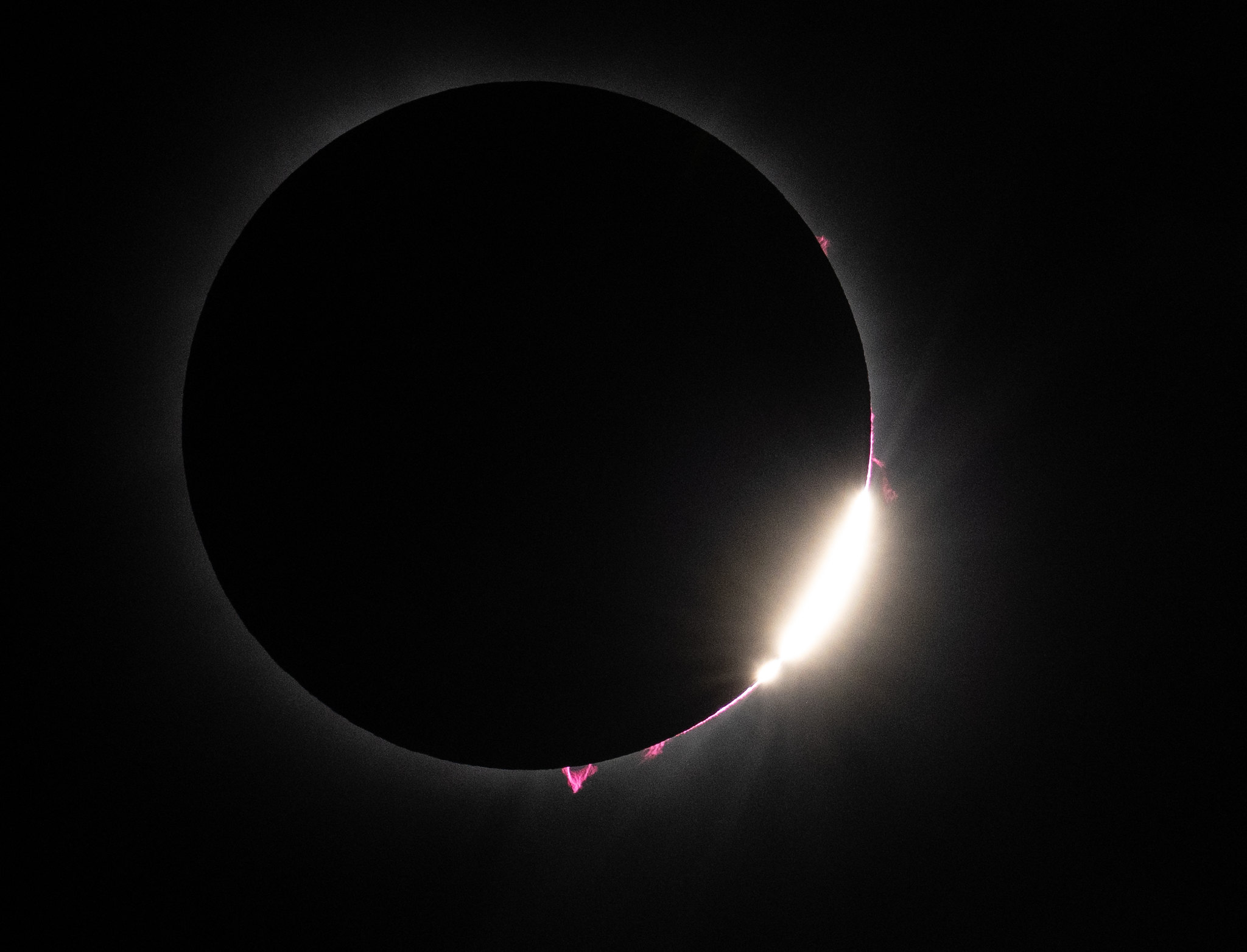
Baily's Beads and pink solar prominences just after totality, Dallas, April 8, 2024. The 2026 eclipse offers similar photographic opportunities. NASA/Keegan Barber
Partial Phase Photography
During the partial phases (before and after totality), your camera must have a proper solar filter in front of the lens or telescope.
- Use ISO 100–200 for sharp, low-noise partial-phase images
- Shutter speed: 1/1000s–1/4000s typical with OD 5.0 filter
- A 400mm–600mm telephoto fills the frame with the solar disc
- A telescope with T-ring adapter delivers excellent solar disc images
- Bracket exposures: shoot 3–5 frames at different speeds
Use a remote shutter release or 2-second timer to eliminate camera vibration. Mirror lock-up (on DSLR) helps at longer focal lengths.
Totality Photography
Remove the solar filter as soon as totality begins (confirmed by Baily's Beads disappearing). The corona has a huge dynamic range — use a bracket of exposures:
- 1/1000s–1/60s at f/5.6–f/8, ISO 400 covers inner corona, prominences, and chromosphere
- 1/8s–1s captures the outer corona streamers
- Set continuous high-speed bracketing before totality begins
- At 2 min 18 s max totality, there's time for 30+ bracketed frames
Critical reminder
Reattach the solar filter the instant the diamond ring appears. Do not rely on a timer — watch the sky and react immediately.
Frequently Asked Questions
Where exactly can I see the total solar eclipse on August 12, 2026?
The path of totality crosses Greenland, Iceland, and northern-to-central Spain, ending over the western Mediterranean. Key observation cities include Reykjavík (Iceland), Bilbao, Zaragoza, and Valencia (Spain). The partial eclipse is visible across all of Europe, North Africa, and parts of the Middle East. If you are outside the narrow path of totality (approximately 185km wide), you will only see a partial eclipse — still impressive, but without the corona.
Can I use my regular telescope for the solar eclipse without a filter?
Never use a telescope to observe the Sun without an appropriate full-aperture solar filter, except during the seconds of complete totality. A telescope concentrates sunlight to an intense focus — looking through one without a proper solar filter causes immediate, permanent retinal damage with zero warning or pain (the retina has no pain receptors). A full-aperture solar filter (like the Celestron EclipSmart series) attaches to the front of the telescope and is the only safe method. Eyepiece-end solar filters sold as accessories are considered dangerous by astronomers and should not be used.
How long does totality last in Spain on August 12, 2026?
Totality duration in Spain varies by location along the path. On the central line near Zaragoza and Valencia, totality lasts approximately 1 minute 45 seconds to 2 minutes. The longest totality along the entire eclipse path is approximately 2 minutes 18 seconds, occurring near the Faroe Islands. By comparison, the April 8, 2024 eclipse had a maximum of 4 minutes 28 seconds — the 2026 event is shorter, but still fully features the corona, prominences, and chromospheric effects.
What will I see through a telescope during totality?
During totality, with the solar filter removed, a telescope shows: (1) The solar corona — the Sun's wispy white outer atmosphere extending several solar diameters from the limb; (2) Pink solar prominences — huge arcs of plasma extending off the solar limb, visible even in a 50mm telescope; (3) The chromosphere — a thin red arc visible for a second or two at second and third contact; (4) Baily's Beads — points of sunlight shining through valleys on the lunar limb, just before and after totality. Lower power (25mm eyepiece at ×20–40) is usually better for totality because it widens the field to capture more corona extent.
Are eclipse glasses from the last solar eclipse still safe to use?
Eclipse glasses from previous eclipses are safe to reuse if they are in perfect condition — no scratches, punctures, cracks, tears, or wrinkles in the filter material. Hold them up to a bright light (not the Sun) and inspect closely. If the filter material is damaged in any way, discard them and buy new ones. ISO 12312-2-certified glasses don't have an inherent expiration date, but physical damage to the filter material is the key concern. When in doubt, replace them — the price of a new pair is negligible compared to the risk.
Do I need special equipment for the partial eclipse if I'm not in the totality path?
Yes. During the partial eclipse, looking at the Sun without ISO-certified eclipse glasses causes eye damage regardless of how much is covered. Even at 99% coverage, the remaining 1% of direct sunlight is enough to cause harm. ISO 12312-2 eclipse glasses are essential for everyone watching, anywhere in Europe. If you have a telescope, add a proper full-aperture solar filter. The partial eclipse is still spectacular — at 90% coverage in the UK and France, the sky noticeably dims and the temperature drops. A filtered telescope reveals the Moon's limb advancing across the solar disc in remarkable detail.
Is the August 12, 2026 solar eclipse visible from the United States?
Yes — as a partial solar eclipse only. Totality is not visible from any US location. A partial eclipse is visible from 27 states plus Alaska. The best coverage in the contiguous US is in Maine (~21% max coverage). Alaska sees up to ~28% coverage in Anchorage. Most of the western and southern US (California, Texas, Florida) will not see the eclipse at all. ISO 12312-2 certified eclipse glasses are required at all times for US observers — there is no moment of totality when glasses can safely be removed.
What states can see the 2026 solar eclipse?
27 states plus Alaska see the partial eclipse: Alaska, Connecticut, Delaware, District of Columbia, Illinois, Indiana, Iowa, Kentucky, Maine, Maryland, Massachusetts, Michigan, Minnesota, Montana, New Hampshire, New Jersey, New York, North Carolina, North Dakota, Ohio, Pennsylvania, Rhode Island, South Dakota, Vermont, Virginia, West Virginia, and Wisconsin. Times range from morning in Alaska (7:34 am AKDT) to afternoon in the Northeast (ending ~2:52 pm EDT). See the full state-by-state times table in the US visibility section above.
What eclipse glasses are safe? What does ISO 12312-2 mean?
Safe eclipse glasses must be certified to ISO 12312-2:2015(E) international standard. This means the glasses reduce sunlight intensity by a factor of at least 100,000× and block harmful infrared and ultraviolet radiation. Look for the ISO 12312-2 marking printed on the frame. The American Astronomical Society (AAS) maintains a list of approved vendors at eclipse.aas.org. CE-certified glasses meeting EN ISO 12312-2 are equally safe. Avoid any glasses not explicitly marked with these certifications — regular sunglasses, even very dark ones, provide zero protection against solar UV and IR.
Related Guides
What to See in May 2026
Asteroid Vesta, Saturn, and more
Asteroid Vesta May 2026
Opposition guide + gear picks
Eta Aquarid Meteor Shower 2026
Peak May 5–6, 2026
How to See Saturn in 2026
Rings returning — complete guide
Best Telescopes for Beginners 2026
Top picks for first-time buyers
Saturn's Rings Returning 2026
Best year to observe Saturn