Telescope Advisor Logo Telescope Advisor
M81 galaxy in Ursa Major photographed by the NASA/ESA Hubble Space Telescope

Constellation Guide · 2026

Ursa Major Constellation: Big Dipper Guide, Star Map & Telescope Targets

Ursa Major contains some of the best galaxy targets in the northern sky — M81, M82, and M101 — plus the classic Mizar double star. Here is everything you need to find it and observe it tonight.

Best SeasonMarch – May
HemisphereNorthern (circumpolar)
Brightest StarAlioth (mag 1.77)
HighlightsM81, M82, Mizar/Alcor
By Telescope Advisor Editorial Team Published: Updated: Editorial Standards

Ursa Major at a Glance

Ursa Major — the Great Bear — is the third-largest constellation in the sky and one of the most useful for amateur astronomers. Its core asterism, the Big Dipper, is the single most recognized star pattern in the Northern Hemisphere and the starting point for virtually every beginner star-hop.

Beyond navigation, Ursa Major harbors M81 (Bode Galaxy) and M82 (Cigar Galaxy) — two of the brightest galaxies in the northern sky, visible side-by-side in the same low-power field of view. It also contains M101 (Pinwheel Galaxy), the Owl Nebula (M97), and the classic naked-eye double star Mizar and Alcor. At any aperture level, Ursa Major is a year-round destination.

Beginner (60mm–100mm)

M81 and M82 as faint glows from dark skies; Mizar double star; Big Dipper star-hopping practice.

Intermediate (130mm–200mm)

M82 elongated structure clear; M101 from dark skies; M97 Owl Nebula as a ghostly disk.

Advanced (200mm+)

M82 dark lanes; M101 spiral hints; M108 edge-on and M109 barred spiral details.
Ursa Major: History, Mythology & Constellation Facts

Ursa Major (pronounced oor-suh MAY-jer; Latin: the Great Bear) is one of the 48 constellations catalogued by Greek astronomer Ptolemy in the 2nd century AD, and one of 88 constellations officially recognized by the International Astronomical Union. At 1,280 square degrees it is the third-largest constellation in the entire sky, after Hydra and Virgo.

The mythology of the Great Bear is among the oldest continuous sky stories. In Greek mythology, Zeus transformed the nymph Callisto into a bear and placed her in the sky; her son Arcas became Ursa Minor beside her. Remarkably, many Native American oral traditions independently tell a nearly identical story — hunters (the handle stars) chasing a bear (the bowl stars) — suggesting the pattern was recognized and given meaning across cultures with no shared origin, for at least 13,000 years.

Navigators have relied on the Big Dipper as a Polaris-finder for millennia. The two outer bowl stars, Dubhe and Merak, are called the “pointer stars” because a line through them points directly at Polaris, the North Star, approximately 5× their separation away.

Ursa Major: Constellation Data

IAU abbreviation
UMa
Area
1,280 sq deg (3rd largest)
Stars brighter than mag 5.5
56
Brightest star
Alioth (1.77)
Messier objects
7 (M81, M82, M97, M101, M108, M109, M40)
Best months
March – May
Meaning in English
Great Bear
Pronunciation
oor-suh MAY-jer
Center (approx.)
RA 10h 40m / Dec +55°
Circumpolar above latitude
~40° N

Big Dipper Star Names, Magnitudes & Distances

Five of the seven Big Dipper stars (Alioth, Mizar, Megrez, Phecda, and Merak) are members of the Ursa Major Moving Group — a loose stellar association sharing the same motion through space. Dubhe and Alkaid are moving in different directions entirely, which means the Dipper’s shape is slowly changing over tens of thousands of years.

Star Bayer Magnitude Distance Color / Type Position in Dipper
Alioth ε UMa 1.77 82.6 ly White A-type spectroscopic binary Base of handle (bowl junction)
Dubhe α UMa 1.79 123 ly Yellow-orange K giant (binary) Top-right bowl (pointer star)
Alkaid η UMa 1.86 103.9 ly Blue-white B-type main sequence Tip of handle
Mizar ζ UMa 2.04 86.3 ly White A-type (4-star system) Middle of handle
Merak β UMa 2.37 79.7 ly White A-type main sequence Bottom-right bowl (pointer star)
Phecda γ UMa 2.44 83.9 ly White A-type main sequence Bottom-left bowl
Megrez δ UMa 3.32 80.5 ly White A-type main sequence Top-left bowl (handle junction)

Apparent magnitudes as seen from Earth. Distances in light-years (ly). Megrez is noticeably dimmer than the other six — a useful observation to test your dark-sky limiting magnitude.

Ursa Major Star Map & Orientation

This map shows the Big Dipper as it appears high in the north during spring evenings from mid-northern latitudes. The bowl faces right, the handle curves down-left. Pointer stars Dubhe and Merak indicate Polaris; M81/M82 lie above Dubhe; M101 is near Alkaid.

Dubhe ★ Merak ★ Phecda Megrez Alioth Mizar Alcor Alkaid Polaris (North Star) M81 Bode Galaxy M82 Cigar Galaxy M101 Pinwheel Galaxy N Pointer star (Dubhe/Merak) Main star Deep-sky object

Ursa Major — spring evenings, mid-northern latitudes

Bowl opens to the right; handle curves down-left. Amber stars Dubhe & Merak point to Polaris (follow the dashed arrows). Purple circles = galaxies: M81 & M82 sit just above Dubhe; M101 near Alkaid at the handle tip.

How to Find Ursa Major Tonight: Step-by-Step

The Big Dipper is one of the most distinctive star patterns in the sky. Here is the complete method for locating it and hopping to the key telescope targets:

  1. Face north approximately 60–90 minutes after sunset (astronomical twilight).
  2. Identify the Big Dipper: seven moderately bright stars forming a dipper or plough shape. In spring the bowl is high overhead or in the high northeast.
  3. Find the bowl: four stars in a rough quadrilateral — Dubhe (top right, slightly orange), Merak (bottom right), Phecda (bottom left), Megrez (top left, noticeably dimmer).
  4. Trace the handle: three stars curve away from Megrez toward the tip star Alkaid. The slight arc inspired the classic memory aid “arc to Arcturus, speed on to Spica.”
  5. Find Polaris: draw a line from Merak through Dubhe and continue approximately 5× that star separation. Polaris sits at that point — it does not move and marks true north.
  6. Hop to M81 and M82: from Dubhe, sweep about 10° further in the direction away from Merak (northwest on spring evenings). Use the lowest-power eyepiece. Both galaxies fit in one 1° field.
  7. Hop to M101: from Alkaid (tip of handle), sweep about 5° toward Mizar. M101 is large but low-surface-brightness — use dark adaptation and averted vision.

Key beginner technique: averted vision

For faint galaxies like M101 and M108, look slightly to the side of the target rather than directly at it. The edge of your retina (packed with rod cells) is more sensitive to faint light than the center (cone-dominant fovea). This trick can reveal objects invisible with direct gaze, especially from suburban skies.

Mizar & Alcor: The Classic Double Star & Naked-Eye Vision Test

The second star from the end of the Big Dipper handle — Mizar — has been used as an astronomy test for at least 1,000 years. Adjacent to it is Alcor, a fainter companion (magnitude 3.99) separated by 11.8 arcminutes — just wide enough to split with the naked eye under clear conditions. Medieval astronomers used naked-eye resolution of the pair as a test of military eyesight fitness.

Naked eye test

Under suburban or rural skies with a limiting magnitude of about 5.0 or better, Alcor should be visible just to the northeast of Mizar. A fun first test on any clear night — the pair appears distinctly non-stellar compared to a single star.

Binoculars (7× or 10×)

Any binoculars cleanly separate Mizar and Alcor with room to spare. At 10× you may also begin to sense that Mizar itself is elongated — a hint of its true double nature.

Telescope (any aperture, 50× to 100×)

Any telescope at 50× to 100× splits Mizar A and B into two matched white stars separated by 14.4 arcseconds. This is one of the finest beginner double stars. Technically the full Mizar–Alcor system contains six stars: Mizar A and B are each spectroscopic binaries, and Alcor has its own close companion.

Mizar / Alcor: Quick Reference

Mizar magnitude
2.04
Alcor magnitude
3.99
Mizar–Alcor separation
11.8 arcmin (naked-eye)
Mizar A–B separation
14.4 arcsec (telescope)
Min magnification to split A–B
~50× (any aperture)
Distance to Mizar
86.3 light-years
Total stars in system
6

Best Time of Year to Observe Ursa Major

Peak season — March to May: The Big Dipper is near or past zenith for mid-northern latitudes, minimizing the atmospheric air mass you are looking through. Galaxy surfaces appear brighter and sharper at high altitude. Best evening observing of the year for Ursa Major DSOs.

Early summer (June–August): Still well-placed in the northwest after dark. Excellent for M97/M108 side-by-side and M101 before it drops lower.

Autumn (Sep–Nov): Constellation sits lower in the north on evening skies; galaxy work becomes harder but Mizar/Alcor and double star work remain productive.

Winter (Dec–Feb): The dipper rises in the northeast late evening. Early risers enjoy excellent spring-like pre-dawn views from 2–5 AM.

Moon: For galaxy work, observe within 5 days of new moon. M81 and M82 survive a crescent moon but contrast drops noticeably with a gibbous moon above the horizon.

Monthly visibility (Northern Hemisphere)

March · Excellent April · Excellent May · Excellent June · Very Good July · Good August · Good September · Fair October · Fair Nov – Dec · Low eve Jan – Feb · Low eve

Evening galaxy observing window. Circumpolar above 40° N — always visible in some part of the night.

Best Deep-Sky Objects in Ursa Major

Ursa Major contains 7 Messier objects — more than most constellations. This is the complete observing table with difficulty ratings and what each aperture class will show:

Object Type Mag Size Min aperture Difficulty
M81 — Bode Galaxy Spiral (Sa-Sb) 6.94 26.9′ × 14.1′ 70mm Easy
M82 — Cigar Galaxy Irregular / starburst 8.41 11.2′ × 4.3′ 90mm Easy
M101 — Pinwheel Galaxy Face-on spiral (Sc) 7.86 28.8′ × 26.9′ 130mm Moderate
M97 — Owl Nebula Planetary nebula 9.9 3.4′ × 3.3′ 150mm Moderate
M108 — Surfboard Galaxy Edge-on spiral 10.0 8.7′ × 2.2′ 150mm Moderate
M109 — Barred Spiral Barred spiral (SBbc) 9.8 7.6′ × 4.7′ 200mm Challenging

M81 & M82 — Your First Stop

M81 and M82 are only 0.6° apart — both fit in a 25mm eyepiece field in most telescopes, making this the premier galaxy pair for northern observers. They are physically associated: M82 is undergoing a violent burst of star formation triggered gravitationally by M81, both about 12 million light-years away. At 100×, M82 shows a distinctly elongated cigar shape with irregular mottling. At 150× with 200mm aperture, dark dust lanes begin to cross M82’s disk.

M101 — The Low-Surface-Brightness Challenge

M101 is a classic face-on spiral 21 million light-years away. Its integrated magnitude of 7.86 sounds bright, but that light is spread over an area nearly as large as the full Moon (29′). The low surface brightness makes it deceptively difficult. Use low power (40× to 80×), observe near new moon, and allow 30 minutes of dark adaptation. From Bortle 4 skies, a 150mm scope will show the galaxy disc; spiral structure hints require 250mm+ under Bortle 3 or better.

M97 — The Owl Nebula

M97 is one of the largest planetary nebulae in the sky — the glowing shell cast off by a dying star roughly 2,600 light-years away. Its magnitude 9.9 is spread over a 3.4′ disc, giving low surface brightness. A 150mm scope shows a round grey smudge; the two darker patches that create the “owl eye” appearance require 200mm+ and a UHC or OIII narrowband filter. M97 and M108 share the same low-power field of view near Merak — a worthwhile one-stop pointing.

M108 & M109 — Edge-On and Barred Galaxy

M108 is a nearly edge-on spiral (the “Surfboard Galaxy”) that sits 45′ northeast of Merak, making it easy to find by nudging from the pointer star. At magnitude 10.0 it needs 150mm and dark suburban skies to detect as a faint streak. M109 lies only 40′ southeast of Phecda and is one of the sky’s showpiece barred spirals; at 200mm+ under Bortle 3–4 conditions the bar structure becomes just visible. Both objects are part of the Ursa Major Cluster — a concentration of galaxies about 55 million light-years away.

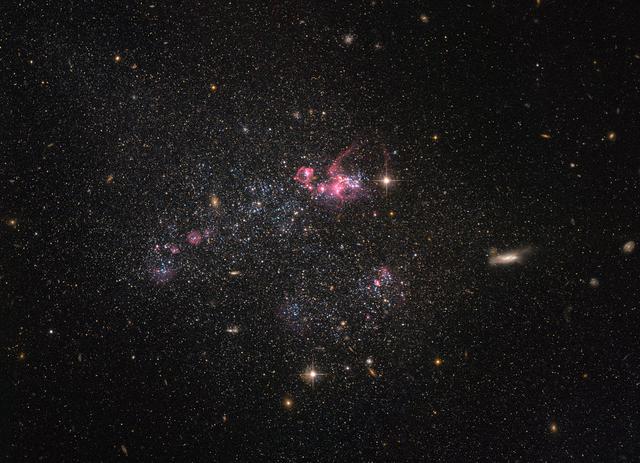
M81 Bode Galaxy in Ursa Major photographed by the NASA ESA Hubble Space Telescope showing grand spiral structure

M81 (Bode Galaxy) — NASA/ESA Hubble Space Telescope

M81 at 12 million light-years is the nearest and brightest galaxy in Ursa Major. Amateur observers see an oval glow brightening toward the core; larger apertures reveal a brightness gradient and subtle mottling. Credit: NASA, ESA, and the Hubble Heritage Team.

Light Pollution Guide for Ursa Major Galaxy Targets

Galaxy targets in Ursa Major are sensitive to sky brightness. Here is what to realistically expect from each Bortle class:

Bortle 8–9 — City Center

M81 and M82 very difficult or impossible. Mizar/Alcor double star, Big Dipper pointer practice, and planetary/lunar observing remain productive.

Bortle 6–7 — Suburb

M81 detectable as a faint oval in 100mm+. M82 difficult. Most productive for double stars, the Moon, and planets before switching to galaxies.

Bortle 4–5 — Rural-Suburban

M81 and M82 clear with 80mm+; M101 visible with 150mm+; M97 Owl Nebula detectable. The best realistic home-observatory target zone.

Bortle 1–3 — True Dark Sky

Full Messier list accessible. M101 spiral hints, M82 dark lanes, M108/M109 structural detail. Galaxy hunting at its best.

Use lightpollutionmap.info to find your local Bortle class. Our Indianapolis Stargazing Guide shows how to make the most of Bortle 7 suburban skies.

Best Telescopes for Ursa Major

Three specific telescope picks, one for each aperture tier. Each unlocks a different level of Ursa Major detail — from the Mizar double star and the M81/M82 galaxy pair up to M101 spiral hints and M82 dark lanes.

Editor’s Pick — Best Entry Telescope
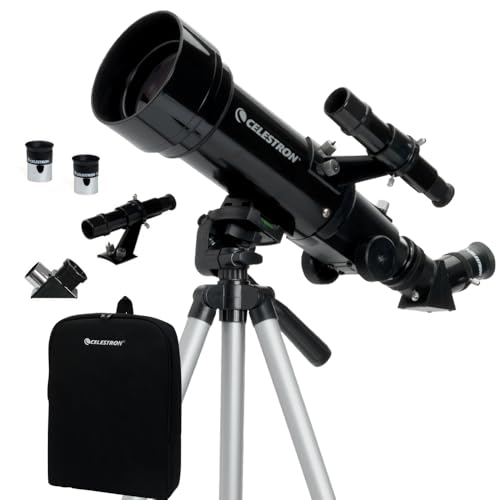
Celestron Travel Scope 70mm refractor telescope — best entry telescope for Ursa Major

Celestron Travel Scope 70mm Refractor

70mm aperture 400mm focal length f/5.7 wide-field Budget-friendly

The ideal first telescope for Ursa Major. The short 400mm focal length delivers a wide field of view at low power so M81 and M82 both appear in the same eyepiece field right away. At 50× with the included 8mm eyepiece, Mizar splits cleanly into its A and B components. Compact and tripod-ready — you can be observing within five minutes.

What you’ll see: M81 as a faint oval glow (Bortle 4–5 required); M82 as a sliver beside it; Mizar double perfectly split; the full Big Dipper in a low-power wide-field sweep.

Why we picked it: Short focal length is rare at this price. Both M81 & M82 in one view from night one — no star-hopping frustration for new observers.

View on Amazon See all beginner picks →

Affiliate link — we may earn a small commission at no extra cost to you.

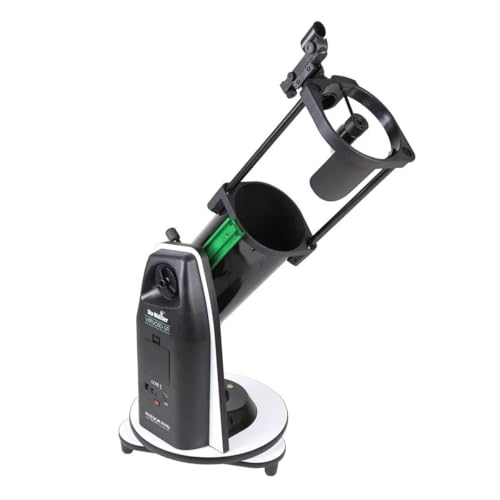
Sky-Watcher Virtuoso GTi 130P tabletop GoTo Dobsonian telescope — best mid-aperture telescope for M81 M82

Sky-Watcher Virtuoso GTi 130P Tabletop GoTo Dobsonian — Best mid-aperture pick

130mm aperture 650mm f/5 focal length Built-in Wi-Fi GoTo SynScan app control Collapsible tube

The sweet spot for Ursa Major galaxy work, and a big step up from a basic 130mm because of its built-in Wi-Fi GoTo. Point your phone, tap M81, and the Virtuoso GTi slews automatically — no manual star-hopping required. The 130mm f/5 parabolic mirror gathers 3.5× more light than a 70mm, making M82’s elongated cigar shape clearly visible alongside M81 from Bortle 4–5 skies. The Freedom Find™ dual-encoder system lets you move the scope manually without losing alignment — critical when chasing faint targets.

What you’ll see: M82 as a distinct elongated sliver with M81 glowing beside it; M97 Owl Nebula as a small disk; M108 in the same low-power field; M101 detectable from darker Bortle 4 sites. The GoTo database includes all 7 Ursa Major Messier objects.

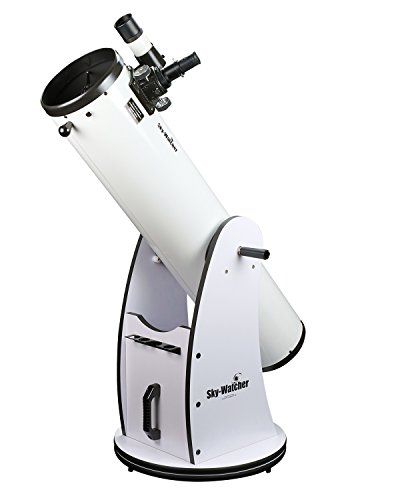
Sky-Watcher Classic 200P 8-inch Dobsonian telescope — best telescope for Ursa Major deep-sky objects

Sky-Watcher Classic 200P Dobsonian (8″) — Best for serious deep-sky

203mm aperture 1200mm focal length 2-inch focuser Push-to Dobsonian

The premium all-around tool for Ursa Major. Eight inches of aperture is the threshold where M82 dark dust lanes become visible under good seeing from Bortle 4. M101 reveals spiral-structure hints from Bortle 3. At 150× the full 7-object Messier list is accessible in a single session, and M81’s core-to-halo brightness gradient is obvious. The 2-inch focuser accepts wide-field eyepieces for rich star fields across the entire constellation.

Trade-off: Heavier and bulkier than the 130P. Requires collimation check every few sessions. But for Ursa Major’s galaxy targets, this is where the real detail starts. See all 8-inch Dobsonian picks →

Not sure which aperture is right for you?

Answer 3 quick questions in our free Telescope Finder Tool and get a personalized recommendation matched to your budget, sky conditions, and observing goals.

Prices and availability subject to change. All product links are affiliate links — see our editorial standards for our review process.

FAQ: Ursa Major

Is the Big Dipper the same as Ursa Major?

No. The Big Dipper is an asterism — an informal star pattern formed by seven of Ursa Major’s brightest stars. Ursa Major is the full IAU constellation, covering 1,280 square degrees and containing dozens of stars and deep-sky objects beyond the Dipper.

Is Ursa Major visible year-round from the US?

Yes, for latitudes above about 40° N. Ursa Major is circumpolar and never fully sets. At southern US latitudes (below 35° N) the lower stars briefly touch the northern horizon in autumn, but the constellation is observable most of the year.

What is the brightest star in Ursa Major?

Alioth (ε Ursae Majoris) at magnitude 1.77, located at the base of the Big Dipper handle approximately 82.6 light-years from Earth.

Can I see M81 with a small telescope?

Yes. A 70mm refractor will detect M81 as a faint oval glow from Bortle 4–5 or darker skies. A 100mm scope shows the bright compact core. A 150mm or larger aperture reveals a clear brightness gradient from core to halo. M82 sits just 0.6° away in the same low-power field.

What is Mizar and Alcor?

Mizar is the second star from the Big Dipper handle tip. Alcor is a fainter companion (magnitude 3.99) visible to the naked eye nearby — a traditional eyesight test. In any telescope at 50×, Mizar splits into two matching white stars (Mizar A and B, 14.4 arcseconds apart), one of the finest beginner double stars.

When is the best time to observe Ursa Major?

Spring — March through May — when Ursa Major is highest in the north during evening hours. Culmination is near 10–11 PM in April. Observe near new moon for darkest galaxy skies.

What does Ursa Major mean?

Ursa Major is Latin for Great Bear (pronounced oor-suh MAY-jer). The name refers to the bear-shaped constellation pattern catalogued since antiquity. In English, Ursa Major is sometimes called the Great Bear or the Big Bear. Its IAU abbreviation is UMa, and it is the third-largest constellation in the sky at 1,280 square degrees.

What is Ursa Major’s nickname?

Ursa Major is nicknamed the Great Bear. The most famous part of the constellation — the seven brightest stars — carries its own popular nickname, the Big Dipper (in the US) or the Plough (in the UK). The constellation also includes Ursa Minor (the Little Bear, representing Callisto’s son Arcas in Greek mythology) as its smaller neighbour.

What are some fast facts about Ursa Major?

Key Ursa Major facts: (1) 3rd-largest constellation at 1,280 sq deg; (2) contains 7 Messier objects including M81 and M82 galaxies; (3) circumpolar from latitudes above ~40° N (visible year-round); (4) brightest star is Alioth at magnitude 1.77; (5) IAU abbreviation UMa; (6) Big Dipper pointer stars Dubhe and Merak point to Polaris; (7) recognized by every major ancient culture independently for at least 13,000 years.

What telescope is best for M81 and M82?

A 130–150mm reflector under Bortle 4 or darker skies is excellent. An 8-inch Dobsonian is the top all-around value choice. See our Best Dobsonian Telescopes guide for specific models and prices.

Related Guides