Telescope Advisor Logo Telescope Advisor
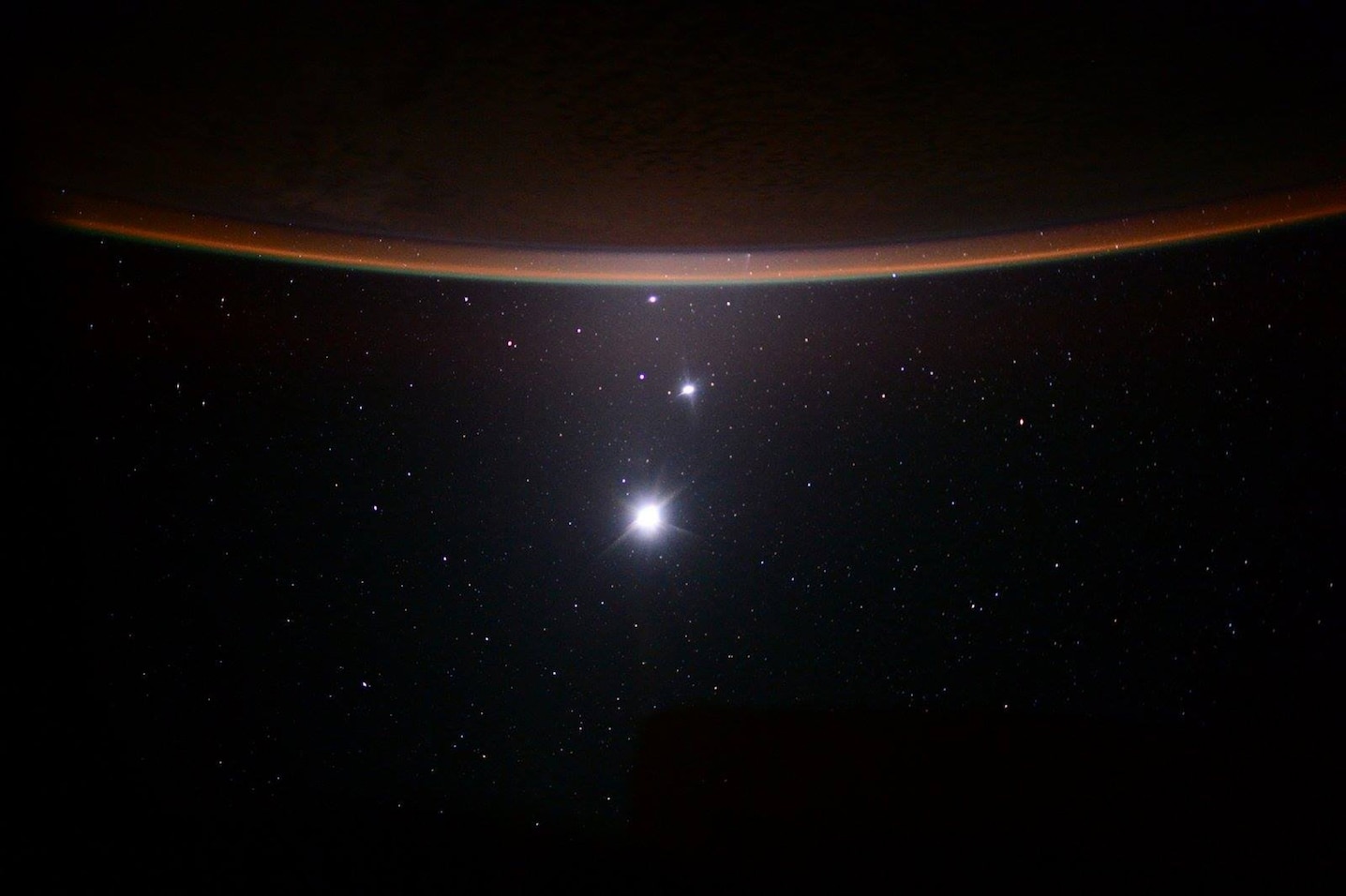
Crescent Earth above the Moon, Venus and Jupiter aligned in space — photographed from the International Space Station by NASA astronaut Scott Kelly, July 19, 2015

Sky Event Guide · June 2026

Venus–Jupiter Conjunction June 9, 2026: Which Binoculars and Telescope Show Both Planets Together?

Two of the brightest planets in the sky pass within ~1.5° of each other on June 9 — close enough to fit in a single binocular field. Most guides stop at "look west after sunset." We give you the exact gear that fits both planets in one view and reveals Venus's half-phase and Jupiter's four moons.

Date of closest approachJune 9, 2026
Separation~1.5° (3 lunar diameters)
Where to lookWNW horizon, ~30 min after sunset
Best tool10×50 or 15×70 binoculars
By Telescope Advisor Editorial Team Published: Updated: Editorial Standards

Quick Answer: What's the Best Way to See Venus and Jupiter Together on June 9, 2026?

Use 10×50 binoculars — they are the single best tool for this event. At 1.5° apart, Venus and Jupiter fit easily inside a 5–7° binocular field of view, and 10× magnification is enough to clearly resolve Jupiter's four Galilean moons (Io, Europa, Ganymede, Callisto) as bright pinpricks beside the planet. Venus appears as a brilliant, blazing point. No telescope required. No tripod required.

If you want a telescope view of both planets in the same eyepiece, you need a short-focal-length wide-field instrument — a 70–80mm refractor with a low-power eyepiece. Most computerized GoTo scopes (NexStar 8SE, SCTs) and high-magnification planetary scopes cannot frame both planets simultaneously because their fields of view are too narrow. We recommend the Celestron Travel Scope 70mm for the best telescope experience of this specific event.

If you want to see Venus's half-phase and Jupiter's cloud bands, switch your telescope to higher magnification (40×–80×) and observe each planet individually. Venus shows a clean ~49% illuminated half-phase (just past greatest elongation on June 5); Jupiter shows a small but identifiable disk with two darker equatorial belts.

Naked eye

Spectacular — two of the three brightest objects in the night sky paired close together. Venus blazes at magnitude −4.2; Jupiter at magnitude −1.7. Visible from any sky, urban or rural.

Binoculars (best tool)

Both planets fit in one view with Jupiter's four Galilean moons resolved. Wide field, fast setup, and brings out the color contrast between the two planets.

Telescope (deep dive)

Wide-field refractor at low power = both planets in one view. High power on each individually = Venus's half-phase + Jupiter's belts & moons. Best planetary telescopes →

What Is the Venus–Jupiter Conjunction of June 9, 2026?

A planetary conjunction occurs when two planets appear close together in our sky — not because they are physically near each other in space (Venus is ~80 million km from Earth in early June 2026; Jupiter is over 900 million km away), but because our line of sight crosses both at nearly the same angle.

June 2026 produces an unusually photogenic Venus–Jupiter pairing for two converging reasons:

  • Venus is at greatest eastern elongation on June 5, 2026 — its farthest apparent angular distance east of the Sun (~46°). This makes it the dazzling "evening star" at peak prominence and visibility, blazing at magnitude −4.2.
  • Jupiter is approaching its June 24, 2026 solar conjunction — meaning Jupiter is sliding lower and lower in the western evening sky each night, fading from view as it nears the Sun's glare. In its final weeks of evening visibility, Jupiter passes close to Venus.

The result: in the days around June 9, 2026, both planets appear within roughly 1.5° of each other in the WNW twilight — about three lunar diameters apart, easily framed together in any binoculars. This is the closest the two will come in the evening sky in 2026, and one of the year's signature naked-eye sky events.

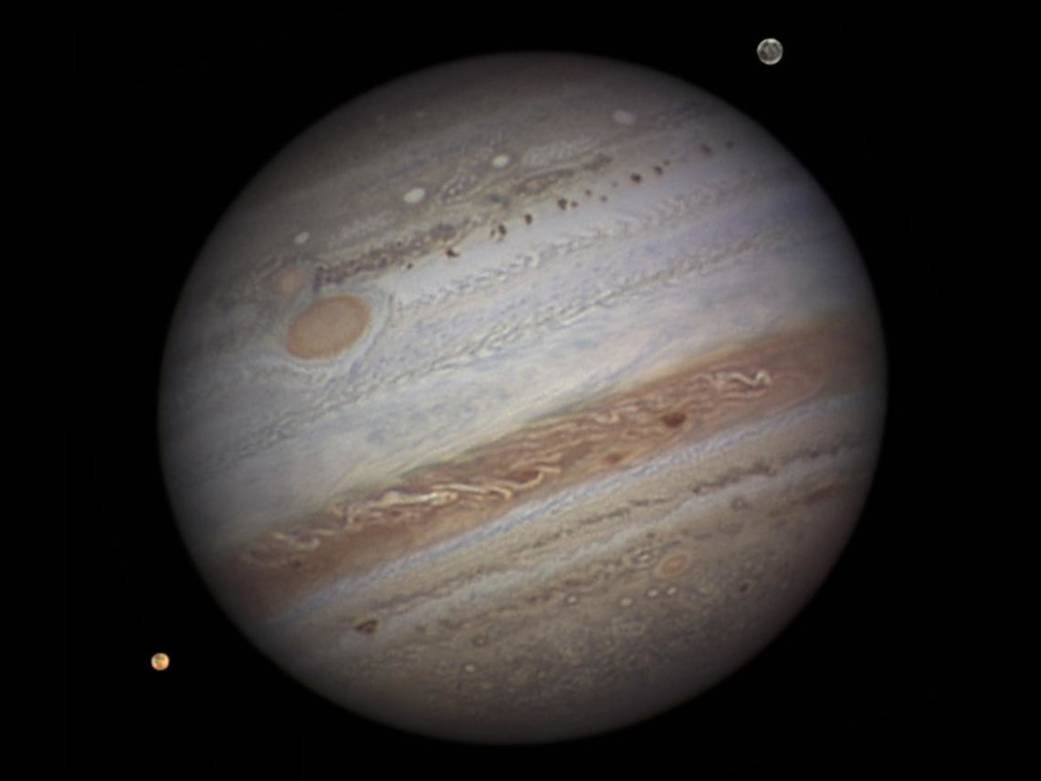
Jupiter photographed from a ground-based telescope — its cloud bands and Galilean moons visible

Jupiter — Cloud Bands and Galilean Moons

Jupiter's four Galilean moons — Io, Europa, Ganymede, Callisto — are easily resolved in 10× binoculars. On June 9, 2026, they will appear as a tiny line of bright dots beside the planet's disk. Credit: NASA / amateur reference image.

Conjunction Fast Facts

Date of closest approachJune 9, 2026
Minimum separation~1.5° (≈3 lunar widths)
Venus magnitude−4.2 (brightest evening "star")
Jupiter magnitude−1.7
Venus phase~49% illuminated (half-phase)
Where to lookWNW, low above horizon
Altitude at nautical twilight~10–15° (mid-northern lat.)
Visible window~30–60 min after sunset
Moon phase June 9Waning crescent (set, not visible)

June 2026 Event Timeline: Watch Them Approach, Pair, and Separate

The conjunction is not a single-night event. The two planets are visibly converging for over a week before June 9 and visibly separating for several nights after. Anyone with even a passing interest in the sky will notice them moving night after night.

Date (2026) Approx. Separation What's Happening
June 1 ~7° Venus high in the WNW, Jupiter lower and to its right. Easy naked-eye pair.
June 5 ~4° Venus reaches greatest eastern elongation — at its farthest angular distance from the Sun. Half-phase (dichotomy).
June 7 ~2.5° Both planets fit comfortably in a 7×50 or 10×50 binocular field. Begin photographing.
June 9 (peak) ~1.5° Closest approach. Both planets fit in a single low-power telescope eyepiece. Best photography night.
June 11 ~2.5° Pair beginning to separate. Jupiter sliding lower as it heads toward solar conjunction.
June 14 ~5° New Moon (won't interfere with viewing). Jupiter increasingly difficult — close to horizon at twilight.
June 17 ~7° Bonus event: Daytime lunar occultation of Venus across the entire US (~3:45 PM EDT) — a rare daylight event for binocular and telescope observers.
June 24 Jupiter at solar conjunction — no longer visible from Earth. Venus continues as evening star.

Don't wait until June 9 — start watching now

Cloud-out insurance is essential for any single-night event. The pair is photogenic from June 5 through June 12 — eight consecutive evenings where Venus and Jupiter are within roughly a binocular field of each other. If June 9 is overcast where you are, June 7, 8, 10, or 11 will look almost identical to the naked eye.

The Field-of-View Math: Will Both Planets Actually Fit in Your View?

This is the question every other guide skips. Whether both planets fit in a single eyepiece view depends entirely on your instrument's true field of view (TFOV). The math is simple:

TFOV (degrees) = Apparent Field of View (eyepiece) ÷ Magnification
Magnification = Telescope Focal Length ÷ Eyepiece Focal Length

For both planets at ~1.5° separation to fit in your view with breathing room, you need a TFOV of at least . Here's how common instruments compare:

Instrument Setup Mag. TFOV Fits both planets?
7×50 binoculars Stock ~7.2° Easily — huge margin
10×50 binoculars Stock 10× ~6.5° Easily — Jupiter's moons visible
15×70 binoculars Stock (tripod recommended) 15× ~4.4° Easily — best detail/wide-field combo
70mm refractor (400mm focal) 20mm Plössl (50° AFOV) 20× ~2.5° Yes — comfortable framing
8" Dobsonian (1200mm focal) 2" 32mm wide-field (70° AFOV) 37× ~1.87° Tight — fits with little margin
8" Dobsonian (1200mm focal) 1.25" 32mm Plössl (50° AFOV) 37× ~1.33° No — too narrow
5" SCT / NexStar 5SE (1250mm) 25mm Plössl (50° AFOV) 50× ~1.0° No — too narrow
8" SCT / NexStar 8SE (2030mm) 40mm Plössl (50° AFOV) 51× ~1.0° No — too narrow

Why short refractors and binoculars win

A short focal length (400–500mm) divided by a low-power eyepiece gives modest magnification with a wide TFOV. This is the only telescope geometry that fits both planets at once with comfortable margin.

Why long-focal-length scopes lose

A 2000mm Schmidt-Cassegrain pointed at the conjunction shows you exactly one planet, beautifully detailed, with the other off-screen. SCTs and Maks are excellent for inspecting Venus's phase or Jupiter's bands one at a time — but they cannot frame the pair.

Best Binoculars for the Venus–Jupiter Conjunction

For this specific event, binoculars beat every telescope under $1,000. They frame both planets with margin, resolve Jupiter's four Galilean moons, are ready in seconds, and travel anywhere. These three picks cover three different observer profiles.

Editor's Pick — Best for This Event
Celestron SkyMaster 15x70 binoculars — best binoculars for the Venus Jupiter conjunction

Celestron SkyMaster 15×70 Binoculars

15× magnification 70mm objective ~4.4° FOV Tripod-compatible

The single best instrument for this event. 15× magnification clearly resolves Jupiter's four Galilean moons as separate pinpricks beside the planet's disk, and at 4.4° true field of view both Venus and Jupiter sit comfortably in the same image with substantial breathing room. The 70mm objectives gather enough light to keep the planets dazzling against the deep twilight blue. The standard tripod-adapter port (1/4-inch thread) lets you mount these on any photographic tripod for rock-steady viewing — strongly recommended at 15×.

What you'll see: Venus as a brilliant blue-white blaze; Jupiter with a tiny but distinct disk; two to four Galilean moons in a near-straight line beside Jupiter (depending on their orbital positions that night). The contrast and tonal range is genuinely beautiful.

View on Amazon

Affiliate link — we may earn a small commission at no extra cost to you.

Celestron UpClose G2 10x50 binoculars — handheld binoculars for Venus Jupiter conjunction

Celestron UpClose G2 10×50 Binoculars — Best handheld pick

10× magnification 50mm objective ~6.5° FOV Truly handheld

The classic 10×50 is the all-purpose astronomy binocular — and 10× is the upper limit of comfortable handheld magnification for most adults. Both planets fit with massive room to spare in the 6.5° field, and Jupiter's brightest Galilean moons (typically Ganymede and Callisto on most nights) are visible as faint pinpoints. The lighter weight makes them ideal if you don't want to deal with a tripod, and they double as your primary binocular for every other sky event of the year.

Trade-off vs the 15×70: Slightly fewer Galilean moons resolved (smaller aperture gathers less light, lower magnification means tighter angular resolution), but vastly easier to grab and use without setup.

View on Amazon

Affiliate link.

Nikon Aculon A211 7x50 binoculars — wide field binoculars for Venus Jupiter conjunction

Nikon Aculon A211 7×50 Binoculars — Brightest, most stable handheld

7× magnification 50mm objective ~7.2° FOV 7.1mm exit pupil

The 7×50 was historically the standard astronomy binocular for a reason: 7× is rock-steady handheld even with shaky hands, the 7.1mm exit pupil maximizes the light reaching your eye in twilight, and the 7.2° field encompasses huge swathes of sky. For older observers, those with hand tremor, or anyone who prizes a relaxed view, this is the easiest pair of binoculars to point at the planets and just see. Jupiter's Galilean moons appear as a tight cluster rather than fully separate pinpricks, but the planet pair is dazzlingly framed against the entire WNW twilight gradient.

View on Amazon

Affiliate link.

Prices and availability subject to change. All product links are affiliate links — see our editorial standards for our review process.

Best Telescopes for the Venus–Jupiter Conjunction

If you already own or want a telescope for this event, the right choice is dictated entirely by focal length and the eyepiece you pair with it. A short refractor at low power is the only telescope geometry that frames both planets together with margin. A larger aperture instrument is the right choice if you'd rather observe each planet in detail, one at a time.

Editor's Pick — Best Telescope for This Event
Celestron Travel Scope 70mm — wide field refractor for Venus Jupiter conjunction

Celestron Travel Scope 70mm

70mm aperture 400mm focal length ~2.5° TFOV at 20× Budget-friendly

The short focal length (400mm, f/5.7) is exactly what this event demands. With the included 20mm eyepiece you get 20× magnification and a generous ~2.5° true field of view — both planets sit comfortably in one frame with margin to spare. Then swap to the included 10mm eyepiece for 40× and observe each planet individually: Venus's clean half-phase shows clearly, and Jupiter's two main equatorial belts become visible along with all four Galilean moons. The included tripod and aluminum case mean you can be observing within five minutes of opening the box.

Why we picked it: The only sub-$200 telescope whose native focal length actually fits both planets in a single eyepiece view. Dual-purpose: low power for the pair, high power for individual planet detail.

Sky-Watcher Classic 200P 8 inch Dobsonian telescope — high detail planetary views

Sky-Watcher Classic 200P Dobsonian (8-inch) — Best for planet detail

203mm aperture 1200mm focal length 2" focuser Push-to mount

If you'd rather observe each planet in serious detail than frame them together, the 200P delivers — with an important caveat. To fit both planets in a single eyepiece, you need a 2-inch wide-field eyepiece (a 32mm 70° AFOV gives ~37× and ~1.87° TFOV — just enough). The supplied 1.25" eyepieces won't get there. With a wide-field eyepiece installed, both planets fit, and the 8 inches of aperture deliver dazzling brightness.

Where this scope shines is on each planet individually at 120–200×: Venus's terminator (the day–night boundary) is razor-sharp at half-phase, and Jupiter shows two to four cloud belts plus subtle festoons in the equatorial zone. The four Galilean moons appear as obvious disks rather than points. See all Dobsonian picks →

View on Amazon

Affiliate link.

A note on Schmidt-Cassegrain and high-magnification telescopes

If you own a long-focal-length scope (Celestron NexStar 5SE, 6SE, or 8SE; any 8" SCT; Maksutov-Cassegrains), accept that you will not fit both planets in one eyepiece, and that's fine — these are superb instruments for inspecting Venus's phase and Jupiter's belts individually. Use binoculars for the wide pair, then swing the SCT onto each planet at 100–200× for the detail. Best of both worlds.

What You'll Actually See on June 9, 2026

Different instruments reveal different details. Here is exactly what to expect at each magnification level — based on the actual physics of the planets that night, not vague "look up after sunset" copy.

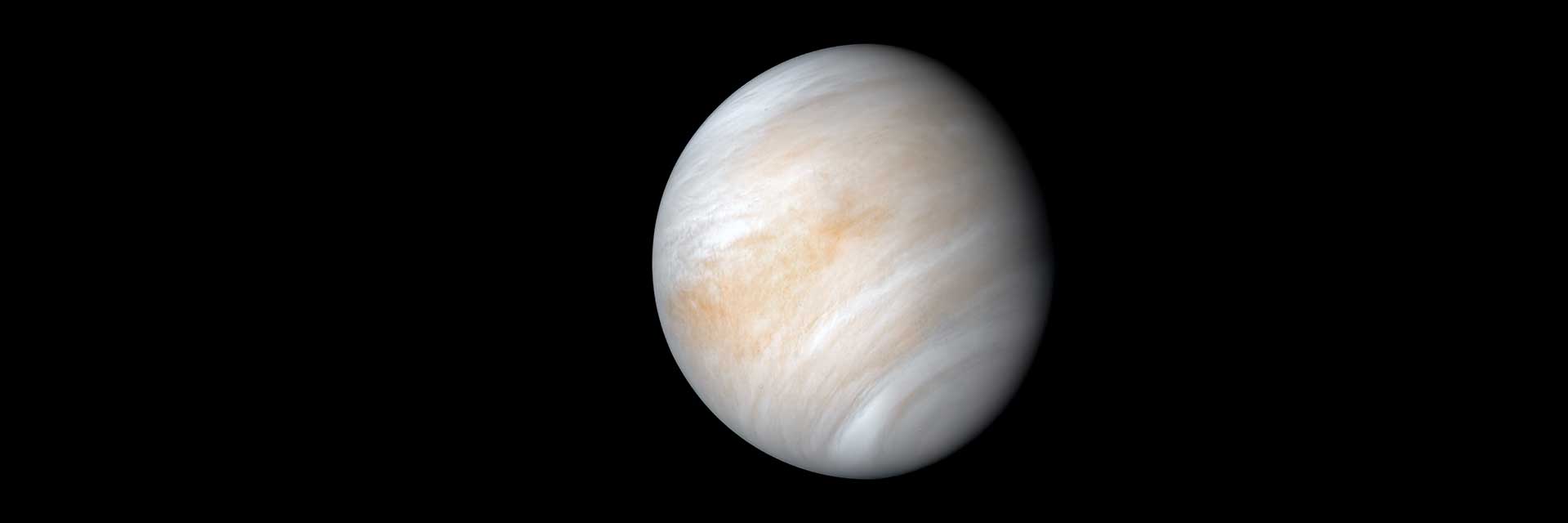
Venus reference image showing phase — Venus appears at half phase on June 9, 2026

Venus at ~49% Illumination — Half Phase

On June 9, 2026, Venus shows a clean half-phase (called dichotomy), four days past greatest eastern elongation. Through any telescope at 40× or higher, the terminator — the boundary between day and night sides — is razor-sharp. Credit: NASA.

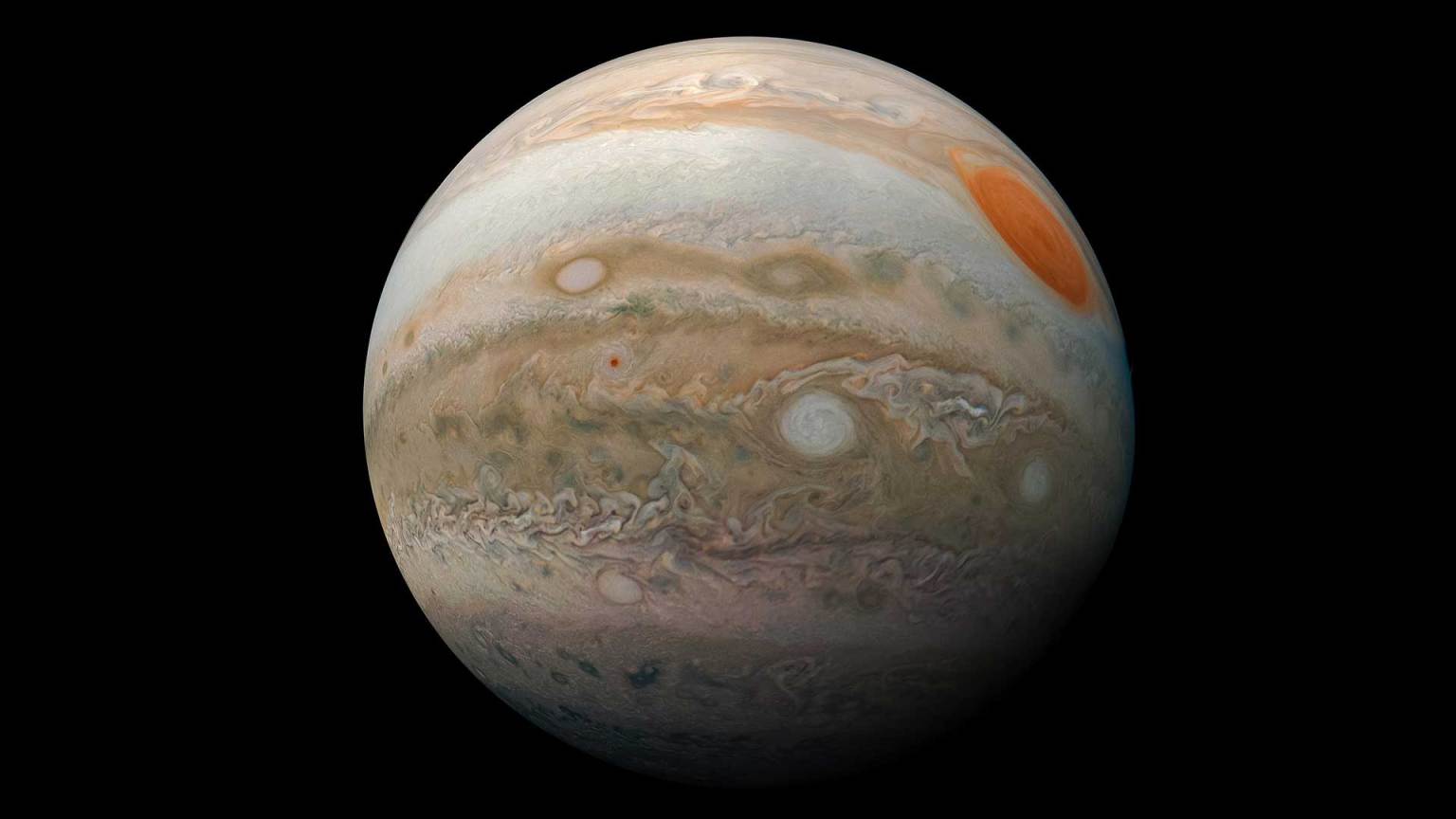
Jupiter reference image showing equatorial cloud bands and Great Red Spot

Jupiter — Cloud Bands and Galilean Moons

On June 9, 2026, Jupiter is small and dim by Jovian standards (mag −1.7) because it's nearing solar conjunction. But its two main equatorial belts and four moons are still visible in any telescope above 40×. Credit: NASA / Hubble.

Instrument / Magnification Venus appearance Jupiter appearance Both in one view?
Naked eye (1×) Brilliant blue-white "star" — unmistakably bright Bright cream-white "star" — a few degrees from Venus Yes
7×–10× binoculars Brilliant disk; phase not yet resolved Tiny but distinct disk; 2–4 Galilean moons visible Yes
15×70 binoculars Disk obvious; phase becoming hintable Disk clearly resolved; all 4 moons visible (positions vary) Yes
Telescope at 20× Phase visible — half-illuminated disk Disk obvious; 4 Galilean moons sharp Yes (short refractor)
Telescope at 40–80× Beautiful sharp half-phase; subtle cloud markings (rare) Two equatorial belts visible; moons as small disks Tight or no
Telescope at 100–200× Stunning half-phase, terminator razor-sharp Multiple cloud belts, festoons; moons clearly disks No (one at a time)

A note on Jupiter's relative dimness

Don't expect Jupiter to look "normal" on June 9, 2026. With Jupiter only about two weeks from solar conjunction, it sits low in twilight and is significantly dimmer than at opposition. Cloud-band detail will be subtle — atmospheric turbulence near the horizon also blurs the view. The 4 Galilean moons remain easy targets in any binoculars, but for crisp belt detail, use a short refractor and observe within the first 30–45 minutes after sunset before Jupiter sinks too low.

Viewing Times by US Region — June 9, 2026

Because both planets are setting in the WNW shortly after sunset, your viewing window is short — typically only 45–75 minutes, ending when Jupiter dips below ~5° altitude where horizon haze and obstructions take over.

US City Sunset (June 9) Best Viewing Window Pair sets in WNW
New York, NY ~8:25 PM EDT 8:55 PM – 10:00 PM ~10:30 PM
Atlanta, GA ~8:45 PM EDT 9:15 PM – 10:15 PM ~10:45 PM
Chicago, IL ~8:25 PM CDT 8:55 PM – 10:00 PM ~10:30 PM
Dallas, TX ~8:35 PM CDT 9:05 PM – 10:05 PM ~10:30 PM
Denver, CO ~8:25 PM MDT 8:55 PM – 10:00 PM ~10:30 PM
Phoenix, AZ ~7:40 PM MST 8:10 PM – 9:10 PM ~9:35 PM
Los Angeles, CA ~8:00 PM PDT 8:30 PM – 9:30 PM ~10:00 PM
Seattle, WA ~9:05 PM PDT 9:35 PM – 10:35 PM ~11:00 PM

Times are approximate and assume an unobstructed western horizon. Use a planetarium app (Stellarium, SkySafari) for your exact location. Window opens once the sky darkens enough to make Jupiter (mag −1.7) visible — typically 25–35 minutes after sunset — and closes when Jupiter sinks below ~5° altitude in the WNW horizon haze.

Site selection: an unobstructed western horizon is everything

Both planets will be only 5–15° above the horizon during the viewing window. This means buildings, trees, and even gentle hills to your west will block them entirely. Scout your location during daylight on June 8 — anywhere with a clear view to the WNW (e.g., a rooftop, lakeshore, hilltop, or open field) will work. Beach observers along the West Coast and Gulf Coast have ideal natural geometry.

How to Photograph the Venus–Jupiter Conjunction

A close planetary conjunction with both planets at high brightness in residual twilight is one of the easier celestial events to photograph well — even with a smartphone.

Smartphone (any modern phone)

  • ✓ Use Night Mode (or "Pro" mode if available)
  • ✓ ISO 400–800, 2–6 second exposure
  • ✓ Tap to focus on Venus, then lock focus
  • ✓ Use a small tripod or rest on a wall — handheld will blur
  • ✓ Include a foreground (tree, building) for scale and composition

DSLR / Mirrorless on tripod

  • ✓ 35–85mm lens for landscape framing; 200mm+ for tight pair
  • ✓ ISO 400, f/4 or wider, 1–2 second exposure
  • ✓ Use 2-second shutter delay or remote trigger
  • ✓ Manual focus on Venus at infinity using live view
  • ✓ Bracket exposures to capture both bright planets and twilight color

Through binoculars / telescope (afocal)

  • ✓ Hold phone camera lens against eyepiece — Night Mode 1–3 sec
  • ✓ A smartphone-to-eyepiece adapter ($15–25) gives much better results
  • ✓ Both planets fit in a binocular afocal shot — Galilean moons may register
  • ✓ Shoot multiple frames; pick the sharpest
Composition tip: The most striking conjunction photographs include both planets and a recognizable foreground (silhouetted treeline, distant mountain, city skyline). Twilight blue gradient + bright planets + dark foreground = a postcard-quality image. Shoot 25–40 minutes after sunset for the best balance of dark sky and visible foreground detail.

Venus–Jupiter Conjunction June 2026 — FAQ

When is the closest approach of Venus and Jupiter in June 2026?

The closest approach occurs on the evening of June 9, 2026, when Venus and Jupiter pass within approximately 1.5° of each other — about three lunar diameters. The pair is photogenic from June 5 (when Venus reaches greatest eastern elongation) through approximately June 12, with Jupiter sliding lower in the sky each night as it heads toward solar conjunction on June 24.

Where do I look to see the Venus–Jupiter conjunction?

Look toward the west-northwest (WNW) horizon roughly 30 minutes after sunset. Both planets will be low — typically 10–15° above the horizon at the start of the viewing window, sinking lower over the next hour. An unobstructed western horizon (free of buildings, hills, or trees) is essential. Venus is the brighter of the two and will be the easier "first find" — Jupiter will be just below and slightly to the right (north) on June 9.

Do I need a telescope to see the Venus–Jupiter conjunction?

No. Both planets are easily visible to the naked eye — Venus is the third-brightest object in the sky after the Sun and Moon, and Jupiter is the fourth. The conjunction itself is a naked-eye spectacle from any location, urban or rural. Binoculars dramatically improve the experience, however, by fitting both planets in one view while resolving Jupiter's four Galilean moons. A telescope is optional and best used for inspecting each planet individually at higher magnification — Venus's half-phase and Jupiter's cloud bands.

What binoculars are best for the Venus–Jupiter conjunction?

For this specific event, the Celestron SkyMaster 15×70 is our top pick — 15× magnification clearly separates Jupiter's four Galilean moons from the planet's disk, and the 4.4° field of view fits both planets with margin. For handheld use without a tripod, the Celestron UpClose G2 10×50 is the classic all-rounder. For maximum brightness and stability, the Nikon Aculon A211 7×50 offers a 7.2° field that frames the entire scene against the WNW twilight gradient.

Can I see both Venus and Jupiter in the same telescope eyepiece?

Yes — but only with a short focal length telescope and a low-power eyepiece. At a 1.5° separation, you need a true field of view of at least 2° for comfortable framing. A 70mm refractor with 400mm focal length and a 20mm eyepiece delivers ~2.5° TFOV and frames both planets cleanly. By contrast, a Schmidt-Cassegrain (NexStar 8SE, etc.) with focal length ~2000mm cannot fit both planets in a single eyepiece. Our recommendation for this event: the Celestron Travel Scope 70mm, which has the right focal length out of the box.

What phase is Venus during the June 2026 conjunction?

On June 9, 2026, Venus appears approximately 49% illuminated — a clean half-phase known as "dichotomy." This is because Venus is just four days past its greatest eastern elongation on June 5 (when it sits at its farthest apparent angular distance from the Sun, ~46°). In any telescope at 40× or higher, the half-phase is unmistakable, with a razor-sharp terminator separating the day and night sides. In the weeks after June 9, Venus's phase shrinks toward a thin crescent as it swings between Earth and the Sun on its way to inferior conjunction.

Can I see Jupiter's four moons during the conjunction?

Yes — Jupiter's four Galilean moons (Io, Europa, Ganymede, Callisto) are visible in any binoculars 7× or higher and in any telescope. The number visible on any given night depends on their orbital positions — sometimes all four are spread on either side of Jupiter, sometimes one or two are in front of (transiting) or behind (occulted by) the planet. Use a free planetarium app like Stellarium to predict the exact moon configuration for June 9, 2026.

Why is Jupiter dimmer than usual during this conjunction?

Jupiter is approximately two weeks away from solar conjunction on June 24, 2026 — the date when it passes behind the Sun from Earth's perspective. As Jupiter approaches solar conjunction, it sinks lower in the western evening sky, sits in brighter twilight, and is at its greatest distance from Earth. All three factors reduce its apparent brightness to magnitude −1.7 (compared to −2.5 to −2.9 at opposition). It's still very bright by ordinary standards — only Venus, the Moon, and the Sun outshine it — but it lacks the dazzling impact it has at opposition.

Will the Moon affect viewing on June 9, 2026?

No. New Moon falls on June 14, 2026, so on June 9 the Moon is a thin waning crescent that has already set well before sunset. The Moon will not interfere with the western twilight at any point during the viewing window.

Can the Venus–Jupiter conjunction be seen from urban areas?

Yes — fully. Venus (mag −4.2) and Jupiter (mag −1.7) are bright enough to punch through any level of light pollution, including the brightest downtown city centers. As long as your western horizon is unobstructed by buildings or trees, you can observe this event from a New York rooftop or a Phoenix parking lot just as easily as from a dark rural site. Light pollution does not dim planets — it only washes out faint deep-sky objects.

When is the next Venus–Jupiter conjunction after June 2026?

Venus–Jupiter conjunctions occur roughly once a year as the two planets repeatedly lap each other along the ecliptic. The next notably close pairing after June 9, 2026, occurs in August 2027, when the two planets again pass within ~1° in the morning sky. The June 2026 event is the closer evening-sky conjunction of the two.

Related Guides