Saturn Opposition 2026: October 4 Viewing Guide — Best Night of the Year
Telescope Advisor Logo Telescope Advisor
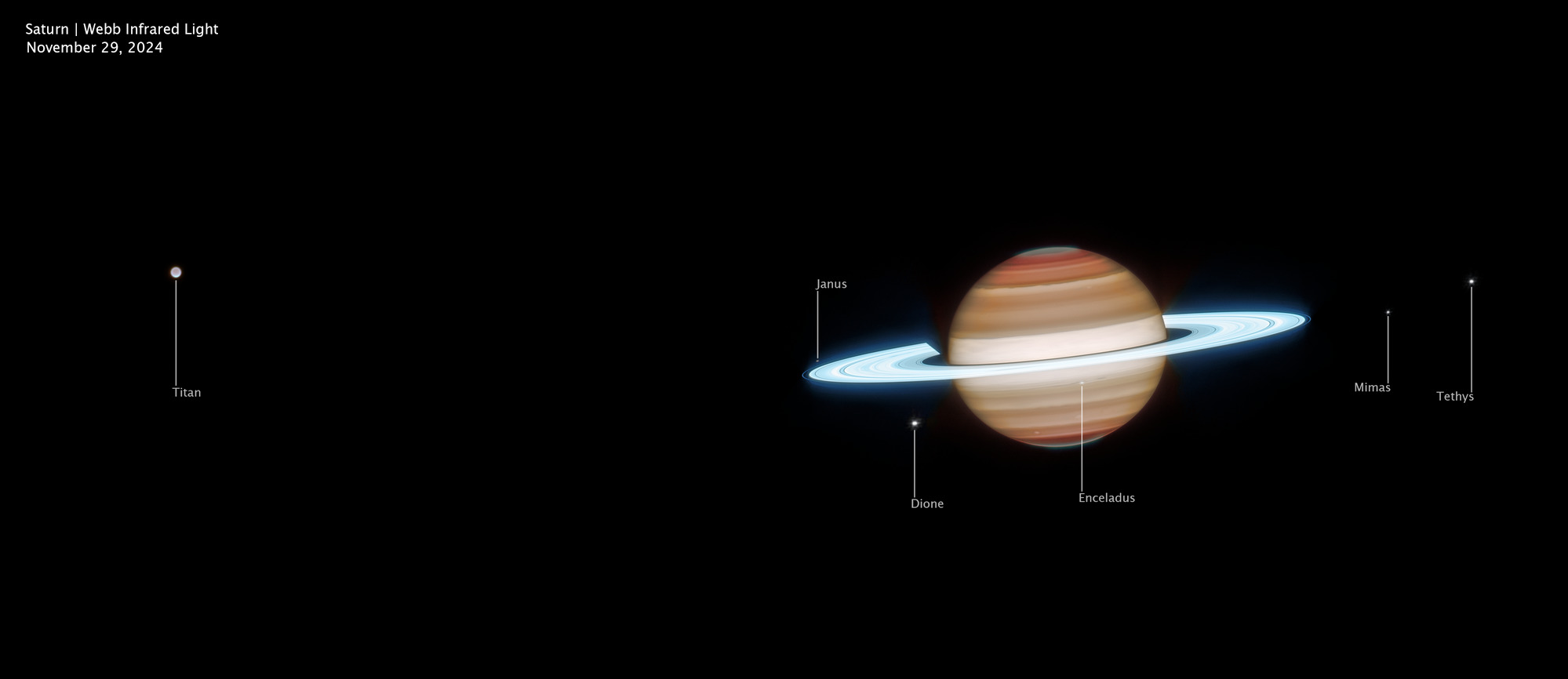
Saturn and its moons captured in near-infrared by NASA's James Webb Space Telescope, showing the ring system and multiple moons

Saturn Opposition Guide · October 2026

Saturn Opposition 2026: October 4 Is the Best Night of the Year

Earth passes directly between the Sun and Saturn on October 4, 2026. Saturn rises at sunset, shines at magnitude 0.3 all night, and reveals its returning ring system at 7.5° tilt. Here’s exactly what you need to make the most of it.

Oct 4, 2026

Opposition date

0.3

Magnitude (very bright)

7.5°

Ring tilt — rings returning

All night

Rises at sunset, sets at sunrise

By Telescope Advisor Editorial Team Published: Updated: Editorial Standards

Quick Answer: What Is Saturn Opposition 2026 and What Do I Need?

Saturn opposition 2026 is October 4. On this date, Earth sits directly between the Sun and Saturn, placing Saturn at its closest point to Earth for the year, its peak brightness, and its largest apparent disk size. It rises at sunset, transits the meridian around midnight, and sets at sunrise — giving observers a full night of access.

The rings are back but still narrow. Following the March 2025 edge-on ring-plane crossing — when the rings appeared to vanish — the ring system has been tilting back toward Earth. At the October 4 opposition, the rings are tilted approximately 7.5 degrees, showing their southern face. They are thinner than the wide-open views in most telescope advertising, but clearly visible and genuinely striking in any telescope of 60 mm aperture or larger.

What you need: Any telescope with a 60 mm or larger aperture and a magnification of 50× or higher will show the rings as a distinct structure. For Cassini Division detail and multiple moons, aim for 4″–6″ aperture and 100×–150× magnification. You do not need a computerized GoTo mount — at magnitude 0.3, Saturn is one of the brightest objects in the October sky and easy to find manually.

Naked eye

Saturn at magnitude 0.3 outshines all but a handful of stars. Look south-southeast at midnight — it is the steadily glowing golden-yellow “star” that does not twinkle.

Small telescope (60–100 mm)

Ring halo clearly visible at 50×+, planet disk clearly oval, Titan as a faint point. Already rewarding. A 70 mm refractor is a legitimate Saturn telescope at this opposition.

4″–8″ telescope

Cassini Division, multiple moons, ring shadow on the globe. This is where Saturn becomes jaw-dropping. See our full planet telescope guide →

What Is Saturn Opposition — and Why Does It Matter?

A planetary opposition occurs when Earth passes directly between the Sun and an outer planet. For Saturn, this happens once per year (every 378 days to be precise, because Saturn moves slowly along its orbit). At opposition, three things happen simultaneously:

  • Saturn reaches its closest point to Earth for the year, making the disk and ring system appear at their largest apparent size in your eyepiece.
  • Saturn reaches peak brightness — at magnitude 0.3 in 2026, it outshines every star in the sky except Sirius, Canopus, and a few others.
  • Saturn is visible all night — it rises at sunset, reaches its highest point (transit) around midnight, and sets at sunrise. There is no waiting for it to rise.

There is also a subtle physical effect called the Seeliger effect (or opposition surge): at exact opposition, backscattering of sunlight from the billions of ice particles in Saturn’s rings causes a measurable brightening of up to 0.3 magnitudes compared to just a week before or after. It is a real phenomenon, not merely geometry.

Opposition vs. Any Other Night

Largest disk: 19.7″ disk diameter — the widest the planet appears all year.
Brightest magnitude: 0.3 at opposition vs. ~0.7–1.0 six months away.
All-night access: Observe from dusk to dawn without waiting for a rise time.
Opposition surge: Ring backscattering adds ~0.3 magnitudes of extra brightness.
Shadow geometry: Ring shadow directly behind planet — minimises shadow on rings for cleaner view.

The surrounding two-week window — roughly September 20 to October 18, 2026 — is nearly as good. Saturn is at essentially peak brightness and disk size throughout. If clouds force you off on October 4, any clear night within this window produces excellent results.

October 4, 2026 Opposition — Key Data

Oct 4, 2026

Opposition date

0.3

Peak magnitude

19.7″

Disk diameter (arcsec)

7.5°

Ring tilt (southern face)

How 2026 Compares to Recent Oppositions

Context matters. The 2025 and 2024 oppositions were disappointing because of the closing ring cycle. 2026 is the turning point — the first opposition with clearly returning rings since 2023.

Opposition Date Ring Tilt Ring View Quality Notes
Aug 27, 2023 ~8.5° Good Rings closing, still worthwhile
Sep 8, 2024 ~3.7° Marginal Rings very thin, approaching edge-on
Sep 21, 2025 <1° Poor Ring-plane crossing month — rings effectively invisible
Oct 4, 2026 ★ 7.5° Good — rings returning First clear ring view since 2023 — you are here
Oct 18, 2027 ~12.5° Very good Rings opening noticeably
Nov 4, 2028 ~17° Excellent Rings two-thirds of the way to maximum
The long view: Every year from now through 2032, the ring tilt increases by roughly 3–4 degrees. A telescope you buy for the 2026 opposition will show you progressively better Saturn views for the next six years, culminating in the ~27-degree maximum in 2032. The investment compounds.

What You’ll Actually See at the October 4 Opposition

Here is an honest, aperture-by-aperture breakdown of what Saturn shows at 7.5° ring tilt through a quality eyepiece under steady skies:

60–80 mm

Entry-level refractors & small reflectors

At 50×–75× the ring structure reads as a distinct oval halo around an clearly flattened disk. The rings and disk are separated by visible space. Titan appears as a steady orange-yellow pinpoint to one side. This is genuinely worth seeing — the view is unmistakably Saturn. Honest expectation: rings are a thin, delicate structure rather than the wide arcs in photographs.

100–127 mm

Strong beginner & intermediate telescopes

At 100×–150× the ring structure becomes unmistakable and the gap between the ring inner edge and the planet’s equator is clearly visible. On steady nights, the Cassini Division — the dark gap between the A and B rings — becomes detectable. Cloud belts on the disk are visible. Two to three moons (Titan, Rhea, Dione) can be identified. This is the aperture where Saturn starts to astonish.

150–203 mm

The sweet spot — jaw-dropping at opposition

At 150×–200× the Cassini Division appears as a definite dark line on good nights. Multiple cloud bands cross the globe. The ring shadow cast on the planet’s surface is visible, creating the three-dimensional “floating disc” impression that makes Saturn unlike anything else in the eyepiece. Four to six moons are routinely identifiable. The planet looks genuinely three-dimensional and physically real.

250 mm+

Large aperture — advanced territory

At this aperture the Encke Division (a finer gap within the A ring) becomes accessible on nights of excellent atmospheric seeing. Additional cloud structure and polar hexagon detail emerge with careful observation. Six or more moons can be tracked. Astrophotography with a CMOS camera at this aperture produces gallery-worthy results even at 7.5° tilt.

Best Telescopes for Saturn Opposition 2026

These three picks cover every budget. All are currently in stock, all are legitimate Saturn telescopes, and all will show the returning ring system on October 4, 2026.

Editor’s Pick — Best Value for Saturn
Celestron NexStar 4SE — best telescope for Saturn opposition 2026

Celestron NexStar 4SE (102 mm Mak-Cas)

102 mm aperture 1325 mm focal length GoTo computerized f/13 Mak-Cas

The Maksutov-Cassegrain design is arguably the ideal optical configuration for Saturn. Its long focal length (1325 mm, f/13) delivers high magnification with excellent image contrast and minimal false colour — exactly what you want when threading out ring detail from a disk that spans under 20 arcseconds. At 150× with the supplied eyepiece, the Cassini Division is visible on nights of steady seeing, Titan glows clearly, and the ring shadow on the planet’s surface gives the view that unmistakable three-dimensional quality.

The GoTo computerized mount means you spend zero time star-hopping and maximum time at the eyepiece — valuable when you want to observe Saturn at multiple magnifications or compare it with other planets during the same session. One of the few scopes that works brilliantly from a city backyard.

View on Amazon

Affiliate link — we may earn a small commission at no extra cost to you.

Celestron PowerSeeker 127EQ — budget telescope for Saturn

Celestron PowerSeeker 127EQ (Budget Pick)

127 mm aperture 1000 mm focal length Newtonian reflector EQ mount

A 127 mm aperture Newtonian at a fraction of the NexStar’s price delivers genuine Saturn performance. At 100×–125×, the rings are cleanly separated from the disk, Titan is easily visible, and the Cassini Division is detectable on stable nights. The equatorial mount allows Saturn to be tracked by turning a single slow-motion control knob, which makes sustained high-magnification viewing practical. The ideal choice if budget is the primary constraint but you still want proper ring detail.

Celestron NexStar 8SE — best premium telescope for Saturn opposition

Celestron NexStar 8SE (Premium Upgrade)

203 mm aperture 2032 mm focal length GoTo SCT f/10

The NexStar 8SE is the most widely recommended planetary telescope at its price point, and for good reason. Its 203 mm aperture and 2032 mm focal length put the Cassini Division, ring shadow, multiple cloud bands, and up to six moons within reach on any reasonable night. At the October 2026 opposition, this telescope will show Saturn as an almost sculptural, three-dimensional object. For the complete review, see our Celestron NexStar 8SE review.

For a broader comparison across all budgets, see our best telescopes for viewing planets guide and our best telescopes for beginners 2026 roundup.

How to Find Saturn in October 2026

Saturn is exceptionally easy to locate at opposition. You do not need charts, apps, or a GoTo mount:

Step 1: Look south-southeast

At nautical twilight (about 45 minutes after sunset on October 4), Saturn rises in the east-southeast. By 9 p.m. local time it is well clear of the horizon in the south-southeast. By midnight it transits the meridian (due south from northern hemisphere locations) at its highest point.

Step 2: Spot the golden “star” that doesn’t twinkle

At magnitude 0.3, Saturn outshines almost every star in the southern sky in October. It glows with a distinctive warm golden-yellow colour and, unlike stars, shows minimal atmospheric twinkle — its extended disk stabilises the image. It is almost impossible to confuse with anything else once you know what you are looking for.

Step 3: Aim your telescope

Point your lowest-power eyepiece at Saturn. Centre the bright golden point, then switch to a higher-power eyepiece (100×–150×). The ring structure should snap into view immediately. If the image is blurry, wait 20 minutes for the telescope optics to cool to ambient temperature — a cold lens that has just come from a warm house needs time to equilibrate.

Best observing window on October 4

The atmospheric column between your telescope and Saturn is shortest when Saturn is near the meridian (due south). For most US locations on October 4, Saturn transits between approximately 11:45 p.m. and 12:15 a.m. EDT. Plan your best viewing session for 10:30 p.m.–1:30 a.m. local time.

The Rings: Setting the Right Expectations

Saturn’s rings did not vanish — they appeared to vanish. The ring system is still 43,000 to 87,000 miles wide. What changed was our viewing angle. Saturn’s axis is tilted 26.7° to its orbital plane, and as Saturn orbits the Sun every 29.5 years, Earth’s perspective on the rings shifts continuously. The rings were edge-on (0° tilt) in March 2025. By October 2026, they have tilted back to approximately 7.5° — still narrow by historical standards, but clearly and beautifully visible.

Don’t expect the iconic images

The wide-open 27° ring view from 2017 looked like a vinyl record suspended in space. At 7.5°, the rings form a compressed oval — noticeably thinner. Marketing photos always show maximum tilt; what you see in 2026 is real but different.

Do expect something genuinely beautiful

Even at 7.5°, Saturn through a 4″–6″ telescope produces one of the most arresting sights available to any backyard observer. The three-dimensional quality is real and visceral. Most observers remember the first time they saw Saturn through a telescope for the rest of their lives.

It only gets better from here

The ring tilt grows ~3–4 degrees per year toward the 2032 maximum. Every October from now through 2032, the view improves. Buying a telescope in 2026 means you watch the rings open wider every single year through the end of the decade.

Want the full story of the ring disappearance and return? Our dedicated Saturn’s Rings Returning 2026 guide covers the science of the ring-plane crossing, the complete 2025–2032 ring tilt timeline, and an extended telescope buying guide for every budget.

Saturn Opposition 2026 — Frequently Asked Questions

When exactly is Saturn at opposition in 2026?

Saturn reaches opposition on October 4, 2026. The surrounding two-week window — approximately September 20 to October 18 — offers views that are nearly indistinguishable from opposition night itself. Any clear night during this window is worth observing.

What direction should I look for Saturn on October 4, 2026?

Saturn rises in the east-southeast at around sunset on October 4. By 9–10 p.m. local time it is high in the south-southeast from mid-northern latitudes (US, Europe). It transits due south around midnight. It is a steady, warm golden-yellow object at magnitude 0.3 — far brighter than any star in the same area of sky.

Are Saturn’s rings visible in 2026?

Yes. The rings are tilted approximately 7.5 degrees toward Earth at the October 2026 opposition, showing their southern face. They are visible in any telescope with 60 mm or larger aperture at 50× or higher magnification. They appear thinner than the wide-open views from 2015–2023 but are clearly recognisable as a ring system. Every year through 2032, the tilt increases and the view improves.

What magnification do I need to see Saturn’s rings at the 2026 opposition?

A minimum of 50× magnification resolves the rings as a distinct structure around the disk. At 75×–100× the rings are unambiguous in a 100 mm or larger telescope, and the gap between the ring inner edge and the planet’s equator is visible. For the Cassini Division (the gap between the A and B rings), aim for 150× or higher on a night of steady atmospheric seeing.

What is the minimum telescope to see Saturn well in October 2026?

A 60 mm refractor is the practical minimum — it resolves the rings clearly at 50×–75× and shows Titan. However, a 100 mm or larger telescope produces a noticeably better experience: ring structure is sharper, the Cassini Division is accessible on good nights, and 2–3 additional moons become visible. For the best value, the Celestron NexStar 4SE (102 mm Mak-Cas) hits the sweet spot.

How does Saturn opposition 2026 compare to 2025?

The 2025 opposition (September 21) was the worst in years: the ring tilt was below 1 degree, making the rings nearly invisible. The 2026 opposition at 7.5° tilt is substantially better. It is the first opposition where the rings are clearly back as a visible feature since the 2023 opposition at ~8.5°.

Can I see Saturn’s moons through a telescope on October 4, 2026?

Titan (magnitude 8.5) is visible in any telescope at 50× or higher — it appears as a steady orange-yellow point close to the planet. A 100 mm or larger scope at 100×–150× may also show Rhea and Dione as faint stars. A 200 mm+ scope on a good night can reveal up to four or five moons simultaneously.

Related Guides

Published May 16, 2026, by the Telescope Advisor Editorial Team. All astronomical data — opposition dates, magnitudes, ring tilt angles, and disk diameters — verified against the NASA/JPL Horizons ephemeris and in-the-sky.org.

Some links in this article are affiliate links. If you purchase through them, we earn a small commission at no additional cost to you. This never influences our recommendations. See our affiliate disclosure for full details.