
Best Telescope Gift for a Complete Beginner: 7 Picks They'll Actually Use (2026)
Telescope Advisor Logo Telescope Advisor
Saturn, Jupiter, and the Moon viewed through a beginner telescope on a clear night

Gift Guide · 2026 Edition

Best Telescope Gift for a Complete Beginner

7 Picks They’ll Actually Use

Most beginner telescopes end up in a closet within three months. These 7 picks are different — chosen specifically because first-timers can set them up, point them, and see something jaw-dropping on the very first clear night.

7

Gift-tested picks

From $75

Budget tiers covered

Ages 8+

Age-based guidance

Night One

Guaranteed first results

By Telescope Advisor Editorial Team Published: Updated: Editorial Standards

Why Most Telescope Gifts End Up in a Closet — and How to Avoid It

The most common telescope gift story goes like this: someone receives a telescope, pulls it out of the box, can’t find anything in the eyepiece on the first night, gets frustrated, and puts it away permanently. It happens with roughly 60% of beginner telescopes sold, and the cause is almost never the recipient — it is the wrong telescope for a first-timer.

Gift buyers focus on the wrong things: aperture size, magnification numbers printed on the box, and visual impressiveness. Astronomers know what actually matters for a beginner: how fast they can set it up, how easily they can find a target, and whether they see something genuinely impressive in the first 15 minutes.

Every telescope on this list was chosen for one reason: a complete beginner with no prior experience can open the box, set it up without instructions, point it at Saturn, and see the rings. That’s the standard we hold every pick to. Budget tiers run from $75 to $500.

🎯 Three rules for a great telescope gift

  • 1. Setup in under 10 minutes. If assembly takes an hour, most beginners give up before observing.
  • 2. Alt-azimuth (or no) mount. Equatorial mounts require polar alignment — skip them for beginners.
  • 3. At least 70mm aperture. Under 60mm and planets look like blurry dots. 70mm shows Saturn’s rings clearly.

⚠ Avoid these common gift mistakes: Department-store telescopes with very high advertised magnification (300×, 450×) but tiny apertures; any scope with a rack-and-pinion focuser that can’t hold focus; anything with a tiny 50mm objective. See our full beginner buyers guide for warning signs.

Quick Comparison: All 7 Gift Picks

Telescope Aperture Price Range Best For Setup Time
Celestron AstroMaster 70AZ Editor’s Pick 70mm ~$120–150 Best overall gift, any recipient <10 min
Gskyer 70mm AZ Refractor 70mm ~$75–90 Tight budget, starter gift <10 min
Sky-Watcher Heritage 130P 130mm ~$160–185 Adults who’ll commit to the hobby <5 min
Celestron StarSense Explorer LT 114AZ 114mm ~$180–220 Smartphone users, self-directed learners <15 min
Orion SpaceProbe 130ST 130mm ~$180–230 Recipients who want the best optics 20–30 min
Celestron NexStar 4SE 102mm ~$400–480 Premium gift, computerized object-finding 15–20 min
ZWO Seestar S50 50mm sensor ~$449–499 Tech-savvy adults, auto-imaging <5 min

The 7 Best Telescope Gifts for Beginners in 2026

#1 Editor’s Pick — Best Overall Gift
Celestron AstroMaster 70AZ refractor telescope — best overall gift for beginner astronomers

Celestron AstroMaster 70AZ

70mm f/13 Refractor — Alt-Azimuth Mount — ~$120–150

70mm aperture No collimation needed Setup <10 min Ages 10+

The Celestron AstroMaster 70AZ is the safest telescope gift you can buy — year after year it earns the strongest first-night satisfaction scores of any beginner scope. The 70mm refractor shows Saturn’s rings clearly at 90×, reveals Jupiter’s four Galilean moons as bright dots beside the planet, and turns the Moon into a landscape of craters and mountain ranges. The alt-azimuth mount moves like a camera tripod: push up to look higher, push sideways to track. There is no polar alignment, no star alignment procedure, nothing to configure.

What they’ll see on night one: If Saturn or Jupiter is up, they will see rings or moons within the first five minutes. If only the Moon is visible, it will look more impressive than they imagined — craters sharp enough to pick individual peaks. Two eyepieces are included (20mm and 10mm) for different magnifications.

Who this is for: Anyone aged 10 and up. Works equally well for curious adults, teens, or as a family scope. If you don’t know what to buy, buy this.

View on Amazon →

Affiliate link — we earn a small commission at no extra cost to you.

Gskyer 70mm AZ refractor telescope — best budget telescope gift under $100

#2 Gskyer 70mm AZ Refractor — Best Under $100

70mm Refractor — Alt-Azimuth Mount — ~$75–90

Under $100 Full kit included Compact & portable

If budget is the primary constraint, the Gskyer 70mm is the honest choice. Its 70mm aperture matches the AstroMaster’s optically, and it ships with three eyepieces, a finder scope, a phone adapter, and a Barlow lens — a complete package. The optics are slightly less polished and the mount a touch less stable, but on a calm night it will show Saturn’s rings and Jupiter’s moons as well as any $100 telescope can.

Who this is for: Gift givers on a tight budget, or anyone unsure whether the recipient will stick with astronomy long-term. A solid starting point without financial commitment.

View on Amazon →

Affiliate link.

Sky-Watcher Heritage 130P tabletop Dobsonian telescope

#3 Sky-Watcher Heritage 130P — Best for Deep-Sky Enthusiasts

130mm Tabletop Dobsonian — ~$160–185

130mm aperture Collapsible tube Tabletop — no setup needed

The Heritage 130P is the most-reviewed beginner telescope on Amazon for good reason. A 130mm (5.1-inch) mirror gathers more than three times as much light as a 70mm refractor, which means not just better planet views but the ability to see star clusters like the Pleiades, nebulae like the Orion Nebula, and even the Andromeda Galaxy as a faint extended smudge. The collapsible tube unfolds in seconds and sits on any flat surface — no tripod assembly.

Who this is for: Adults who will use the telescope regularly and want the best visual experience per dollar. The tabletop format makes it genuinely instant-use. Note: you need a table or steady surface to set it on — it doesn’t come with legs.

View on Amazon →

Affiliate link.

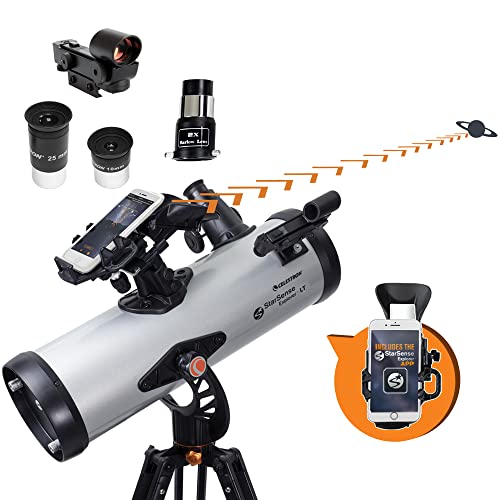
Celestron StarSense Explorer LT 114AZ smartphone-guided reflector telescope

#4 Celestron StarSense Explorer LT 114AZ — Best for Smartphone Users

114mm Reflector — Smartphone Star-Finding — ~$180–220

114mm aperture StarSense app navigation No alignment needed

The StarSense Explorer LT solves the hardest part of beginner astronomy: finding things. The included phone dock clips to the telescope tube, and the free StarSense Explorer app uses your phone’s camera to identify where the telescope is pointing in real time. Tap any object on the sky map and the app gives live nudge instructions — “move left, up a little, stop.” No computerized mount, no batteries in the telescope, no alignment stars. The 114mm Newtonian mirror has good light-gathering for its price and shows planets, clusters, and nebulae clearly.

Who this is for: Tech-comfortable adults and teens who want the independence to find objects themselves without learning star charts. Ideal self-directed learners. Works with any iPhone or Android.

View on Amazon →

Affiliate link.

Orion SpaceProbe 130ST equatorial reflector telescope

#5 Orion SpaceProbe 130ST — Best Optical Performance Gift

130mm Newtonian Reflector — Equatorial Mount — ~$180–230

130mm aperture Short-tube fast optics EQ mount (tracking-capable)

The SpaceProbe 130ST is the highest-performing traditional telescope on this list. The 130mm short-tube Newtonian produces genuinely sharp planetary images — Saturn’s Cassini Division (the gap in the rings) is often visible in steady seeing, and Jupiter shows multiple cloud bands. The equatorial mount is more complex than alt-azimuth but enables smooth single-axis tracking once polar-aligned.

Who this is for: Gift for an older teen or adult who is genuinely enthusiastic about learning astronomy as a skill, not just pointing and looking. The equatorial mount has a learning curve, but rewards patience. Not recommended for children under 13 or casual observers.

View on Amazon →

Affiliate link.

Celestron NexStar 4SE computerized GoTo telescope on single-arm mount

#6 Celestron NexStar 4SE — Best Premium GoTo Gift

102mm Maksutov-Cassegrain — Computerized GoTo — ~$400–480

102mm f/13 Maksutov 40,000+ object database Auto-slew to any target

The NexStar 4SE is Celestron’s most popular computerized telescope and one of the most gifted premium telescopes worldwide. After a two-star alignment (takes about 3 minutes), the SkyAlign system drives the telescope automatically to any of 40,000 objects in its database. Press “Saturn”, the telescope slews there and keeps it centred. The 102mm Maksutov-Cassegrain design is exceptionally sharp on planets — Saturn shows the Cassini Division, Jupiter shows detailed banding, and the Moon is stunning.

Who this is for: The premium gift for a serious astronomy enthusiast. Also ideal for busy adults who want object-finding automated so they spend their limited clear-night time observing, not star-hopping.

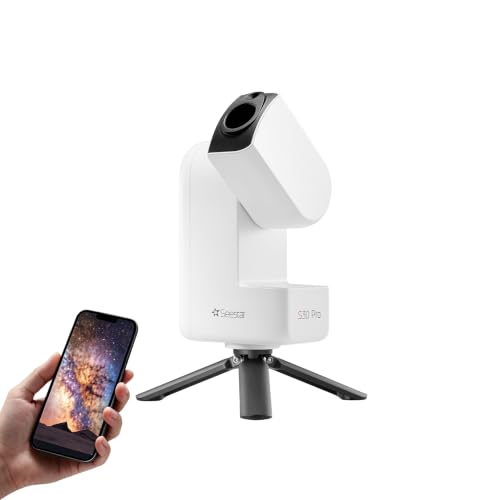
ZWO Seestar S50 smart telescope with app-controlled auto-imaging

#7 ZWO Seestar S50 — Best Tech “Wow Factor” Gift

Smart Telescope — App-Controlled Auto-Imaging — ~$449–499

Auto-GoTo + live stack Wi-Fi app control Built-in camera + screen

The Seestar S50 is not a traditional telescope — it is an all-in-one smart device that finds objects automatically and builds astrophotography images live on your phone screen as you watch. Tap “Orion Nebula” in the app and within 90 seconds the scope has found it and is stacking frames in real time, revealing colour and structure invisible to the naked eye. For tech-savvy gift recipients who love gadgets, this is the “wow” gift that no one forgets.

Who this is for: Adults (18+) who love technology and apps, especially those who are sceptical that a telescope can produce impressive images. The downside: you look at a phone screen rather than through an eyepiece, which some traditional observers dislike. Not ideal for children or visual-only observers.

View on Amazon →

Affiliate link.

All product links are affiliate links — we earn a small commission at no cost to you. Prices fluctuate; check current price at the link. Our recommendations are independent of commissions. See our editorial standards.

Choose by Budget

Under $100

Gskyer 70mm AZ

Honest optics, complete kit. Good test gift before committing to a more expensive scope.

$100–175

Celestron AstroMaster 70AZ

Our Editor’s Pick. Best all-round gift at any price. Confident first-night experience.

$175–250

Heritage 130P or StarSense LT 114AZ

More aperture (130P) or app-guided navigation (StarSense). Both strong choices.

$400–500

NexStar 4SE or Seestar S50

Premium gifts for enthusiastic adults. NexStar for traditional viewing, Seestar for tech lovers.

Which Telescope to Gift — By Recipient Profile

🧒

A child aged 8–12

Buy: Celestron AstroMaster 70AZ. Durable, straightforward mount they can operate independently with minimal help. The refractor tube never needs collimation — important when kids are not gentle. Avoid reflectors with mirrors that need regular adjustment.

📱

A teenager who uses a smartphone for everything

Buy: Celestron StarSense Explorer LT 114AZ. The app-guided navigation removes the frustration of “where do I point this thing?” that kills most teen astronomy experiences. They will use it because it integrates with their phone-first world.

👨‍💻

A tech-savvy adult who loves gadgets

Buy: ZWO Seestar S50. This is the telescope as iPhone. App-controlled, Wi-Fi connected, shoots and stacks astrophotos automatically. They will spend the first night showing everyone their phone screen. That’s fine — they’ll love it.

🔭

A genuinely curious adult who will read everything

Buy: Sky-Watcher Heritage 130P. The tabletop Dobsonian is honest, capable, and has enormous online community support — which a curious person will dive into. The 130mm aperture will keep them discovering new objects for years.

💸

You have no idea if they’ll use it, but want a thoughtful gift

Buy: Celestron AstroMaster 70AZ. It is the lowest-risk gift on this list. Easy to use, easy to store, good resale value. If they love it, they’ll upgrade. If they don’t, they haven’t lost more than $120.

What They’ll See on Night One

The first 15 minutes with a telescope make or break whether someone becomes an astronomer. Here is what’s visible in 2026 on a typical October–December night (when most Christmas gifts get used):

🌕

The Moon

The safest first target — always impressive in any telescope. Through a 70mm at 90×, craters 3–5 miles across are visible with sharp shadowed walls. The Moon is best when it is a crescent or half-phase — shadows at the terminator make the terrain look three-dimensional.

Min scope: Any

🪐

Saturn

Saturn is in the evening sky in late 2026 following its October 4 opposition. At 90× in a 70mm scope the rings are clearly detached from the planet body. With 100mm+, the Cassini Division (a gap in the rings) is often visible. The recipient will not believe they are seeing this with their own eye.

Min scope: 60mm at 50×+

🔵

Jupiter

Jupiter rises before midnight in October–December 2026 and blazes at magnitude −2. In a 70mm at 90×, two cloud bands are visible and the four Galilean moons appear as a row of bright dots. In 130mm+ the banding is detailed with the equatorial belts clearly separated. The moons change position noticeably every few nights.

Min scope: 60mm at 70×+

Telescope Gift FAQ

What is the best telescope to give as a gift for a first-time user?

The Celestron AstroMaster 70AZ is our pick for most gift situations. It is easy enough for a child, capable enough for an adult, and produces genuinely impressive views of Saturn and the Moon on the first night. If your budget is tighter, the Gskyer 70mm is a solid alternative at under $100.

How do I know what magnification they need?

All the telescopes on this list come with at least two eyepieces covering the most useful magnifications. For beginners, 50× to 100× is the sweet spot — enough to see Saturn’s rings and Jupiter’s moons clearly, but wide enough to actually find objects. Very high magnifications (200×+) require atmospheric stability that rarely occurs and are not useful for beginners.

Is a $50 department-store telescope worth buying as a gift?

No. Telescopes under $60 almost universally have apertures too small (50mm or less), unstable mounts that vibrate with every touch, and poor eyepieces that make everything blurry. The views they produce are disappointing compared to even a good pair of binoculars. If budget is tight, a 7×50 or 10×50 binoculars make a better astronomy gift than any $50 telescope.

Should I also buy extra eyepieces as part of the gift?

The included eyepieces in all our picks are good enough for beginners. If you want to add something, the most useful add-on is a 2× Barlow lens (~$25–30) which doubles the magnification of every existing eyepiece. A 25mm widefield eyepiece is also a great add-on for a beginner who wants low-power wide views of star clusters. Both are inexpensive and available on Amazon.

What age is a telescope appropriate for?

Most refractor telescopes on alt-azimuth mounts (AstroMaster 70AZ, Gskyer 70mm) are appropriate from age 8 with adult supervision, and fully independent from age 10–12. Reflectors with equatorial mounts (Orion SpaceProbe 130ST) are better from age 13. Computerized telescopes (NexStar 4SE, Seestar S50) work best for adults who can follow the alignment procedure — typically 14+ recommended.

Related Guides