Best Telescopes Under $500 in 2026: 6 Expert Picks Ranked
Telescope Advisor Logo Telescope Advisor
Saturn, Jupiter and the Moon viewed through a telescope — what you can see with a telescope under $500

Telescope Buying Guide · 2026

Best Telescopes Under $500 in 2026: 6 Expert Picks, Every Budget

$500 is the sweet spot where aperture, GoTo automation, and portability all become genuinely great. These 6 picks — from $130 tabletop Dobsonians to $450 computerized GoTo scopes — cover every observer profile. No junk, no compromises.

6

Expert-ranked picks

200mm

Max aperture in this guide

$130+

Saturn’s rings visible

GoTo

Available from ~$300+

By Telescope Advisor Editorial Team Published: Updated: Editorial Standards

Top 3 Under $500 at a Glance

Best for Most

Sky-Watcher Heritage 130P

130mm parabolic · tabletop Dob · ~$130–160
Saturn’s rings + Jupiter’s bands, any flat surface

View on Amazon →
Best GoTo Under $500

Celestron NexStar 4SE

102mm Maksutov GoTo · ~$380–450
Auto-finds Saturn, tracks it. Cassini Division visible.

View on Amazon →
Most Aperture Under $500

Sky-Watcher Dobsonian 8

200mm manual Dob · ~$380–450
8 inches of aperture — deep sky at its best.

View on Amazon →

Why $300–500 Is the Telescope Sweet Spot

Under $200, you are choosing between a small 70mm refractor and a 130mm tabletop reflector. Both are legitimate telescopes, but you feel the aperture limit on deep-sky nights. Above $600, you are entering the NexStar SE territory — serious instruments for dedicated observers.

The $300–500 window is where everything changes:

Aperture jumps

130mm to 150mm to 200mm all live here. More aperture = brighter, sharper objects, fainter galaxies visible, Cassini Division reliably clear.

GoTo enters the picture

Computerized GoTo mounts — which automatically find and track objects — start at ~$300. No more hunting the sky manually.

Optics quality improves

Parabolic primary mirrors (better than spherical) are standard in this range. The views are genuinely different from entry-level scopes.

The October 4, 2026 Saturn opposition is the best planetary viewing night this year. Every pick in this guide will show Saturn’s rings at the 7.5° ring tilt — see our Saturn Opposition 2026 guide for what each aperture class reveals.

The 6 Best Telescopes Under $500

Updated May 2026
Editor’s Pick — Best for Most Observers #1
Sky-Watcher Heritage 130P tabletop Dobsonian telescope ~$130–160

Sky-Watcher Heritage 130P Tabletop Dobsonian

130mm f/5 parabolic Newtonian · Collapsible tabletop rocker box · Two eyepieces (25mm + 10mm)

The Heritage 130P is the best telescope most people should buy under $500 — and under $200. The 130mm parabolic primary mirror (not the spherical lens found in cheap department-store scopes) delivers genuinely sharp planetary views. At 26× (25mm eyepiece), the Orion Nebula is beautiful with the Trapezium resolved. At 65× (10mm), Jupiter’s equatorial bands are clear and Saturn’s ring gap is visible on steady nights. The collapsible tube folds down to half its length and fits in a backpack. The tabletop rocker box sits on any flat surface — car roof, picnic table, balcony wall — and swings smoothly in any direction.

For the October 2026 Saturn opposition, the Heritage 130P will show the rings at 7.5° tilt clearly. This is the telescope that converts curious beginners into lifelong astronomers. Read our full Heritage 130P review →

Best for: Beginners, balcony observers, apartment users, travel, and anyone wanting a proper first scope without overspending.

Pros

  • ✓ Best beginner scope available under $200
  • ✓ Parabolic primary — genuinely sharp optics
  • ✓ Compact, collapsible, works on any surface
  • ✓ Ships with 25mm and 10mm eyepieces
  • ✓ Outstanding resale value

Cons

  • ✗ Needs a table or stable surface
  • ✗ No motorized tracking
  • ✗ 130mm aperture is the limit for faint deep-sky
🔭
~$200–250
#2 — Best Smartphone-Guided

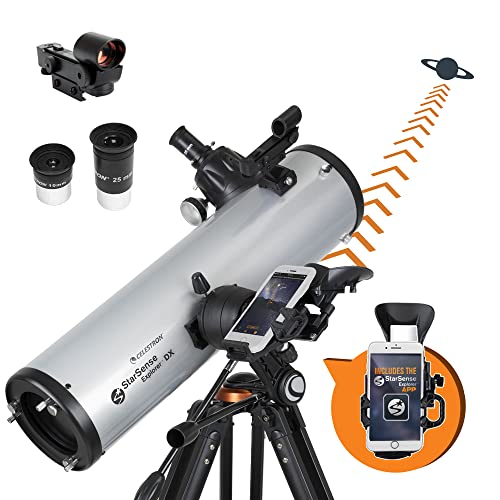
Celestron StarSense Explorer DX 130AZ

130mm f/5 Newtonian · Optical StarSense dock · Alt-azimuth mount with slow-motion controls

The StarSense Explorer DX 130AZ solves the biggest beginner problem — not knowing where to look. Clip your smartphone into the StarSense dock and the free app uses your phone’s camera to photograph the star field above. In seconds it knows exactly where your telescope is pointed and guides you to any target with on-screen arrows. No batteries in the mount. No alignment ritual. Just point, check your phone, and follow the arrows to Saturn, Jupiter, Andromeda, or any of thousands of deep-sky objects.

The 130mm parabolic mirror gives genuine optical performance — Jupiter’s equatorial belts, Saturn’s rings with the Cassini Division on clear nights, and deep-sky objects including M42, M45, M31, and M13. This is the best way to get into guided astronomy without committing to a full GoTo motorized mount.

Best for: Smartphone-native observers, guided astronomy without GoTo cost, beginners who hate star charts.

Pros

  • ✓ StarSense phone guidance — no star chart knowledge needed
  • ✓ 130mm parabolic mirror — real optical quality
  • ✓ No batteries needed in the mount
  • ✓ Works for planets, deep sky, and thousands more targets

Cons

  • ✗ Requires a compatible smartphone
  • ✗ Guidance is push-to only — no motorized tracking
  • ✗ Alt-az mount with slow-motion controls only
🌌
~$220–280
#3 — Best Mid-Size Tabletop

Sky-Watcher Heritage 150P Tabletop Dobsonian

150mm f/5 parabolic Newtonian · Collapsible tabletop Dobsonian · Two eyepieces (25mm + 10mm)

The Heritage 150P is the step up from the 130P for observers who want noticeably more capability without a full-size floor telescope. The 150mm aperture collects 33% more light than the 130P — which is a meaningful difference on deep-sky objects. M13 (Hercules Cluster) resolves into hundreds of individual stars. M81 and M82 show structural differences between the two galaxies. The Orion Nebula has more complex 3D structure visible. For planets, the Cassini Division is a reliable, defined dark line on good nights — not the marginal detection it can be through 130mm.

Same compact form factor as the 130P: the collapsible tube folds down, the tabletop rocker box fits on any flat surface, and the whole setup weighs about 5kg. This is the sweet spot for observers who want more without a full-size telescope.

Best for: Observers stepping up from a 130mm scope, apartment and balcony users wanting more aperture, galaxy and globular cluster enthusiasts.

Pros

  • ✓ 150mm — 33% more light than 130mm
  • ✓ Same compact, collapsible tabletop design
  • ✓ Cassini Division reliable on good nights
  • ✓ Parabolic primary for sharp images
  • ✓ Two eyepieces included

Cons

  • ✗ Still needs a stable table or surface
  • ✗ No motorized tracking or GoTo
  • ✗ Collapsible tube needs collimation check each session
Sky-Watcher Virtuoso GTi 130P motorized GoTo tabletop Dobsonian ~$380–450
#4 — Best GoTo Tabletop

Sky-Watcher Virtuoso GTi 130P

130mm f/5 parabolic Newtonian · Motorized GoTo alt-az · WiFi-controlled via free SynScan app

The Virtuoso GTi 130P does something no other telescope in this price range attempts: it combines a quality tabletop Dobsonian with full motorized GoTo in a compact, portable package. Built-in WiFi connects to the free SynScan app — open the app, align on three bright stars, and the motorized mount automatically slews to any of 42,000+ objects in its database. Tap “Saturn” and it slews directly there. Tap “M13” and the Hercules Cluster appears in the eyepiece. The motors then track the object continuously as the Earth rotates.

The 130mm parabolic mirror delivers excellent views: Saturn’s rings and cloud belts, Jupiter with 2–3 visible equatorial belts, M42 with the Trapezium cluster, and dozens of Messier deep-sky objects. This is the best of both worlds — GoTo automation with the portability of a tabletop Dobsonian.

Best for: GoTo beginners, city observers, balcony astronomy, anyone who wants motorized tracking in a compact package.

Pros

  • ✓ Full motorized GoTo — auto-slews and tracks
  • ✓ WiFi SynScan app — intuitive, no hand controller
  • ✓ Compact tabletop design — highly portable
  • ✓ 130mm parabolic mirror — quality optics
  • ✓ No polar alignment needed

Cons

  • ✗ Requires smartphone for SynScan app
  • ✗ Battery-powered motors need charging
  • ✗ 130mm aperture limit for faintest deep sky
  • ✗ Needs flat surface like any tabletop Dob
Celestron NexStar 4SE computerized GoTo Maksutov-Cassegrain telescope ~$380–450
#5 — Best GoTo Planetary Under $500

Celestron NexStar 4SE

102mm f/13 Maksutov-Cassegrain · Single-arm GoTo alt-az mount · NexStar+ 40,000-object controller

The NexStar 4SE is the smallest scope in Celestron’s legendary NexStar SE line — the same single-arm GoTo architecture as the 6SE and 8SE, at a fraction of the price. The 102mm f/13 Maksutov-Cassegrain optical design delivers extremely high contrast planetary views — the long focal length (1,325mm) and closed tube naturally suppress stray light and produce crisp, high-magnification images. At 200×, Saturn’s Cassini Division is a distinct dark gap, multiple moons are identifiable, and the ring shadow on the globe is visible on steady nights.

The NexStar+ hand controller with 40,000+ objects and SkyAlign (align on any three bright objects, no star chart knowledge needed) makes finding targets effortless. The entire scope packs into a single arm carry bag. For observers whose primary interest is Saturn, Jupiter, and the Moon rather than faint deep-sky objects, the 4SE is the best GoTo instrument under $500.

Best for: Planetary observers, Moon enthusiasts, compact GoTo, solo urban observing.

Pros

  • ✓ NexStar+ GoTo — full 40,000-object database
  • ✓ Maksutov design — exceptional planetary contrast
  • ✓ Extremely compact and portable
  • ✓ NexStar SE single-arm mount — proven reliability
  • ✓ Expandable (same accessories as 6SE/8SE)

Cons

  • ✗ 102mm aperture limits deep-sky performance
  • ✗ f/13 means very slow — narrow field of view
  • ✗ Requires GoTo alignment before each session
  • ✗ Batteries drain quickly — DC power recommended
Sky-Watcher Dobsonian 8 200mm manual Dobsonian telescope ~$380–450
#6 — Most Aperture Under $500

Sky-Watcher Dobsonian 8 (200mm)

200mm (8-inch) f/5.9 parabolic Newtonian · Full alt-az rocker box · 1,200mm focal length

The benchmark 8-inch Dobsonian — the most aperture you can buy under $500, period. 200mm of parabolic primary mirror collects 2.4× more light than the Heritage 130P and accesses objects invisible to smaller scopes in this price range. Under moderately dark skies, the Dobsonian 8 shows M31’s Andromeda Galaxy with dust lane hints, M82’s irregular filamentary structure, M51’s spiral companion, and globular clusters resolved to the core. M42 becomes a three-dimensional structure. M13 resolves into thousands of individual stars.

There is no GoTo, no tracking, no automation. You push the telescope in two axes — up/down and left/right — and use a star chart or a planetarium app on your phone to find targets manually. At this price point, the trade-off is clear: you give up convenience and get 83% more aperture than the NexStar 4SE. For deep-sky visual observing, nothing beats it under $500. See our full Dobsonian telescopes guide.

Best for: Deep-sky visual observing, Messier catalog, observers willing to learn manual star-hopping, budget-conscious serious observers.

Pros

  • ✓ 200mm — best aperture per dollar under $500
  • ✓ Teflon-padded rocker box, smooth movement
  • ✓ Easy collimation with thumbscrews
  • ✓ Accepts 2-inch eyepieces for wide-field views
  • ✓ Excellent quality eyepieces included

Cons

  • ✗ Large and heavy — needs dedicated space
  • ✗ No tracking or GoTo
  • ✗ Manual aiming requires practice
  • ✗ Some assembly required

All 6 Picks: Side-by-Side Comparison

Telescope Aperture Type GoTo? Price ~ Best For
Heritage 130P ⭐ 130mm f/5 Tabletop Dob No $130–160 Best for most beginners
StarSense Explorer DX 130AZ 130mm f/5 Newtonian, Alt-Az Guided $200–250 Smartphone-guided finding
Heritage 150P 150mm f/5 Tabletop Dob No $220–280 More aperture, same form
Virtuoso GTi 130P 130mm f/5 GoTo Tabletop Dob Yes ▲ $380–450 GoTo + tabletop portability
NexStar 4SE 102mm f/13 Mak-Cass GoTo Yes ▲ $380–450 Planetary GoTo, compact
Dobsonian 8 200mm f/5.9 ▲ Full Dob No $380–450 Deep sky, max aperture

▲ = category leader. Prices are approximate 2026 retail — check Amazon for current live pricing.

What’s Above $500? The Step-Up Options

Once you clear $500, the landscape changes significantly. The next tier introduces dedicated Schmidt-Cassegrain GoTo telescopes — and the difference in capability is real.

Celestron NexStar 6SE (~$600–800)

150mm f/10 Schmidt-Cassegrain GoTo. This is the telescope where serious planetary astronomy begins — the Cassini Division is reliably clear, limiting magnitude reaches 13.4, and the NexStar+ system with 40,000+ objects automatically tracks anything in the sky. 13 lbs lighter than the 8SE. Our recommended upgrade for observers who outgrow this guide. Read our full NexStar 6SE review.

Celestron NexStar 8SE (~$800–1,000)

203mm f/10 Schmidt-Cassegrain GoTo. The premium planetary and deep-sky GoTo telescope. 83% more light than the 6SE, limiting magnitude ~14, and the finest planetary views available under $1,500. If you find yourself wanting more from any scope in this guide, the 8SE is where the journey ends for most visual observers. Read our full NexStar 8SE review or compare them in our 8SE vs 6SE comparison.

Not sure which level is right for you? Our best telescopes for beginners guide covers the full range with a decision tool.

Frequently Asked Questions

What is the best telescope under $500 for beginners?

The Sky-Watcher Heritage 130P (~$130–160) is our top recommendation for most beginners. It is significantly under $500, delivers genuinely good planetary and deep-sky views, is compact and portable, and comes with two eyepieces. If budget is less of a concern and you want GoTo automation, the Celestron NexStar 4SE (~$380–450) automatically finds and tracks objects — no manual star-hopping needed.

What can I see with a telescope under $500?

Every scope in this guide can show: Saturn’s rings (all clearly visible at the Oct 2026 7.5° tilt), Jupiter’s equatorial belts and moons, the Moon in stunning crater detail, the Orion Nebula (M42), the Andromeda Galaxy (M31), dozens of Messier star clusters, and hundreds of double stars. With the 200mm Dobsonian 8, you can add galaxy details, globular cluster resolution, and faint NGC objects down to magnitude 13–13.4.

Should I buy a GoTo telescope or a manual Dobsonian for $400?

It depends on what you value. GoTo (NexStar 4SE or Virtuoso GTi): automatically finds and tracks objects — great if you want to spend all your time looking, not hunting. Manual Dobsonian 8: twice the aperture — great if you want the best possible views and are willing to spend 5–10 minutes learning to star-hop. Many observers regret buying less aperture in exchange for GoTo convenience. If you’re primarily interested in planets (Saturn, Jupiter, Moon), GoTo is worthwhile. If you love deep-sky objects and have patience to learn, the Dobsonian 8 is hard to beat.

Is a $500 telescope good enough for astrophotography?

For planetary video imaging (Jupiter, Saturn, Mars, Moon) — yes. The NexStar 4SE and Virtuoso GTi 130P can do short-exposure planetary video stacking with a phone camera adapter. For long-exposure deep-sky astrophotography (galaxies, nebulae), no — you need an equatorial mount with polar alignment and dedicated imaging software, which starts well above $500. See our astrophotography telescope guide for the right platforms.

How does a $500 telescope compare to the NexStar 6SE?

The NexStar 6SE is in a different category: it is a 150mm f/10 Schmidt-Cassegrain GoTo telescope at ~$600–800 that delivers professional-grade planetary views with a 40,000-object GoTo system. The best scope in this guide at $500 (the Dobsonian 8) matches the 6SE on aperture but has no GoTo. The NexStar 4SE has GoTo but less aperture (102mm vs 150mm). The 6SE is the natural step up once you outgrow what $500 can offer — see our NexStar 6SE review.

Which telescope under $500 is best for seeing Saturn in 2026?

All six picks show Saturn’s rings at the October 2026 opposition. For the best view, the Dobsonian 8 (200mm) or Heritage 150P (150mm) deliver the most aperture and therefore the sharpest Saturn images. For the most convenient experience (auto-finds Saturn, tracks it), the NexStar 4SE is outstanding — it keeps Saturn centred in the eyepiece without manual adjustment and shows the Cassini Division clearly. See our Saturn Opposition 2026 guide for detailed aperture comparisons.

Published May 16, 2026, by the Telescope Advisor Editorial Team. Prices are approximate 2026 retail — check Amazon for current pricing. Some links are affiliate links: we earn a small commission at no extra cost to you. This never influences our recommendations. See our affiliate disclosure.