How to See Jupiter Through a Telescope: Bands, Moons & the Great Red Spot
Telescope Advisor Logo Telescope Advisor
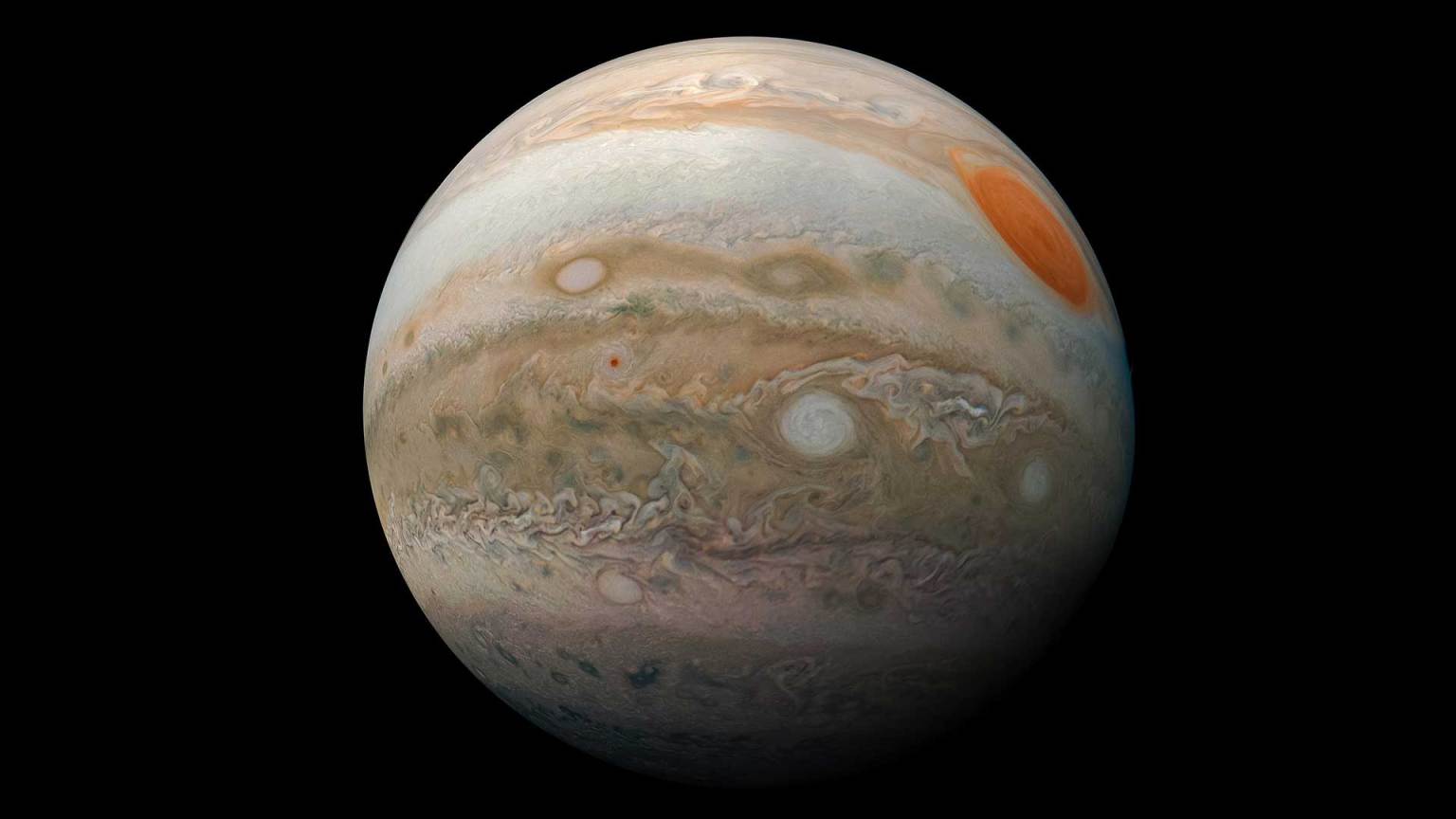
Jupiter photographed through a telescope showing cloud bands and the Great Red Spot

JUPITER OBSERVING GUIDE — 2026 – 2027

How to See Jupiter Through a Telescope

Jupiter is the most rewarding planet to observe in any telescope. Even a 60mm scope shows its two main cloud belts and four moons. Here’s everything you need to know — what you’ll see, how to find it, and which telescope makes the biggest difference.

60mm

Min to See Bands

75–200×

Best Magnification

Feb 2027

Next Opposition

4

Galilean Moons

By Telescope Advisor Editorial Team Published: Updated: Editorial Standards

What Will You See? Quick Summary by Aperture

Jupiter is the most detail-rich planet visible through an amateur telescope. Unlike Saturn (whose rings are the main event), Jupiter shows new things every time you look — cloud belts, the Great Red Spot, shadow transits, and four moons that visibly move night to night. Here’s what each aperture tier delivers:

Aperture What You See Example Telescope
60–70mm Obvious disk, NEB & SEB belts, 4 Galilean moons as star-like points Small refractor
80–100mm 3–4 belts, equatorial zone, Galilean moon disks visible at high power 4″ Mak, 4″ refractor
100–150mm Great Red Spot, 4–5 belts, festoons, shadow transits, polar regions NexStar 4SE / 5SE
150mm+ 6+ belts, GRS consistently, oval storms, turbulence in SEB, cloud colour NexStar 6SE / 8SE

When Is Jupiter Visible? 2026–2027 Calendar

Jupiter reaches opposition (closest approach to Earth, highest in the sky, visible all night) once every 13 months. Here’s the viewing window for 2026 and 2027:

Jupiter Visibility Calendar 2026–2027

Jan 10, 2026Opposition — Peak!
Jan–March 2026Excellent evening sky ⭐
April–May 2026Evening sky, getting lower
June–July 2026Near solar conjunction — avoid
Aug–Oct 2026Returns to morning sky
Nov 2026–Jan 2027Excellent morning / evening ⭐
~Feb 13, 2027Next Opposition — Peak!

Why Jupiter Moves Through the Calendar

Jupiter’s synodic period (time between oppositions) is about 399 days — roughly 33 days longer than a calendar year. So each year’s opposition falls about a month later than the previous year. Jupiter was in Taurus/Gemini during its January 2026 opposition; the February 2027 opposition will find it in Cancer.

How Big Does Jupiter Look?

At opposition, Jupiter’s apparent diameter is about 47–48 arcseconds — the largest of any planet other than Venus (which never shows detail). This is 2× Saturn’s apparent disc size, which is why Jupiter rewards lower magnification than you might expect. A 100× view gives a disc as large as the Moon seen with the naked eye.

Can You See Jupiter Tonight?

Use a free app like Stellarium, SkySafari, or Celestron’s StarSense app to check whether Jupiter is above the horizon at your location tonight. In May 2026, Jupiter is low in the western sky after sunset and heading toward conjunction — plan for the best views from late 2026 onward.

What You’ll See at Each Aperture

Unlike faint deep-sky objects, Jupiter is so bright that aperture mainly adds detail, not visibility. A 60mm scope will always show Jupiter’s disk. What aperture buys you is finer cloud structure, the Great Red Spot, and cleaner views at high magnification.

60–70mm Small Refractors & Entry-Level Scopes

At 60mm you can resolve Jupiter into a clearly non-circular oblate disc (its equatorial diameter is wider than its polar diameter, visible as a slight flattening). Even at 60×–75×, the North and South Equatorial Belts (NEB/SEB) appear as two dark horizontal stripes bracketing a bright equatorial zone. The four Galilean moons — Io, Europa, Ganymede, and Callisto — appear as tiny star-like points in a line alongside the planet. On the best nights, three or all four moons are visible simultaneously.

80–102mm 100mm Maks, 80mm Refractors (Big Improvement)

At 4″ aperture the jump in detail is significant. You now see 3–4 distinct cloud belts, and on nights of steady seeing (good atmospheric stability), the festoons — dark wisps dangling from the NEB into the equatorial zone — become detectable. Shadow transits (dark dot where a moon’s shadow falls on Jupiter’s cloud tops) are clearly visible at this aperture. The Galilean moons occasionally show as tiny discs rather than pure points at 150×+.

100–150mm NexStar 4SE / 5SE Range — Great Red Spot Territory

The Great Red Spot (GRS) — a storm roughly 1.3× the diameter of Earth — becomes reliably visible in this aperture class when it’s facing Earth (roughly 5 hours per rotation). At 125×–175×, the GRS appears as an obvious salmon-orange oval embedded within the South Equatorial Belt (SEB). You’ll also begin to see colour in the cloud belts: the NEB is a warm brown-ochre, the SEB a greyer tone, and the polar regions noticeably darker than the mid-latitudes. Belt detail — rifts, knots, darker nodules within the SEB — becomes apparent.

150mm+ NexStar 6SE / 8SE — Maximum Detail for Visual Observers

At 6″ and above, Jupiter becomes a world of constantly changing weather. Six or more cloud belts are visible, and on excellent nights you can trace the fine structure within individual belts: dark eddies, bright ovals, the turbulent wake region following the Great Red Spot. The SEB sometimes goes through “revival” events where a normally prominent belt fades and then storms break out — visible in an 8″ scope. The polar regions show distinct colour and structure. Ganymede occasionally shows an identifiable disk. This aperture tier separates casual from serious planetary observers.

Jupiter’s Key Features Explained

Cloud Belts & Zones

  • NEBNorth Equatorial Belt — the most prominent belt, dark brown-ochre, always visible from 60mm+
  • SEBSouth Equatorial Belt — often as prominent as the NEB; contains the Great Red Spot on its southern edge
  • EZEquatorial Zone — bright white band between NEB and SEB; festoons dangle into it from the NEB
  • NTBNorth Temperate Belt — visible at 100mm+ on good nights
  • STBSouth Temperate Belt — home to the “Oval BA” (Baby Red Spot) occasionally visible at 150mm+

The Great Red Spot (GRS)

The Great Red Spot is a persistent anticyclonic storm that has been observed for over 350 years. It is currently about 15,000 km in diameter — roughly 1.3 times Earth’s diameter — and sits in the SEB at roughly 23° south latitude. The GRS rotates once every ~400 days relative to Jupiter’s surface and is visible from Earth when Jupiter’s rotation (9h 56m period) brings it to the central meridian.

The GRS transits Jupiter’s central meridian roughly twice per Jovian day — use a GRS transit predictor (built into most planetarium apps) to know when to look. Its colour varies between a pale salmon and deep brick-orange.

The Four Galilean Moons

First observed by Galileo in 1610, these four large moons are visible in almost any telescope — even binoculars. They orbit Jupiter in a plane nearly edge-on to Earth, appearing as a roughly straight line of bright points.

  • Io — innermost, most volcanic body in the solar system; orange-yellow in large scopes
  • Europa — icy ocean world; smallest but brightest of the four
  • Ganymede — largest moon in the solar system (larger than Mercury); shows as a disc at 200×+
  • Callisto — outermost, most heavily cratered; faintest of the four

Occasionally one or more moons passes in front of (transit) or behind (occultation) Jupiter, or casts a shadow on its cloud tops (shadow transit). These events are easily visible at 100mm+ and scheduled in advance by planetarium software.

Jupiter’s Fast Rotation

Jupiter rotates in just 9 hours 56 minutes — the fastest of any planet. This is long enough that over a 2-hour observing session, you can watch features noticeably drift across the disc. The Great Red Spot takes about 2 hours to traverse the visible hemisphere. Observing Jupiter on multiple consecutive nights reveals the moons in completely different positions — a visual demonstration of orbital mechanics in real time.

Best Magnification for Jupiter

Jupiter is large and bright, so it rewards higher magnification better than any other planet except Saturn. The practical ceiling depends on your aperture and the quality of seeing (atmospheric steadiness) on any given night.

Magnification What You See Notes
50–75× Bright disc, NEB & SEB, moons as points Good starting view; field of view shows all 4 moons
100–125× 3–4 belts, equatorial zone, polar darkening Sweet spot for most 60–100mm scopes
150–175× Great Red Spot, festoons, shadow transits, 4–5 belts Best all-round magnification for 100–150mm scopes
200–250× Fine belt structure, GRS detail, oval storms Needs steady seeing and 150mm+ aperture
250×+ Maximum planetary detail for large apertures Only useful on exceptional seeing nights; 200mm+ scope

Rule of Thumb: Maximum Useful Magnification

A common formula is 50× per inch of aperture (or 2× per mm). A 100mm scope gives roughly 200× maximum; a 150mm scope gives ~300×. In practice, atmospheric seeing limits useful magnification to 150–200× on typical nights. Only on rare nights of excellent seeing (Antoniadi scale I–II) does pushing beyond 200× improve the view rather than just making it larger and blurrier.

Best Telescopes for Viewing Jupiter

Three telescope picks across entry, mid-range, and premium tiers — all GoTo-equipped for easy Jupiter finding in any sky condition.

Best All-Round Jupiter Scope — Entry to Mid Tier
Celestron NexStar 4SE telescope for Jupiter viewing

Celestron NexStar 4SE

102mm Maksutov-Cassegrain — f/13 — 1325mm focal length

The NexStar 4SE is the most popular entry-level GoTo telescope for a reason. Its 102mm Mak optics deliver crisp cloud belts and a reliable Great Red Spot view at 130×–175×. The f/13 focal ratio suppresses chromatic aberration to near-zero, and the sealed Mak tube means Jupiter views are never degraded by internal air turbulence. The NexStar+ hand controller aligns on Jupiter in under two minutes — no star-hopping, no frustration.

  • NEB/SEB always sharp; GRS visible when facing Earth
  • GoTo tracking holds Jupiter centred for hours
  • Compact Mak tube — quick cool-down, easy transport
  • Best all-round planetary scope under $600
Celestron NexStar 6SE telescope

Celestron NexStar 6SE — Best Mid-Range Jupiter Scope

150mm SCT — f/10 — 1500mm focal length

The 6SE’s 150mm aperture is the sweet spot for Jupiter observation — large enough to show 5–6 cloud belts, GRS detail, and occasional oval storms, yet compact enough to set up in minutes. At 150×–200×, the jump from a 4″ to a 6″ on Jupiter is immediately obvious: the image is brighter, steadier, and richer in colour. For serious Jupiter observers who want everything the 4SE offers plus noticeably more detail, the 6SE is the logical next step.

Celestron NexStar 8SE telescope

Celestron NexStar 8SE — Premium: Maximum Visual Detail

200mm SCT — f/10 — 2000mm focal length

The NexStar 8SE is the benchmark premium GoTo telescope and the scope most serious visual planetary observers recommend. Its 8″ (200mm) aperture allows 200×–250× on good nights — enough to trace the turbulent wake region behind the Great Red Spot, resolve Ganymede’s disk, and follow the finest cloud belt rifts. If you want to see Jupiter at the limit of what your eye can detect through a practical backyard telescope, this is the scope to own.

Tips for the Sharpest Jupiter Views

Wait for Atmospheric Seeing

Atmospheric turbulence (“bad seeing”) blurs Jupiter far more than aperture helps. On poor-seeing nights, a 4″ scope at 100× often shows more than an 8″ at 200×. Seeing is best when Jupiter is high (above 30° altitude), on calm nights with stable air, and in winter/spring when the atmosphere is more settled. Never observe immediately after sunset when warm daytime air is still rising.

Let Your Scope Cool Down

Mirror-based scopes (Newtonians, SCTs, Maks) need to cool to the ambient outdoor temperature before the optics perform at their best — typically 15–30 minutes for an SCT and 20–40 minutes for a larger Newtonian. A scope that hasn’t cooled will show Jupiter as a shimmering, detail-free disc even on a perfect night.

Use the GRS Transit Times

The Great Red Spot transits Jupiter’s central meridian roughly twice every 9h 56m Jovian day. To catch it, look up the GRS transit time for your date using Sky & Telescope’s Jupiter Almanac, Stellarium, or SkySafari. The GRS is visible for roughly 2 hours around each transit (1 hour before and after). Planning your session around a transit will vastly increase your GRS sightings.

Try a Colour Filter

A #80A (medium blue) filter increases the contrast of Jupiter’s cloud belts against the bright equatorial zone, making them appear darker and more distinct. A #21 orange filter enhances the Great Red Spot and can make it stand out more clearly when it’s pale. Filters are inexpensive (under $15) and screw into standard eyepiece barrels.

Draw What You See

Making a simple pencil sketch of Jupiter forces you to look more carefully than you otherwise would. Even rough sketches of belt positions and the Great Red Spot location serve as records of a dynamic planet — and reveal changes you’d otherwise miss. The BAA (British Astronomical Association) and ALPO (Association of Lunar & Planetary Observers) accept member observations.

Keep Jupiter Above 30° Altitude

The lower Jupiter is in the sky, the more atmosphere you’re looking through — and the more turbulence degrades the view. Below 30° altitude, even a large-aperture scope will struggle. Plan your Jupiter sessions around the period when it’s highest — near the meridian (due south for Northern Hemisphere observers). A GoTo mount helps by tracking precisely as Jupiter rises and sets.

Frequently Asked Questions: Seeing Jupiter Through a Telescope

What does Jupiter look like through a telescope?

Even through a small 60mm telescope at 60×–75×, Jupiter appears as a clearly oval disc with two obvious dark horizontal stripes — the North and South Equatorial Belts (NEB and SEB). At 100mm+ aperture you can see 3–5 belts, the bright equatorial zone, and on the right nights, the Great Red Spot. Four Galilean moons are visible as tiny points of light alongside the planet, changing position night to night. Larger telescopes reveal cloud turbulence, colour gradations, and fine detail within individual belts.

What magnification is needed to see Jupiter’s bands?

The two main belts (NEB and SEB) are visible at just 60×–75× in almost any telescope. You don’t need high magnification to see them — Jupiter’s apparent disk is so large that the belts are obvious at moderate power. For finer detail, festoons, and the Great Red Spot, you’ll want 150×–175× and at least 100mm of aperture.

Can I see Jupiter’s Great Red Spot through a telescope?

Yes, but it requires timing and adequate aperture. The Great Red Spot is visible in any scope of 100mm or larger when atmospheric seeing is steady. The challenge is timing: the GRS is only facing Earth for roughly 2 hours at a time (twice per 10-hour Jovian day). Use a GRS transit predictor (built into Stellarium, SkySafari, or Sky & Telescope’s Jupiter tools) to know when to look. On a good night with a 4″ or larger scope, the GRS appears as a distinct salmon-coloured oval embedded in the SEB.

Can I see Jupiter’s moons through binoculars?

Yes! Jupiter’s four Galilean moons (Io, Europa, Ganymede, Callisto) are visible as tiny star-like points in any 7× or larger binoculars, aligned in a roughly straight line with Jupiter. They’re at magnitudes 4.6–5.6, bright enough to be naked-eye objects in perfect conditions. Through a telescope they appear as very bright points — only Ganymede is large enough to show an actual disc at 200×+ in a large scope.

Is Jupiter visible in 2026?

Jupiter was at opposition on January 10, 2026 — the best viewing of this cycle. In May 2026, Jupiter is low in the western evening sky and heading toward solar conjunction around July 2026. It returns to the morning sky in August 2026 and is well-placed for evening viewing again from November 2026 onward. The next Jupiter opposition is around February 13, 2027, when it will be closest to Earth and visible all night. Plan your Jupiter sessions around that period for the best views.