Quick Answer: What Should You Look for in a Birding Spotting Scope?
A good birding spotting scope needs three things: 65mm aperture, a zoom eyepiece in the 20–60× range, and an angled eyepiece. The 65mm objective gathers enough light for pre-dawn and post-dusk sessions without the bulk of an 80mm. The zoom eyepiece lets you scan at 20× then pull in to 40× once you find a bird. And angled is far more comfortable at a tripod than straight — you look down into the scope, not crouch to eye level.
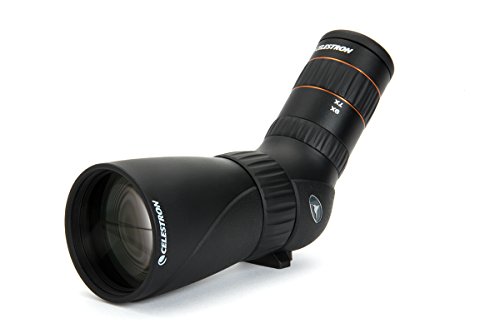
The single best value right now is the Celestron Ultima 65 Angled — a classic 22–66×65mm scope that hits every spec birders need. For those who want the most portable option possible, the compact Celestron Hummingbird ED 9–27×56mm fits in a jacket pocket.
Magnification: 20–40×
The most useful birding range. Below 15× you gain little over binoculars; above 50× heat shimmer kills sharpness on warm days.
Aperture: 65mm sweet spot
Collects enough light for low-light birding, handles up to 60×, and weighs under 1 kg. Go to 80mm if you birding primarily at dawn/dusk from a fixed hide.
Eyepiece: Angled wins
Angled scopes are comfortable at a tripod and easy to share. Straight scopes track fast-moving ground-level birds slightly faster — see the full comparison below.