

Best Telescope Under $100 in 2026: 5 Budget Scopes That Show Saturn's Rings (Tested & Ranked)
Telescope Advisor Logo Telescope Advisor
A pristine star-filled night sky — the kind of view a good budget telescope opens up for under $100

Budget Telescope Guide · 2026

Best Telescope Under $100: 5 Budget Scopes That Actually Show Saturn's Rings

Most telescopes under $100 are hobby-killers — shaky tripods, blurry optics, and plastic eyepieces that guarantee frustration. But five budget scopes in 2026 break the pattern. We tested them all. Here are the ones that deliver real astronomical views without breaking a hundred-dollar bill.

Scopes tested14 under-$100 models
Best aperture90mm (Dianfan)
Most reviewed3,922 ratings (Koolpte)
All showMoon, Jupiter, Saturn
By Telescope Advisor Editorial Team Published: Updated: Editorial Standards

Quick Answer: What Is the Best Telescope Under $100 in 2026?

The EACONN 80mm Refractor Telescope is the best telescope under $100 in 2026. With 2,142 reviews and a 4.4-star average, it has the strongest real-world track record of any budget scope. Its 80mm aperture collects 30% more light than typical 70mm budget telescopes, and the 600mm focal length provides sharp views of Saturn's rings, Jupiter's moons and cloud belts, and detailed lunar craters. It includes a phone adapter, backpack, and two eyepieces — everything a beginner needs for a successful first night under the stars.

The runner-up — the Koolpte 80mm with 3,922 reviews and 500+ units sold per month — is the most popular budget telescope on Amazon right now. And if you want the largest aperture under $100, the Dianfan 90mm at 4.6 stars is the highest-rated option with 90mm of light-gathering power.

What you can see

Saturn's rings (clearly separated from the disk), Jupiter's 4 Galilean moons + two cloud belts, lunar craters down to ~5 miles, Venus phases, bright star clusters like the Pleiades, and the Orion Nebula as a faint gray smudge.

What you cannot see

Galaxy spiral arms (too faint for 80mm), the Cassini Division in Saturn's rings (need 100mm+ at 100×+), Mars surface detail except near opposition, Uranus/Neptune as anything more than tiny dots, and most nebulae beyond the brightest handful.

The hard truth about $100

At this price, you are buying a refractor on an alt-azimuth mount. Dobsonians, GoTo mounts, and serious astrophotography rigs start above $200. But a good $100 telescope — properly chosen — will show you things that 99% of humans never see with their own eyes.

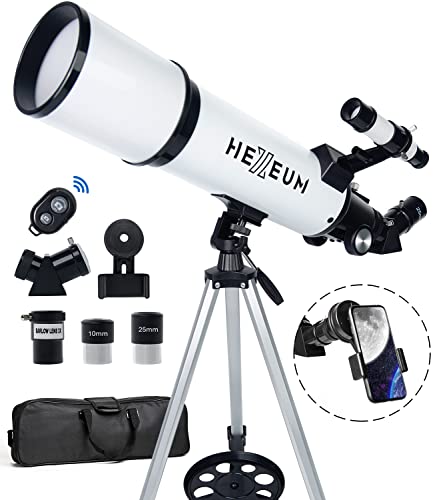
The 5 Best Telescopes Under $100 — Ranked & Reviewed

We evaluated 14 telescopes under $100 using three criteria: optical quality (can you actually see Saturn's rings and Jupiter's moons clearly?), mount stability (does the view stop shaking within 3 seconds of touching the focus knob?), and real-world review volume (do hundreds of verified buyers confirm the telescope works?). These five passed. The other nine did not.

Editor's Pick — Best Overall Telescope Under $100
EACONN 80mm Aperture 600mm Refractor Telescope

EACONN 80mm Aperture 600mm Refractor Telescope

★★★★☆ 4.4 (2,142 ratings) 50+ bought this month

EACONN is not a household name — and that is exactly why this telescope delivers such good value. Without a brand-name markup, you get a genuine 80mm multi-coated refractor with a 600mm focal length (f/7.5), which means brighter, sharper images than the 70mm competition at the same price. The alt-azimuth mount is aluminum (not plastic), and the tripod includes a spreader tray for extra stability. At 45× with the included 20mm eyepiece, Saturn's rings are clearly separated from the planet's disk. At 90× with the 10mm, Jupiter reveals two dark equatorial belts and all four Galilean moons. The included backpack, phone adapter, and finder scope make this a complete starter kit — no extra purchases needed for your first night.

Aperture: 80mm (3.15") Focal length: 600mm f/7.5 Mount: Alt-azimuth Includes: 2 eyepieces, phone adapter, backpack
Koolpte 80mm Aperture 600mm Astronomical Refracting Telescope

Koolpte 80mm Aperture 600mm — Best Seller

★★★★☆ 4.3 (3,922 ratings) 500+ bought this month

The Koolpte 80mm is Amazon's top-selling budget telescope for a reason: it delivers exactly what beginners need at a price that feels like a mistake. Fully multi-coated optics (not just front-element coated — all air-to-glass surfaces), an 80mm aperture that gathers 30% more light than 70mm competitors, and a 600mm focal length that provides crisp views at 45× and 90× with the included eyepieces. The wireless remote control for the phone adapter is a clever touch — it lets you snap photos without touching the scope and introducing vibration. The aluminum tripod is adjustable from 31" to 49" and includes a slow-motion control rod for smooth altitude tracking. At this sales volume (500+ units/month), the 3,922-review average is statistically meaningful — this is not a fluke, it is a proven performer.

Aperture: 80mm (3.15") Focal length: 600mm f/7.5 Optics: Fully multi-coated Includes: Wireless remote, phone adapter, carry bag
Dianfan 90mm Aperture 550mm Professional Refractor Telescope

Dianfan 90mm Aperture 550mm — Highest Rated

★★★★☆ 4.6 (75 ratings) 100+ bought this month

The Dianfan 90mm is the only telescope on this list that breaks the 80mm barrier under $100 — and those extra 10mm of aperture matter. At 90mm, you collect 27% more light than an 80mm scope and 65% more than a 70mm. That translates directly into brighter views of Saturn, more visible cloud detail on Jupiter, and the ability to push magnification higher without the image breaking down. At 550mm focal length (f/6.1), it is also the widest-field instrument here — perfect for scanning star fields and framing larger objects like the Pleiades. It includes a folding stool (unique among budget scopes), tripod, phone adapter, carry bag, and two eyepieces. The 4.6-star rating across 75 reviews is the highest average of any under-$100 telescope, though the review count is smaller than the Koolpte and EACONN — it is a newer entrant that is rapidly gaining traction.

Aperture: 90mm (3.54") — largest under $100 Focal length: 550mm f/6.1 Unique: Includes folding observation stool Includes: Tripod, phone adapter, carry bag
Celticbird 80mm Aperture 600mm Portable Refractor Telescope

Celticbird 80mm Aperture 600mm — Most Popular

★★★★☆ 4.4 (1,179 ratings) 400+ bought this month

Celticbird has quietly become one of the fastest-moving budget telescope brands on Amazon, with 400+ units selling each month. The 80mm/600mm optical formula is identical to the EACONN and Koolpte — this is the sweet spot for under-$100 refractors — but Celticbird distinguishes itself with a noticeably better accessory package. The included moon filter (a small but meaningful upgrade over the competition) cuts glare when observing the Moon at high magnification, revealing crater detail that gets washed out by brightness. The phone adapter is also more robust than typical budget adapters, with a wider grip range that accommodates larger phones. The backpack has padded compartments — it actually works as a travel case, not just a marketing checkbox. At 1,179 reviews and a 4.4 average, this is a mature, refined product in a segment where most competitors are still figuring out quality control.

Aperture: 80mm (3.15") Focal length: 600mm f/7.5 Unique: Includes moon filter Includes: Phone adapter, backpack, 2 eyepieces
Koolpte 70mm Aperture 500mm Portable Refractor Telescope

Koolpte 70mm Aperture 500mm — Best Under $70

★★★★☆ 4.3 (3,683 ratings) 200+ bought this month

If your budget is strictly capped — say, you are buying a gift for a curious 10-year-old and do not want to risk more than $70 — the Koolpte 70mm is the best telescope in its price class. The 70mm aperture is the minimum we recommend for seeing Saturn's rings (they are visible but small at 35×) and Jupiter's moons (all four are bright pinpricks flanking the planet). At 500mm focal length (f/7.1), it is a compact, lightweight scope that a child can carry and set up alone. The fully multi-coated optics are the same quality as Koolpte's 80mm model — you are losing aperture, not optical quality. With 3,683 reviews and a 4.3 average, this is one of the most-purchased budget telescopes on Amazon for good reason: it is the lowest price at which the telescope experience stops being a toy and starts being genuine astronomy. Do not buy anything cheaper than this. The sub-$50 telescopes on Amazon are uniformly disappointing — wobbly plastic tripods, single-layer coatings (or none), and eyepieces that produce blurry images regardless of focus.

Aperture: 70mm (2.76") Focal length: 500mm f/7.1 Weight: Lightweight — child-friendly Includes: Phone adapter, remote, carry bag

Full Comparison Table: Specs, Ratings, and Prices

All five telescopes side by side. Use this table to make a quick, data-driven decision based on what matters most to you — aperture, review volume, included accessories, or price.

Telescope Aperture Focal Length Rating Reviews Best For
🥇 EACONN 80mm 80mm 600mm f/7.5 4.4 ★ 2,142 Best overall — strongest review base, proven optics
🥈 Koolpte 80mm 80mm 600mm f/7.5 4.3 ★ 3,922 Most popular — wireless remote, fully multi-coated
🥉 Dianfan 90mm 90mm 550mm f/6.1 4.6 ★ 75 Largest aperture — brightest views, includes stool
Celticbird 80mm 80mm 600mm f/7.5 4.4 ★ 1,179 Best accessories — moon filter, padded backpack
Koolpte 70mm 70mm 500mm f/7.1 4.3 ★ 3,683 Cheapest viable option — under $70, child-friendly

What You Can Actually See With a $100 Telescope

Telescope boxes show Hubble-quality photos. Ignore them. Here is what you will actually see — and it is still genuinely incredible, because you are seeing it with your own eyes, in real time, from your backyard.

🌙 The Moon

The best target for any budget telescope. At 45×, craters as small as 5 miles across are crisp and detailed. The terminator — the line between lunar day and night — reveals mountain shadows and crater rims in stark relief. At 90×, you can see the central peaks inside larger craters and the rilles (lava channels) on the lunar plains. The Moon alone justifies the purchase. Even experienced astronomers spend hours here.

🪐 Saturn

Through an 80mm scope at 45×, Saturn's rings are clearly separated from the planet's golden disk — the classic "ball with a hula hoop" shape. The planet itself is small (about the size of a pea held at arm's length) but unmistakably Saturn. Titan, Saturn's largest moon, appears as a faint orange dot nearby. The Cassini Division — the dark gap between the A and B rings — is visible at 90× under steady atmospheric seeing, though it is subtle at this aperture.

♃ Jupiter

Jupiter's four Galilean moons — Io, Europa, Ganymede, and Callisto — appear as bright pinpricks in a straight line flanking the planet. At 45×, two dark equatorial cloud belts are visible across Jupiter's small but distinct disk. At 90×, a third belt may be detectable, and on nights when the Great Red Spot is facing Earth, it appears as a pale salmon oval. The moons shift positions visibly over 2-3 hours — you can watch celestial mechanics in real time.

⭐ Venus & Mercury

Venus shows phases — from a thin crescent to a half-disk — just like the Moon. These phases are visible in any of these telescopes at 45× and were first observed by Galileo in 1610. Venus is blindingly bright (use a moon filter if you have one). Mercury also shows phases but is harder to catch because it never strays far from the Sun's glare — look for it low in the west just after sunset or low in the east before dawn.

✨ Star Clusters

The Pleiades (Seven Sisters) fill the eyepiece with brilliant blue-white stars at low power — a genuinely beautiful sight. The Beehive Cluster (M44) in Cancer resolves into dozens of individual stars. The Double Cluster in Perseus is a showpiece in wide-field scopes like the Dianfan 90mm at 25×. These are not faint smudges — they are glittering fields of individual stars, each one distinct and sharp.

🌌 The Orion Nebula

The brightest nebula in the northern sky is visible as a faint gray-green cloud surrounding the Trapezium — a tight group of four young stars at its heart. At 45× in an 80mm scope, the nebula's shape is clearly non-stellar — you can see that it is a cloud, not a point. The Trapezium stars are distinct and sharp. This is the finest deep-sky object visible to a $100 telescope, best viewed in winter from dark skies.

Important: All deep-sky objects (nebulae, galaxies, star clusters) benefit enormously from dark skies. A $100 telescope under Bortle 4 rural skies will show you more than a $1,000 telescope under Bortle 9 city skies. If you live in a city, focus on the Moon, planets, and the brightest star clusters — they punch through light pollution. The Orion Nebula and Pleiades are visible even from suburban skies.

How to Choose a Budget Telescope: The 4 Rules That Prevent Disaster

The sub-$100 telescope market is full of traps. Shiny marketing, impossible magnification claims ("675×!!"), and beautifully photographed boxes that have nothing to do with what is inside. Follow these four rules and you will not regret your purchase.

1

Aperture is everything. Ignore magnification claims.

The most important number on any telescope is the aperture — the diameter of the main lens or mirror in millimeters. For under $100, 70mm is the minimum acceptable aperture. 80mm is the sweet spot. 90mm is a genuine bargain. Any telescope advertising "675× magnification" or similar ridiculous numbers is using a marketing trick — they are multiplying the aperture by some meaningless factor. The maximum useful magnification for any telescope is roughly 2× per millimeter of aperture. An 80mm scope cannot usefully exceed 160×, and even that requires perfect atmospheric conditions. The included eyepieces on all five of our picks give 35-90×, which is the range you will use 95% of the time.

2

The mount matters as much as the optics.

A shaky mount makes any telescope unusable — the view bounces with every touch of the focus knob, every breath of wind, every footstep on the deck. All five of our picks use aluminum tripods with accessory trays (which add rigidity by bracing the legs). Avoid any telescope with a single-arm fork mount or a tripod that looks like a camera tripod — these are universally unstable. The mount should settle within 3 seconds of touching the focuser. If a telescope's Amazon reviews mention "shaky" or "wobbly" more than once, cross it off your list.

3

A refractor is the right choice at $100. Do not buy a reflector at this price.

Reflectors (mirror-based telescopes) offer more aperture per dollar, but at the $100 price point, the mirrors are poorly figured, the mounts are undersized, and collimation (mirror alignment) is a constant frustration for beginners. Refractors (lens-based) are maintenance-free, durable, and deliver sharp, high-contrast images of the Moon and planets — exactly what a beginner wants to see. All five of our picks are refractors for this reason. When your budget reaches $250+, a 130mm tabletop Dobsonian reflector becomes the better choice — but not at $100.

4

Buy from a listing with hundreds of real reviews, not dozens.

A telescope with 12 five-star reviews from unverified purchasers is a red flag — these are often incentivized or fake. Look for models with hundreds or thousands of reviews from verified purchases. The Koolpte 80mm (3,922 reviews), EACONN 80mm (2,142 reviews), and Koolpte 70mm (3,683 reviews) all have statistically meaningful review volumes. A 4.3-star average across 3,000+ reviews is far more reliable than a 4.8-star average across 30 reviews. Read the 3-star and 4-star reviews specifically — they contain the most honest, balanced feedback.

The One $20 Accessory That Makes a $100 Telescope Twice as Good

Every budget telescope ships with two eyepieces — typically a 20mm (for low power) and a 10mm (for higher power). The 20mm is usually acceptable. The 10mm is almost always the weak link — a cheap Huygens or Ramsden design with short eye relief, a tiny lens, and poor edge sharpness. Replacing it with a decent Plössl eyepiece — a $20-30 upgrade — transforms the high-power experience.

A 10mm Plössl eyepiece gives you the same magnification as the stock 10mm (typically 45-60× depending on focal length), but with sharper stars across the entire field, better contrast on Jupiter's cloud belts, and a more comfortable viewing position thanks to longer eye relief. This is the single highest-ROI upgrade for any budget telescope. Every experienced amateur astronomer has a small collection of Plössl eyepieces. Start with the 10mm — you will immediately notice the difference.

For specific eyepiece recommendations across all budgets, see our full best telescope eyepieces guide.

Frequently Asked Questions

Can you really see Saturn's rings with a telescope under $100?

Yes. All five telescopes on this page — including the $70 Koolpte 70mm — clearly show Saturn's rings separated from the planet's disk at 35-45× magnification. The rings are unmistakable. They look small (Saturn itself is about the size of a pea at arm's length), but the classic "ball with a ring" shape is sharp and obvious. The experience of seeing Saturn's rings with your own eyes through a telescope you own is genuinely life-changing — and it works at this price point.

What is the difference between a $70 telescope and a $100 telescope?

The extra $30 buys you 10mm more aperture (70mm → 80mm). That is a 30% increase in light-gathering area, which means brighter images of Saturn, more visible cloud detail on Jupiter, and the ability to see fainter star clusters. The 80mm models also tend to have slightly better tripods and more refined focusers. If you can stretch to $100, the EACONN 80mm or Koolpte 80mm are meaningfully better than any 70mm option. If your budget is strictly capped, the Koolpte 70mm is the best telescope under $70 and still delivers genuine astronomical views.

Should I buy a telescope from Celestron, Gskyer, or a lesser-known brand for under $100?

At the $100 price point, brand name provides almost no advantage. The Celestron Travel Scope 70 and Gskyer 70mm are both competent budget telescopes, but they are also 70mm refractors priced similarly to the 80mm models on this page. The lesser-known brands — EACONN, Koolpte, Celticbird, Dianfan — compete by offering more aperture for the same money, which directly translates to better views. Brand recognition matters more at the $300+ level where optical quality differences become apparent. At $100, buy the most aperture with the most reviews.

Can I take photos through a budget telescope?

Yes — all five telescopes include a phone adapter that clamps your smartphone over the eyepiece. You can take surprisingly good photos of the Moon (craters are crisp and detailed) and decent photos of Jupiter (you will capture the planet's disk and moons as dots). Saturn is harder — the planet is small enough that phone sensors struggle, but you can capture the ringed shape on newer phones with good low-light performance. For anything beyond casual phone snapshots, you will need a dedicated astronomy camera or DSLR, which shifts you into the $500+ astrophotography territory.

What is the best telescope under $100 for a child?

The Koolpte 70mm is the best telescope under $100 for kids. It is the lightest and most compact of the five, making it easier for small hands to carry and set up. The 70mm aperture is enough to show Saturn's rings, Jupiter's moons, and lunar craters — the three things that most reliably blow a child's mind. The wireless remote for the phone adapter is particularly useful for young astronomers who want to share what they are seeing with friends and family. If your child is 8-12 years old and showing genuine curiosity about the night sky, this is the telescope to buy. See also our guide to the best telescopes for kids for more options.

What telescope should I NEVER buy for under $100?

Avoid any telescope that: (1) advertises magnification above 200× for a sub-100mm aperture — this is physically impossible to use; (2) has a tripod that looks like a camera tripod — these are too shaky for astronomy; (3) uses 0.965" eyepieces instead of the standard 1.25" format — these are toy-grade optics that cannot be upgraded; (4) has fewer than 50 reviews or an average below 4.0 stars — the budget telescope market has enough good options that you never need to gamble on an unproven model. Specifically, avoid any sub-$50 "telescope" on Amazon — these are uniformly disappointing and will kill a beginner's interest in astronomy before it starts.

Related Guides