

August 12, 2026 Eclipse Livestream: Watch Online | Telescope
Telescope Advisor Logo Telescope Advisor
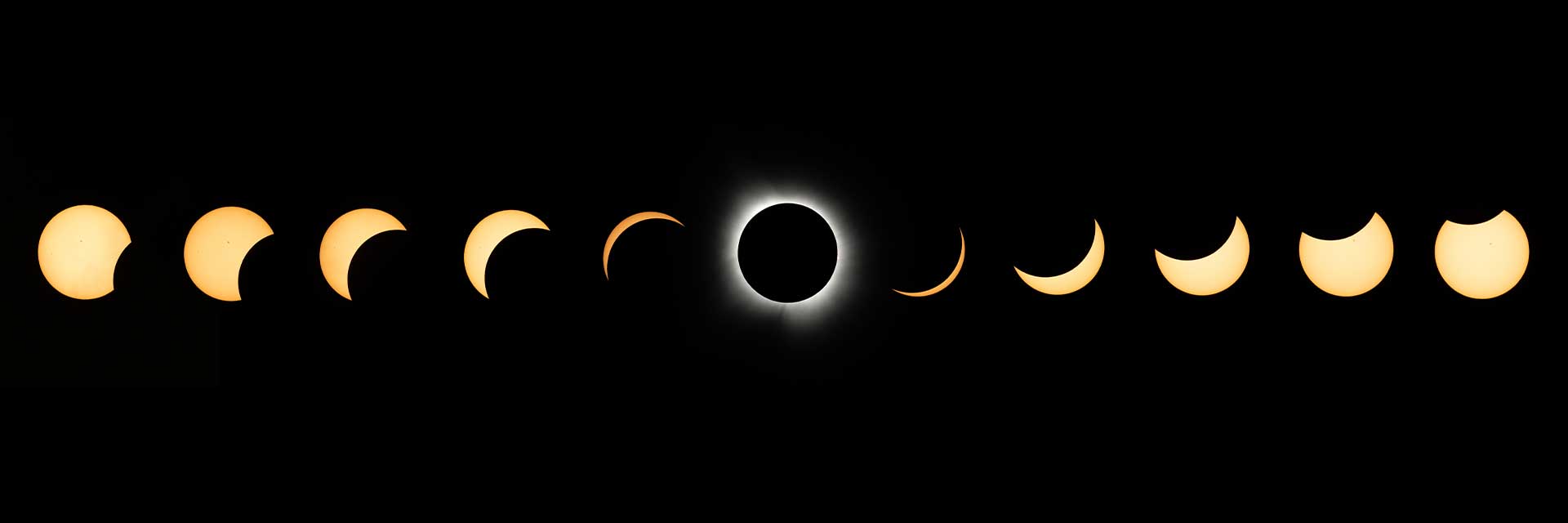
Multi-exposure composite showing the progression of a total solar eclipse from partial phases through totality and back — April 8, 2024

Eclipse Guide · Livestreams · August 12, 2026

Watch the August 12, 2026 Total Solar Eclipse Live Online

The path of totality crosses Spain, Iceland, and Greenland — but if you are watching from anywhere else, these free livestreams bring totality to your screen. Confirmed broadcasters, start times in every US time zone, and exactly what to watch for during the 2 minutes and 18 seconds of darkness.

DateAugust 12, 2026
Totality durationUp to 2 min 18 sec
Path of totalitySpain, Iceland, Greenland
Livestream starts~16:30 UTC (varies)
By Elena Reyes Published: Updated: Reviewed & approved by Juhi Sahni, Senior Editor Editorial Standards
Elena Reyes — Senior Science Editor

Elena Reyes

Senior Science Editor

Covers NASA missions, space science discoveries, and astronomical events for Telescope Advisor. Translates complex astrophysical research into practical insights for backyard observers. Based in the San Francisco Bay Area.

Quick Answer: Where to Watch the August 12, 2026 Eclipse Online

NASA's official broadcast will stream the eclipse live from multiple locations across Spain, beginning at approximately 12:30 PM ET (16:30 UTC) on August 12, 2026. NASA's feed is the most reliable option with expert commentary, telescope feeds, and real-time totality coverage. If NASA is your choice, bookmark plus.nasa.gov or the NASA+ app now.

Time and Date AS (timeanddate.com) will run a simultaneous free stream with interactive chat, multi-camera angles, and a real-time countdown. Their stream is particularly useful if you want community engagement alongside the eclipse — their chat room is one of the largest eclipse-watching communities online, with viewers from over 100 countries typically tuning in for major events.

ESA Web TV will broadcast from Iceland and Greenland, offering a unique perspective from the northern reaches of the path of totality. ESA's coverage typically includes interviews with on-site astronomers and behind-the-scenes preparations at remote observing sites.

If you miss the live stream, every broadcaster listed on this page archives their eclipse footage — but the real-time experience of watching totality unfold with thousands of other viewers is something replays cannot replicate. Bookmark this page now; we will update stream links and start times as broadcasters finalize their schedules in the weeks leading up to August 12.


Confirmed Livestreams for the August 12, 2026 Total Solar Eclipse

The following broadcasters have confirmed eclipse coverage for August 12, 2026. All streams are free to watch. Start times are approximate and will be refined as broadcasters finalize their production schedules — typically in the two weeks before the eclipse. We will update this page with exact links and timings as they become available.

NASA

NASA+ / NASA TV

NASA's flagship eclipse broadcast will feature live feeds from multiple locations across the path of totality in Spain, including professional solar telescopes, wide-angle cameras capturing the 360-degree sunset effect, and expert commentary from solar physicists and eclipse veterans. NASA's 2024 eclipse broadcast reached over 15 million concurrent viewers; the 2026 stream is expected to match or exceed that.

  • Platform: NASA+ (website, iOS, Android, Roku, Apple TV, Fire TV)
  • Expected start: ~12:30 PM ET / 16:30 UTC
  • Totality window: ~1:55 PM – 2:10 PM ET (depends on location)
  • Features: Multi-camera, expert commentary, telescope feeds, Spanish-language option
T&D

Time and Date AS (timeanddate.com)

Time and Date's eclipse streams are a staple for the global online astronomy community. Their 2024 stream accumulated over 10 million views across YouTube and their own platform. For 2026, they will broadcast from at least two locations in Spain with real-time eclipse tracking, interactive chat, and a countdown widget. Their stream is particularly well-suited for classrooms and group viewing because of the on-screen annotations and progress indicators.

  • Platform: timeanddate.com, YouTube
  • Expected start: ~12:00 PM ET / 16:00 UTC
  • Features: Interactive chat, multi-camera, real-time countdown, on-screen annotations
ESA

ESA Web TV

The European Space Agency will cover the eclipse from Iceland and Greenland — the northernmost segments of the path of totality. ESA's coverage offers a unique perspective: the Sun will be at a lower altitude (around 20–30 degrees above the horizon) in these northern latitudes, creating different photographic conditions and a more dramatic horizon glow during totality. ESA typically includes interviews with astronomers stationed at remote observing sites.

  • Platform: ESA Web TV (esa.int), YouTube
  • Expected start: ~1:00 PM ET / 17:00 UTC
  • Features: Northern path coverage, remote site feeds, astronomer interviews
RGO

Royal Observatory Greenwich

The Royal Observatory Greenwich will host a live stream featuring astronomers from the UK's oldest scientific institution. Their coverage will focus on the science of solar eclipses, with segments on coronal physics, solar magnetism, and how eclipses have advanced our understanding of the Sun throughout history. The Royal Observatory's stream is an excellent choice for viewers who want educational context alongside the visual experience.

  • Platform: YouTube, Royal Observatory website
  • Expected start: ~12:30 PM ET / 16:30 UTC
  • Features: Educational commentary, historical context, solar science focus
S&T

Sky & Telescope Magazine

Sky & Telescope's eclipse coverage is produced by and for experienced amateur astronomers. Their stream typically includes higher-magnification telescope feeds that show solar prominences, Bailey's beads, and the diamond-ring effect in greater detail than mainstream broadcasters. They also provide real-time analysis of the corona's structure and shape, which varies with the solar cycle — the 2026 eclipse occurs near solar maximum, meaning the corona will be exceptionally complex and active.

  • Platform: YouTube, skyandtelescope.org
  • Expected start: ~1:00 PM ET / 17:00 UTC
  • Features: High-mag telescope feeds, prominence tracking, corona analysis, experienced-amateur perspective

Note on stream availability: Livestream links are typically published 1–2 weeks before the eclipse. We will update this page with direct URLs as broadcasters announce them. If a stream is not yet listed with a direct link, bookmark the broadcaster's main eclipse page — they will host the stream there on eclipse day. All streams listed here are free and do not require a subscription.

Livestream Start Times by US Time Zone

The August 12 total solar eclipse reaches totality over Spain between approximately 18:55 and 19:10 UTC (depending on the exact location within the path). Most livestreams begin 30 to 90 minutes before totality to cover the partial phases. The table below converts these times to each US time zone so you can plan your viewing without doing the math.

Broadcaster Stream Start (ET) Stream Start (CT) Stream Start (MT) Stream Start (PT) Totality Window (ET)
NASA+ / NASA TV ~12:30 PM ~11:30 AM ~10:30 AM ~9:30 AM ~1:55–2:10 PM
Time and Date AS ~12:00 PM ~11:00 AM ~10:00 AM ~9:00 AM ~1:55–2:10 PM
ESA Web TV ~1:00 PM ~12:00 PM ~11:00 AM ~10:00 AM ~2:05–2:15 PM
Royal Obs. Greenwich ~12:30 PM ~11:30 AM ~10:30 AM ~9:30 AM ~1:55–2:10 PM
Sky & Telescope ~1:00 PM ~12:00 PM ~11:00 AM ~10:00 AM ~1:55–2:10 PM

Totality occurs simultaneously across all locations in the path — what changes is which broadcaster captures which segment. NASA's feed will focus on central Spain (where totality lasts approximately 2 minutes and 18 seconds near Bilbao). ESA's feed covers northern Iceland (shorter totality at ~1 minute 40 seconds but with dramatically different sky conditions). The time zone conversion above uses Eastern Daylight Time (UTC-4), Central Daylight Time (UTC-5), Mountain Daylight Time (UTC-6), and Pacific Daylight Time (UTC-7). If you are in Arizona or parts of Canada that do not observe daylight saving, subtract one additional hour from the Mountain Time column.

Pro tip: Open the stream 15 minutes before the listed start time. Eclipse livestreams often begin with a pre-show or countdown, and the first partial phase (first contact) is easy to miss if you tune in late. Set a calendar reminder now — you will not get a notification on eclipse day if you do not schedule it in advance.

Totality Timeline: What to Watch For During the 2 Minutes and 18 Seconds

If you have never watched a total solar eclipse online before, the experience is surprisingly immersive — a well-produced livestream captures not only the visual progression but also the audible reactions of the crowd, the commentary from experts, and the sudden environmental changes. Here is a minute-by-minute breakdown of what the broadcast will show.

C1 — First Contact (Partial Phase Begins): ~15 minutes before totality

The Moon takes its first bite out of the Sun's edge. On the livestream, you will see a small dark notch appear on the upper right quadrant of the solar disk. This is first contact — the moment the Moon's limb begins crossing the Sun. Over the next 15 minutes, the partial phase accelerates noticeably: the Sun becomes a narrowing crescent, the sky begins to take on an eerie gray-blue cast, and shadows on the ground (if the stream shows ground-level footage) become unusually sharp.

Baily's Beads: ~30 seconds before totality

As the crescent of the Sun narrows to a thin sliver, the last rays of sunlight pass through valleys on the Moon's irregular limb, creating a string of bright spots that appear to hug the edge of the Moon. These are Baily's Beads — named after Francis Baily, who first described the effect during an annular eclipse in 1836. High-magnification telescope feeds from Sky & Telescope are particularly good at resolving individual beads. The phenomenon lasts only a few seconds before the final bead vanishes.

Diamond Ring: ~5 seconds before totality

The last Baily's bead combines with the emerging inner corona to produce the diamond ring effect — a single brilliant point of sunlight surrounded by a soft pearly glow. This is arguably the most photographed moment of any eclipse. On the livestream, you will likely hear the crowd gasp. Within seconds, the diamond fades and the corona blossoms into full visibility.

T2 — Totality: 2 minutes 18 seconds

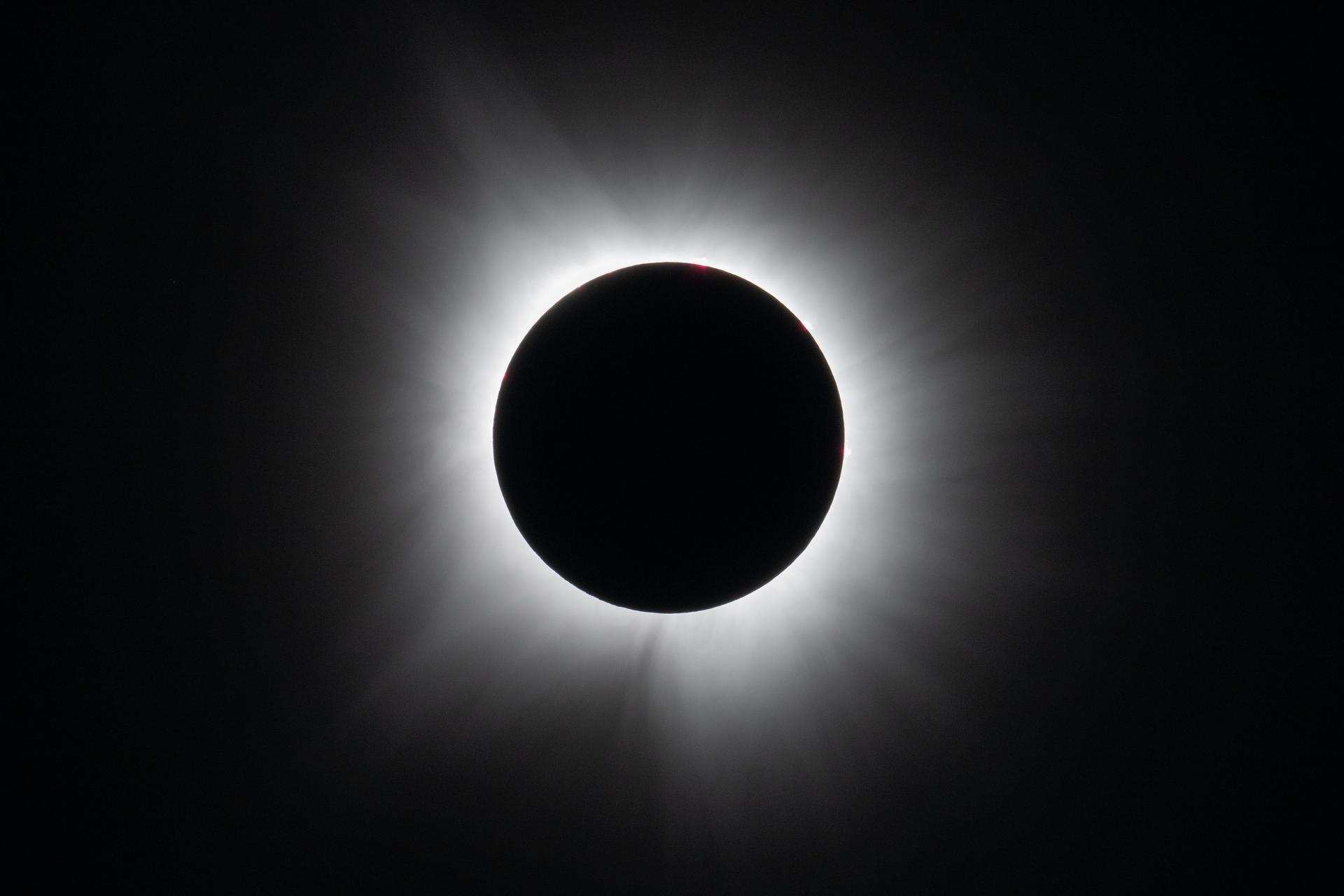
The Moon completely covers the Sun's disk. The corona — the Sun's outer atmosphere, normally invisible against the bright solar disk — becomes fully visible as a delicate white halo extending outward from the black silhouette of the Moon. During the 2026 eclipse (occurring near solar maximum), the corona is expected to be highly structured with prominent streamers, loops, and possibly coronal mass ejections visible as bright arcs or bubbles. The sky darkens to a deep twilight blue, bright stars and planets become visible (Venus and Jupiter will be prominent), and the horizon glows orange in all directions — a 360-degree sunset effect. Temperatures at ground level can drop by 5–10°F (3–6°C).

T3 — Third Contact (Totality Ends): Diamond ring in reverse

The first ray of sunlight re-emerges from behind the Moon's opposite limb, producing a second diamond ring. This marks the end of totality and the beginning of the partial phases in reverse. The corona fades within seconds. If you are watching on a livestream, this is a good moment to check the chat — viewers around the world will be sharing their reactions.

C4 — Fourth Contact (Partial Phase Ends): ~15 minutes after totality

The Moon's last visible contact with the Sun's edge. The eclipse is over. Most livestreams continue broadcasting for another 15–30 minutes with post-eclipse analysis, expert Q&A, and highlights from the event.

Partial Eclipse from the USA: What You Can See from Home

While the path of totality does not touch the continental United States in 2026, a partial solar eclipse will be visible across the eastern half of the country during the morning hours of August 12. The partial eclipse will be deepest — meaning the Moon covers the greatest percentage of the Sun — in the northeastern states, with coverage decreasing as you move south and west.

City Partial Eclipse Start (local) Maximum Eclipse Partial Eclipse End (local) Sun Coverage
New York, NY 11:34 AM ET 12:51 PM ET 2:11 PM ET ~18%
Boston, MA 11:30 AM ET 12:50 PM ET 2:13 PM ET ~22%
Washington, DC 11:38 AM ET 12:52 PM ET 2:08 PM ET ~14%
Chicago, IL 10:40 AM CT 11:50 AM CT 1:02 PM CT ~8%
Miami, FL 11:45 AM ET 12:42 PM ET 1:38 PM ET ~6%

From the US, the partial eclipse will be modest — even in Boston, the Sun will appear as a thin crescent only about one-fifth covered. You will need certified solar viewing glasses (ISO 12312-2) to observe it safely. Do not look at the partially eclipsed Sun without proper eye protection, even if the coverage is small. Eclipse glasses are inexpensive and widely available; pair them with the livestream for a complete eclipse experience on August 12.

If you miss this eclipse, the next total solar eclipse visible from the continental United States occurs on March 30, 2033 (Alaska only) and then August 23, 2044 (Montana and the Dakotas). A more accessible event for most Americans is the August 2, 2027 total solar eclipse in North Africa and the Middle East — which many US-based eclipse chasers are already planning to travel for.

Spanish & Icelandic Broadcasters: Local Coverage from the Path

Local broadcasters in Spain and Iceland will provide unique coverage that global streams cannot match — ground-level footage from city plazas, interviews with local astronomers, and real-time crowd reactions from the path of totality. These streams are especially valuable for viewers who want to see what it is like to experience totality from the ground in a specific location.

Spanish Broadcasters

  • RTVE (Radio Televisión Española) — Spain's national public broadcaster will provide comprehensive coverage from multiple locations across northern Spain, including Bilbao, Oviedo, and Santander. RTVE's coverage will be in Spanish and is expected to feature live feeds from the path of totality with local reporters stationed at major viewing events.
  • Televisión de Cataluña (TV3) — Catalan public television will cover the eclipse from the northeastern path, including Barcelona (where the eclipse will be near-total at ~92% coverage) and Girona.
  • EITB (Basque Country) — The Basque public broadcaster will stream from Bilbao and San Sebastián, which lie very close to the centerline of totality. The Basque region offers some of the most dramatic eclipse-viewing landscapes in Europe, with coastal cliffs and mountainous terrain framing the Sun.

Icelandic Broadcasters

  • RÚV (Iceland's National Broadcasting Service) — RÚV will cover the eclipse from Iceland's west coast, particularly around Reykjavik and the Snæfellsnes peninsula. Iceland's segment of totality occurs with the Sun low in the northwest sky, creating unusual photographic conditions with long shadows and dramatic landscape silhouettes.
  • Channel 2 (Stöð 2) — Iceland's commercial broadcaster will feature a morning broadcast from multiple viewing sites, with segments on how the eclipse aligns with Icelandic folklore and the country's unique geological setting.

Links to these local streams will be added as broadcasters finalize their eclipse programming — typically 2 to 3 weeks before August 12. Most European broadcasters offer free online streaming without geolocation restrictions. If you speak Spanish, the local coverage tends to include more atmospheric footage (town squares, beach viewing parties, mountain-top telescope setups) than the global feeds.

Mobile Apps & Secondary Streams: Watch from Your Phone

If you will be away from your computer on August 12, several mobile apps will carry eclipse streams. These are especially useful for watching during a lunch break, from a park, or while traveling.

NASA+ (iOS / Android / Roku / Apple TV / Fire TV)

NASA's streaming app carries the full eclipse broadcast with multi-camera feeds. The app supports background audio, so you can listen to commentary while doing other tasks. Download the app and set up notifications for eclipse day. Available on all major app stores.

YouTube (all platforms)

Every broadcaster listed on this page will stream simultaneously on YouTube. The YouTube app offers a stable cross-platform experience, and you can cast it to a TV using Chromecast. Search for "2026 total solar eclipse" on YouTube on August 12 and multiple live streams will appear in search results.

Time and Date Eclipse App

Time and Date's dedicated eclipse app provides a live stream alongside interactive eclipse maps, local timings, and cloud cover forecasts. The app automatically detects your location and shows you the eclipse circumstances for your specific city, even outside the path of totality.

Streaming tip: If you plan to watch on mobile, connect to Wi-Fi before the stream begins. Eclipse broadcasts in HD can consume 1–2 GB of data per hour. Download the streaming app at least a week in advance so you are not waiting for downloads on eclipse morning.

After August 12: What's Next for Eclipse Chasers

The August 12, 2026 total solar eclipse is a major event, but it is far from the last. The next 18 months offer an extraordinary sequence of solar eclipses that will make this period one of the most active in a generation. Here is what to watch for after August 12:

Date Type Path Duration
Feb 6, 2027 Annular solar eclipse Chile, Argentina, Uruguay ~7 minutes
Aug 2, 2027 Total solar eclipse Morocco, Spain (enclaves), Algeria, Tunisia, Libya, Egypt ~6 min 23 sec
Jan 26, 2028 Annular solar eclipse Ecuador, Colombia, Brazil ~10 minutes

The August 2, 2027 total solar eclipse is particularly significant: with a maximum totality duration of 6 minutes and 23 seconds (the longest until 2150), it is being called the "Eclipse of the Century." The path crosses North Africa from Morocco to Egypt, offering excellent weather prospects and accessibility from Europe and the Middle East. Many of the livestream broadcasters covering the 2026 eclipse will also cover 2027.

For US-based viewers, the next total solar eclipse visible from the contiguous 48 states occurs on August 23, 2044 (Montana and the Dakotas) and August 12, 2045 (coast to coast from California to Florida). The 2045 eclipse is particularly anticipated as it will track across the entire continental US, similar to the 2017 and 2024 events.

Get Ready for the Next One

The August 12, 2026 eclipse is just the beginning. The "Eclipse of the Century" on August 2, 2027 delivers over 6 minutes of totality — and the right gear makes all the difference. Solar viewing glasses, solar filters for your telescope, and eclipse photography equipment sell out fast before major events. Check our gear guide for the equipment that will serve you through both the 2026 and 2027 eclipses.

Eclipse Viewing Gear Guide →
Total solar eclipse corona — the Sun's outer atmosphere visible during totality

Frequently Asked Questions

What time is the eclipse livestream on August 12, 2026?

Most livestreams begin between 12:00 PM and 1:00 PM ET (16:00–17:00 UTC), with totality occurring between approximately 1:55 PM and 2:10 PM ET. NASA's broadcast starts around 12:30 PM ET, while Time and Date's stream starts earlier at approximately 12:00 PM ET. Check the start time table in this guide for exact times by broadcaster and US time zone.

Can I watch the 2026 eclipse online for free?

Yes. Every livestream listed in this guide is completely free to watch. NASA's broadcast is available on NASA+ (free, no subscription required), Time and Date streams on YouTube, and ESA Web TV on their website. You do not need a cable subscription, streaming service, or paid account to watch any of these broadcasts.

Will the total solar eclipse be visible from the United States?

No — the path of totality does not reach the continental United States. However, a partial solar eclipse will be visible from the northeastern US, with Boston seeing approximately 22% of the Sun covered at maximum. Viewers in the US can watch the full event via livestream from Spain, Iceland, and Greenland where totality occurs.

How long does totality last for the 2026 eclipse?

The maximum duration of totality is 2 minutes and 18 seconds, occurring near the center of the path in northern Spain. Totality is shorter at the edges of the path and in Iceland (approximately 1 minute 40 seconds). The next total solar eclipse, on August 2, 2027, offers dramatically longer totality at 6 minutes and 23 seconds.

Which broadcaster has the best eclipse livestream?

NASA's broadcast is the most reliable with the highest production value, multiple camera angles, and expert commentary. For technical detail (solar prominences, corona structure), Sky & Telescope's stream with high-magnification telescope feeds is excellent. Time and Date offers the best community experience with interactive chat. If you want local atmosphere, Spanish broadcaster RTVE provides ground-level footage from city viewing events.

What equipment do I need to photograph the 2026 eclipse?

For the partial phases, a DSLR or mirrorless camera with a telephoto lens (200mm or longer) and a certified solar filter is essential. During totality, remove the filter to capture the corona. A sturdy tripod, remote shutter release, and practice with the sequence of exposures (from partial through totality) will dramatically improve your results. Our eclipse viewing guide covers recommended gear for both photography and safe visual observation.

Will there be another total solar eclipse after 2026?

Yes. The next total solar eclipse after August 12, 2026 occurs on August 2, 2027, crossing North Africa and the Middle East with a maximum totality of 6 minutes and 23 seconds — the longest until 2150. Following that, a total eclipse on July 22, 2028 crosses Australia and New Zealand. The next total eclipse visible from the contiguous US is on August 23, 2044.