
How Many Stars Can You See Through a Telescope? (vs. Naked Eye)
Telescope Advisor Logo Telescope Advisor
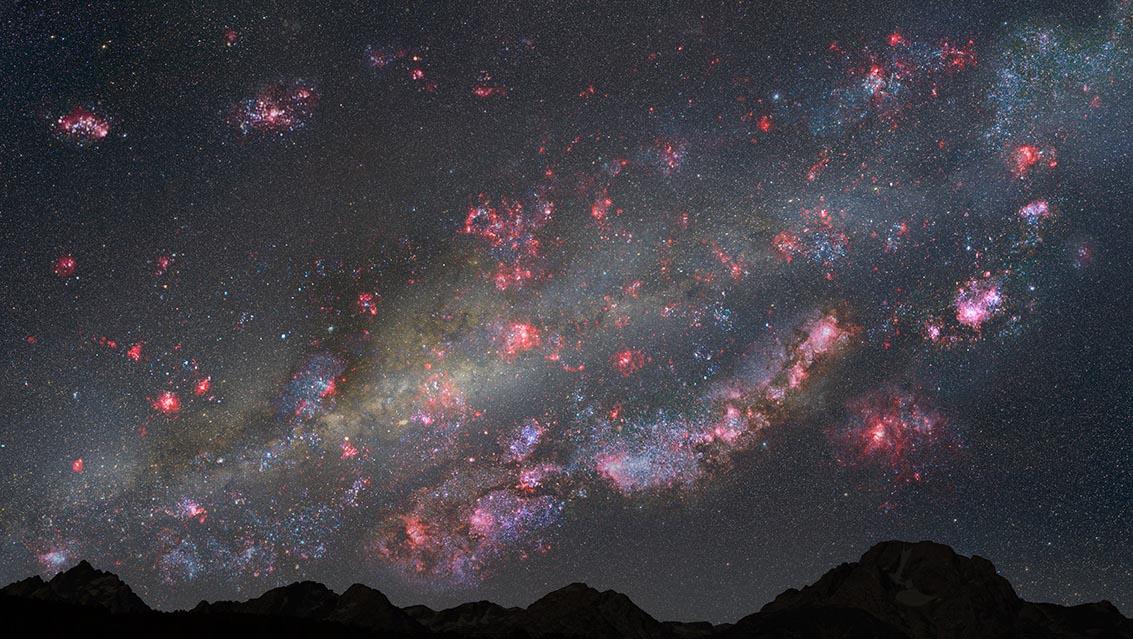
Milky Way arch over a dark landscape — the sky is packed with millions of stars invisible to the naked eye

STAR-GAZING GUIDE · EDUCATIONAL

How Many Stars Can You See Through a Telescope?

With your naked eyes you can see roughly 4,500 stars. A 130mm telescope reaches 1.8 million. The jump is real — here’s exactly how it works.

~4,500

Naked Eye (Dark Sky)

~1.8M

Through a 130mm Scope

400×

More Stars Than Naked Eye

6.5 → 12.7

Limiting Magnitude Gain

By Telescope Advisor Editorial Team Published: Updated: Editorial Standards

Stars Visible by Aperture — Quick Reference

The number of stars visible through a telescope is governed by limiting magnitude — the faintest star your instrument can detect. Each full step in magnitude reaches roughly 3× more stars. Here’s how the numbers stack up across common apertures:

Instrument / Aperture Limiting Magnitude Approx. Stars Visible vs. Naked Eye
👀 Naked eye (suburban) Mag 4.5 ~500 baseline
👀 Naked eye (dark sky) Mag 6.5 ~4,500 9× suburban
🔬 10×50 binoculars Mag 9.5 ~80,000 18× naked eye
🔭 70mm telescope Mag 11.3 ~270,000 60× naked eye
🔭 102mm (4″) telescope Mag 12.1 ~600,000 133× naked eye
🔭 130mm (5″) telescope Mag 12.7 ~1,800,000 400× naked eye
🔭 200mm (8″) telescope Mag 13.6 ~4,000,000 890× naked eye
🔭 300mm (12″) telescope Mag 14.5 ~14,000,000 3,100× naked eye

ⓘ Star counts are estimates based on the Hipparcos and Tycho-2 star catalogs. Limiting magnitude formula: Mlim = 2.1 + 5 × log10(Dmm). Actual results vary with atmospheric seeing, sky darkness, and observer experience.

The Science: What Is “Limiting Magnitude”?

Astronomers measure star brightness on a magnitude scale where lower numbers mean brighter. Sirius (the brightest star) is magnitude −1.46. The faintest stars your eye can detect in perfect dark skies are around magnitude 6.5. A “limiting magnitude” is simply the faintest object your instrument can show.

The Limiting Magnitude Formula

Mlim = 2.1 + 5 × log10(Dmm)

Where Dmm is your telescope’s aperture in millimetres. This is the Nemec – Crumey formula for point-source limiting magnitude under good conditions, widely used in practical astronomy literature.

70mm scope

2.1 + 5 × log(70)

= Mag 11.3

130mm scope

2.1 + 5 × log(130)

= Mag 12.7

203mm scope

2.1 + 5 × log(203)

= Mag 13.6

Why Does Aperture Matter So Much?

A telescope’s primary function for star-counting is not magnification — it’s light gathering area. The human pupil opens to about 7mm in full darkness. A 70mm telescope has a collecting area 100 times larger. A 200mm telescope has over 800 times the light gathering of your eye.

Aperture Collecting Area vs. Dark-Adapted Eye (7mm)
7mm (eye) 38 mm² 1× (baseline)
50mm refractor 1,963 mm² 51×
70mm refractor 3,848 mm² 100×
102mm (4″) 8,171 mm² 213×
130mm (5″) 13,273 mm² 344×
203mm (8″) 32,365 mm² 841×

More light gathered means fainter stars become detectable. And because the stellar population increases steeply as you go fainter (roughly tripling with every full magnitude step), even a modest aperture increase unlocks a dramatically richer sky.

Sky Darkness Matters as Much as Aperture

The limiting magnitude formula assumes dark skies (Bortle 4 or better). Light pollution raises your sky’s background brightness, which drowns out faint stars regardless of aperture. A 200mm telescope under city skies may see fewer stars than a 70mm telescope at a dark site.

💡 Practical impact on a 130mm telescope

  • Bortle 9 (city core): limiting mag ~10.5 → ~200,000 stars — aperture advantage largely wasted
  • Bortle 6 (suburban): limiting mag ~11.5 → ~450,000 stars
  • Bortle 4 (rural): limiting mag ~12.7 → ~1,800,000 stars — full aperture potential
  • Bortle 2 (exceptional): limiting mag ~13.2+ → >3,000,000 stars

⚠ The city vs dark site trade-off

For planet viewing (Jupiter, Saturn, the Moon), light pollution barely matters — these objects are bright enough to overwhelm it. But for star-counting, the Milky Way, nebulae, and star clusters, driving 30 minutes to a dark site unlocks more sky than buying a bigger telescope. Both matter — dark skies compound aperture.

What You Actually Experience: Star-Counts in Practice

Raw numbers tell part of the story. Here’s what those numbers look and feel like at the eyepiece:

👀

Naked eye (dark sky): ~4,500 stars

The whole sky is beautiful but finite. You can name the constellations easily — each one has just a handful of bright stars. The Milky Way appears as a soft, diffuse glow — you know it’s made of stars, but they don’t resolve individually. The Pleiades cluster shows 6–7 individual stars. Globular clusters like M13 (Hercules) appear as faint fuzzy smudges, their individual stars completely invisible.

🔬

70mm telescope: ~270,000 stars

The Milky Way begins to resolve into a dense carpet of individual stars at low power (25×–40×). The star field in Sagittarius — pointed toward the galactic center — becomes genuinely crowded. Globular cluster M13 starts to show a granular texture; its edges hint at resolution. Open clusters like the Pleiades and Hyades fit beautifully in wide-field eyepieces with dozens of member stars visible.

130mm telescope: ~1,800,000 stars

The Milky Way is now a river of resolved stars — individual points of light packed edge to edge. Sweeping through Sagittarius in a 26mm eyepiece is one of the most rewarding experiences in amateur astronomy. M13 starts to resolve into individual stars at 130×+; the cluster’s core still glows but the outer regions sparkle. Star counts in a single eyepiece field in the Milky Way core approach hundreds of visible stars simultaneously.

200mm telescope: ~4,000,000 stars

Globular cluster M13 fully resolves — you’re seeing perhaps 100,000 individual stars packed into a sphere, each one distinct. The Milky Way becomes so dense in places that empty patches of sky are more notable than star-filled ones. Faint galaxies appear against a background already rich with stars. This is the aperture where “how many stars” becomes “too many to count”.

💡 The single most impactful target for star-counting: globular clusters

Globular clusters are gravitationally bound balls of 50,000 to 1,000,000 ancient stars. M13 in Hercules, M22 in Sagittarius, and ω Centauri in the southern hemisphere each contain hundreds of thousands of stars in a sphere a few hundred light years across. Watching a globular “pop” from a fuzzy blob into a resolved glittering ball as aperture increases is the most visceral illustration of what a bigger telescope actually does to star-counts.

Best Telescopes for Seeing More Stars

For star-counting, aperture per dollar is the key metric. Here are three picks across the price spectrum.

Editor’s Pick — Most Stars Per Dollar
Sky-Watcher Heritage 130P tabletop Dobsonian telescope

Best for Deep Star Fields & Clusters

Sky-Watcher Heritage 130P

130mm f/5 parabolic Newtonian · tabletop Dobsonian · limiting mag ~12.7

At 130mm aperture, the Heritage 130P reaches an estimated 1.8 million stars — about 400 times more than your naked eyes. The fast f/5 focal ratio produces wide, bright star fields at low magnification that make Milky Way sweeping spectacular. Globular clusters like M13 begin to partially resolve. The short, portable tube stores under a bed and sets up in two minutes. This is the sweet spot for star-count per pound of telescope.

Celestron AstroMaster 70AZ refractor telescope

Budget Pick — 270,000 Stars With an Entry-Level Scope

Celestron AstroMaster 70AZ

70mm f/10 refractor · alt-az mount · limiting mag ~11.3

The 70mm aperture of the AstroMaster already represents a 60× increase over naked-eye star counts. At 30×–50×, the Milky Way begins to resolve into individual stars and open clusters like the Pleiades, Hyades, and M35 fill the eyepiece with jewel-like star fields. It’s a clear, immediate improvement over the naked eye — and a satisfying first telescope for anyone who wants to understand what “more stars” actually feels like.

Celestron NexStar 8SE computerized telescope

Premium Pick — Resolves Globular Clusters Into Individual Stars

Celestron NexStar 8SE

203mm f/10 SCT · GoTo computerized mount · limiting mag ~13.6 · ~4 million stars

With 203mm of aperture, the 8SE gathers over 840 times more light than the human eye. The defining experience at this aperture is globular cluster resolution: M13, M22, M5 — each one transforms from a fuzzy glow into a resolved ball of thousands of individual stars. The GoTo mount finds any of the 40,000+ targets in its database automatically, so you spend your time observing rather than searching.

Frequently Asked Questions

How many stars can you see with the naked eye from a dark location?

Under excellent dark sky conditions (Bortle 3–4, no Moon), you can see approximately 4,500 stars at any one time — these are all the stars brighter than magnitude 6.5 in the hemisphere of sky above your horizon. From the entire globe, there are about 9,100 stars brighter than magnitude 6.5. In suburban skies (Bortle 6–7), that drops to 500–1,000 visible stars as light pollution brightens the sky background and washes out faint ones.

Does magnification affect how many stars you can see?

For counting total stars, low magnification (25×–50×) is better than high magnification. Low power gives you a wider field of view, so more stars fit in the eyepiece at once, and the sky background stays darker, making faint stars easier to detect. High magnification narrows the field dramatically — useful for resolving planetary detail but it actually reduces the number of stars visible at any moment. For Milky Way sweeping and star fields, use your lowest-power, widest-field eyepiece.

How many stars are there in total in the Milky Way?

Current estimates place the number of stars in the Milky Way at 100–400 billion. The vast majority are too faint to see in even the largest amateur telescopes — most are red dwarf stars smaller and dimmer than the Sun, distributed across the 100,000 light-year diameter of the galaxy. The 14 million stars reachable with a 300mm amateur telescope represent a tiny fraction of the galaxy’s stellar population, mostly the brighter, closer stars within a few thousand light-years of Earth.

Can a telescope show stars in a completely new way — not just more of them?

Yes. One of the most surprising discoveries for new telescope owners is that many apparent “single stars” are actually double stars — two stars orbiting each other, too close for the naked eye to separate. Albireo (Beta Cygni) is a stunning gold and blue double. Epsilon Lyrae is a “double double” — what looks like two stars at 30× resolves into four individual stars at 100×+. A telescope doesn’t just count stars, it reveals hidden structure.

What aperture do I need to see the Milky Way resolved into individual stars?

You can begin resolving the Milky Way into individual stars in a 70mm telescope at 30×–50× from a dark sky site. The experience significantly improves at 100mm+. With 130mm and a wide-field 2″ eyepiece at 25×–40×, sweeping the Milky Way through Cygnus, Sagittarius, or Scorpius is one of the most immersive experiences in amateur astronomy — the sky transforms from a glow into a river of individual points.

Related Guides