Does Light Pollution Ruin Telescope Viewing? What Urban Observers Can Still See | Telescope Advisor
Telescope Advisor Logo Telescope Advisor
Starry night sky over a suburban area — light pollution affects some targets more than others

Urban Stargazing Guide · 2026

Does Light Pollution Ruin Telescope Viewing?

The honest answer — with exactly what you can and can’t see from a city or suburban backyard.

No

Planets still brilliant

80%

Of targets visible from suburbs

Bortle

The key number to know

Filters

Can recover some deep sky

By Telescope Advisor Editorial Team Published: Updated: Editorial Standards

The Short Answer

No — light pollution does not ruin telescope viewing. The planets (Saturn, Jupiter, Mars, Venus), the Moon, double stars, and most star clusters look just as impressive from a city backyard as from the countryside. Light pollution only significantly affects faint deep-sky objects — distant galaxies and dim nebulae. For most beginners, their first year of targets is barely touched by light pollution at all.

Light pollution doesn’t matter for these

  • The Moon — completely unaffected (it’s brighter than your streetlight)
  • All planets — Saturn, Jupiter, Mars, Venus, Mercury
  • Double stars — unaffected at any magnification
  • Open clusters — Pleiades, Beehive, Hyades (fine in Bortle 7)
  • Globular clusters — M13, M3, M92 visible in Bortle 6–7
  • Bright nebulae — M42 Orion Nebula (visible even from city)
  • Solar system targets — asteroids (bright), comets (nucleus)

Light pollution does affect these

  • Faint galaxies — M101, M51, Leo triplet (need Bortle 4 or better)
  • Large diffuse nebulae — California, Rosette (need dark skies)
  • The Milky Way — structure washed out in Bortle 7+
  • Comet tails — full extent suppressed by skyglow
  • Faint planetary nebulae — difficult from Bortle 7+
  • Zodiacal light — invisible from suburban areas

The Bortle Scale: Your Single Most Useful Number

The Bortle Dark-Sky Scale (1–9) measures the darkness of the sky at your observing site. Most suburban backyard observers are Bortle 5–7. Most cities are Bortle 8–9. Check your location on lightpollutionmap.info →

Class Sky type What the sky looks like Telescope performance
1–2 Excellent dark sky Milky Way casts shadows. Zodiacal light bright. Hundreds of naked-eye stars. Very rare — remote desert or mountain. Elite Everything visible
3 Rural sky Milky Way structure obvious. Some airglow on horizon. Outer suburbs of small towns on a clear night. Excellent Faint galaxies visible
4 Rural / suburban transition Milky Way visible but lacks fine structure. Light domes visible on horizon from small cities. National park campgrounds. Very good Most deep sky accessible
5 Suburban sky Milky Way patchy but visible overhead. Light dome from nearest city prominent. Typical exurban/outer suburb. Good Most objects visible
6 Bright suburban Milky Way barely visible. Horizon washed out by skyglow. Sky looks pale white-gray at low altitudes. Typical inner suburb. Decent Planets, clusters, bright nebulae
7 Suburban / urban transition Milky Way invisible. Sky is noticeably light at zenith. Many stars invisible to naked eye. City outskirts. Limited Moon, planets, clusters
8 City sky Sky appears orange-white. Milky Way totally invisible. Only ~100 naked-eye stars. Typical city backyard. Urban Moon & planets excellent
9 Inner city Sky is bright enough to read a newspaper. Stars barely visible. Telescope used as pure optical instrument for planets. City center Planets only

💡 Key insight for most readers: The majority of backyard astronomers in the US, UK, and Australia are in Bortle 5–6. This means the Moon, all planets, double stars, open clusters, globular clusters, and the brightest 50–100 deep-sky objects are fully accessible from your backyard. That’s more than a lifetime’s worth of observing. How many stars can you actually see with a telescope? →

What You Can See From a Light-Polluted Sky

🌙

The Moon — Your Best Target, 100% Unaffected

The Moon is brighter than any source of light pollution. Craters, mountain ranges, the Sea of Tranquility, the terminator line (the shadow boundary) — all of these are best viewed with a telescope no matter where you live. The Moon is the single best target for a beginner in any sky condition, and it’s spectacular. Ironically, many experienced astronomers prefer the full Moon from a dark sky because the glare washes out faint deep-sky objects — in the city you have nothing to lose, so enjoy the view.

🍝

All Planets — Completely Immune to Light Pollution

Saturn’s rings, Jupiter’s cloud bands and the four Galilean moons, Mars’s polar ice caps, Venus’s crescent phases — all of these are viewed under high magnification, which spreads the faint sky background out but concentrates the bright planetary image. A telescope at 150× from a Bortle 9 city center gives an identical view of Saturn’s rings to the same scope under Bortle 2 dark skies. The planet image is simply too bright for light pollution to compete.

Double Stars — A Lifetime of Targets in Any Sky

There are thousands of double and multiple star systems in the sky, and all of them are bright point sources that cut right through light pollution. Albireo (a stunning gold and blue pair in Cygnus), Mizar & Alcor in Ursa Major, Epsilon Lyrae (the Double Double — two close pairs), Castor in Gemini (six stars in three pairs) — these are best viewed at medium-high magnification and are unaffected by skyglow. Double-star observing is one of the most rewarding and entirely underrated specialties in amateur astronomy.

Star Clusters — Most Work Fine From Suburbs

Open clusters like the Pleiades (M45), the Beehive (M44), and the Double Cluster in Perseus are bright enough to be visible from Bortle 6–7 skies. Globular clusters — dense balls of 100,000+ stars — like M13 (Hercules) and M3 (Canes Venatici) are compact enough to punch through moderate light pollution. The view from a Bortle 6 suburban sky with a 5-inch scope is genuinely beautiful. Low magnification gives a spectacular rich star field; higher magnification resolves the individual stars of globular clusters into a glittering ball.

🌌

Bright Nebulae — Still Accessible, Better With Filters

The Orion Nebula (M42) is visible even to the naked eye and is stunning through a telescope even from city centers. The Ring Nebula (M57) is compact enough to be visible from Bortle 7 skies with a 4-inch telescope. A narrowband or UHC filter (see the filters section below) dramatically improves nebula contrast under light pollution by blocking the specific wavelengths of artificial light while letting through the wavelengths nebulae emit. With a $60 filter, a Bortle 6-7 suburban sky becomes usable for several dozen bright emission nebulae.

What Light Pollution Does Affect

Light pollution raises the background brightness of the sky. For bright objects, this background noise is irrelevant — the signal (your target) is far brighter. For faint objects, the background competes with the target and overwhelms it. This is why some targets are immune while others are severely affected.

Target type Bortle 5–6 (suburb) Bortle 7–8 (city) Fix?
Moon & planets Unaffected Unaffected None needed
Double stars Unaffected Unaffected None needed
Open clusters Good Reduced contrast Use higher mag
Globular clusters Good Visible, less resolved More aperture
Bright emission nebulae (Orion, Ring) Reduced but visible Dim but detectable UHC/OIII filter
Large diffuse nebulae (California, Rosette) Very difficult Invisible Drive to dark sky
Bright galaxies (M31, M81, M82) Detectable but faint Very difficult Smart scope / dark sky
Faint galaxies (M101, Leo Triplet) Difficult Effectively invisible Drive to dark sky
The Milky Way Patchy, reduced Invisible Drive to dark sky

💡 Practical reality check: A beginner telescope user typically spends their first 6–12 months exploring the Moon, planets, double stars, and bright clusters. All of these are entirely accessible from a suburban or urban backyard. Deep-sky frustration only arrives later, after the beginner-phase targets are well-explored — and by then, the observer knows enough to plan a dark-sky trip for the faint stuff.

Do Light Pollution Filters Work?

The short answer: it depends entirely on the target. Filters work by blocking certain wavelengths of light. Most artificial light pollution (mercury vapor, sodium, LED streetlights) emits in specific narrow wavelength bands. A narrowband filter that blocks those bands while transmitting the wavelengths emitted by nebulae can dramatically improve contrast — but only if the target emits at those specific wavelengths.

Works well

Emission nebulae

Orion Nebula, Ring Nebula, Dumbbell Nebula, Lagoon, Trifid, Crab. These emit primarily at Hα (656nm) and OIII (500nm) wavelengths. A UHC or OIII filter blocks the streetlight bands and passes these. Result: dramatically improved contrast from suburban skies.

⚠️ Helps a little

Planetary nebulae & reflection nebulae

Small, bright planetary nebulae (M57, M27) benefit from OIII filters. Reflection nebulae (Pleiades nebulosity, Merope) don’t — they reflect broadband starlight in the same spectrum as light pollution.

Doesn’t help

Galaxies, planets, stars

Galaxies emit broadband starlight across all wavelengths — the same spectrum as light pollution. No filter can distinguish galaxy light from streetlight. Planets and the Moon are far brighter than LP and need no filter.

Filter types: “Broadband LPR” filters (sold by Celestron, Zhumell, etc.) offer modest improvement across many targets. UHC (Ultra-High-Contrast) filters offer significant improvement for emission nebulae. OIII filters are the most aggressive — best for planetary nebulae and emission nebulae but they make everything else very dim. Start with a UHC if you want one filter that does the most from suburban skies. Budget: $60–$120 for a quality UHC in 1.25-inch format.

7 Practical Tips for Urban Observers

1

Aim high in the sky

Objects near the zenith pass through far less atmosphere (and light pollution) than objects on the horizon. When Saturn or Jupiter are high overhead, the views improve dramatically compared to when they sit low on the horizon through 5× more atmosphere.

2

Observe after opposition

Saturn opposition (October 4, 2026) and Jupiter opposition (January 2027) are the nights each planet is closest, largest, and highest in the midnight sky. Scheduling around oppositions maximizes planetary view quality even from the city.

3

Wait for the atmosphere to settle

Planets twinkle and blur due to atmospheric turbulence. The best planetary views come 1–2 hours after sunset when the atmosphere cools and stabilises. Nights after rain are especially steady.

4

Dark-adapt your eyes

Your eyes need 20–30 minutes to fully dark-adapt. Avoid looking at a phone screen, porch light, or bright streetlights during an observing session. Even a single glance at a bright light resets dark adaptation. Use a red flashlight if you need to read star charts.

5

Use averted vision for faint objects

Your eye’s peripheral vision (using rod cells) is significantly more sensitive to faint light than direct vision (cone cells in the fovea). When looking at a dim nebula or galaxy, look slightly to the side of it — it pops into view. This technique can recover targets that seem invisible with direct vision.

6

Know your light pollution map

Use lightpollutionmap.info to find your Bortle class and discover how far you need to drive for darker skies. Often, a 30–45 minute drive to a county park or rural area drops you from Bortle 7 to Bortle 4–5 — a massive improvement for deep-sky viewing.

7

Use GoTo to bypass star-hopping problems

Light pollution makes star-hopping (finding objects by navigating from bright stars) difficult — many reference stars are invisible. A computerized GoTo telescope finds objects automatically by coordinates, regardless of your sky brightness. This makes faint targets findable even from Bortle 7–8 skies where the object itself is visible but nearly impossible to locate by traditional methods.

Best Telescopes for Light-Polluted Skies

These three telescopes are especially well-suited to city and suburban observers. Each excels at the targets light pollution doesn’t affect, and all three have practical advantages for backyard use in sub-ideal skies.

Editor’s Pick — Best for Urban Planetary Observers
Celestron NexStar 5SE

Celestron NexStar 5SE

5″ SCT • 1,250mm focal length • GoTo mount • ~$649

The NexStar 5SE is the ideal city telescope. Its 5-inch (127mm) aperture is large enough for stunning planetary views — Saturn’s Cassini Division, Jupiter’s cloud bands and Great Red Spot, Mars’s polar caps — and the GoTo computerized mount finds every object automatically, which is essential when light pollution hides the reference stars needed for manual star-hopping. Setup takes under 10 minutes. The 1,250mm focal length gives naturally high magnification: a standard 10mm eyepiece delivers 125×, hitting the planetary sweet spot immediately. Compact enough to set up on an apartment balcony.

GoTo finds objects despite LP Saturn Cassini Division at 150× Balcony/apartment ready
View on Amazon →
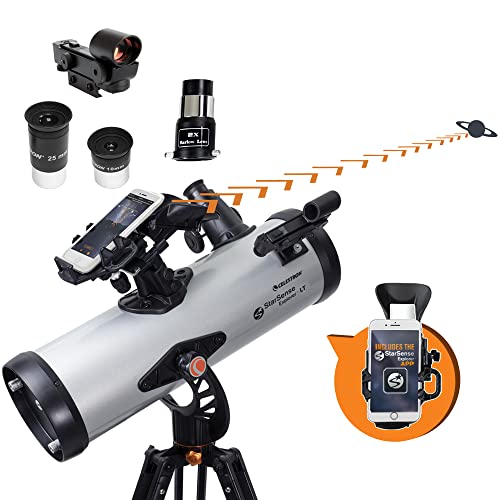
Celestron StarSense Explorer LT 114AZ

Celestron StarSense Explorer LT 114AZ Best for suburbs

4.5″ Newtonian • 1,000mm focal length • StarSense app pointing • ~$229

The StarSense Explorer solves the suburban observer’s biggest problem: finding objects in a sky where only a fraction of the usual guide stars are visible. The StarSense dock attaches your smartphone, which analyses a photo of the sky and points you to any object in a database of 4,000+ targets — no alignment, no setup, no experience required. The 114mm aperture handles planets well (Saturn’s rings and Jupiter’s moons easily) and shows the brighter Messier objects from Bortle 5–6 suburban skies. An excellent first telescope for an urban household.

Finds objects without star-hopping ~$229
View on Amazon →
ZWO Seestar S50 smart telescope

ZWO Seestar S50 Best for deep sky under LP

50mm smart scope • digital stacking • app-controlled • ~$499

If you live in a Bortle 7–8 city sky and want to see galaxies and nebulae beyond the reach of conventional telescopes under those conditions, the Seestar S50 is the answer. It uses digital long-exposure stacking — automatically taking dozens of images and combining them to dig out faint detail that light pollution would wash out in a single exposure. Andromeda, the Orion Nebula, the Pleiades nebulosity, the Whirlpool Galaxy — all revealed on your phone in near-real time from your backyard, regardless of Bortle class. It works completely differently from a traditional eyepiece scope, but for city observers wanting deep-sky views, it’s genuinely transformative.

Deep sky in Bortle 7-8 skies No experience required ~$499
View on Amazon →

Frequently Asked Questions

Can I use a telescope in my backyard with streetlights nearby?

Yes, absolutely. Streetlights affect the naked-eye sky but barely affect what you see through a telescope at high magnification. Position yourself so the streetlight is behind or beside you (not in your field of view), wait 10 minutes for your eyes to adjust, and observe. The Moon and planets are completely unaffected. For deep-sky objects, use a hood or shield around your head to block direct glare from nearby lights.

How do I find out my Bortle class?

Go to lightpollutionmap.info and zoom into your location. The colour overlay shows your Bortle class: white/red = Bortle 8–9 (city), orange = 7, yellow = 6, green = 5, blue/grey = 4–3, dark = 2–1. Most inner city residents are Bortle 8–9; most outer suburbs are Bortle 5–7; a 30-minute drive to a rural area typically reaches Bortle 4–5.

Should I buy a cheaper telescope and drive to dark skies, or a better one for home use?

For most beginners, the best option is a capable telescope for home use — because you’ll use it far more often. The planets and Moon are always accessible from home, and a good telescope once a week beats a great telescope once a month at a dark-sky site. If you later develop a strong interest in faint deep-sky objects, plan occasional dark-sky trips as a supplement. The compromise: the NexStar 5SE works brilliantly from home and is still excellent at a dark site.

Does more aperture help under light pollution?

Yes, but not as much as under dark skies. More aperture gathers more light — but it also gathers more background sky glow, so the signal-to-noise ratio improves less dramatically under light-polluted skies than under dark skies. A 10-inch under Bortle 8 skies doesn’t perform as much better than a 6-inch as it would under Bortle 4. That said, more aperture still helps: globular clusters resolve better, planetary detail improves, and faint stars within the brightened background sky become more accessible. For planets, aperture always helps regardless of light pollution.

Is light pollution getting better or worse?

Generally worse globally — but some local improvements are possible. The LED transition in streetlighting initially made light pollution worse (LEDs emit more blue light, which scatters more in the atmosphere and is more damaging to dark adaptation than the old orange sodium lamps). However, some municipalities now use fully shielded “dark sky friendly” LEDs that direct light only downward, with low-color-temperature warm LEDs that scatter less. Organizations like the International Dark-Sky Association (DarkSky.org) work with local governments on dark-sky friendly lighting ordinances. Participation in local astronomy clubs that advocate for dark-sky lighting can make a real difference.

Related Guides