Best Telescope to See the Orion Nebula (M42) — 2026 Guide
Telescope Advisor Logo Telescope Advisor
The Orion Nebula (M42) as seen through a telescope — the brightest emission nebula in the sky and the most rewarding deep-sky object for beginner telescope owners

Buying Guide · Deep Sky

Best Telescope to See the Orion Nebula (M42) — 2026 Complete Guide

The Orion Nebula is the most observed deep-sky object in the night sky — and for good reason. Unlike most nebulae that require large apertures and dark skies, M42 reveals its structure through even the smallest telescopes. This guide helps you choose the right telescope to get the best possible view of the Orion Nebula at every budget level.

Object typeEmission nebula (M42)
Apparent magnitude4.0
Best seasonNovember – March
Best aperture130mm+ for detail
By Telescope Advisor Editorial Team Published: Updated: Editorial Standards Star-Hop Finder Guide →

Quick Answer: What Telescope Do I Need for the Orion Nebula?

Every telescope shows the Orion Nebula, but the experience varies enormously with aperture. Binoculars (10×50): a fuzzy patch below Orion's Belt — clearly non-stellar, with a hint of brightness at the centre. 70–80mm refractor at 40×: a bright greenish-grey cloud with a brighter core, the four stars of the Trapezium clearly visible. 130mm (5-inch) at 60–80×: the nebula fills the eyepiece with mottled structure, the Trapezium stars sharp and distinct, and the "wings" of the nebula extending outward. 200mm (8-inch) at 100–150×: the full grandeur of M42 — delicate filaments, dark lanes (the "Fish's Mouth"), and subtle colour visible on steady nights.

What M42 Looks Like Through Different Apertures

Instrument Tier Magnification What You'll See
10×50 binocularsEntry10×Small fuzzy patch below Orion's Belt, clearly non-stellar. The easiest deep-sky object in the sky to find.
70mm refractorEntry40–60×Bright grey-green cloud with distinct core. Trapezium stars easily split. The shape of the nebula is clear.
130mm (5") DobsonianMid-tier60–80×Mottled structure with bright core and extended wings. Multiple Trapezium stars visible. "Fish's Mouth" dark lane hinted.
200mm (8") DobsonianMid-tier+100–150×Full grandeur: delicate filamentary structure, dark lanes, subtle green-grey colour. The defining telescope view of M42.
250mm+ (10"+)Premium150–200×Rich detail across full nebula. Six Trapezium stars. Colour more evident. Structure visible even at high power.

Best Telescopes for the Orion Nebula

The right telescope for M42 depends on your budget and how much detail you want to see. All telescopes show the nebula, but larger apertures reveal more.

Editor's Pick — Best for M42
Sky-Watcher Classic 200P

Sky-Watcher Classic 200P (8-inch Dobsonian)

The 8-inch Dobsonian is the sweet spot for M42. At 100×, the nebula fills the eyepiece with detailed structure — the Trapezium stars are crisp, the "wings" extend across the field, and the dark lanes dividing the nebula are clearly visible. No other telescope under $1,000 delivers this level of detail on the Orion Nebula. The 200P's 2-inch focuser and 8-inch aperture also make it an outstanding all-round telescope for deep-sky observing beyond M42.

Sky-Watcher Heritage 130P

Sky-Watcher Heritage 130P

A 5-inch Dobsonian shows M42's core structure and Trapezium clearly. Ideal for beginners — portable and affordable.

Celestron UpClose G2 10x50

Celestron UpClose G2 10×50

The cheapest way to see M42. Binoculars show the nebula as a distinct fuzzy patch — enough to confirm you have found it.

Why Aperture Matters for Nebula Observation

Nebulae are extended objects — they spread their light across a larger area of the sky rather than concentrating it in a point like a star. This means aperture (the diameter of your telescope's main mirror or lens) is the single most important factor in how much detail you will see in the Orion Nebula. More aperture collects more light, which reveals fainter structure at the edges of the nebula and allows higher magnification before the image becomes too dim.

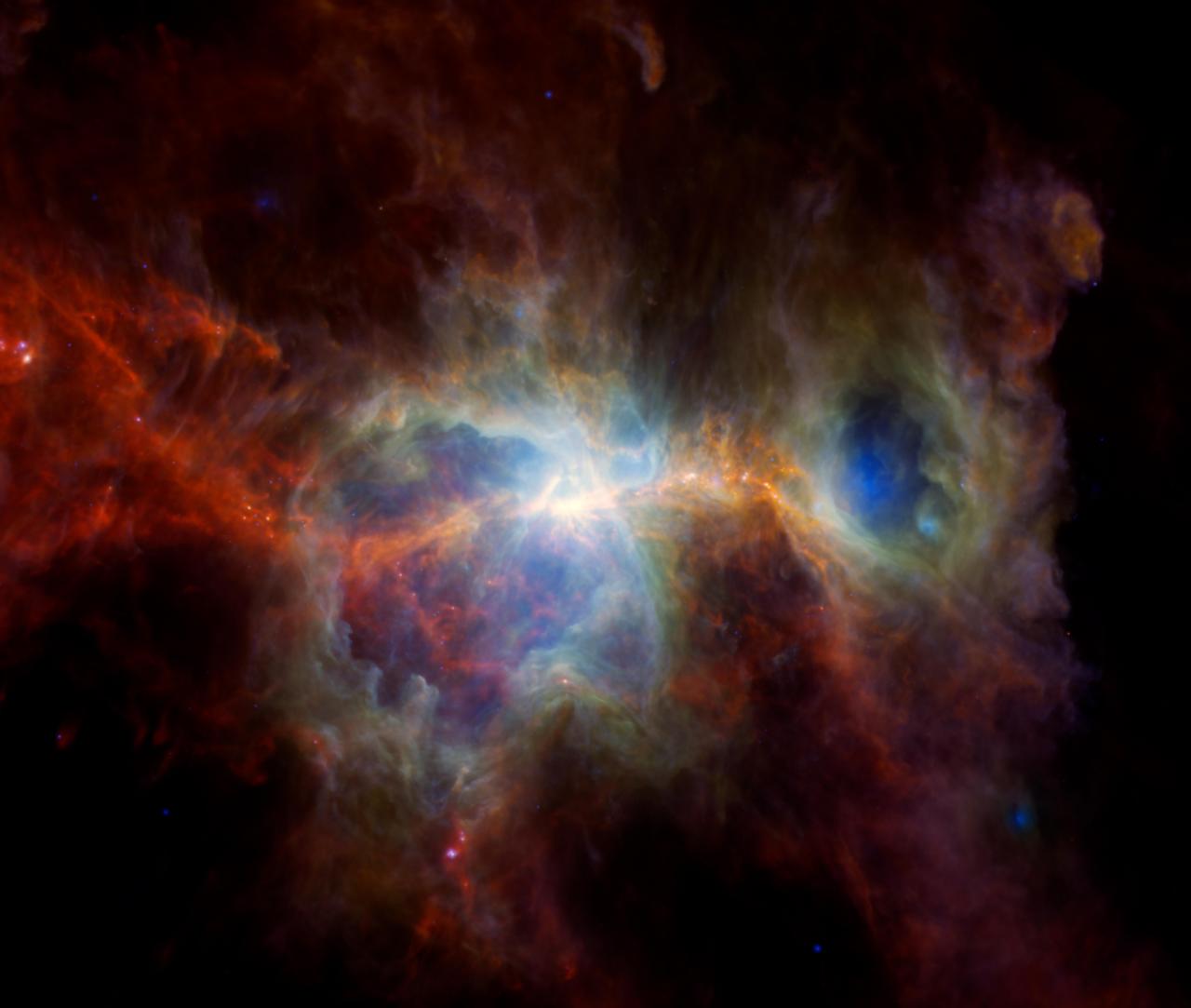
The Orion Nebula (M42) as imaged by the Hubble Space Telescope — revealing the intricate structure of ionized hydrogen, dark dust lanes, and the Trapezium cluster at its core

Credit: NASA/ESA/Hubble Heritage Team — M42 in visible and infrared light

For M42 specifically, the difference between a 70mm refractor and an 8-inch Dobsonian is dramatic. Through a 70mm scope, the nebula is a bright patch but lacks fine detail. Through an 8-inch scope at 100×, M42 reveals its full complexity: the intricate "wings" of ionized hydrogen, the dark lanes of obscuring dust, and the subtle greenish glow of doubly ionized oxygen (O-III). The Trapezium cluster at the heart of the nebula appears as four distinct stars in a 70mm scope, but an 8-inch reveals six stars (the A, B, C, D, E, and F components) on a steady night — and the E and F stars are a true test of both aperture and seeing conditions.

For those who want to try before investing in a telescope, we recommend joining a local astronomy club. Most clubs hold public observing nights where you can view M42 through a variety of telescopes — this is the best way to decide how much aperture you need. The Astronomical League's website maintains a directory of clubs by state. For more information on choosing the right telescope for your needs, see our complete telescope buying guide.


Frequently Asked Questions

Can I see the Orion Nebula with a small telescope?

Yes — the Orion Nebula is visible in any telescope, even a 50mm finder scope. A 70mm refractor at 40× shows the nebula as a bright grey-green cloud with the Trapezium stars visible inside. Smaller apertures show less detail, but M42 is always recognisable.

What magnification is best for the Orion Nebula?

For M42, 60–100× is the sweet spot for most telescopes. This magnification provides enough detail to see structure while keeping the nebula bright. Higher power (150–200×) works on larger telescopes (8-inch+) to examine the Trapezium and fine filaments, but the nebula becomes dimmer.

Is the Orion Nebula colourful through a telescope?

Through most telescopes, M42 appears grey-green — the green colour comes from doubly ionized oxygen (O-III) emission. The colour is subtle and most visible in 8-inch and larger apertures on dark, steady nights. The reddish-pink colour seen in astrophotos is from hydrogen-alpha emission, which is too dim for the human eye to see.

What is the best time of year to see the Orion Nebula?

The Orion Nebula is best observed from November through March in the northern hemisphere, when Orion is high in the evening sky. In the southern hemisphere, it is a summer constellation visible from November through March.

Do I need a telescope to see the Orion Nebula?

Technically no — M42 is visible as a faint fuzzy "star" to the naked eye under very dark skies (Bortle 3 or better). However, any binoculars or telescope reveals it as a nebula. A pair of 10×50 binoculars shows it as a distinct patch; a telescope reveals its true splendour.