Telescope Near Me (2026): Where to Buy Locally, What to Check In-Store, and Best Alternatives
Telescope Advisor Logo Telescope Advisor
Starry sky above silhouetted trees

Local Buying Guide · 2026

Telescope Near Me: Where to Buy Today Without Regret

If you are searching for a telescope store near you, this guide helps you decide when local pickup is worth it, what to test in-store, and when online buying is the smarter move for price and support.

Same day

Best for urgent gifts

20 min

In-store quality checklist

3 tiers

Budget, value, premium picks

No hype

Realistic first-night outcomes

By Telescope Advisor Editorial Team Published: Updated: Editorial Standards

Quick Answer: Should You Buy a Telescope Locally or Online?

Buy locally when you need a telescope the same day, want in-person setup guidance, or need easy returns within a short gift deadline. Buy online when you need better model selection, clearer spec comparison, and stronger price transparency. Most buyers searching telescope near me are trying to reduce uncertainty, not just reduce delivery time. This guide is designed to remove that uncertainty with a practical checklist and product short list you can use immediately.

Local stores can be excellent for hands-on confidence, especially if staff can show mount stability, focuser smoothness, and eyepiece quality before purchase. Online channels often win on range and value, especially for models like tabletop Dobsonians and app-assisted beginner scopes that local inventory may not stock consistently. The right decision depends on your timeline, budget, and willingness to learn setup basics.

Local Telescope Store vs Online: Practical Tradeoff Matrix

When people search "telescope store near me," they usually have one of three goals: buy a birthday gift fast, avoid buying the wrong model, or get setup support without waiting. All three goals are valid. The challenge is that no single channel wins every category. Local and online each have strengths and risks.

Decision Factor Local Store Online Best For
Immediate availabilityHigh if in stockLow to mediumLast-minute gift buyers
Model selection depthLimitedHighResearch-driven buyers
Price transparencyVariableHighBudget-sensitive shoppers
Hands-on evaluationExcellentNoneFirst-time users
Return convenienceFast, localProcess dependentRisk-averse families

If your nearest local option is a broad electronics chain, use caution. Big-box inventory often emphasizes beginner kits with high printed magnification claims and weaker tripod quality. If your local option is a dedicated astronomy shop or camera/outdoor retailer with knowledgeable staff, local buying can be excellent. The key is to evaluate the instrument, not the brand logo on the box.

20-Minute In-Store Checklist Before You Buy

Use this checklist in any local store. It prevents the most expensive mistake: paying for accessories and claims that do not improve first-night viewing.

  1. Test tripod rigidity by lightly tapping the tube and counting vibration settle time. Under 3 seconds is good for beginner use.
  2. Move altitude and azimuth controls through full range. Motion should feel smooth, not sticky.
  3. Check focuser travel and backlash. It should not wobble under eyepiece weight.
  4. Confirm included eyepiece focal lengths. A practical set starts with low and medium power.
  5. Verify finder alignment mechanism is present and adjustable.
  6. Ask staff to show actual setup order in under five minutes.
  7. Ignore claims based only on extreme magnification numbers.
  8. Ask return window and condition policy in writing.

Bring this checklist on your phone and score each category from 1 to 5. A model that scores well on stability, focusing, and control smoothness will produce better results than a model with higher claimed magnification but poor mechanics.

Best Product Recommendations If You Need to Buy Today

These picks are selected for beginner success rates, setup simplicity, and practical value. They are also commonly available through mainstream channels, making them useful for "buy today" scenarios.

Editor's Pick — Best Balance of Ease + Performance
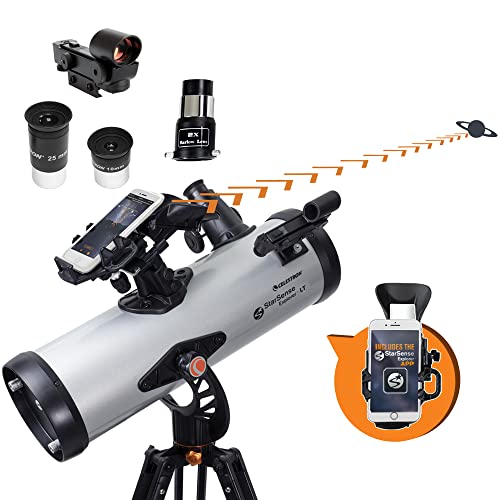
Celestron StarSense Explorer LT 114AZ telescope

Celestron StarSense Explorer LT 114AZ

Excellent for first-time buyers who want guided target finding and low setup friction. Particularly useful under suburban sky glow where manual star-hopping can feel overwhelming.

Celestron AstroMaster 70AZ

Celestron AstroMaster 70AZ

Best true budget starter that still supports clear lunar and bright-planet sessions with realistic expectations.

View on Amazon →
Sky-Watcher Heritage 130P tabletop telescope

Sky-Watcher Heritage 130P

Best value aperture-per-dollar choice for users who can handle a tabletop Dobsonian format and want deeper sky capability.

View on Amazon →
Celestron NexStar 6SE computerized telescope

Celestron NexStar 6SE

Premium step-up for buyers who want reliable GoTo convenience and stronger long-term planetary/deep-sky flexibility.

View on Amazon →

How to Find Legit Telescope Stores Near You

Use search patterns that surface expertise, not just inventory. Try queries like "astronomy store near me," "telescope shop with staff setup help," and "amateur astronomy club local recommendations." Then validate each candidate by reading reviews for phrases such as "collimation help," "beginner setup guidance," and "return support."

A strong local store usually has at least one of these signs: scheduled public observing nights, partnership with local astronomy clubs, or staff who can explain focal length and mount stability in plain language. If the listing focuses only on generic electronics and does not mention astronomy support, treat it as convenience-only, not guidance-first.

For many buyers, a hybrid path works best: shortlist online using objective filters, then inspect one or two locally available models in person before purchase. This combines local confidence with broader model intelligence.

Same-Day Buying Scenarios: Best Decision by Use Case

Gift tonight: prioritize setup simplicity and return policy over aggressive specs. Family first telescope: prioritize stable mount and low-friction setup. Adult beginner with budget flexibility: prioritize tracking convenience and long-term use potential.

If you only have one hour to choose, use the "stability first" rule. A stable, modest-power scope gets used repeatedly. An unstable high-claim scope often gets abandoned after two sessions. In astronomy, repeat usage beats theoretical capability.

If weather is uncertain for the next week, avoid over-investing in accessories immediately. Buy the core scope and one practical eyepiece first, then expand after two to three sessions. This lowers buyer regret and improves learning sequence.

Local Search Playbook: How to Find Quality Telescope Sellers in Your City

The fastest way to waste money is to search "telescope near me" and choose the first result without quality screening. A smarter process starts with query refinement. Use multiple query variants: "astronomy store near me," "telescope shop with setup help," "amateur astronomy gear store," and "local astronomy club telescope recommendations." Each variant surfaces a different kind of business and support profile.

Once you have a list, scan reviews for evidence of real astronomy support. Useful signals include staff helping with finder alignment, realistic expectations discussion, and post-purchase setup assistance. Weak signals include review language focused only on fast checkout or decorative product presentation. You are not buying a consumer gadget for occasional use. You are buying a skill-building instrument that benefits from support quality.

Call the store before visiting and ask three direct questions: can they demonstrate a beginner setup in under ten minutes, do they stock practical low-power eyepieces for first sessions, and how do returns work after one clear-night test. The way staff answers these questions is often more informative than the shelf inventory itself.

Build a comparison note with four columns: product fit, support quality, return terms, and total cost. Include taxes and any required adapter purchases. A slightly higher upfront local price may still be better value if setup support prevents early frustration and unnecessary accessory mistakes. Conversely, a low local sticker price can become expensive if return terms are restrictive or key components are weak.

If your city has no specialty store, use a mixed strategy. Attend one public club night, test equipment styles in person, then order confidently from a reliable online channel. This approach replicates the main advantage of local buying, which is hands-on confidence, while preserving broader inventory options.

Buying Used Locally: How to Avoid Bad Deals and Find High-Value Scopes

Used telescope listings are one of the best answers to "telescope near me" if you have a clear inspection method. A well-maintained used telescope can outperform new budget models at the same price. The risk is buying a scope with hidden mechanical issues, missing parts, or severe optical contamination. A ten-minute inspection dramatically reduces that risk.

Start with optics condition under natural light. Dust is normal; fungus, haze, or scratches are not. Check focuser travel for smooth movement and minimal wobble. Test mount balance and axis movement. Verify all required screws, diagonal, and finder components are present. Missing small parts can be surprisingly expensive and hard to source, especially for older or less common models.

Ask the seller to demonstrate a daylight focus test on a distant object. If focus cannot be achieved with included accessories, stop and investigate before paying. Ask whether the telescope has been stored in humid conditions. Long humid storage can damage coatings and promote mold growth in optical paths.

Local astronomy clubs are often the safest used market. Members typically disclose condition honestly and can explain real-world performance. They may also help you inspect and set up the scope on first use. This support layer is valuable for beginners and can make used buying more reliable than random marketplace listings.

Set a clear used-buying rule: no demo, no purchase. If a seller cannot show smooth motion and basic focus, move on. Good used deals are common enough that patience pays off.

After Purchase: 90-Day Success Framework for New Telescope Owners

Buying the right telescope is only the first half of the decision. The second half is using it enough to build confidence. A simple 90-day framework prevents the common pattern where buyers use a scope twice and then stop. Month one focuses on setup fluency and easy targets. Month two focuses on repeatable tracking and cleaner focus habits. Month three expands target variety and introduces light logging.

Month one target set: Moon, Jupiter or Saturn when available, and one bright open cluster. Keep sessions short and frequent. Learn how your mount behaves, how long setup takes, and what your realistic field of view looks like. Do not chase difficult deep-sky objects yet. Early wins matter more than ambitious goals.

Month two adds observational discipline. Start each session with the same checklist: tripod stability check, finder alignment verification, low-power centering, focus calibration. This sequence reduces variability and makes problems easier to diagnose. If one session underperforms, you can identify whether sky conditions changed or setup steps were skipped.

Month three introduces expansion, not complexity overload. Add one new target category per week and keep a short session note. This builds momentum and long-term retention. If you purchased from a local store with support, schedule one follow-up check-in for mount and accessory optimization. If purchased online, use your notes to prioritize your first accessory decisions based on real friction points rather than impulse buying.

The result of this 90-day process is a buyer who becomes an observer. That transition is the real metric of success for a telescope purchase, and it is exactly what this page is designed to support.

Mistake-Proof Buying Checklist: 15 Questions to Ask Before You Pay

Most telescope buyer regret comes from preventable decisions made in the final ten minutes before purchase. A clear checklist protects you from urgency, marketing language, and accessory bundling traps. Use these fifteen questions at checkout, whether local or online, and you will avoid the most common errors first-time buyers make.

1) What is my first-month target plan? If you cannot name at least three realistic first targets, pause purchase and define them first. 2) Is the mount stable at practical observing height? unstable mounts create immediate frustration. 3) Does the package include a useful low-power eyepiece? beginners need wide field first, not aggressive magnification.

4) Can I verify focusing behavior before committing? in-store demo or clear return protection is essential. 5) What is the actual return timeline? confirm exact day count and condition requirements. 6) Are there restocking fees? hidden fees can erase perceived savings. 7) Who handles warranty claims? clear support pathways reduce downtime when issues occur.

8) Is this scope transportable for my real life? a telescope that is too heavy or awkward is often underused. 9) Will I observe from city, suburb, or dark site most often? this influences what targets will feel rewarding. 10) Do I understand what this aperture can realistically show? realistic expectations are central to satisfaction.

11) Is the accessory bundle practical or just long? many bundles include low-value extras that distract from fundamentals. 12) Do I have a setup plan for the first clear night? if not, schedule one now. 13) Can I get help if setup fails? local support, club help, or trusted guides should be identified before purchase.

14) Is this purchase aligned with usage frequency? weekly use supports larger investment; occasional use may favor simpler systems. 15) Have I compared at least two alternatives? comparison reduces impulse risk and increases confidence. Answering these questions takes ten minutes and can prevent months of frustration.

Keep this checklist in your notes app and reuse it for future upgrades. Good telescope buying is a repeatable skill. The first purchase teaches decision discipline that pays off across every later equipment choice.


A Fast Script You Can Use in Any Store

If you feel pressured during a purchase conversation, use this short script: "I am buying for beginner visual use. Please show me the mount stability, low-power field, and return terms first." This instantly shifts the discussion toward practical outcomes. Follow up with: "Can you show how this scope is set up and focused in under ten minutes?" Stores that can answer clearly are usually safer for first-time buyers.

Then ask one final qualifier: "If this does not perform as expected after two clear nights, what is my exact return path?" Getting a precise answer protects you from vague promises. This three-question script works in specialty shops, chain retailers, and online support chats, and it keeps your decision anchored to usability rather than marketing claims.

Telescope Near Me FAQ

Is buying a telescope in-store better than online?

It is better when you need same-day pickup or want hands-on setup guidance. Online usually offers wider model selection and better price comparison.

What should I test before buying locally?

Tripod stability, focuser smoothness, mount motion, finder adjustability, and included eyepiece practicality.

Can a beginner use a computerized telescope right away?

Yes, if you follow setup steps and alignment guidance. App-assisted and GoTo scopes often reduce frustration for urban beginners.

How much should I spend on a first telescope?

Most first-time buyers find the best balance between $150 and $400, depending on expected use frequency and sky conditions.

What if there are no specialty telescope stores near me?

Use a hybrid process: research online first, then inspect any local models with the checklist in this guide before finalizing.