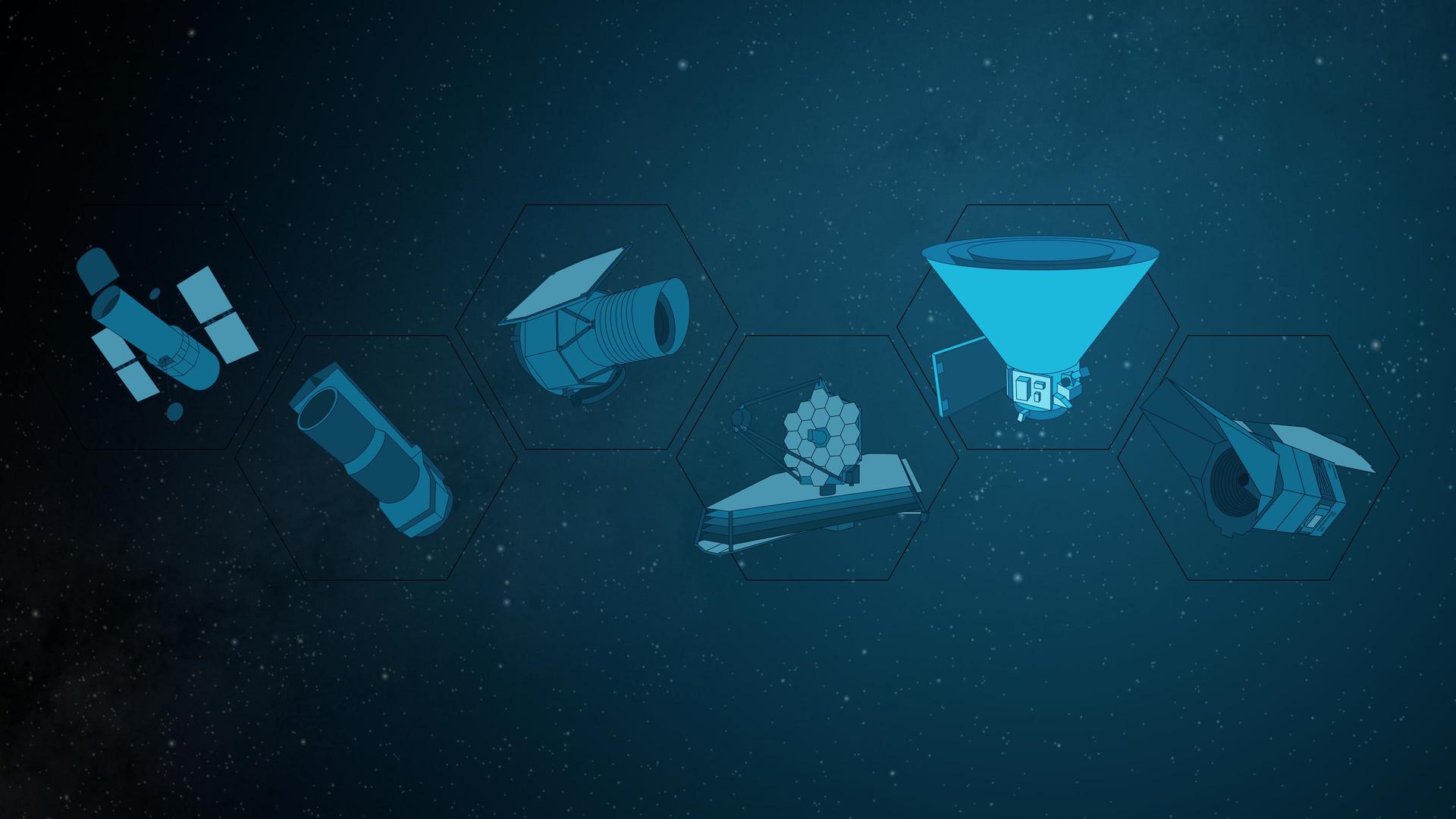
Space Telescopes — Above the Atmosphere
No matter how large or sophisticated ground-based telescopes become, they must contend with Earth's atmosphere, which blurs images and blocks ultraviolet, X-ray, and most infrared wavelengths. The solution — placing telescopes in space — transformed astronomy in the late twentieth century.
The Hubble Space Telescope, launched in 1990, is arguably the most important scientific instrument ever built. With its 2.4-metre mirror orbiting 540km above Earth, Hubble produced images five to ten times sharper than any ground-based telescope of its era. Over 30+ years of operation, Hubble has made more than 1.5 million observations, contributed to 20,000+ scientific papers, and fundamentally changed our understanding of the universe's age, expansion rate, and evolution. Its iconic images — the Pillars of Creation, the Hubble Deep Field, and countless galaxies and nebulae — have become cultural touchstones.
The James Webb Space Telescope, launched in December 2021, is Hubble's successor. With a 6.5-metre segmented mirror optimised for infrared light, Webb can see the first stars and galaxies that formed in the early universe, peer through dust clouds to observe star formation, and analyse the atmospheres of exoplanets. Webb operates from the L2 Lagrange point, 1.5 million kilometres from Earth, where its sunshield keeps it at a stable -233°C.
Other major space telescopes include Chandra (X-ray astronomy, launched 1999), Spitzer (infrared, 2003-2020), Kepler (exoplanet hunting, 2009-2018), TESS (exoplanet hunting, 2018-present), and the Nancy Grace Roman Space Telescope (launched Aug. 30, 2026), which will survey vast swaths of the sky to study dark energy, exoplanets, and infrared galaxies.
Space telescopes have opened windows to the universe that ground-based instruments cannot reach. The future includes missions like the proposed Habitable Worlds Observatory, a 6-metre-class space telescope optimised for directly imaging Earth-like exoplanets and searching for biosignatures in their atmospheres — the culmination of the journey that began with Lippershey's three-power spyglass in 1608.