
Can You See Neptune's Rings with a Telescope? (Honest Answer + What You CAN See)
Telescope Advisor Logo Telescope Advisor
James Webb Space Telescope wide-field view of Neptune with Triton, faint rings, and background galaxies

Planet Observation Guide · Neptune 2026

Can You See Neptune’s Rings with a Telescope?

Neptune has rings — confirmed by Voyager 2 in 1989. But no amateur telescope on Earth can reveal them. Here’s the honest science behind why, what a backyard scope actually shows, and how to find the planet tonight.

7.8

Magnitude (needs scope)

2.4″

Apparent diameter (arcsec)

1989

Rings confirmed — Voyager 2

29 AU

Distance from Sun

By Telescope Advisor Editorial Team Published: Updated: Editorial Standards

The Direct Answer

No — you cannot see Neptune’s rings with any amateur telescope.

Neptune’s rings are real, but they are extremely thin and dark — composed of dust-sized particles coated in organic material. Even the Hubble Space Telescope struggles to image them. From Earth, you would need a professional observatory-class instrument or the James Webb Space Telescope (JWST) to detect them. No consumer or prosumer backyard scope, regardless of aperture, will show Neptune’s rings.

That said, Neptune itself is observable with a modest telescope — you just won’t see anything resembling Saturn’s spectacular ring system. Here is exactly what each tier of equipment reveals, and why the rings stay invisible.
What Are Neptune’s Rings, and Why Are They Invisible?

Neptune has six known rings, confirmed when Voyager 2 flew past in August 1989. From innermost to outermost, they are: Galle, Le Verrier, Lassell, Arago, an unnamed ring, and Adams — the outermost and most concentrated. The Adams ring contains five bright arcs named Courage, Liberté, Egalité 1, Egalité 2, and Fraternité, which are denser clumps of material within the ring.

So why can’t we see them? Three reasons stack against the amateur observer:

  1. They reflect almost no light. Saturn’s rings are bright because they’re mostly water-ice — reflective and thick. Neptune’s rings are dark organic material, reflecting roughly 5% of incoming light (similar to charcoal). Saturn’s rings are perhaps 100× more reflective in comparison.
  2. They are extremely thin and narrow. Most of Neptune’s rings are only a few kilometres wide. At 29 AU distance, even the most powerful amateur telescopes cannot resolve structures that small.
  3. Neptune itself outshines them completely. At magnitude 7.8, Neptune is already near the limit of binocular visibility. The rings, orbiting this already-faint planet, are billions of times dimmer than the night sky background. They are effectively invisible from any ground-based observatory without sophisticated image-stacking techniques.
For comparison: JWST captured Neptune’s rings in a stunning image released in September 2022 — the clearest view since Voyager 2. It required a 6.5-metre gold-plated mirror in deep space with no atmospheric interference. Your 8-inch Dob has a 0.2-metre mirror and sits at the bottom of a turbulent atmosphere.

What Neptune’s Rings Look Like in Webb Images

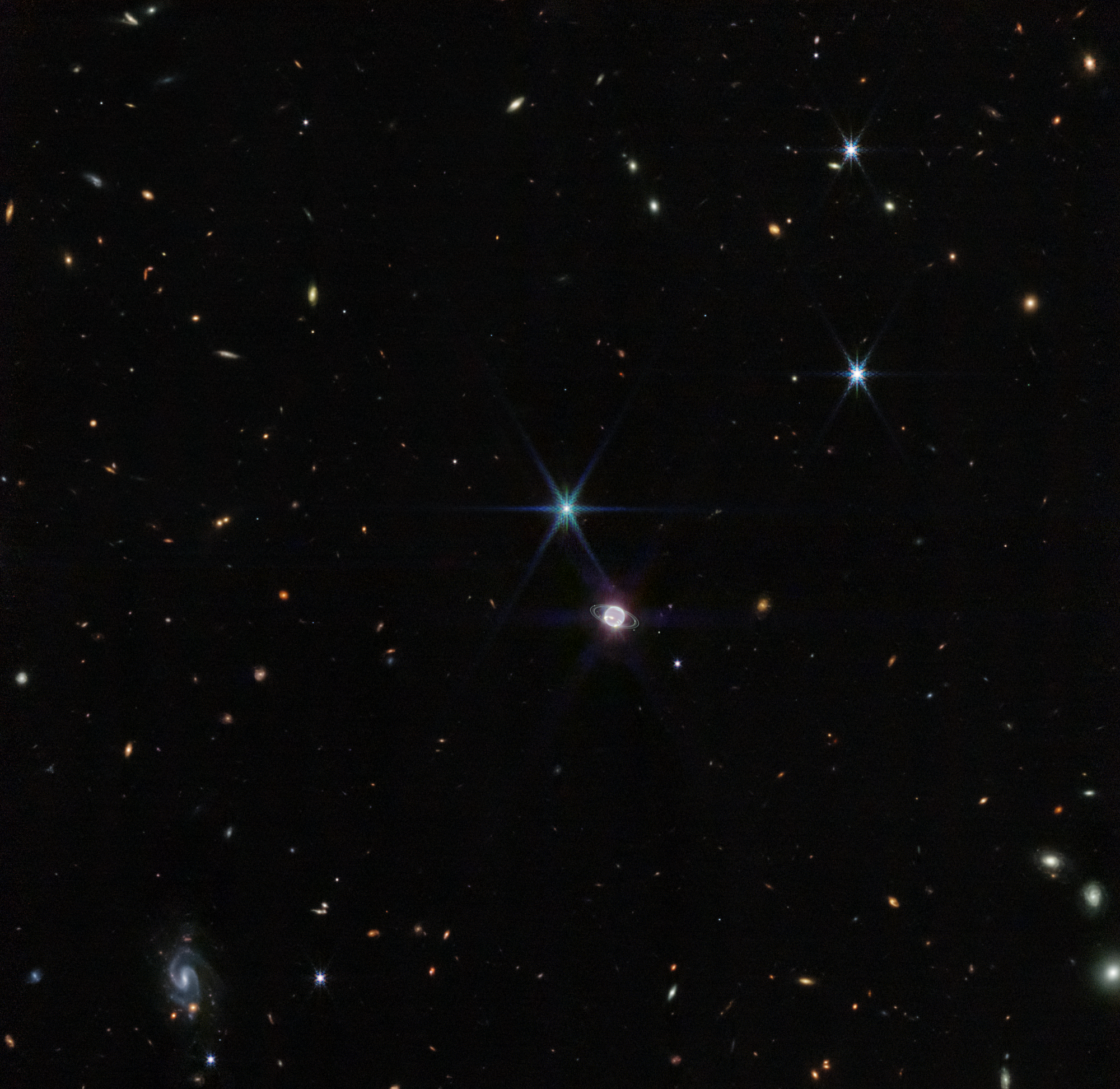
This is the view that fuels the question in the first place. NASA’s James Webb Space Telescope captured Neptune’s ring system with a level of contrast amateur observers will never get from the ground. That makes these images perfect for setting expectations: they show what is physically there, and why a backyard telescope still cannot reveal it.

Webb wide-field image of Neptune, Triton, rings, and distant background galaxies

Wide-field Webb portrait

Neptune looks small against a deep field of background galaxies, while Triton blazes with Webb’s diffraction spikes. The rings are present here, but only because a space observatory can collect faint infrared light with extreme stability.

Reality Check

The rings are real. The amateur view is still just Neptune’s disc.

Webb sees Neptune in the near-infrared, above Earth’s atmosphere, with a 6.5-meter mirror and long, stable exposures. Your telescope is fighting sky glow, turbulence, and a target only 2.4 arcseconds across. That contrast gap is the whole story.

6.5 m

Webb primary mirror

0 m

Atmosphere above Webb

8 in

Typical serious backyard scope

2.4″

Neptune disc from Earth

Webb close-up image of Neptune showing bright methane-ice clouds and faint rings

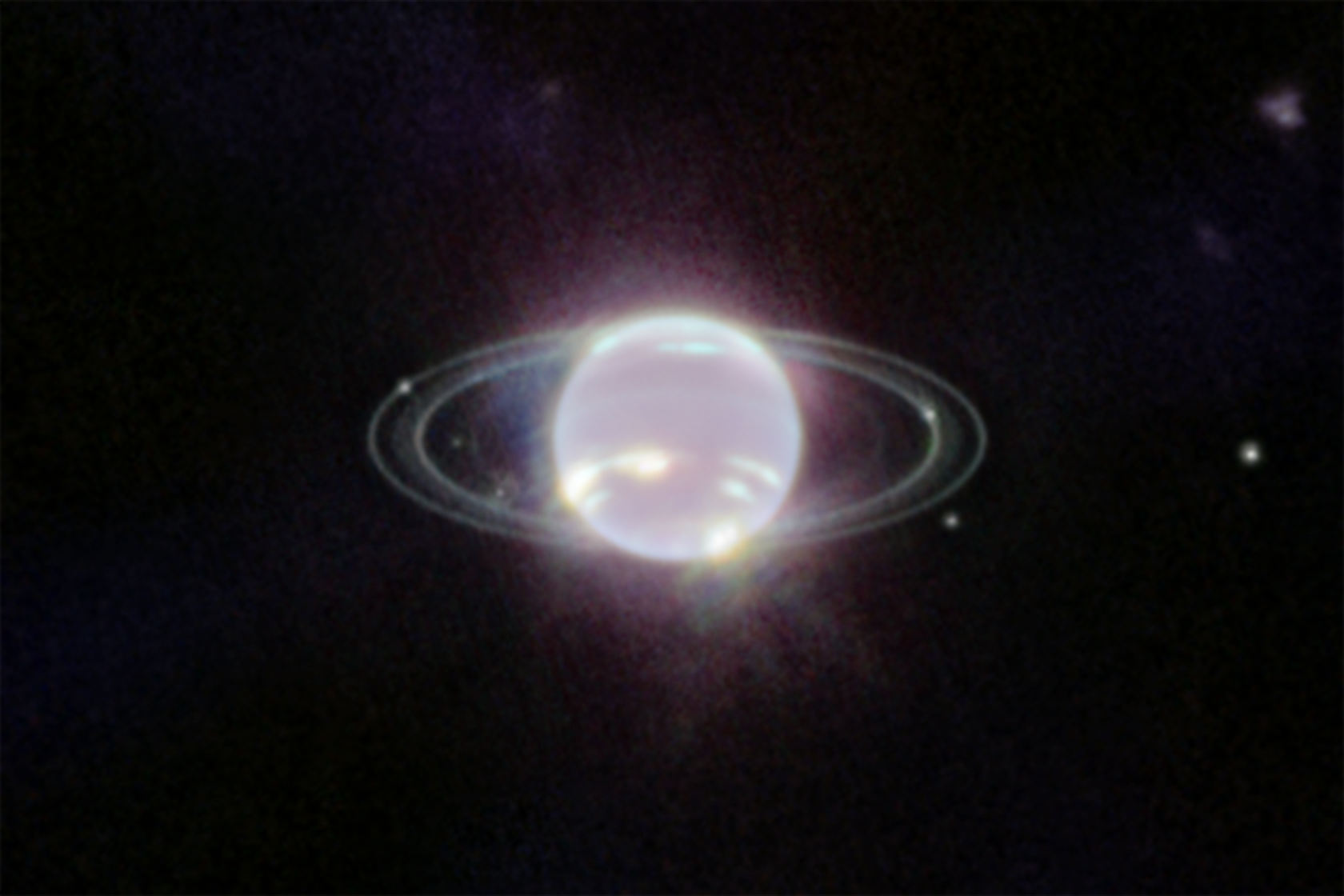
Close-up ring and cloud structure

This tighter Webb crop makes the ring geometry and bright methane-ice clouds obvious. It is the cleanest modern reminder that Neptune is an active, dynamic world even when it looks like a tiny blue-grey bead at the eyepiece.

Credit: NASA, ESA, CSA, STScI; image processing by Joseph DePasquale (STScI), Naomi Rowe-Gurney (NASA-GSFC)

Webb labeled image of Neptune with Triton and visible moons identified

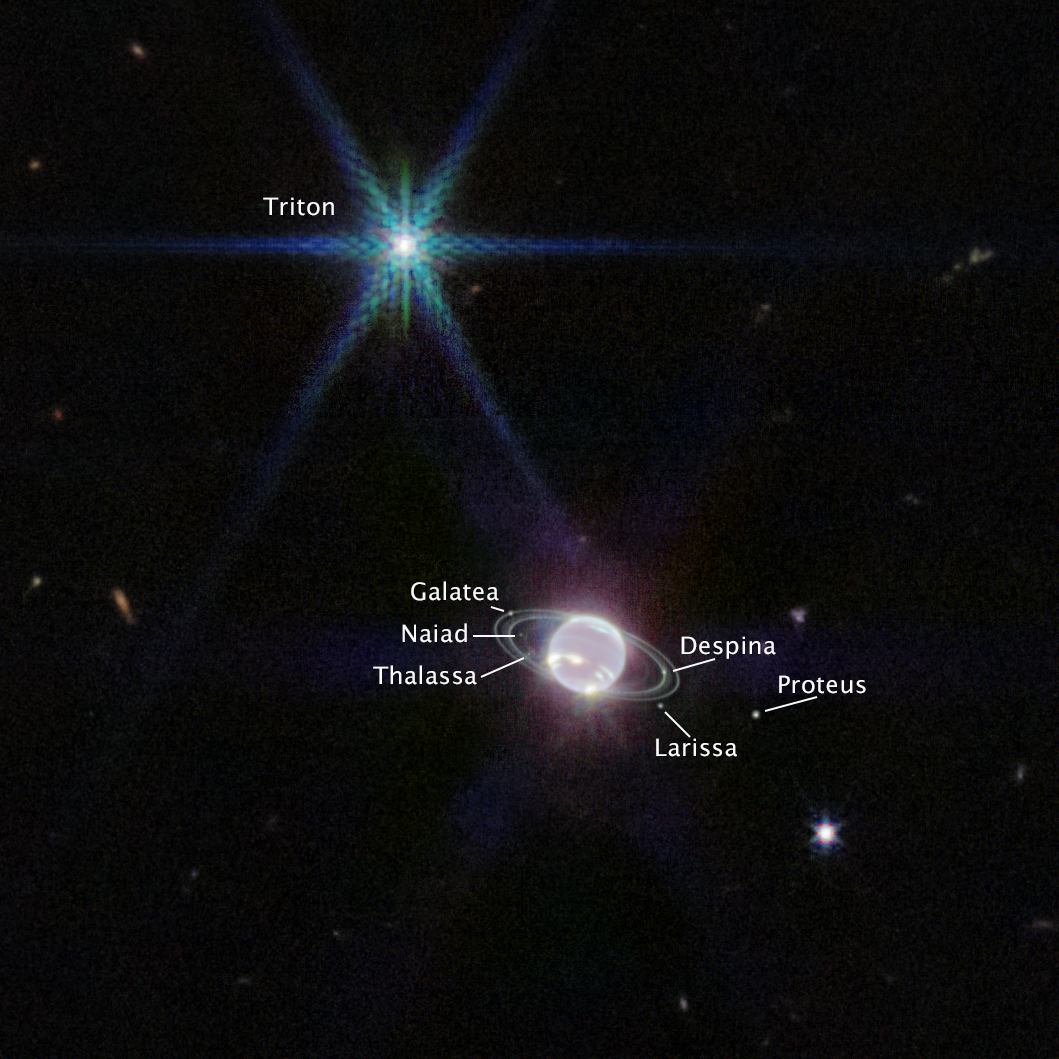
Labeled moons and Triton

The labeled version is especially useful for readers trying to understand why Triton is the only realistic “extra” target for advanced amateurs. Webb shows seven moons here; backyard observers should focus on Neptune’s disc first and treat Triton as the stretch goal.

Credit: NASA, ESA, CSA, STScI; image processing by Joseph DePasquale (STScI), Naomi Rowe-Gurney (NASA-GSFC)

What Webb Records

Rings, methane-ice clouds, multiple moons, and infrared atmospheric structure

  • The rings come into full focus because Webb can hold long, stable infrared exposures above Earth’s atmosphere.
  • Bright patches in Neptune’s southern hemisphere mark high-altitude methane-ice clouds.
  • A thin bright equatorial band hints at global atmospheric circulation and storm dynamics.
  • Triton and several other moons stand out clearly in the same frame.

What You See At The Eyepiece

A tiny blue-grey disc, and maybe Triton if your night and scope are both excellent

  • With 70mm to 150mm aperture, Neptune is a point or very small disc with no ring structure at all.
  • No amateur telescope will show the dark, narrow rings against the sky background.
  • Cloud details are beyond visual reach because Neptune is only 2.4 arcseconds across from Earth.
  • An 8-inch or larger scope under dark, steady skies may add Triton as a faint pinpoint near the planet.

What You Can See: Neptune Through a Telescope

Even without the rings, observing Neptune is a genuine achievement — you are tracking down a world four times the diameter of Earth, nearly 4.5 billion kilometres away. Here is what each equipment level reveals:

Binoculars (7×50 or 10×50) or any 70mm+ scope What you see: faint star-like dot

Neptune at magnitude 7.8 is invisible to the naked eye (limit ~6.0) but easily picked up in any binoculars. The only way to confirm it is Neptune and not a background star is to note its position on one night, check a sky app, and revisit the same area a few days later — Neptune moves slowly but measurably against the star field over a week or two.

100–150mm (4–6 inch) telescope at 150×–200× What you see: small blue-grey disc

A 5–6 inch scope at 150× or higher will show Neptune as a clearly non-stellar object — a tiny, noticeably blue-grey disc about 2.4 arcseconds across. This is how you distinguish it from a star with certainty: stars remain points at high magnification, while Neptune puffs up into a small disc with a distinctly cold, blue-grey tint from its methane-rich atmosphere. This is often considered the real “goal” for Neptune observers.

200mm (8 inch) or larger, under dark skies, excellent seeing What you see: disc + possibly Triton

With an 8-inch or larger instrument and an exceptional night (Antoniadi I–II seeing, dark skies, low humidity), experienced observers have spotted Triton — Neptune’s largest moon — at magnitude ~13.5. It sits roughly 15–17 arcseconds from Neptune and looks like an extremely faint star-like point. This is a challenging observation that rewards patience. No surface detail on Neptune is visible from Earth with amateur equipment.

How to Find Neptune in 2026

In 2026, Neptune is in the constellation Pisces, near the star Lambda (λ) Piscium. It reaches opposition (closest to Earth, highest in the sky at midnight) around September 20, 2026, when it will be at its brightest (magnitude 7.8) and largest apparent diameter (2.4″). This is the best window of the year to observe it.

Step-by-step: finding Neptune tonight

  1. Download SkySafari or Stellarium (free) on your phone
  2. Search for “Neptune” — the app shows its exact position in real time
  3. Use the app’s augmented-reality view to star-hop to the right field
  4. Point your scope at the field and identify the faint blue-grey “star” that doesn’t match the star chart
  5. Confirm it’s Neptune by observing the same field 2–3 nights later — it will have moved slightly

Best conditions for Neptune observation

  • 🌑 New Moon or moonless nights — essential for dim targets at mag 7.8
  • 🌌 Dark sky site — even moderate light pollution drowns Neptune’s surroundings
  • 💨 Steady seeing — turbulent air destroys the tiny disc at high magnification
  • 🕐 Near opposition (around Sep 20) — highest in sky, best contrast
  • 📱 A star chart app — you need precise coordinates to pick Neptune out of the star field

Which Telescope to Use for Neptune

You don’t need anything exotic. Here are two real-world recommendations depending on your goal.

Editor’s Pick — See Neptune as a Blue Disc
Celestron AstroMaster 70AZ refractor telescope

Celestron AstroMaster 70AZ

70mm Refractor · 900mm focal length · Alt-azimuth mount

At 90×–150× this shows Neptune as a small but clearly non-stellar blue-grey disc — exactly enough to confirm you’re looking at a planet rather than a star. It’s also the entry-level scope we recommend for beginners, so it pulls double duty across the rest of the solar system. See our full AstroMaster 70AZ review for real views of each planet.

Celestron NexStar 8SE Schmidt-Cassegrain telescope

Celestron NexStar 8SE (for seeing Triton)

8″ (203mm) Schmidt-Cassegrain · GoTo computerised mount

If your goal is spotting Triton at magnitude ~13.5, you need 8″ aperture and a computerised mount — the GoTo system locks onto Neptune precisely while you focus on the eyepiece. Under dark skies at opposition, experienced observers report consistent Triton sightings at 200×–250×. See our NexStar 8SE review for a full breakdown.

Neptune vs Uranus vs Saturn: Ring Visibility at a Glance

Planet Rings visible from Earth? Minimum scope What you see
Saturn Yes — spectacular Any 60mm+ at 50× Distinct ring system, Cassini Division with 150mm+
Uranus No — rings invisible 150mm at 200× for disc Small pale blue-green disc, no rings
Neptune No — rings invisible 70mm for dot; 150mm for disc Tiny blue-grey disc; Triton with 8″+ on dark nights

Saturn is the only planet whose rings are routinely visible in a small telescope. Both Uranus and Neptune have ring systems, but both are dark, narrow, and invisible from the ground without professional equipment. See our full Uranus rings guide →

Frequently Asked Questions

Can any amateur telescope show Neptune’s rings?

No. Neptune’s rings are too dark, too narrow, and too far away to be detected by any consumer or prosumer telescope. They require space-telescope or large professional-observatory imaging to resolve, even in photographs. The James Webb Space Telescope published the first clear ring image in 2022.

What does Neptune look like through a telescope?

With a 70mm scope you see a faint blue-grey star-like point. With 150mm at 150×–200× you resolve a small disc with a distinctly blue-grey colour from methane in its atmosphere. No cloud bands or surface detail are visible. With an 8-inch on an excellent night you may glimpse Triton as a magnitude-13.5 pinpoint nearby.

Can you see Triton — Neptune’s largest moon — with a telescope?

Triton is at magnitude ~13.5, which is within range of an 8-inch (200mm) or larger telescope under dark skies. It orbits Neptune at about 17 arcseconds maximum separation. The main challenge is separating it from background stars — you need to confirm the object moves relative to Neptune over several nights. A GoTo computerised mount makes this much easier.

What magnification do you need to see Neptune?

Any magnification will show Neptune as a faint dot. To actually resolve the disc and distinguish Neptune from a star, you need at least 150× with a 100mm+ aperture. The disc is only 2.4 arcseconds across — roughly 50 times smaller than Jupiter at opposition — so high-quality optics and steady seeing matter more than maximum magnification.

Where is Neptune in the night sky in 2026?

In 2026 Neptune is in the constellation Pisces. It reaches opposition (best viewing) around September 20, 2026, rising in the east at sunset and highest in the sky around midnight. Use SkySafari, Stellarium, or Cartes du Ciel to find the exact position — Neptune moves slowly and your app will give you current coordinates updated in real time.

Why are Neptune’s rings so much fainter than Saturn’s?

Saturn’s rings are primarily water-ice, which is highly reflective (albedo ~0.6). Neptune’s rings are dark organic material, reflecting only ~5% of sunlight — comparable to coal. They are also much narrower and contain far less material than Saturn’s vast ring system, which spans 280,000 km across. Neptune’s rings are thought to be relatively young and may be the remnants of a disrupted moon.

Related Guides