Can You See Uranus's Rings With a Telescope? (Honest Answer + What You CAN See)
Telescope Advisor Logo Telescope Advisor
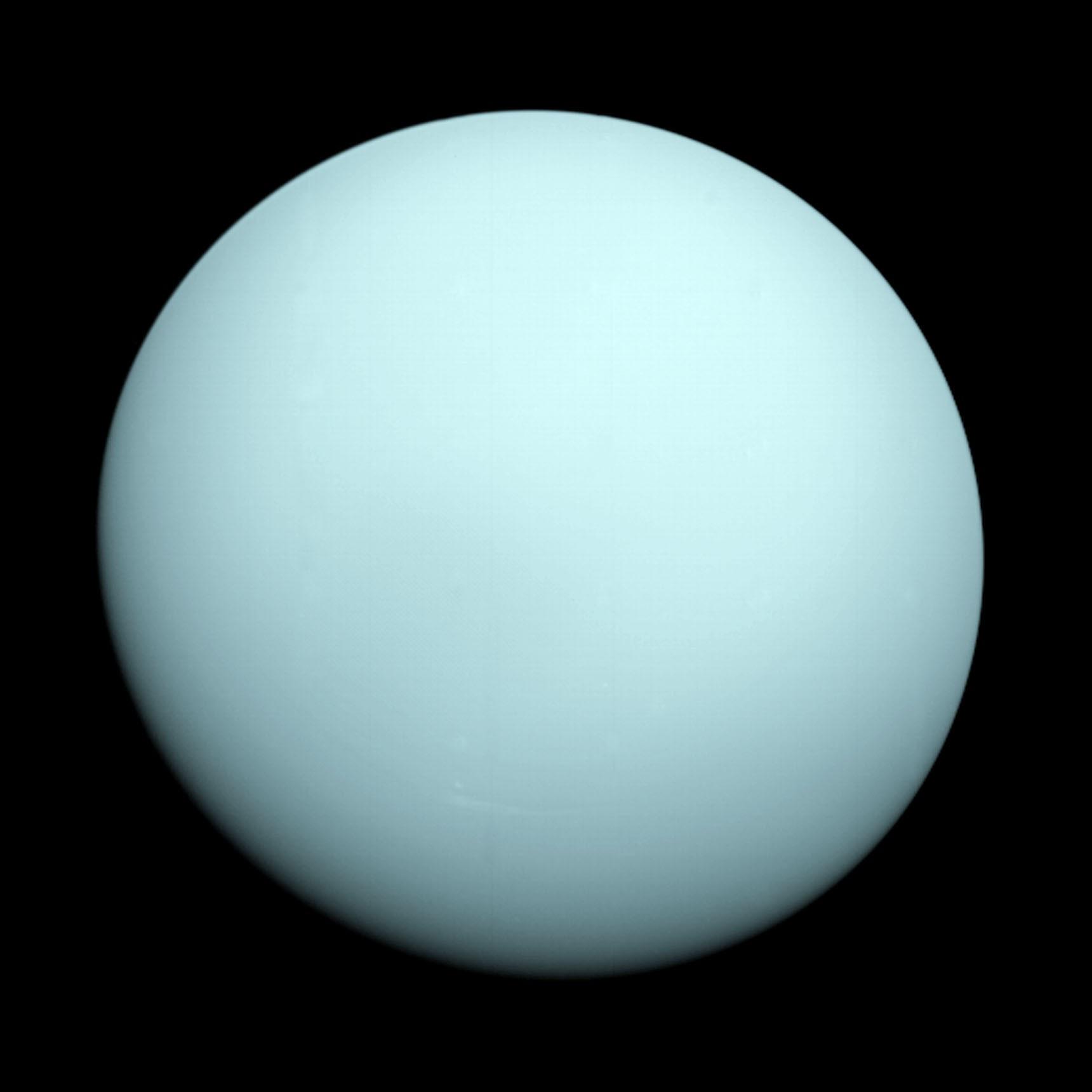
Uranus as seen by Voyager 2 — a featureless pale blue-green sphere with no visible rings from Earth

PLANET OBSERVATION GUIDE · URANUS 2026

Can You See Uranus’s Rings With a Telescope?

Honest answer: no — the rings are invisible from Earth. But Uranus itself is surprisingly rewarding at opposition. Here’s what you can actually see — and how to find it on November 25, 2026.

13 Rings

Uranus Has Them

All Invisible

To Amateur Scopes

Mag. 5.6

2026 Opposition

Nov 25

2026 Opposition Date

By Telescope Advisor Editorial Team Published: Updated: Editorial Standards

Short Answer: No — But Here’s What You CAN See

Uranus does have rings — 13 known ring systems, discovered in 1977 when astronomers watched them block light from a background star during a stellar occultation. But no amateur telescope can show them. The rings are extremely dark (reflecting less than 3% of sunlight, darker than coal), incredibly narrow (the widest is only about 100 km across), and composed of tiny dark particles that scatter almost no light toward Earth.

Even the Hubble Space Telescope needs special infrared imaging to photograph them clearly. From the ground, no instrument short of a large professional observatory has recorded them visually.

✗ What you CANNOT see

  • ✗ The rings — invisible in any amateur telescope
  • ✗ Surface features or cloud detail (too far, too small)
  • ✗ Axial tilt of 97.77° (can’t see the geometry)
  • ✗ Individual moons (except in 6”+ on a dark night)

✓ What you CAN see

  • ✓ Blue-green disk (distinct from background stars)
  • ✓ Definite non-stellar shape at 100×+
  • ✓ Slight oblateness (flattening) at 200×+ in 6”+
  • ✓ Titania & Oberon (largest moons) in 8”+ under dark skies

Why Are Uranus’s Rings Invisible to Amateur Telescopes?

The contrast with Saturn is striking. Saturn’s rings are bright, wide, and made of ice and rock that reflects 60–80% of incoming sunlight. Uranus’s rings are the opposite in nearly every way:

Property Saturn’s Rings Uranus’s Rings
Reflectivity (albedo) 60–80% <3%
Width of main rings Up to 282,000 km (B ring) Under 100 km (epsilon ring)
Ring composition Bright ice + rock Dark organic particles
Visible in small scope? Yes — 70mm at 75× No — needs space telescope
Discovered by Galileo, 1610 (as “ears”) Stellar occultation, 1977

When Voyager 2 flew past Uranus in January 1986, it took the first clear photographs of the rings — from just 80,000 km away. Even those images, taken by a spacecraft almost 3 billion km from Earth, required long exposures to record the faint ring material. From Earth’s distance, the rings subtend less than 0.1 arcseconds and are photometrically invisible against the glare of Uranus itself.

The one exception: edge-on geometry

In 2007, Uranus’s rings were edge-on to Earth (Uranus solstice/equinox). Even at this optimal geometry — when the rings present their maximum cross-section to our line of sight — professional ground-based telescopes using adaptive optics in infrared barely detected them. Amateur equipment had no chance. The next edge-on presentation is decades away.

What Uranus Looks Like Through a Telescope — By Aperture

Uranus is the seventh planet and sits about 2.7 billion km from Earth at opposition. Its angular diameter at the 2026 opposition is approximately 3.7 arcseconds — tiny, but resolvable. Here’s what to expect with different apertures:

Aperture Magnification What You’ll See
Naked eye Barely naked-eye at magnitude 5.6 under dark skies — a very faint “star” with a slight blue tinge, indistinguishable from bright background stars without a chart.
50–70mm (refractor) 50×–100× Noticeably blue-green color. At 100×, marginally non-stellar — slightly “fatter” than a point source but not a clear disk.
100–130mm (4–5”) 100×–150× Clear blue-green disk. Not a point. The aqua color is vivid and unmistakable. No surface features, no rings visible. The disk is small but definite.
150–200mm (6–8”) 150×–250× Resolved disk with slight oblateness (Uranus’s equatorial bulge). The blue-green color is strong. On the best nights, the 5 largest moons (Miranda, Ariel, Umbriel, Titania, Oberon) may be glimpsed near Uranus with 8”+.
250mm+ (10”+) 200×–350× Oblateness clear. Titania and Oberon (magnitudes ~13.7 and ~13.9) visible as tiny star-like points on either side of the planet on dark nights. Still no rings.

The real reward: that aqua-blue color

The vivid blue-green color of Uranus is caused by methane in its upper atmosphere absorbing red light. Even in a modest 100mm scope, the color is unmistakable. This is what makes Uranus worth observing: you are seeing a planet that is fundamentally different in color from anything else in our solar system. Saturn’s rings are more dramatic, but Uranus’s color is genuinely otherworldly — ice giant blue against the black of space.

Uranus Opposition: November 25, 2026

Opposition is the best time to observe Uranus. The planet is directly opposite the Sun from Earth, meaning it rises at sunset, reaches maximum altitude around local midnight, and sets at sunrise. It’s also at its closest and brightest point of the year.

Nov 25, 2026

Date of opposition

5.6

Apparent magnitude (barely naked-eye)

3.7″

Angular diameter (arcseconds)

How to Find Uranus at the 2026 Opposition

At the 2026 opposition, Uranus is in Taurus, between the Pleiades star cluster and the Hyades. This makes it relatively easy to star-hop to from the Pleiades, which are a prominent naked-eye reference point.

  1. 1 Use an astronomy app. SkySafari Pro, Stellarium, or Sky Map all show Uranus’s exact position. Point your phone at the sky and tap on the blue-green dot. This is the easiest method for beginners.
  2. 2 Find the Pleiades (Seven Sisters). The naked-eye star cluster in Taurus is unmistakable. Put it in your finder scope at low magnification (30×–50×). Uranus is approximately 7–8° east-southeast of the Pleiades in November 2026.
  3. 3 Identify by color. At 50×, scan the area east of the Pleiades. Uranus will be slightly blue-green compared to surrounding white or yellow stars. At magnitude 5.6, it’s visible in a finder scope but just below naked-eye threshold in suburban skies.
  4. 4 Confirm with magnification. At 100×+, Uranus shows a small but definite disk. A background star of similar brightness will remain a point. If it has a visible disk: that’s Uranus.
  5. 5 Best viewing window: October 2026 – February 2027. Uranus is well-placed in the evening sky for the whole winter season. Opposition is the peak, but any clear night between October and February gives excellent views.

⚠ GoTo telescopes change everything

Uranus is genuinely difficult to find by star-hopping for beginners — it moves slowly through the background stars and is easily confused with them. A GoTo mount (NexStar 5SE, NexStar 8SE) locates Uranus automatically after a two-star alignment. Type “Uranus” in the hand controller, press Enter, and the telescope slews directly to it. For an ice giant hunt, GoTo is a significant quality-of-life upgrade.

Best Telescopes for Viewing Uranus

Any 70mm+ telescope can show Uranus’s color. For a resolved disk with GoTo convenience, these are our three picks.

Editor’s Pick — GoTo Takes You Straight to Uranus
Celestron NexStar 5SE computerized telescope

Best for Finding Ice Giants

Celestron NexStar 5SE

125mm f/10 SCT · GoTo alt-az mount · 40,000+ object database

The 5SE’s 125mm aperture resolves Uranus’s disk clearly at 150×–200×, showing the distinctive blue-green color against the star field. More importantly, the GoTo system removes all the difficulty of finding it: complete a two-star alignment, scroll to Solar System → Uranus, press Align, and the scope slews and centers the planet automatically. On a cold November night, this is an enormous advantage over manual star-hopping.

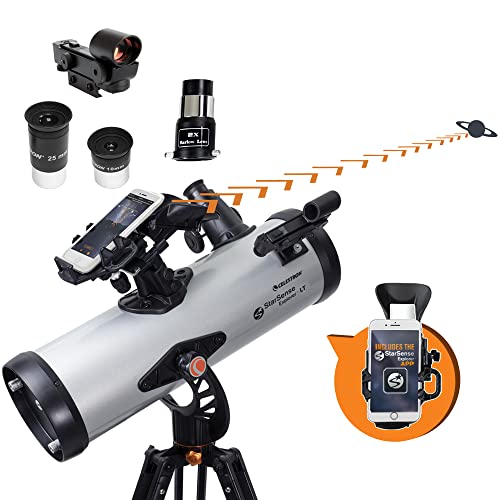
Celestron StarSense Explorer LT 114AZ telescope

App-Assisted — Good Disk Views (114mm)

Celestron StarSense Explorer LT 114AZ

114mm f/8.8 Newtonian · StarSense phone app alignment · 1000mm focal length

The StarSense app on your phone points an arrow at the sky and tells you exactly where to push the telescope to find any object in the database, including Uranus. It’s not as hands-free as full GoTo, but dramatically easier than star-hopping from the Pleiades. The 114mm aperture shows Uranus as a clear, resolved blue-green disk at 130×–180×. This is a strong budget option for the 2026 opposition.

Celestron NexStar 8SE computerized telescope

Premium Pick — Can Show Uranus’s Moons

Celestron NexStar 8SE

203mm f/10 SCT · GoTo · 2000mm focal length · Limiting magnitude ~14.2

With 203mm of aperture, the 8SE can reach Uranus’s two largest moons: Titania (magnitude ~13.7) and Oberon (magnitude ~13.9). These appear as faint star-like points on either side of the planet at high magnification under dark skies. The oblateness of Uranus’s disk also becomes more apparent. If you want the best possible view of this ice giant from your backyard, the 8SE is the scope to choose.

Frequently Asked Questions

Does Uranus really have rings?

Yes. Uranus has 13 known rings, discovered in 1977 when astronomers observed a stellar occultation — Uranus passed in front of a background star, and the star briefly dimmed five times before and after the planet’s disk blocked it, revealing five ring structures. Voyager 2 subsequently photographed the rings close-up in 1986. They are real but extremely dark and narrow.

What magnification do you need to see Uranus’s disk?

Around 100× with a 100mm+ aperture telescope. Below 70×, Uranus appears nearly stellar. At 100×–150×, the disk is clearly resolved and the blue-green color is vivid. Higher magnification (200×+) shows the disk more clearly but requires steady atmospheric seeing to avoid blurring.

Can I see Uranus with binoculars?

Yes — you can find and identify Uranus with 10×50 or larger binoculars, particularly around opposition when it reaches magnitude 5.6. However, it will appear as a faint blue-green star-like point, with no disk resolution. Binoculars are useful for locating Uranus and confirming its blue-green hue; a telescope is needed to see the actual disk.

Why is Uranus blue-green?

Methane gas in Uranus’s upper atmosphere absorbs red wavelengths of sunlight and reflects blue and green light back. This is the same process that gives Neptune its deeper blue color. Uranus has slightly more haze in its upper atmosphere than Neptune, which dilutes the blue toward a more pale aqua-green. The color is completely genuine — it looks exactly like this through a telescope.

Is the 2026 Uranus opposition the best viewing year?

It’s one of the better years. Uranus’s opposition distance varies slightly each year. The 2026 opposition on November 25 places Uranus in Taurus, a well-positioned part of the sky for Northern Hemisphere observers during winter evenings. Uranus won’t be substantially closer or brighter than in adjacent years — its orbit is slow — but November opposition timing means long, cold winter nights with excellent seeing potential.

Related Guides