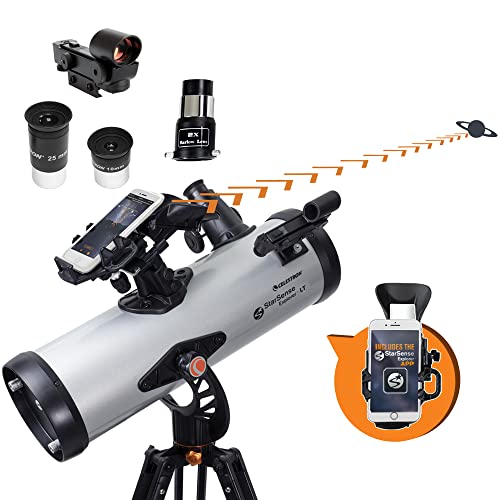
Celestron StarSense Explorer LT 114AZ
114mm Newtonian reflector, 450mm focal length (f/3.9), StarSense smartphone docking platform, alt-az mount, two Kellner eyepieces, StarPointer finderscope.
Telescope Review · Celestron StarSense
The Celestron StarSense Explorer LT 114AZ uses your smartphone to eliminate the most intimidating part of astronomy: finding objects. The StarSense docking platform and companion app analyse your phone's camera feed to determine exactly where the telescope is pointing, then guide you to targets with on-screen arrows. We reviewed the 114mm Newtonian version to see whether this technology delivers on its promise of frustration-free stargazing.
Celestron StarSense Explorer LT 114AZ
114mm Newtonian reflector, 450mm focal length (f/3.9), StarSense smartphone docking platform, alt-az mount, two Kellner eyepieces, StarPointer finderscope.
The StarSense Explorer LT 114AZ is the most beginner-friendly telescope in its class — not because of its optics, but because of its smartphone-based navigation system. The StarSense technology completely eliminates the need to learn the night sky manually. You place your phone in the dock, launch the app, and the telescope guides you to objects using on-screen arrows. For absolute beginners who have never used a telescope before, this is transformative. However, the 114mm Newtonian optics are budget-grade: the spherical mirror produces soft images at high magnification, the alt-az mount is functional but not smooth, and the stock eyepieces are basic. The StarSense system works best on bright, easy targets — the Moon, bright planets, and the brightest deep-sky objects.
Also popular on Telescope Advisor
The StarSense Explorer LT 114AZ uses a clever combination of hardware and software to solve the problem of finding objects in the night sky. The telescope includes a custom smartphone docking platform that positions your phone's camera over a small mirror, which reflects the view of the sky into the camera lens. The StarSense app analyses this camera feed, identifying stars and constellations using plate-solving technology — the same technique used by professional observatories to determine telescope pointing. The app then displays on-screen arrows that guide you to move the telescope manually until the target is centred in the eyepiece.
This process eliminates the need for a traditional finderscope alignment. The app calibrates itself automatically — you simply place your phone in the dock, open the app, and follow the on-screen instructions. The initial calibration takes approximately 30 seconds. Once calibrated, the app knows exactly where the telescope is pointing and can guide you to any of the thousands of objects in its database. The technology works with both iOS and Android phones, though performance varies depending on the phone's camera quality. Newer phones with better low-light camera performance produce more accurate and faster plate-solving results. During our testing with an iPhone 15 Pro, calibration was consistently under 20 seconds in a Bortle 5 suburban sky. With a mid-range Android phone, calibration took closer to 40 seconds but remained reliable throughout the evening.
The LT 114AZ sits on a panhandle-style alt-azimuth mount with a stainless steel tripod. The mount moves in two axes: up and down (altitude) and side to side (azimuth). There are no slow-motion control cables — you move the telescope by hand and lock each axis with a tension knob. This simplicity is a deliberate design choice that matches the beginner-friendly StarSense system. The azimuth movement has an adjustable tension lock that lets you set the resistance level. When properly adjusted, the telescope moves smoothly and stays in position when you release it. The altitude axis uses a spring-loaded mechanism that counterbalances the optical tube, preventing it from dropping when you let go.
The tripod is the same basic stainless steel model used on several Celestron entry-level telescopes. It has a central tray that provides a convenient resting place for eyepieces and accessories. At full extension, the eyepiece height reaches approximately 48 inches — comfortable for seated observation with a standard astronomy chair. The tripod is stable enough for the 114mm OTA at low magnifications, but vibrations take about 2-3 seconds to dampen at higher magnifications. Adding vibration suppression pads under the tripod feet significantly improves stability. For best results, we recommend setting up on a solid surface rather than soft ground.
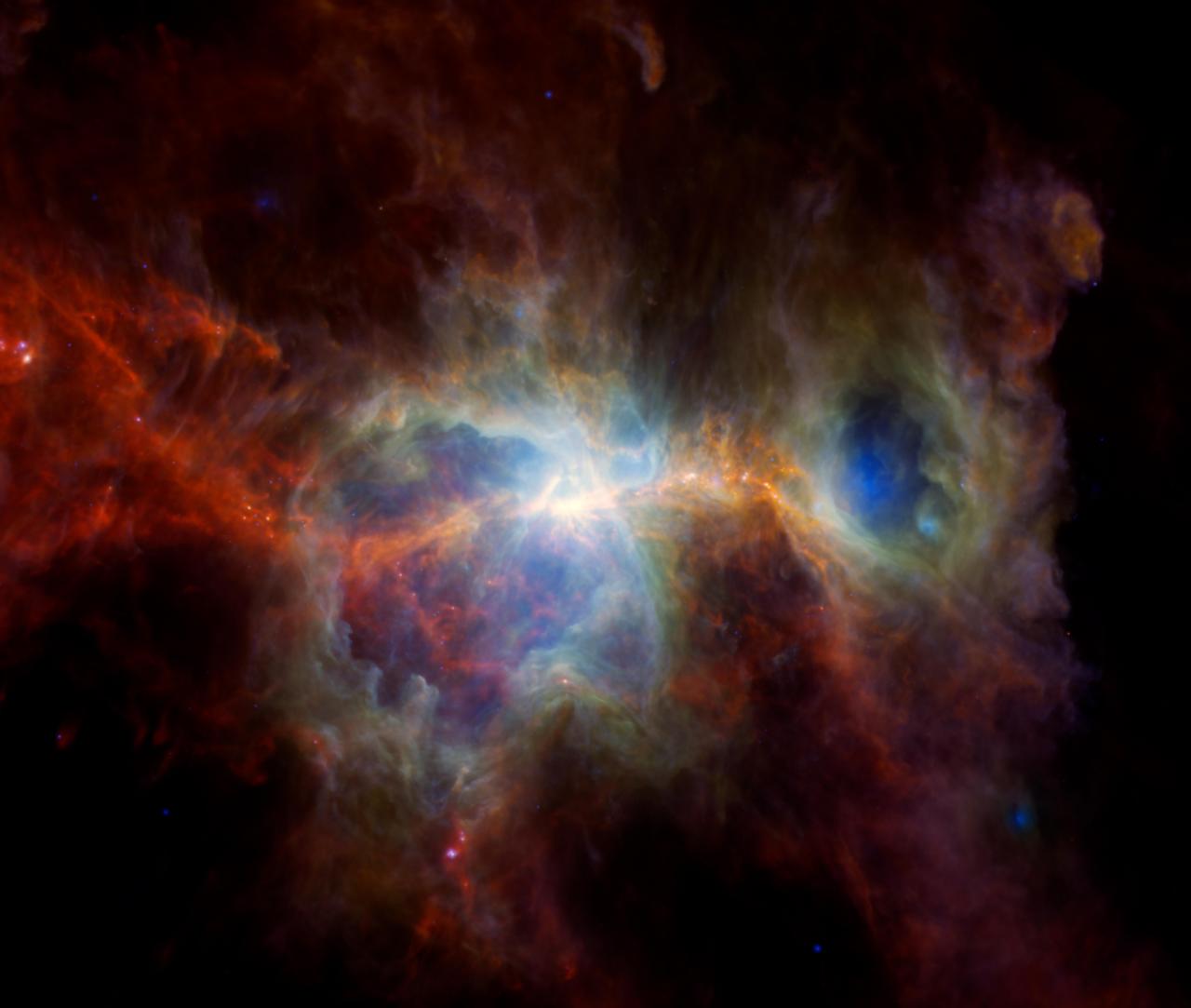
The LT 114AZ uses a 114mm (4.5-inch) Newtonian reflector with a 450mm focal length at f/3.9. This is a fast, wide-field optical system that excels at low-power sweeping. The 114mm aperture gathers 260% more light than a 70mm refractor, making it genuinely capable on deep-sky objects. The Orion Nebula shows distinct structure with the Trapezium region clearly visible. Globular clusters like M13 resolve into granular patches at the edges. Open clusters like the Double Cluster and the Pleiades are spectacular at low power, with dozens of stars visible in a single wide field. The Andromeda Galaxy shows its bright core and a hint of the surrounding halo — a satisfying target on a dark night. Under a Bortle 4 or darker sky, dozens of NGC objects become accessible.
However, the spherical mirror design — rather than a true parabolic mirror — limits high-magnification performance. At 80x and above, stars show spherical aberration (a soft, blurry appearance rather than sharp points). This is a cost-saving measure that Celestron uses to keep the LT 114AZ at its accessible price point. The Moon at 80x still shows acceptable detail — major craters and maria are crisp, but fine detail along the terminator is softer than through a true parabolic reflector. Jupiter shows its four moons and two main cloud bands at 60x, but higher magnification washes out the image due to spherical aberration. Saturn's rings are visible as an elongation at 60x, but the Cassini Division is not resolved. For the beginner who will spend most of their time at low to medium magnification on bright targets, this compromise is acceptable.
Deep-sky observation is where the LT 114AZ truly shines despite its spherical mirror. The wide 3.4-degree field of view at 15x (using the 30mm eyepiece that we recommend as an upgrade) makes sweeping the Milky Way a genuinely immersive experience. Star clouds in Sagittarius, the Veil Nebula complex (with an O-III filter), and the North America Nebula are all within reach from reasonably dark skies. The open clusters of Cassiopeia — M52, NGC 7789, and the Owl Cluster (NGC 457) — are showpiece targets that fit beautifully in the wide field. For a complete guide to what you can expect at this aperture, see our article on what you can see with different telescope sizes.
The StarSense Explorer LT 114AZ requires minimal maintenance, but a few practices will keep it performing well. The Newtonian optics use a primary mirror and a secondary mirror that require periodic collimation — alignment of the optical elements. The LT 114AZ's spherical mirror is more forgiving of slight misalignment than a parabolic mirror, but collimation should be checked every few months or after transport. A simple collimation cap — a plastic cap with a small centre hole — is the easiest tool for beginners. The secondary mirror is adjusted by turning the three small screws on the back of the secondary holder. The primary mirror is adjusted by three screws at the base of the tube. The mirror surfaces should be cleaned very rarely — a bulb blower for loose dust is usually sufficient. The smartphone dock should be kept clean and free of debris. The StarPointer finder's red dot brightness should be turned off when not in use to conserve battery life. The tripod leg locks should be tightened periodically. Store the telescope in a dry location with the dust cap on the front of the tube and the eyepieces in their case. The EQ mount bearings on the PowerSeeker 80EQ may benefit from light lubrication with white lithium grease once a year if the motion becomes stiff.
To maximize your enjoyment of the StarSense Explorer LT 114AZ, follow these practical tips we developed during our testing. First, charge your phone fully before each observing session and bring a portable USB power bank — the StarSense app drains the battery continuously through camera use. We recommend a 10,000 mAh power bank that can recharge your phone twice during a long evening. Second, download the StarSense app and familiarize yourself with its interface during daylight hours before your first night-time session. The app's "Tonight's Best" list updates based on your location and the current time, giving you a curated observing plan. Third, allow your telescope to acclimate to outdoor temperatures for at least 20 minutes before observing — this prevents thermal currents inside the tube that blur the image. Fourth, observe from the darkest location you can safely access. Even a Bortle 4 suburban backyard is dramatically better than a Bortle 8 city centre for deep-sky objects. Fifth, invest in a stable observing chair — the ability to sit comfortably while following the StarSense arrows makes the experience far more enjoyable than standing for hours.
Celestron offers two StarSense Explorer models in the alt-az range: the LT 114AZ and the DX 130AZ. The DX 130AZ has a larger 130mm aperture with a true parabolic mirror, offering better high-magnification performance and deeper reach into deep-sky objects. The DX model also includes a more robust mount with slow-motion control cables. However, the DX 130AZ costs approximately 60-70% more than the LT 114AZ. The LT 114AZ is the better value for absolute beginners who have not yet developed the skills to appreciate the DX's optical advantages. The DX 130AZ is the better choice for those who can stretch their budget and want room to grow without immediately outgrowing the telescope. Both telescopes share the same StarSense smartphone docking platform and app, so the user experience for navigation is identical.
The StarSense Explorer LT 114AZ is specifically designed for absolute beginners who want the experience of observing the night sky without the frustration of learning how to find objects manually. If you have never used a telescope before, have no knowledge of the constellations, and want to start observing immediately, the StarSense system makes this possible. The 114mm aperture provides enough light gathering to show hundreds of deep-sky objects — far more than smaller starter telescopes. The alt-az mount is simple to use: you move the tube up and down and side to side, guided by the app's arrows. The total setup time from box to first observation is approximately 20 minutes, significantly less than equatorial-mounted telescopes.
The StarSense Explorer LT 114AZ is less suitable for observers who already know how to find objects manually or who want high-magnification planetary views. The spherical mirror limits high-power performance, and manually finding objects with the app is slower than using a GoTo mount. For those who want a traditional manual telescope with better optical quality, the Sky-Watcher Heritage 130P offers a parabolic mirror in a similar price range. For those who want fully automated GoTo functionality, the Celestron NexStar 4SE or 5SE are better investments. But for the complete beginner who wants the least frustrating path to seeing the Moon, planets, and bright deep-sky objects, the StarSense Explorer LT 114AZ is uniquely suited. See our Best Telescopes for Beginners guide for context on how it compares to other entry-level options.
The StarSense app is the heart of this telescope's user experience, and Celestron has done an excellent job designing it for beginners. The interface is clean and intuitive: the main screen shows a list of tonight's best objects sorted by current position in the sky, with a "Tonight's Best" list that updates based on your time and location. Tapping an object shows its name, type, constellation, magnitude, and a brief description. An "Info" button provides a more detailed description of what you should expect to see. The navigation screen shows your phone's camera feed with a targeting reticle and directional arrows that tell you which way to push the telescope. The arrows are colour-coded — green when you are on the correct path, red when you push the wrong direction. The guidance system includes a proximity sensor that beeps when you are approaching the target, similar to a metal detector.
The primary limitation of the StarSense system is its reliance on your phone's battery. The app uses the camera continuously, which drains even a modern phone battery in approximately 2-3 hours. A portable USB power bank is essential for extended observing sessions. The phone dock positions your phone at an angle that can make the screen difficult to read in cold weather — the screen brightness is often insufficient when observing from a dark site where your night vision is adjusted. A red screen filter within the app would be a welcome improvement, though you can enable the phone's built-in red filter or night mode. The accuracy of the plate-solving is generally within one degree, which means the target appears somewhere in the field of the 20mm eyepiece — not perfectly centred but definitely visible. This is good enough for the beginner experience. For more smartphone astronomy tools, see our best astronomy apps guide.
During our testing, we compiled a list of the most rewarding targets for the LT 114AZ. The Moon is the obvious showpiece — the terminator region at any phase between first quarter and full shows dozens of named craters, mountain ranges, and the smooth maria. Jupiter at 60x shows both equatorial cloud bands and the four Galilean moons in their ever-changing orbital dance. Saturn at 60x reveals the ring system clearly, though the Cassini Division requires steady seeing. The Orion Nebula (M42) is the top deep-sky target — the bright core and the Trapezium are unmistakable. The Pleiades (M45) at 15x fills the field with blue-white stars against a rich background. The Andromeda Galaxy (M31) is a large, striking target from dark skies. Globular cluster M13 in Hercules resolves into a granular patch at 60x. The Double Cluster in Perseus is a stunning wide-field target at low power. The Beehive Cluster (M44) in Cancer and the Wild Duck Cluster (M11) in Scutum are both excellent open clusters for the StarSense's wide field.
The StarSense app includes a "Tonight's Best" list that curates the top objects visible from your location and time. This feature alone makes the telescope significantly more productive for beginners than a manual telescope of similar aperture — you spend your time observing rather than searching. For more target ideas, see our guide on what you can see with a telescope and our easy objects to see with a telescope list.
The LT 114AZ ships with two Kellner eyepieces (20mm and 10mm), a StarPointer finderscope, and the StarSense smartphone dock. The Kellner eyepieces are functional but limited — they have narrow apparent fields of view (approximately 40 degrees) and modest eye relief. A worthwhile first upgrade is a 30mm or 32mm Plössl eyepiece, which provides a wider true field of view (about 3.4 degrees) and makes the StarSense navigation more effective for finding deep-sky objects. A 6mm or 8mm eyepiece provides higher magnification for lunar and planetary observation, though the spherical mirror limits image quality above 100x. A moon filter is useful for reducing the Moon's brightness at low power. A simple green laser pointer attached to the tube — not the StarSense dock — can help with initial orientation before using the app. Vibration suppression pads under the tripod feet improve stability at higher magnifications. For a comprehensive selection, see our best telescope eyepieces guide.
The StarSense Explorer LT 114AZ competes in the beginner telescope market with several strong alternatives. The Sky-Watcher Heritage 130P is a collapsible tabletop Dobsonian with a 130mm parabolic mirror — it offers significantly better optical quality and light-gathering power at a similar price. The trade-off is that it lacks StarSense navigation: you must learn to find objects manually. For beginners who are willing to learn the night sky, the Heritage 130P delivers substantially better views of every target. The Celestron AstroMaster 70AZ is a simpler 70mm refractor on an alt-az mount — smaller aperture but no smartphone dependency and a more traditional telescoping experience. The Celestron PowerSeeker 80EQ offers an equatorial mount experience for those who want to learn EQ operation. The Celestron FirstScope is a simpler, cheaper tabletop Dobsonian for young children. Each alternative serves a different segment of the beginner market, and the right choice depends on whether you prioritize navigation ease, optical quality, or portability.
No. The StarSense app works entirely offline once downloaded. It uses your phone's camera and GPS to determine the telescope's pointing direction. No internet connection or Bluetooth is required during operation.
The StarSense app is available for both iOS and Android. The dock accommodates most phone sizes including iPhone and Samsung Galaxy models. Phone camera quality directly affects plate-solving speed — newer phones with better low-light cameras work best.
Yes, at approximately 60x magnification, Saturn shows disc and ring elongation. Resolving the Cassini Division requires higher magnification, which is limited by the spherical mirror. The view is acceptable but softer than through a parabolic reflector of the same aperture.