Draco Constellation Guide: Stars, Dragon Myth, and How to Find the Dragon
Telescope Advisor Logo Telescope Advisor
The Draco constellation winding between Ursa Major and Ursa Minor — the Dragon's elongated shape is visible throughout the year from northern latitudes

Constellation Guide · Summer & Year-Round

Draco Constellation — Finding the Dragon, Thuban, and the Cat's Eye Nebula

Draco the Dragon winds its way between Ursa Major and Ursa Minor, coiling around the north celestial pole. As one of the largest constellations in the sky, Draco contains Thuban — the former North Star — along with the spectacular Cat's Eye Nebula and many faint galaxies. This guide covers how to find Draco, its key stars, and its best deep-sky objects.

Best observedMay–September (summer)
Brightest starEltanin (mag 2.2)
Crowning jewelCat's Eye Nebula (NGC 6543)
Size ranking8th of 88 constellations
By Telescope Advisor Editorial Team Published: Updated: Editorial Standards

How to Find Draco

Draco is one of the largest constellations, covering 1,083 square degrees. Its elongated shape winds between the Big Dipper (Ursa Major) and the Little Dipper (Ursa Minor), making it relatively easy to locate once you know the landmarks. The brightest part of Draco is its head, marked by the four stars Eltanin (γ Dra, magnitude 2.2), Rastaban (β Dra, magnitude 2.8), Grumium (ξ Dra, magnitude 3.7), and Kuma (ν Dra, magnitude 4.9). This trapezoidal grouping is located north-west of the bright star Vega in Lyra, and south-east of the bowl of the Little Dipper.

From the Dragon's head, the body of Draco extends in a long sinuous line of third- and fourth-magnitude stars, passing between the Big Dipper and the Little Dipper, before ending near the star Thuban (α Dra, magnitude 3.7). Thuban lies about halfway between the bowl of the Big Dipper and the bowl of the Little Dipper — a useful landmark for locating this historically important star. Draco is circumpolar from most of the northern hemisphere (above about 35°N), meaning some part of the constellation is visible on any clear night of the year, though it is best placed in the evening sky from May through September.

Quick find: North of Vega, between the Dippers

Locate bright Vega high overhead on a summer evening. Look north of Vega toward the Little Dipper. The trapezoid of Draco's head lies midway between Vega and the Little Dipper's bowl. The body of Draco winds between the two Dippers. See our beginner constellation guide for more star-hopping techniques.

Key Stars of Draco

Draco contains no first-magnitude stars, but its second- and third-magnitude stars form a distinctive winding pattern that is easy to trace once located. The constellation is particularly notable for Thuban, which served as the pole star for ancient Egyptian astronomers.

Star Magnitude Distance Type Notes
Eltanin (γ Dra)2.2~148 lyOrange giant (K5)Brightest star in Draco; marks the Dragon's eye
Rastaban (β Dra)2.8~380 lyYellow supergiant (G2)Forms the Dragon's head with Eltanin, Grumium, and Kuma
Thuban (α Dra)3.7~303 lyWhite giant (A0)The North Star from 3942–1793 BCE; used by ancient Egyptians
Grumium (ξ Dra)3.7~112 lyOrange giant (K2)Variable star; slight brightness variations
Kuma (ν Dra)4.9~99 lyWhite main sequence (A6)Wide visual double with 4.9 and 5.0 mag components — easy for binoculars
Altais (δ Dra)3.1~100 lyYellow giant (G9)Marks the bend in the Dragon's body

Thuban — The Ancient Pole Star

Thuban (Alpha Draconis) served as the northern pole star from approximately 3942 BCE to 1793 BCE — a period that coincides with the height of ancient Egyptian civilisation. The ancient Egyptians built the Great Pyramid of Giza with shafts aligned to Thuban, and the star was used for celestial navigation and temple alignment throughout the Old Kingdom period. Thuban is not particularly bright at magnitude 3.7, but its historical significance far outweighs its visual prominence.

Earth's axial precession — a 26,000-year wobble — causes the celestial pole to trace a circle through the sky. Over this cycle, different stars take turns as the pole star. Thuban was the pole star 4,800 years ago, Polaris is the pole star today, and Vega will become the pole star around 14,000 CE. Thuban is now located about 25 degrees from the north celestial pole, making it a second-magnitude star that traces a noticeable circle around Polaris throughout the night, visible to the naked eye as it circles the pole.

Best Telescope for Observing Draco

Draco is best explored with a telescope that offers both wide-field views for the constellation's elongated shape and high-resolution optics for its planetary nebula and galaxies.

Editor's Pick — Best for Draco Deep-Sky
Sky-Watcher Classic 200P

Sky-Watcher Classic 200P (8-inch Dobsonian)

The 8-inch Dobsonian is the sweet spot for Draco's deep-sky objects. The Cat's Eye Nebula (NGC 6543) at magnitude 8.3 is easily visible as a bright blue-green disc at 150×, and many of Draco's faint galaxies become accessible with the 200mm aperture.

Celestron UpClose G2 10x50

Celestron UpClose G2 10×50

Binoculars show the Kuma double star and the winding shape of Draco's body across several degrees of sky.

Celestron SkyMaster 15x70

Celestron SkyMaster 15×70

15×70 binoculars reveal dozens of faint stars in Draco that are invisible in smaller optics, perfect for tracing the full Dragon.

Deep-Sky Objects in Draco

Draco contains the famous Cat's Eye Nebula and two dozen NGC galaxies, making it a rewarding constellation for deep-sky observers with telescopes of 6-inch aperture or larger.

NGC 6543 — Cat's Eye Nebula

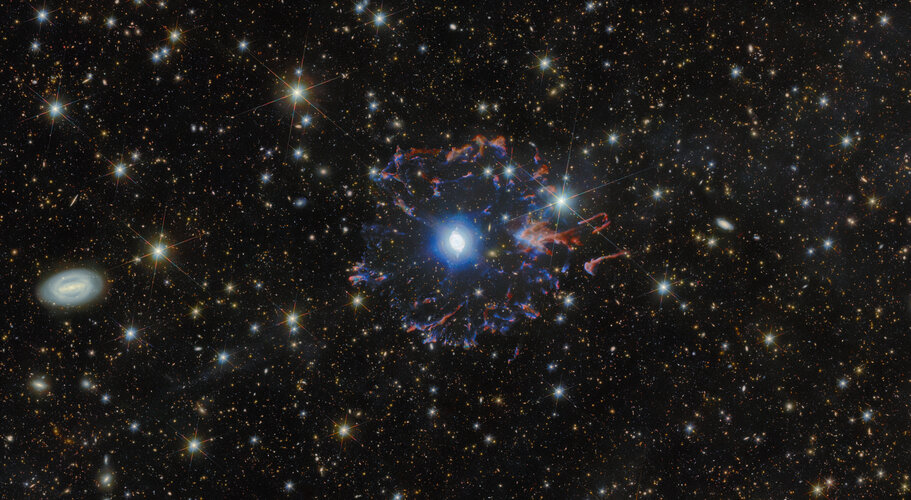
The Cat's Eye Nebula (NGC 6543) as imaged by ESA's Euclid telescope — concentric shells of gas ejected by a dying Sun-like star 3,000 light-years away in Draco

Credit: ESA/Euclid/Euclid Consortium/NASA, J.-C. Cuillandre (CEA Paris-Saclay), G. Anselmi

The Cat's Eye Nebula (NGC 6543) is a bright planetary nebula located near the Dragon's head, about 5 degrees south-west of Eltanin. At magnitude 8.3, it is visible in 4-inch telescopes as a small, bright blue-green disc. Through 8-inch and larger scopes at 200–300×, the nebula shows a complex internal structure with a bright inner core and fainter outer halo. The Hubble Space Telescope has revealed intricate concentric shells of gas ejected by the dying central star.

NGC 6543 Outer Halo

The outer halo of the Cat's Eye Nebula is a vast, faint shell of gas extending about 6 arcminutes from the central star — about one-fifth the diameter of the full Moon. This halo is extremely faint and requires large-aperture telescopes (14-inch+) under very dark skies, photographed with long-exposure astrophotography. The halo was formed approximately 50,000–90,000 years ago during an earlier mass ejection event.

NGC 5866 — Spindle Galaxy

NGC 5866 (also catalogued as M102 by some astronomers) is a lenticular galaxy seen nearly edge-on, giving it a distinctive spindle shape. At magnitude 9.9, it is visible in 6-inch telescopes as an elongated streak of light. Through 10-inch scopes, a dark dust lane bisecting the galaxy is visible under good conditions. The Spindle Galaxy lies in the south-western part of Draco, about 4 degrees north of the bright star Grumium.

Kuma (ν Dra) — Wide Double Star

Kuma is one of the finest wide double stars in the northern sky. The two components (magnitudes 4.9 and 5.0) are separated by 62 arcseconds — more than wide enough to split with binoculars. Through any telescope, the pair appears as two nearly equal white stars in a rich field, easily one of the most attractive double stars in the constellation. Kuma marks the tip of the Dragon's tail near the border with Cepheus.

Mythology and History of Draco

In Greek mythology, Draco represents Ladon, the hundred-headed dragon who guarded the golden apples in the Garden of the Hesperides. As one of Hercules's twelve labours, the hero was sent to retrieve the golden apples. Hercules slew the dragon, and both figures were placed in the sky — Hercules kneeling with his club, and Draco coiled around the north celestial pole. An alternative myth identifies Draco with the dragon killed by Cadmus, the founder of Thebes, before he founded the city.

Draco was one of the 48 constellations catalogued by Ptolemy in the 2nd century. Its stars have been used for navigation and timekeeping for millennia. The ancient Egyptians aligned their pyramids to Thuban when it was the pole star. In Chinese astronomy, Draco's stars are divided among several of the 28 lunar mansions, including parts of the Purple Forbidden Enclosure. The star Thuban is associated with righteousness and moral judgment in some Chinese astrological traditions.

In Norse mythology, the constellation is associated with Níðhǫggr, the dragon that gnaws at the roots of Yggdrasil, the world tree. This northern interpretation of a celestial dragon mirrors many other cultural traditions that see a great serpent or dragon winding through the polar sky — a testament to the constellation's distinctive elongated shape and its prominent position near the celestial pole.

Observing Draco Through the Seasons

Draco is circumpolar from most of the northern hemisphere, but its visibility and orientation change throughout the year. In spring (March–May), Draco's head — the distinctive trapezoid of Eltanin, Rastaban, Grumium, and Kuma — rises high in the eastern sky during the evening, with the Dragon's body stretching north-westward toward the Little Dipper. This is an excellent time to observe the Cat's Eye Nebula (NGC 6543) because it is well above the horizon's atmospheric turbulence. The nebula is located near the Dragon's head, about 5 degrees south-west of Eltanin, and an 8-inch telescope at 150× reveals its bright blue-green disc clearly.

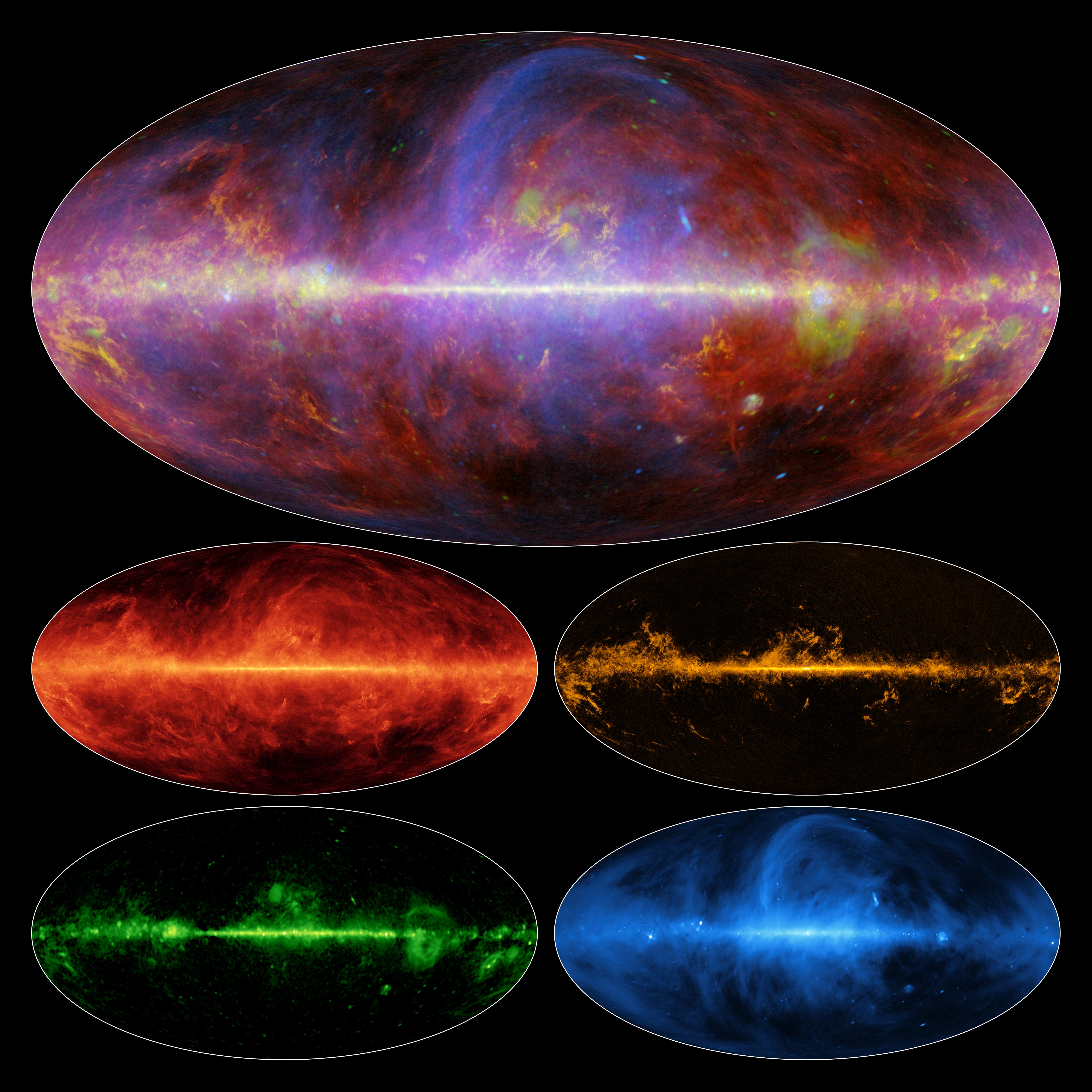
The Milky Way arching across a dark night sky — Draco's circumpolar position offers year-round deep-sky observing

Credit: NASA/P. Horálek (Institute of Physics in Opava)

In summer (June–August), Draco is at its highest point in the evening sky, with the entire constellation stretching across the zenith from east to west. This is the prime season for observing the fainter NGC galaxies in Draco's body and tail, including NGC 5866 (the Spindle Galaxy) and the many small galaxies near the Draco-Ursa Major border. Summer nights offer the advantage of warm temperatures for long observing sessions, though the shorter astronomical darkness at high latitudes (especially above 50°N) means the window for deep-sky observation is narrower. A moonless night in July or August, when Draco is overhead, provides the darkest possible skies for exploring the constellation's dimmest objects.

In autumn and winter (September–February), Draco appears lower in the north-western to northern sky during the evening hours. The Dragon's head sets first (by mid-autumn, it disappears below the north-western horizon for observers at 40°N), while the body and tail remain visible circling around Polaris. Winter is the most challenging season for Draco observing, but it offers the opportunity to see the constellation in a completely different orientation — low in the north, with the Dragon's body arching over the northern horizon like a celestial serpent guarding the pole. The star Thuban, located about 10 degrees from Polaris, is well-placed for observation during winter evenings.

Draco's Rich Galaxy Fields — A Target for Large Telescopes

While Draco is not as rich in bright galaxies as Ursa Major or Virgo, it contains a surprising number of faint NGC galaxies for observers with 10-inch and larger telescopes under dark skies. The Dragon's body and tail contain dozens of galaxies in the magnitude 11–14 range that reward patient observers. Many of these are members of the Draco Group centred on NGC 5907, the Splinter Galaxy, located near the border with Ursa Minor. NGC 5907 is one of the finest edge-on galaxies in the northern sky, visible in 6-inch telescopes as a thin streak of light with a 10:1 length-to-width ratio. Through 12-inch+ scopes, the galaxy shows a prominent dust lane bisecting its disc.

Other notable galaxies include NGC 6015 (a magnitude 11.0 face-on spiral near Thuban), NGC 6395 (a magnitude 12.2 barred spiral in the Dragon's tail), and the interacting pair NGC 5965 and NGC 5963 near the head of Draco. Each requires dark skies and careful star-hopping, but the sense of discovery when a faint fuzzy glow appears at the expected position is one of the great rewards of deep-sky observing. For GoTo telescope users, programming a "Draco galaxy tour" with 15–20 targets provides an excellent summer evening's observing when the constellation is high overhead.

In addition to galaxies, Draco contains several interesting multiple and variable stars worth observing. The star R Draconis is a Mira-type variable that fluctuates between magnitude 7.6 and 12.8 over a period of approximately 245 days, providing a long-term observation project for variable star enthusiasts. The double star 16 Draconis (also known as h Draconis) is a wide pair of magnitudes 5.5 and 5.7 separated by 3.3 arcseconds, easily split in any telescope at moderate magnification. Another fine multiple star is 39 Draconis, a triple system where a 5.0-magnitude primary is accompanied by a 7.0-magnitude secondary at 86 arcseconds (visible in binoculars), with the secondary itself being a close binary. These stellar targets provide excellent variety to a Draco observing session, complementing the faint galaxies with brighter, easier targets suitable for smaller instruments.

Whether you are tracking down the Cat's Eye Nebula, exploring the Dragon's rich galaxy fields, or simply tracing the winding shape of the celestial dragon between the Dippers, Draco offers a rewarding observing experience that changes with the seasons. Its circumpolar nature means it is always there, waiting to be explored on any clear night of the year — a constant companion in the northern sky. From the ancient pole star Thuban to the distant galaxies of the Draco Group, this constellation connects us to both the history of astronomy and the farthest reaches of the universe. Take a night this summer to trace the full length of the Dragon from its head near Vega to its tail between the Dippers — you will be following a star pattern that has guided astronomers for over three millennia. The constellation rewards patient observers with some of the finest planetary nebulae, edge-on galaxies, and multiple star systems in the northern sky.



Frequently Asked Questions

Is Draco visible all year?

Yes — Draco is circumpolar from most of the northern hemisphere (above about 35°N), meaning some part of it is visible on any clear night of the year. It is best placed for evening observing from May through September, when it is high overhead. The Dragon's head is more easily visible in summer, while the tail extends further north year-round.

What is the Cat's Eye Nebula and how can I see it?

The Cat's Eye Nebula (NGC 6543) is a bright planetary nebula in Draco at magnitude 8.3. It is visible in 4-inch telescopes as a small blue-green disc. An 8-inch scope at 200× reveals its bright inner core. The nebula is located about 5 degrees south-west of Eltanin, the brightest star in Draco.

Was Thuban really the North Star?

Yes — Thuban (Alpha Draconis) was the northern pole star from approximately 3942 BCE to 1793 BCE, a period that coincides with the height of ancient Egyptian civilisation. The ancient Egyptians aligned the Great Pyramid of Giza with Thuban. Earth's axial precession caused the pole to shift to its current position near Polaris.

What is the best telescope to see Draco's deep-sky objects?

An 8-inch Dobsonian is ideal for Draco. It shows the Cat's Eye Nebula in detail, reveals the Spindle Galaxy's dust lane, and resolves dozens of faint NGC galaxies. A 6-inch scope shows the brighter objects well, while 10-inch and larger apertures reveal the faint outer halo of the Cat's Eye and the dimmest Draco galaxies.

How large is Draco compared to other constellations?

Draco is the 8th-largest constellation in the sky, covering 1,083 square degrees — about 2.6% of the celestial sphere. Only Hydra (1,303 sq.°), Virgo (1,294 sq.°), Ursa Major (1,280 sq.°), and a few others are larger. Its elongated shape winds nearly 40 degrees across the sky.