
Hercules Constellation: Stars, M13 Globular Cluster, and How to Find
Telescope Advisor Logo Telescope Advisor
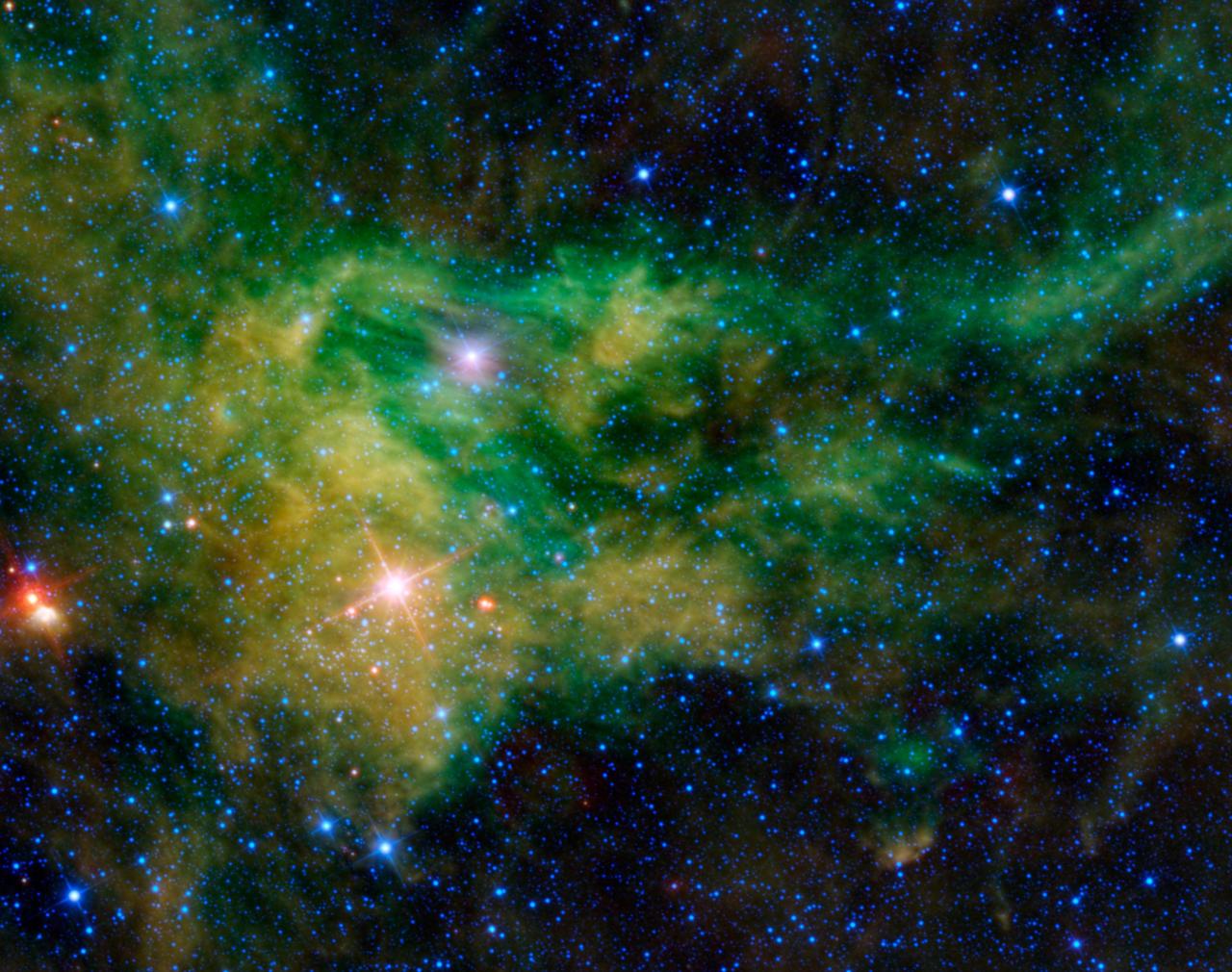
The Hercules constellation in a dark summer sky — containing the Great Globular Cluster M13 and the Keystone asterism

Constellation Guide · Summer 2026

Hercules Constellation Guide — Finding the Hero and the Great Cluster M13

Hercules is the fifth-largest constellation in the night sky, spanning 1,225 square degrees, yet it contains no stars brighter than second magnitude. Its fame rests almost entirely on one of the most spectacular deep-sky objects in the northern heavens: M13, the Great Hercules Globular Cluster. This guide covers how to find Hercules, its key stars, and the best deep-sky objects to observe through various telescope apertures.

Best observedApril – October (summer)
Brightest starRas Algethi (mag 3.0–4.0 var.)
Crowning jewelM13 — mag 5.8, 25K ly
Size ranking5th largest constellation
By Telescope Advisor Editorial Team Published: Updated: Editorial Standards

How to Find Hercules in the Summer Sky

Hercules is best located using the Summer Triangle as a signpost — the bright stars Vega (Lyra), Altair (Aquila), and Deneb (Cygnus) dominate the northern summer sky from June through September. Hercules sits between Vega and Arcturus (Boötes) in the constellation pattern. The most recognisable feature of Hercules is the Keystone, a distinctive trapezoid-shaped asterism of four stars that forms the torso of the mythological Hero. Once you find the Keystone, you are looking at the core of Hercules — and M13 lies along the western side of the Keystone, approximately one-third of the way from Zeta Herculis to Eta Herculis, visible as a faint fuzzy patch even through small binoculars under a dark sky.

From most mid-northern latitudes, Hercules is well-placed for evening observing from April through October, reaching its highest point in the sky around midnight local time in June and July. The constellation culminates (reaches its highest altitude) around 9 PM local time in August, making it an excellent target for summer stargazing sessions. Because Hercules is nearly overhead at culmination for observers at 40°N latitude, the view of M13 through a telescope is less affected by atmospheric turbulence than objects near the horizon — one of the reasons M13 is such a rewarding telescopic target.

Quick find: Follow the arc from Vega

Face east after sunset in July. Find bright Vega (magnitude 0.0) high in the east-northeast. Look about 15 degrees to the south-east of Vega — roughly one and a half fist-widths held at arm's length. The trapezoid shape of the Keystone should be visible to the naked eye from suburban skies. See our beginner constellation guide for more star-hopping techniques.
Key Stars of Hercules

Hercules contains no first-magnitude stars, but its second- and third-magnitude stars form distinctive patterns that are easy to recognise once you know where to look. The four stars of the Keystone are Pi Herculis (mag 3.2), Eta Herculis (mag 3.5), Zeta Herculis (mag 2.8), and Epsilon Herculis (mag 3.9).

Star Magnitude Distance Type Notes
Ras Algethi (α Her)3.0–4.0 (var.)~380 lyRed supergiant (M5)One of the largest known stars; 400× Sun's diameter
Ras Alhague (α Oph)*2.1~47 lyWhite main sequence (A5)Note: officially in Ophiuchus, but visually anchors Hercules
Kornephoros (β Her)2.8~139 lyYellow giant (G7)Brightest star in Hercules; name means "club-bearer"
Zeta Herculis2.8~35 lyBinary (G0 + G8)Nice double star for small telescopes; 1.5" separation
Pi Herculis3.2~370 lyYellow supergiantNorth-west corner of the Keystone asterism
Eta Herculis3.5~112 lyOrange giant (G8)South-east corner of the Keystone; close to M13

* Ras Alhague is the brightest star in the neighbouring constellation Ophiuchus but is often used as a locating aid for Hercules because of its proximity.

M13 — The Great Hercules Globular Cluster

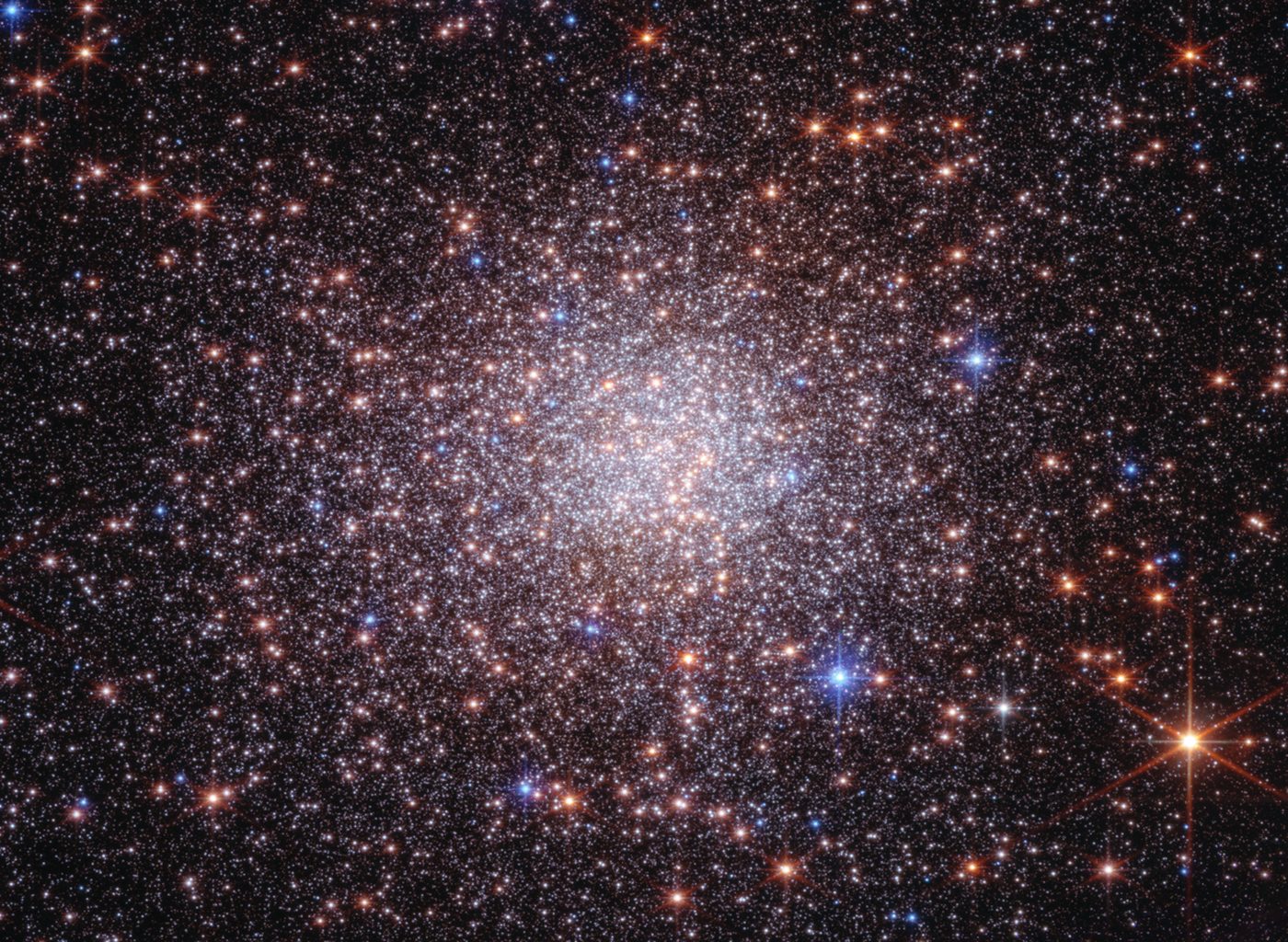
Webb and Hubble composite image of Terzan 5 globular cluster — similar in structure to M13 in Hercules, showing hundreds of thousands of ancient stars packed into a dense sphere

Credit: NASA, ESA, CSA, F. Ferraro (University of Bologna), M. Saraceno (University of Bologna), A. Pagan (STScI)

M13 (NGC 6205) is the finest globular cluster in the northern sky and one of the most rewarding deep-sky objects accessible to amateur telescopes of all sizes. Discovered by Edmond Halley in 1714 and catalogued by Charles Messier in 1764, M13 contains approximately 300,000 stars packed into a sphere roughly 145 light-years in diameter, located 25,000 light-years from Earth. Its integrated magnitude of 5.8 makes it visible to the naked eye under exceptionally dark skies — it was known as the "Nebula without stars" to early observers before telescopes resolved its true nature.

Through a telescope, M13 transforms from a faint fuzzy patch into one of the most spectacular objects in the sky. The view depends heavily on aperture and observing conditions. The cluster spans approximately 20 arcminutes — about two-thirds the diameter of the full Moon — so it fits comfortably in a medium-power eyepiece field with surrounding star field context.

What M13 Looks Like Through Different Apertures

Instrument Magnification What You'll See
7×50 or 10×50 binoculars7–10×Small round fuzzy patch — clearly non-stellar. Visible from suburban skies as a distinct glow
70–80mm refractor40–60×Bright, concentrated core with a granular texture — outer edges beginning to resolve
6-inch (150mm) Dobsonian100–150×Core fully resolved; hundreds of stars visible in a stunning ball extending across half the field
8-inch (200mm) Dobsonian150–200×Thousands of stars resolved; dark lanes and structural detail visible across the face of the cluster
10-inch+ (250mm+)200–300×Overlapping star images at the core requiring high resolution; colour contrast between red giants and blue main-sequence stars

Best Telescope for Observing M13 and Hercules

M13 is visible in virtually any telescope, but the experience varies dramatically with aperture. The recommendations below cover the range of options from casual observation through serious deep-sky viewing.

Editor's Pick — Best for Hercules
Sky-Watcher Classic 200P Dobsonian

Sky-Watcher Classic 200P Dobsonian (8-inch)

An 8-inch Dobsonian is the sweet spot for globular cluster observation — it gathers enough light to fully resolve M13's core into hundreds of individual stars while remaining portable enough to take to a dark-sky site. The Classic 200P's parabolic mirror and 2-inch focuser make it the best value-for-aperture telescope for deep-sky observing in 2026.

Sky-Watcher Heritage 130P

Sky-Watcher Heritage 130P

130mm aperture reveals M13's outer stars clearly — the best budget option for globular cluster observation.

Celestron NexStar Evolution 8

Celestron NexStar Evolution 8

GoTo tracking keeps M13 centred for extended study — ideal for showing the cluster to multiple observers.

Other Deep-Sky Objects in Hercules

While M13 is the crown jewel, Hercules contains several other deep-sky objects worth your time, particularly for observers with larger telescopes and darker skies.

M92 — Globular Cluster

Often overlooked because of M13's fame, M92 is a magnificent globular cluster in its own right at magnitude 6.4. Located about 16 degrees north of the Keystone, M92 is slightly more compressed than M13 and shows a bright, intense core even through small telescopes. Under dark skies, it is visible in 10×50 binoculars as a distinct fuzzy star. Many experienced observers consider M92 nearly as impressive as M13 — it simply suffers from proximity to the most famous cluster in the sky.

NGC 6210 — Turtle Nebula

A small but bright planetary nebula (magnitude 8.8) located about 3.5 degrees south-east of Kornephoros. Through an 8-inch telescope at 150×, NGC 6210 appears as a small, bright blue-green disc with a subtle irregularity in brightness — hence the nickname "Turtle Nebula." At 4,500 light-years away, it is relatively nearby for a planetary nebula. An O-III filter enhances the contrast of this object.

NGC 6229 — Globular Cluster

A challenging globular cluster at magnitude 9.4, located in the far north of Hercules near the border with Draco. NGC 6229 is small and faint — it appears as a uniform glow through 8-inch scopes and begins to resolve individual stars only at 200× in 10-inch or larger apertures. Its remote position makes it less visited by casual observers, but its high surface brightness rewards patient study.

Alpha Herculis (Ras Algethi)

Ras Algethi is a fascinating variable star and optical double. The primary is a red supergiant that varies irregularly between magnitude 3.0 and 4.0 over months to years. Through a telescope at 100×, a fainter blue-white companion star (magnitude 5.4) is visible about 5 arcseconds away — the two stars are not physically related (they are an optical double) but the colour contrast between the red supergiant and its blue neighbour is striking.

Mythology and History of Hercules

Hercules is one of the oldest recognised constellations, associated with the Greek hero Heracles (Roman: Hercules) and his twelve labours. The constellation's depiction shows a kneeling figure holding a club — the Keystone asterism forms the hero's torso, with stars extending outward to mark his arms and legs. The constellation was catalogued by Ptolemy in the 2nd century and has been depicted in Western astronomy since antiquity.

The most famous legend connecting Hercules to the night sky involves his twelfth and final labour: capturing Cerberus, the three-headed dog guarding the underworld. The neighbouring constellation Corona Borealis (the Northern Crown) is associated with the crown of the princess Ariadne, another figure from Hercules's cycle of myths. The nearby constellation Draco (the Dragon) is sometimes identified with the dragon that Hercules slew as one of his labours.

The globular cluster M13 played a notable role in the history of astronomy. In 1974, the Arecibo radio telescope sent the famous Arecibo Message towards M13 — a 1,679-bit encoded message containing information about Earth's position in the solar system, human DNA, and the structure of our solar system. The message will take approximately 25,000 years to reach its destination, making it one of humanity's longest-distance communications.

Tips for Observing Hercules Through Different Seasons

Hercules is best observed from April through October, but the observing experience changes significantly depending on when you look. In late spring (April–May), Hercules rises in the eastern sky around midnight and is well-placed for early-morning observing. The constellation is still relatively low, and atmospheric extinction can affect the view of M13 — use higher magnification (150× or more) to punch through the turbulence near the horizon.

In summer (June–August), Hercules culminates conveniently in the evening hours. This is the prime season for observing both the constellation and its deep-sky objects. The Milky Way passes through the Cygnus region nearby, and the rich star fields of the summer Milky Way provide a stunning backdrop. Plan your observing sessions around the New Moon — a waxing crescent Moon sets early, leaving the sky dark for evening observation. The Perseid meteor shower (peak around August 12–13) often coincides with excellent Hercules viewing conditions.

In autumn (September–October), Hercules is visible in the western sky after sunset and gradually sinks lower each evening. By late October, the constellation is low in the west-northwest during evening hours, and M13 begins to suffer from poor seeing near the horizon. This is still a good time to observe Hercules through binoculars — the wider field of view compensates for the lower altitude and provides a beautiful framing of the Keystone and its surroundings against the fading twilight.

For observers north of 40°N latitude, Hercules is circumpolar — meaning it never fully sets below the horizon. This allows year-round observation, though winter views are challenging because the constellation is low in the northern sky and often obscured by winter weather patterns. However, a clear winter night from a dark site can still reveal M13 as a fuzzy patch through binoculars, even when the constellation is just skimming the northern horizon.

Dark-sky tip for Hercules observers

M13 resolves best from dark-sky sites (Bortle 3 or better). From suburban skies (Bortle 5–6), the cluster appears as a bright fuzzy ball but the outer stars become difficult to resolve. For the best view, take your telescope to a dark-sky national park during summer. The difference between a suburban view and a Bortle 2 view of M13 is genuinely breathtaking — the cluster transforms from a glowing cotton ball into a three-dimensional sphere of thousands of individual stars.

M13 vs. M92: Comparing Hercules's Two Great Globular Clusters

Hercules is one of only a few constellations that contains two bright globular clusters visible in small telescopes. M92, located about 16 degrees north of the Keystone, is often overlooked but is a magnificent object in its own right. The two clusters offer an interesting comparison in structure and appearance.

M13 is larger (20 arcminutes vs. 14 arcminutes for M92) and brighter (magnitude 5.8 vs. 6.4). Through an 8-inch telescope, M13 appears as a sprawling, loosely structured ball of stars with a bright core and many resolved stars across its face. M92, in contrast, appears more compact and concentrated, with a brilliant core that resists resolution even at 200×. This is because M92 is more centrally concentrated — it has a higher central density of stars than M13, making its core appear more intense and star-like.

M92 is also older than M13 — approximately 14.2 billion years old compared to M13's 12.5 billion years. This makes M92 one of the oldest globular clusters in the Milky Way, dating to within a few hundred million years of the Big Bang. Its extreme age means its stars are very metal-poor, which affects their colour and brightness distribution. Through a telescope, M92's stars appear slightly more yellow than M13's, reflecting this difference in stellar population.

To find M92, look about 6 degrees north of the bright star Rastaban (Gamma Draconis) in Draco, or about 16 degrees directly north of the Keystone. In a finder scope, M92 appears as a small, intense fuzzy star — brighter in the centre than M13 appears at the same magnification. Both clusters fit in the same low-power (40×) eyepiece field of view in an 8-inch telescope if you have a 2-inch eyepiece with a 2-degree true field, allowing direct comparison between these two ancient stellar cities.

Property M13 M92
Magnitude5.86.4
Apparent size20 arcminutes14 arcminutes
Distance25,000 light-years26,700 light-years
Age12.5 billion years14.2 billion years
Concentration classV (intermediate)IV (concentrated)
Best view in6–8 inch scope at 100×8–10 inch scope at 150×


Frequently Asked Questions

Can you see the Hercules constellation with the naked eye?

Yes — the Keystone asterism and surrounding stars are visible to the naked eye from suburban and darker skies. None of Hercules's stars are brighter than magnitude 2.8, so it appears as a modest grouping rather than a prominent constellation. From light-polluted urban skies (Bortle 7+), the fainter stars of Hercules may be difficult to discern, but the brighter stars of the Keystone should still be visible through light pollution with dark-adapted eyes.

What is the best telescope to see M13?

An 8-inch (200mm) Dobsonian is the sweet spot for M13 — it fully resolves the cluster's core into individual stars while remaining portable. Through a 6-inch scope, M13 is spectacular but the core remains partly unresolved. Through a 4-inch scope, the cluster appears as a bright, textured patch with some outer star resolution. Even a 70mm refractor will show M13 as a clearly non-stellar object. See our best Dobsonian telescopes guide for recommendations.

How do I find M13 from the Keystone?

M13 is located along the western side of the Keystone asterism, approximately one-third of the way from Zeta Herculis to Eta Herculis. In a finder scope at low power, it appears as a small, round fuzzy patch. In binoculars, it is visible as a distinct non-stellar glow under dark skies. The approximate coordinates for GoTo telescopes are RA 16h 41m 41s, Dec +36° 27' 35".

What is the best time of year to observe Hercules?

Hercules is best observed from April through October in the northern hemisphere, with the constellation reaching its highest point in the sky at midnight local time in June and July. The constellation is circumpolar (always above the horizon) for observers north of about 35°N latitude, meaning some part of Hercules is visible all year from much of the United States, Canada, and Europe.

What is the Arecibo Message connection to M13?

The Arecibo Message was a 1,679-bit binary transmission sent from the Arecibo radio telescope on November 16, 1974, towards M13 as a demonstration of human technological capability. The message encodes information about Earth's solar system, human DNA, and our mathematical and scientific knowledge. It will take approximately 25,000 years to reach M13, and 25,000 more for any reply — making it more a symbolic gesture than a genuine attempt at communication.