The Hubble Image in Full Resolution

Breaking Space News · June 30, 2026
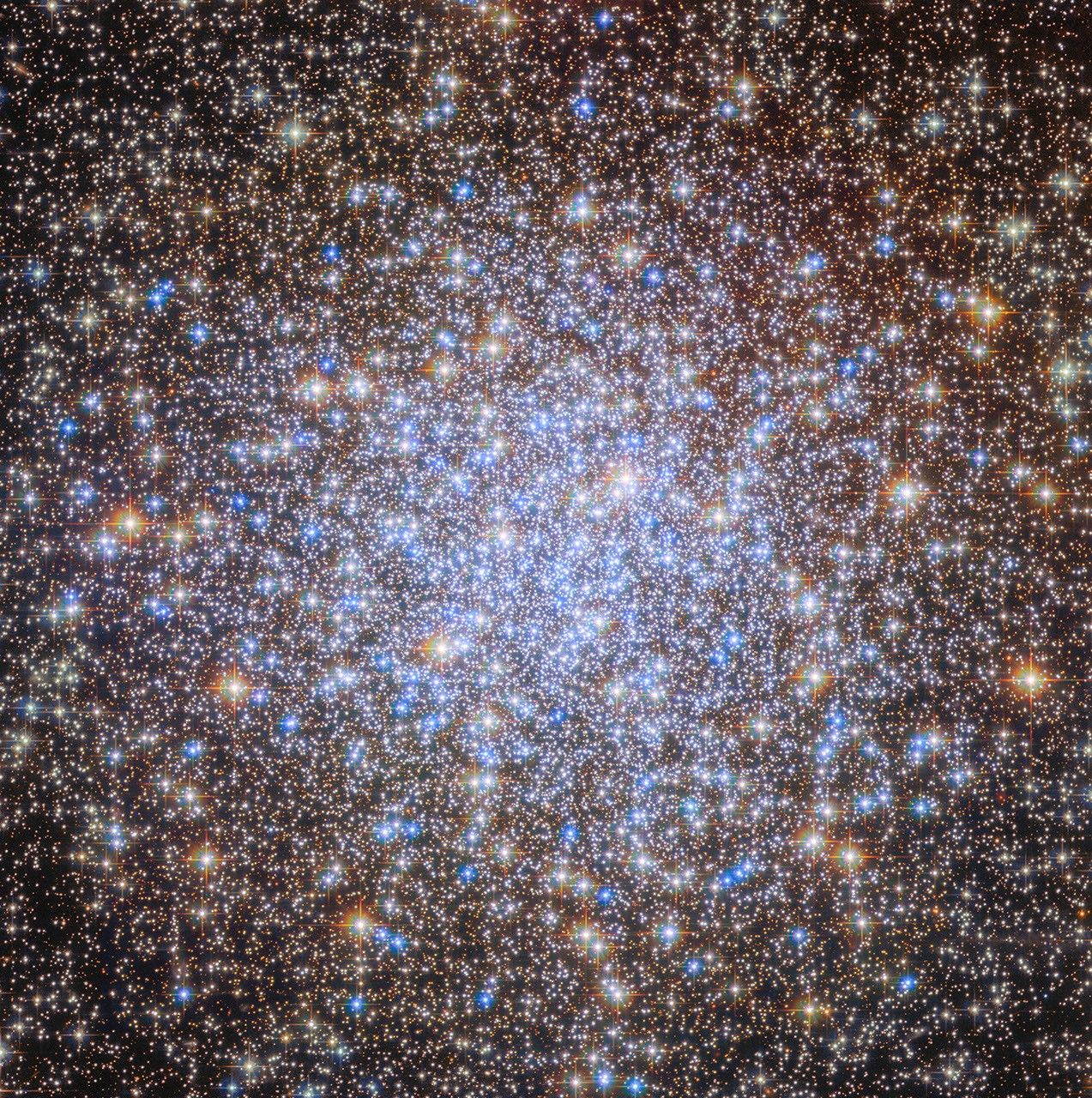
The NASA/ESA Hubble Space Telescope has turned its gaze toward NGC 6723, a globular cluster 27,000 light-years away in Sagittarius. Sometimes called the Chandelier Cluster, this ancient stellar assembly holds clues to how star clusters formed in the early universe — and Hubble's latest observations reveal it underwent not one but two distinct bursts of star formation.
27,000 ly
Distance from Earth
10+ bn yrs
Cluster age
634 myr
Between star formation bursts
150+
Known Milky Way globulars

Juhi Sahni
Senior Editor, Space NewsTelescope Advisor
Senior Editor at Telescope Advisor, overseeing space news coverage and holding editorial responsibility for everything published on the site. Coverage includes NASA and ESA mission updates, JWST and Roman Space Telescope findings, sky-event guides, and equipment analysis that ties space science back to practical observing. Every factual claim is verified against primary sources — NASA/JPL Horizons, the International Meteor Organization, the US Naval Observatory, and mission briefings — before publication. LinkedIn →
On June 26, 2026, NASA and ESA released a striking new image from the Hubble Space Telescope showing NGC 6723, a globular cluster in the constellation Sagittarius. Dubbed the Chandelier Cluster for its glittering, multi-coloured array of stars, NGC 6723 is one of more than 150 known globular clusters orbiting our Milky Way galaxy. The image, captured as part of Hubble's Picture of the Month series, combines observations in ultraviolet, visible, and near-infrared light to reveal the cluster's stellar population in extraordinary detail — from cool orange giants at the outskirts to hot blue stars densely packed at the core.
But the image is more than just a beautiful portrait. Hubble's observations of NGC 6723 are part of a long-term research programme — originally conceived in 2006 as Survey #10775 (PI: Sarajedini) and followed up by Survey #13297 (PI: Piotto) — that has fundamentally changed astronomers' understanding of how globular clusters form and evolve. The key finding: NGC 6723 experienced two distinct episodes of star formation, the second occurring within 634 million years of the first. While 634 million years sounds vast, for a cluster more than 10 billion years old it is a remarkably brief interval — a "closely-spaced" double burst that challenges the traditional view that globular clusters form all their stars in a single, rapid event.
"Globular clusters like NGC 6723 contain some of the oldest stars in our galaxy," the NASA Hubble team explained in the release. "These clusters have ages that often exceed 10 billion years old, and some are nearly as old as the universe itself." Astronomers believe globular clusters were among the first structures to coalesce in our galaxy, potentially forming billions of years before the thin stellar disk that hosts our Sun.
For amateur astronomers, NGC 6723 sits in a particularly rich region of the summer Milky Way. At magnitude 8.6, the cluster is within reach of 4-inch (100mm) telescopes under dark skies, appearing as a faint, hazy patch approximately 11 arcminutes across — about one-third the apparent diameter of the full Moon. The cluster lies just 2.5° south of the bright globular cluster M22 in Sagittarius, making it an excellent target for a summer globular cluster tour with a telescope or even large binoculars.
The scientific significance, however, is what makes this news truly exciting. The discovery of two closely-spaced star formation episodes in NGC 6723 adds to a growing body of evidence that globular clusters have complex formation histories. Using Hubble's unique sensitivity to ultraviolet light, researchers detected subtle variations in chemical composition among the cluster's stars — variations that can only be explained if the cluster formed stars in multiple bursts rather than a single event. This finding has implications for how we understand the early universe, because globular clusters are thought to have formed during the very earliest stages of galaxy assembly, more than 10 billion years ago.
The Hubble survey that included NGC 6723 studied 65 globular clusters across our galaxy, producing data that has inspired "several hundred published research papers," according to NASA. These observations have helped astronomers understand everything from the ages of globular clusters to the process of mass segregation — the gravitational sorting that causes massive stars to sink toward the cluster centre while lower-mass stars drift outward.
NGC 6723 is visible in the southern summer Milky Way from June through September, when Sagittarius is at its highest in the evening sky. Here is how to find and observe it:
Find M22 First
Start with the bright globular cluster M22 in Sagittarius (magnitude 5.1, visible to the naked eye under dark skies). NGC 6723 is located just 2.5° directly south of M22 — less than a finder-scope field of view away.
Telescope Requirements
In a 4-inch (100mm) telescope at 50–60×, NGC 6723 appears as a faint, round haziness — similar to a small unresolved globular. At 100× in a 6-inch scope, the cluster begins to show a granular texture at the edges under good conditions. An 8-inch (200mm) Dobsonian at 120–150× reveals individual stars in the outer regions, with a brighter, unresolved core.
Best Viewing Window
Sagittarius culminates around midnight in July and by 9–10 p.m. in September. The cluster reaches an altitude of about 30° from mid-northern latitudes and passes nearly overhead from the southern United States and Mediterranean Europe. Dark skies (Bortle 4 or better) are recommended, as the cluster's low surface brightness makes it challenging from suburban locations.
Binocular View
In 15×70 binoculars, NGC 6723 appears as a faint, unresolved glow near the brighter teapot-shaped asterism of Sagittarius. It is not visible in standard 10×50 binoculars from suburban skies, but observers at dark sites may detect it as a tiny grey smudge with averted vision.
Globular clusters are spherical collections of stars that orbit the halos of galaxies, far outside the main galactic disk. They are among the oldest known objects in the universe: the stars within a typical globular cluster are 10–13 billion years old, meaning they formed when the universe was less than a quarter of its current age. Our Milky Way is known to host at least 150 globular clusters, though many more may remain undiscovered, hidden behind dense dust clouds in the galactic plane.
For decades, astronomers believed that all stars in a globular cluster formed simultaneously — a single burst of star formation that created a population of stars with identical ages and chemical compositions. Hubble's ultraviolet observations have upended this picture. By detecting multiple populations with distinct chemical signatures, Hubble has revealed that many globular clusters experienced two or even three episodes of star formation, separated by millions or billions of years. The exact mechanism remains debated — possible explanations include multiple gas infall events, mergers with smaller clusters, or accretion of gas from the surrounding galaxy — but Hubble's observations of clusters like NGC 6723 are providing the data needed to test these models.
For more on observing globular clusters, see our M13 Hercules Cluster guide, best Messier objects for beginners, and what you can see with a 130mm telescope.
The image of NGC 6723 was captured by Hubble's Wide Field Camera 3 (WFC3) and Advanced Camera for Surveys (ACS) across five wavelengths: ultraviolet (275 nm), optical U-band (336 nm), optical B-band (438 nm), visible (606 nm), and near-infrared (814 nm). The composite reveals the cluster's stellar population in natural colour: blue stars — mostly concentrated at the centre — are hotter, younger, and more massive, while orange stars distributed around the edges are cooler, older giants. The four-point diffraction spikes visible on some stars are a signature optical effect of Hubble's mirror support structure, and their size indicates which stars are brightest in the foreground.
The field of view spans approximately 3.38 by 3.40 arcminutes — about one-tenth the apparent size of the full Moon. At the cluster's distance of 27,000 light-years, this corresponds to a physical region roughly 27 light-years across. North is 15.8° to the right of vertical in the image.
Credit: ESA/Hubble & NASA, A. Sarajedini, G. Piotto
Also popular on Telescope Advisor
Continue Exploring
Choose the next page based on whether you need a recommendation, a comparison, or a practical observing plan.
Get a Telescope Recommendation
Fastest path if you want one model instead of another long guide.
Use the Buyer Framework
See the decision order that matters before you buy.
Plan Your Next Session
Turn your gear into a concrete observing list for tonight.
⚡ On sale now: Prime Big Deal Days telescope deals · or wait for Black Friday?
🎄 Holiday season: Telescope Christmas Gift Guide 2026 · Black Friday deal tracking
M13 Hercules Cluster Guide
How to see the northern sky's finest globular cluster.
Best Messier Objects for Beginners
Top 10 deep-sky targets including globular clusters.
Sagittarius Constellation Guide
Navigate the Archer — home to M22, NGC 6723, and the Milky Way core.
Best Dobsonian Telescopes
Top picks for resolving globular clusters.
Best Deep-Sky Telescopes
Aperture-first picks for cluster observing.
Summer Triangle Guide
Navigate summer skies to find Sagittarius and its globulars.