

Telescope Advisor Logo Telescope Advisor
The constellation Orion with its iconic three-star belt standing out against a dark winter sky — the most recognisable asterism in the northern hemisphere

Constellation Guide · Winter Sky · Orion's Belt

Orion's Belt Constellation Guide — Stars, Location, and How to Find the Three Kings

Orion's Belt is the most famous asterism in the night sky — three bright stars in a near-perfect straight line that serves as a celestial landmark for finding some of winter's finest deep-sky objects. Known to many cultures as the Three Kings, the Three Sisters, or the Rake, this iconic trio of Alnitak, Alnilam, and Mintaka guides observers to the Orion Nebula, the Horsehead Nebula, and countless other treasures. This guide covers everything you need to find, observe, and appreciate Orion's Belt.

StarsAlnitak, Alnilam, Mintaka
Best seasonDecember – February
Notable DSOOrion Nebula (M42)
ConstellationOrion the Hunter
By Elena Reyes Published: Updated: Reviewed & approved by Juhi Sahni, Senior Editor Editorial Standards
Elena Reyes — Senior Science Editor

Elena Reyes

Senior Science Editor

Covers NASA missions, space science discoveries, and astronomical events for Telescope Advisor. Translates complex astrophysical research into practical insights for backyard observers. Based in the San Francisco Bay Area.

What Is Orion's Belt?

Orion's Belt is a distinctive asterism — a recognisable pattern of stars that is not a formal constellation — formed by three bright stars in a nearly straight line within the constellation Orion the Hunter. From left to right (as seen from the northern hemisphere), these are Alnitak (Zeta Orionis), Alnilam (Epsilon Orionis), and Mintaka (Delta Orionis). Together, they span about 1.4 degrees across the sky — roughly three times the apparent diameter of the full Moon.

What makes Orion's Belt so useful to astronomers is its role as a celestial signpost. The three stars point directly toward some of the most spectacular deep-sky objects in the winter sky. Following the line of the Belt downward and to the left leads to Sirius, the brightest star in the night sky. Following it upward and to the right points toward Aldebaran and the Pleiades cluster. And hanging below the Belt like a sword are the stars and nebulae of the Orion Nebula (M42) — the closest major star-forming region to Earth and one of the most photographed objects in the entire sky.

Culturally, Orion's Belt has been recognised by nearly every civilisation. The ancient Egyptians aligned the pyramids of Giza to mirror the Belt's stars. In the Bible, it is referenced as "the band of Orion" in the Book of Job. Chinese astronomy knows it as the "Balance Beam" or "Three Stars." Many modern cultures still call Orion's Belt the "Three Kings" or "Three Marys." This cross-cultural recognition makes Orion's Belt one of humanity's oldest and most universal astronomical references.

The Three Stars of Orion's Belt

Despite appearing nearly identical to the naked eye, each of the three Belt stars is a distinctly different type of star — a fact that becomes apparent through binoculars or a small telescope, where subtle colour differences emerge.

Star Designation Magnitude Distance Type Notes
Alnitak Zeta Orionis 1.7 1,260 ly Blue supergiant Easternmost Belt star; triple system; illuminates Horsehead Nebula
Alnilam Epsilon Orionis 1.7 1,340 ly Blue supergiant Centre star; brightest in ultraviolet; surrounded by NGC 1990 nebula
Mintaka Delta Orionis 2.2 1,200 ly Blue giant (binary) Westernmost Belt star; lies almost exactly on celestial equator

All three stars are young, massive, and hot — between 15 and 30 times the mass of the Sun and burning at surface temperatures exceeding 25,000°C. They are part of the Orion OB1 association, a loose grouping of hot, massive stars that formed from the same molecular cloud roughly 5 to 10 million years ago. Despite their immense energy output, they appear modestly bright because they are over 1,200 light-years away — far more distant than many stars that appear brighter from Earth. The name Alnitak derives from Arabic meaning "the girdle," Alnilam means "string of pearls," and Mintaka means "belt" — all three names referencing the Belt itself.

How to Find Orion's Belt

Finding Orion's Belt is the easiest star-hop in the northern hemisphere sky. Look for the constellation Orion, which dominates the southern sky during winter evenings. Orion is instantly recognisable by its hourglass shape: two bright shoulder stars (Betelgeuse and Bellatrix), two bright foot stars (Rigel and Saiph), and the three aligned Belt stars in the centre.

From the northern hemisphere (USA, Europe, UK), Orion is best visible in the evening sky from December through February, when it reaches its highest point around midnight. In March and April, Orion shifts westward and sets earlier in the evening. From the southern hemisphere, Orion appears upside-down in the northern sky during summer months (June–August).

Once you have located the three Belt stars, use them as a starting point for exploration:

  • Sword of Orion: Look below the Belt for a line of three fuzzy stars — the middle "star" is the Orion Nebula (M42), visible to the naked eye as a hazy patch even from moderately light-polluted suburbs.
  • Follow to Sirius: Extend the line of the Belt downwards and to the left; it points directly at Sirius (magnitude -1.5), the brightest star in the night sky.
  • Follow to Aldebaran: Extend the line upward and to the right to find Aldebaran (magnitude 0.9) and beyond it the Pleiades star cluster (M45).
  • Orion's Bow: From the Belt, look east (left) to find a curved arc of stars forming Orion's shield or bow — Meissa at the head and the arc of Pi Orionis stars.

Deep-Sky Objects Near Orion's Belt

Orion's Belt points the way to some of the finest deep-sky objects in the entire night sky. Within a few degrees of the Belt, you will find the Orion Nebula, the Horsehead Nebula, and the Flame Nebula — three vastly different celestial objects within a single field of view.

Orion Nebula (M42) — The Great Star Factory

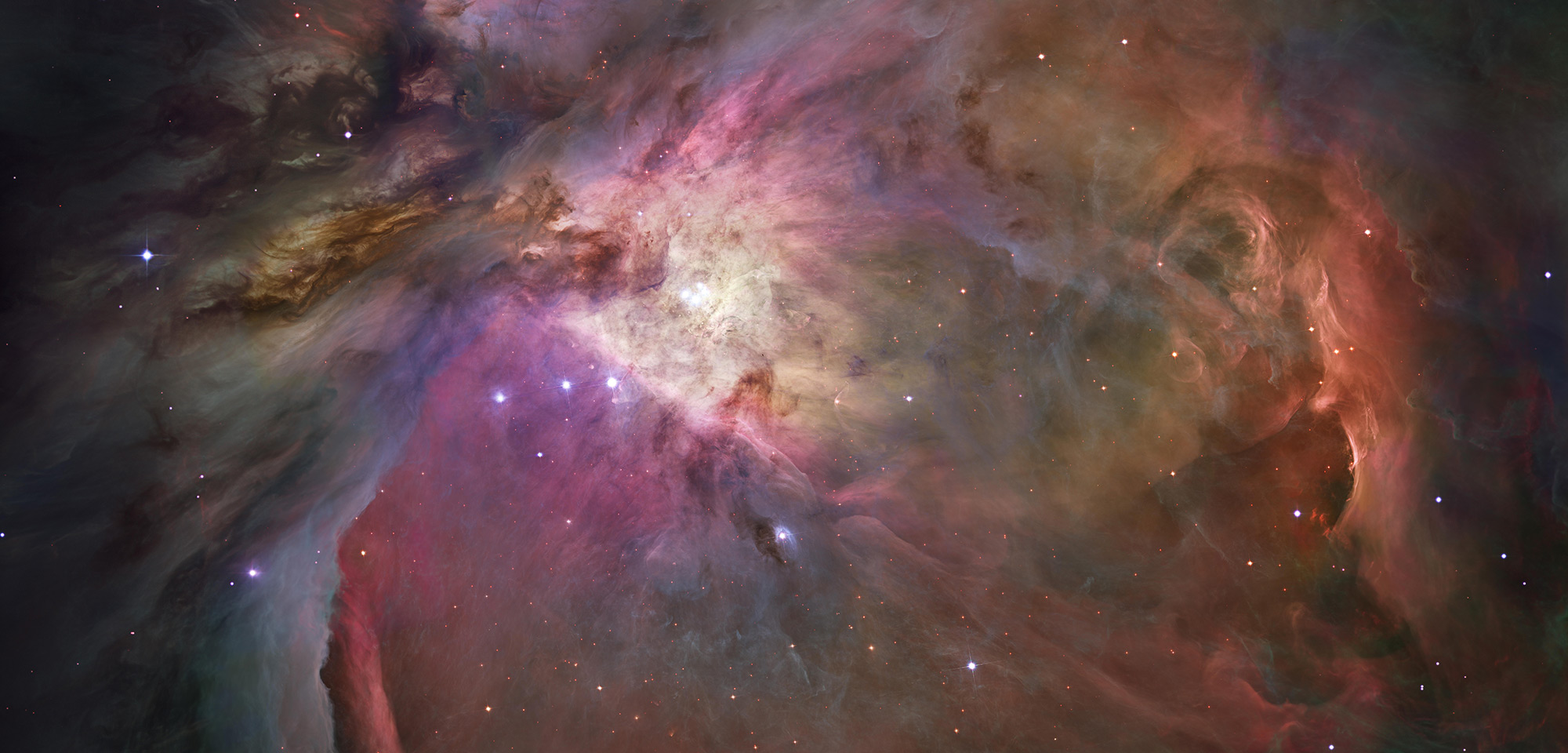
Visible to the naked eye as a fuzzy patch below the Belt, M42 is the closest major star-forming region to Earth at just 1,344 light-years away. Through any telescope, it reveals a glowing greenish-blue cloud of ionised gas with four bright stars (the Trapezium) at its core. A 4-inch scope at 50× shows the nebula's wing-like structure; an 8-inch Dobsonian at 100× reveals the Trapezium clearly and begins to show the dark dust lanes cutting through the nebula. M42 spans about 24 light-years across and contains over 1,000 young stars still forming from the surrounding molecular cloud.

Horsehead Nebula (Barnard 33) — The Iconic Dark Nebula

Located just south of Alnitak, the Horsehead Nebula is one of the most recognisable dark nebulae in the sky. It is a silhouette of dense interstellar dust against the faint red glow of ionised hydrogen behind it. Visually, the Horsehead is notoriously challenging — it requires at least an 8-inch telescope under very dark skies with an H-beta filter to glimpse the dark notch. Astrophotographers with H-alpha filters capture it spectacularly. The nebula spans about 3.5 light-years and is part of the same Orion Molecular Cloud complex as M42.

Flame Nebula (NGC 2024) — A Bright Emission Nebula

Just east of Alnitak lies the Flame Nebula, a bright emission nebula illuminated by the star Alnitak itself. Through a telescope at low power, it appears as a bright comma-shaped glow with a distinctive dark dust lane cutting through its centre — giving it the appearance of a flickering flame. A 6-inch scope with a UHC or O-III filter reveals the nebula's full extent. The Flame Nebula spans about 30 light-years and contains a dense cluster of young stars embedded within its gas.

Running Man Nebula (NGC 1977) — A Reflective Companion

North of the Orion Nebula, the Running Man Nebula is a bright reflection nebula that gets its name from a silhouette of a running human figure visible in long-exposure photographs. Through a 6-inch telescope, it appears as a bright patch of nebulosity surrounding several hot, young stars. At magnitude 7.0, it is visible in binoculars under dark skies as a faint glow.

The Mythology of Orion's Belt

In Greek mythology, Orion was a giant huntsman placed among the stars by Zeus (or by Artemis and Apollo, depending on the version). The three Belt stars represent the hunter's belt or girdle, holding his sword — marked by the stars of Orion's Sword where the Orion Nebula resides. Orion pursues the Pleiades (seven sisters) across the sky, with Taurus the Bull charging ahead of them.

The ancient Egyptians aligned the three pyramids of Giza to mirror the Belt's stars — a theory first proposed in the 1990s and still debated among archaeologists. The pyramids of Khufu, Khafre, and Menkaure are positioned in a slightly off-centre line that closely matches the relative positions and brightness of Alnitak, Alnilam, and Mintaka. Whether intentional or coincidental, the alignment speaks to the universal recognition of Orion's Belt as a symbol of order and orientation.

In Chinese astronomy, the three stars of Orion's Belt are known as Shen (參), one of the 28 lunar mansions. The character itself depicts three stars, reflecting the Chinese tradition of recognising the trio as a distinct celestial entity separate from the surrounding constellation. Polynesian navigators used Orion's Belt as a key waypoint for trans-oceanic voyages, and many Indigenous Australian traditions incorporate the three stars into their songlines and creation stories.

Observing Orion's Belt with Binoculars and Telescopes

Even with the naked eye, Orion's Belt is a spectacular sight on a clear winter night. But binoculars and telescopes reveal what lies hidden within and around these three stars.

Binoculars (10×50): The three Belt stars appear in a single field of view, and subtle colour differences become apparent — Alnitak shows a slight blue-white hue, while Alnilam appears subtly warmer. The Orion Nebula below the Belt transforms from a fuzzy star to a distinct glowing cloud. The faint stars of the Sword of Orion become visible, and the surrounding Milky Way star field — rich in the winter months — fills the binocular view.

Small Telescope (4-inch / 100mm): At 50×, Alnitak splits into a double star (the primary and a 4th-magnitude companion separated by 2.5 arcseconds). The Orion Nebula shows clear wing structure and the four Trapezium stars become visible at 100×. The Flame Nebula appears as a faint glow beside Alnitak. An O-III filter dramatically improves contrast on both nebulae.

Moderate Telescope (8-inch / 200mm): The view becomes stunning. The Orion Nebula shows intricate detail — wisps of gas, dark lanes, and dozens of faint stars in the surrounding cluster. The Horsehead Nebula becomes a possible visual target with an H-beta filter under dark skies. The Flame Nebula reveals its dark dust lane clearly. At 200×, the three Belt stars resolve into multiple systems: Mintaka reveals its 6th-magnitude companion, and Alnitak shows a third, much fainter star.

Frequently Asked Questions

What are the names of the three stars in Orion's Belt?

Alnitak (Zeta Orionis), Alnilam (Epsilon Orionis), and Mintaka (Delta Orionis). From the northern hemisphere, Alnitak is the leftmost star of the Belt, Alnilam is the centre, and Mintaka is the rightmost.

How far apart are the stars of Orion's Belt?

The Belt spans about 1.4 degrees across the sky — roughly three times the diameter of the full Moon. In physical space, Alnitak and Mintaka are about 800 light-years apart, while Alnilam is approximately 80 light-years beyond Alnitak along our line of sight.

Can you see Orion's Belt from the southern hemisphere?

Yes. Orion's Belt is visible from both hemispheres. In the southern hemisphere, Orion appears upside-down relative to northern views, with the Belt still prominent but the Sword (and Orion Nebula) appearing above rather than below the Belt.

What is the best time of year to see Orion's Belt?

Orion's Belt is best visible from December through February in the northern hemisphere, when it reaches its highest point around midnight. From the southern hemisphere, it is best seen in the evening sky during June through August.

What deep-sky objects are near Orion's Belt?

The Orion Nebula (M42), Horsehead Nebula (Barnard 33), Flame Nebula (NGC 2024), and Running Man Nebula (NGC 1977) are all within a few degrees of the Belt. M42 is visible to the naked eye as a fuzzy patch below the Belt.

Why are the pyramids aligned with Orion's Belt?

The Orion Correlation Theory, first proposed in the 1990s, suggests the three main pyramids of Giza were deliberately aligned to mirror the positions of Alnitak, Alnilam, and Mintaka. While debated academically, the alignment's precision — within 0.1 degrees — remains intriguing and deeply symbolic of Orion's cultural significance.