Roman Space Telescope Launch Date Update: Aug. 30, 2026 (NASA)
NASA's June 3 mission update sets Roman's launch for Aug. 30, 2026, about eight months earlier than the previous target. Here is what changed and what it means for amateur astronomers.
The Nancy Grace Roman Space Telescope (usually just called "Roman") is NASA's next flagship space observatory. It is named after Dr. Nancy Grace Roman, the first woman to hold an executive position at NASA and the scientist who championed the Hubble Space Telescope before it was ever built — making her, informally, the "Mother of Hubble."
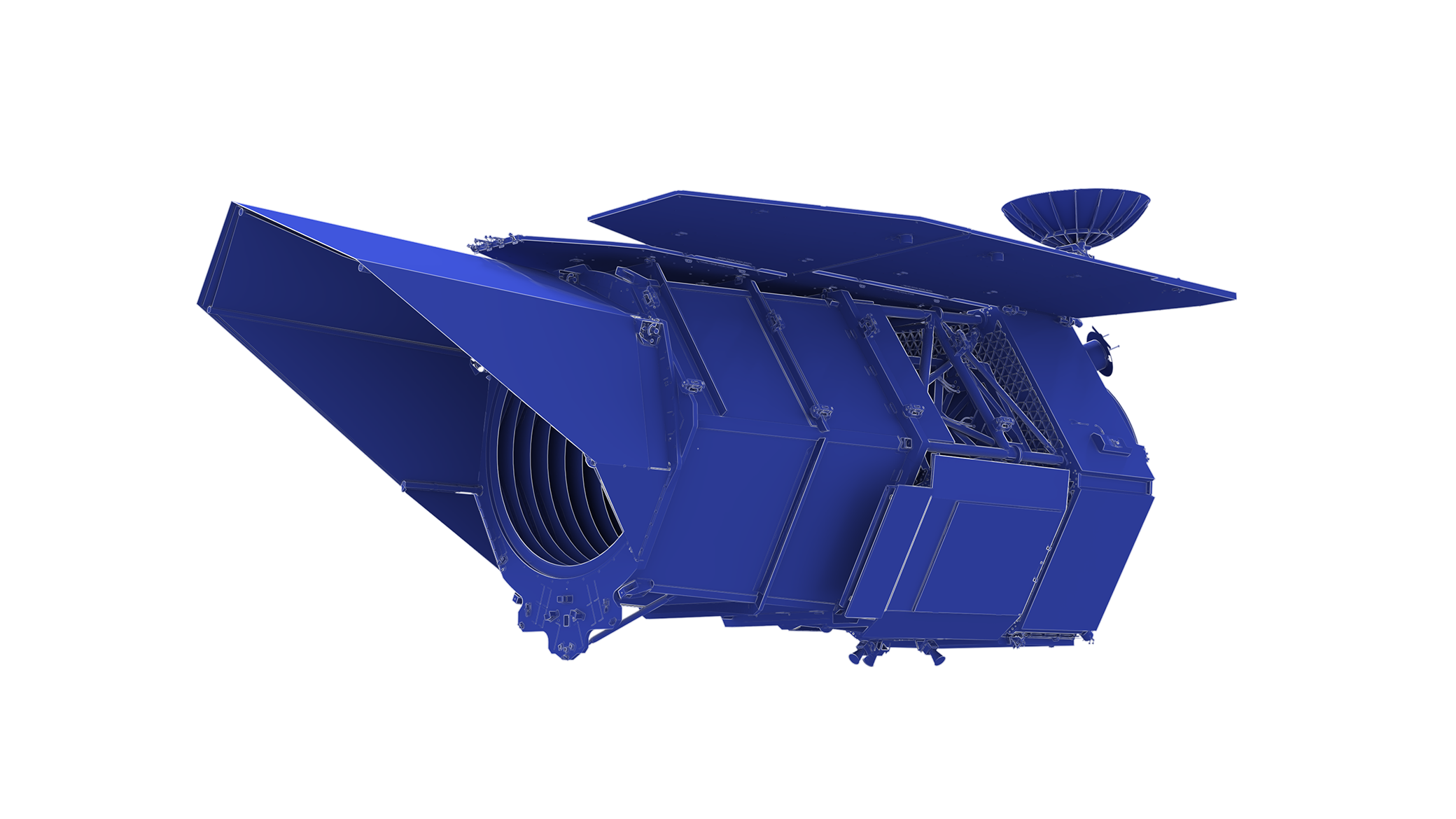
Roman carries a 2.4-metre mirror — the same size as Hubble's — but its 300-megapixel Wide Field Instrument covers a patch of sky 100 times bigger per exposure. Where Hubble would need 100 separate pointings to image a region, Roman does it in one. It also carries a Coronagraph for directly blocking starlight to photograph planets orbiting other suns.
Mission 1: Dark Energy
Roman will measure the shapes and distances of billions of galaxies to map how dark energy is driving the accelerating expansion of the universe. This is the biggest open question in cosmology.
Mission 2: Exoplanet Census
Roman will discover ~100,000 transiting exoplanets and hunt for free-floating "rogue" planets via gravitational microlensing — providing the first statistical census of planetary systems across the Milky Way.
Mission 3: Time-Domain Sky
Roman will repeatedly survey the same sky regions, detecting supernovae, variable stars, tidal disruption events, and transient phenomena to build the deepest and most comprehensive time-lapse movie of the cosmos ever made.
NASA Update: Roman Launch Set for Aug. 30, 2026
On June 3, 2026, NASA shared that the Roman Space Telescope is now set to launch on Aug. 30, 2026 aboard a SpaceX Falcon Heavy from Kennedy Space Center. NASA also noted this schedule is about eight months ahead of the previous target.
For readers tracking this mission closely: this page has been updated so launch-date references, FAQ answers, and timeline sections all reflect that June 3 NASA update.
Roman vs Hubble vs James Webb: The Plain-English Comparison
The three most powerful space observatories humans have ever built — and how they each see the universe differently.
Feature
Hubble
James Webb (JWST)
Roman (NEW)
Mirror diameter
2.4 m
6.5 m
2.4 m
Field of view
~3.4 arcmin (tiny)
~9.7 arcmin² (small)
~0.28 sq deg — 100× Hubble
Wavelengths
UV, visible, near-IR
Near-IR & mid-IR
Visible & near-IR
Camera resolution
16 megapixels (ACS)
88 megapixels (NIRCam)
300 megapixels (WFI)
Best at
Sharp optical detail on individual targets
Extreme depth on tiny areas, early universe
Wide-area sky surveys, statistics of billions
Orbit
Low Earth Orbit (~550 km)
L2 point (1.5M km)
L2 point (1.5M km)
Launch year
1990
2021
Aug. 30, 2026
The mental model: Hubble is a fine microscope. Webb is an even finer microscope pointed at fainter objects. Roman is a wide-angle all-sky camera that photographs entire cities at once instead of individual street corners. All three are complementary.
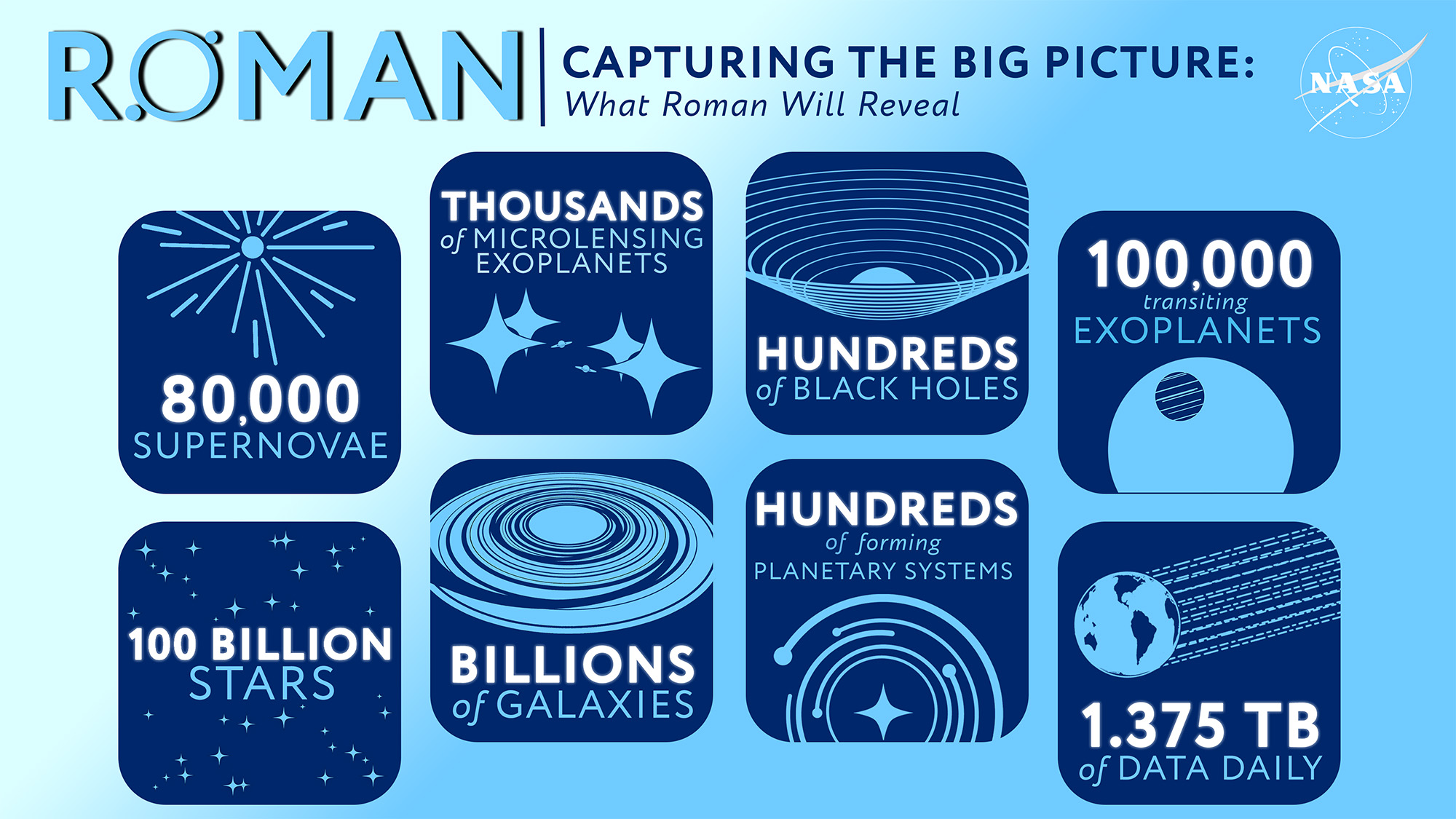
NASA Infographic: Roman by the Numbers
The scale of what Roman expects to discover during its 5-year primary mission.
Credit: NASA's Goddard Space Flight Center — SVS #14931
~100,000
Transiting exoplanets expected
1 billion+
Galaxies measured for dark energy
Thousands
Type Ia supernovae detected
Hundreds
Free-floating rogue planets
Launch Details: When, Where, Rocket & How to Watch Live
Launch window & site
▶Target date: NASA's June 3, 2026 update says Roman is set to launch on Aug. 30, 2026, about eight months ahead of the previous target.
▶Launch site: Kennedy Space Center, Florida — Launch Complex 39A (the same pad used for Apollo 11 and many SpaceX missions).
▶Rocket: SpaceX Falcon Heavy — one of the most powerful rockets currently flying.
▶Destination: Sun-Earth L2 Lagrange point, ~1.5 million km from Earth (where Webb orbits too).
▶Travel time: Approximately 30 days to reach L2, followed by several months of commissioning before first science observations begin.
How to watch the launch live (free)
1NASA TV — nasa.gov/nasatv — free, no login required. Coverage begins ~2 hours before launch.
2NASA YouTube — search "NASA" on YouTube and subscribe. Live streams appear automatically in your feed.
3NASA App (iOS / Android) — free, streams NASA TV, sends push notifications for launch updates.
4SpaceX YouTube — provides its own launch coverage, often from a different camera angle showing the Falcon Heavy booster landings.
Tip: The Falcon Heavy's side boosters will return and land simultaneously — one of the most spectacular sights in modern rocketry. Set an alarm so you don't miss it.
Inside the Spacecraft: How Roman's Two Systems Work Together
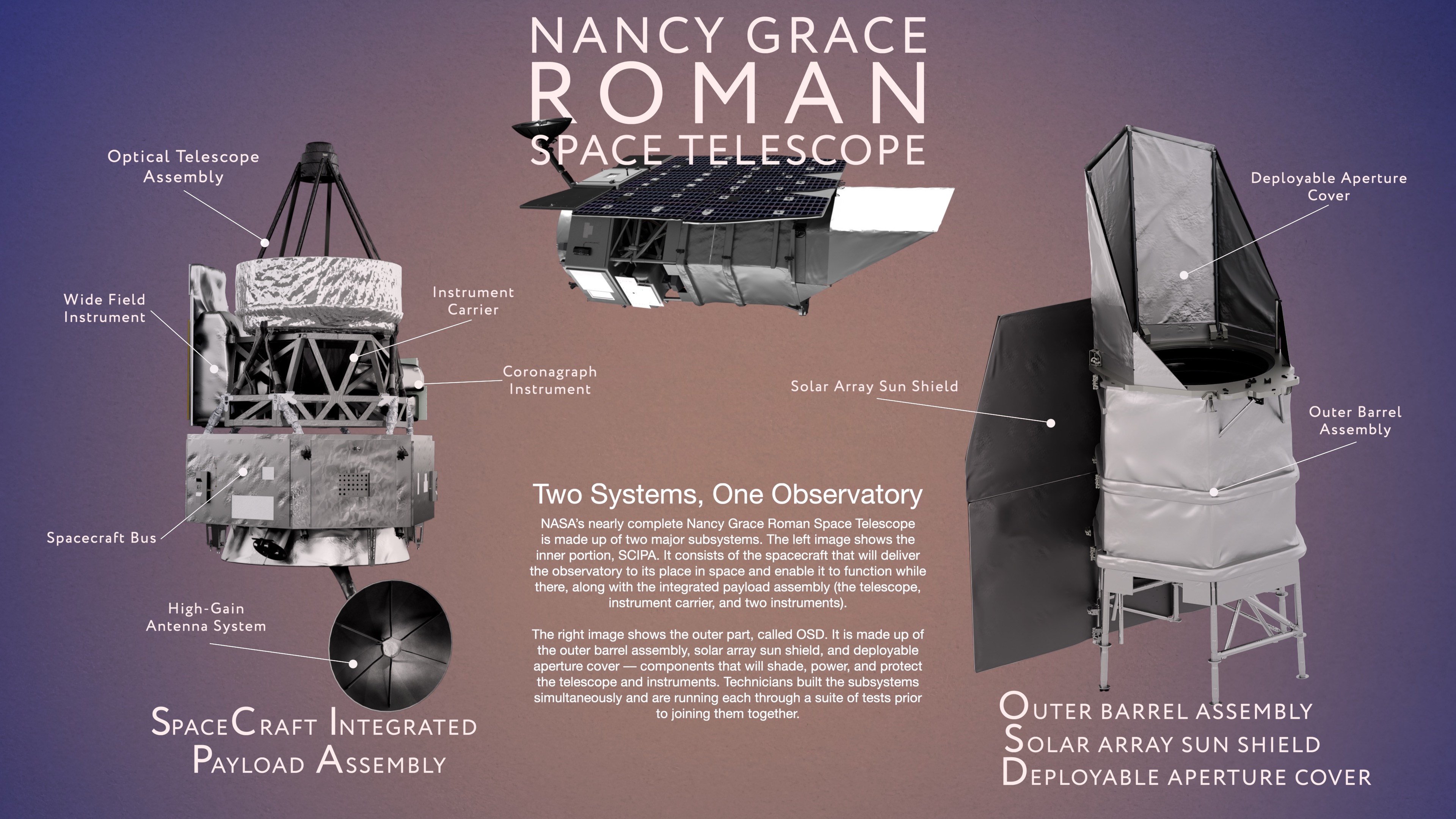
Roman is assembled from two major modules — the inner payload and science package, and the outer protective shell with solar arrays.
Credit: NASA's Goddard Space Flight Center — SVS #14836
SCIPA — The Inner Core
The inner module combines the spacecraft bus (power, communication, propulsion) with the Integrated Payload Assembly: a 2.4-metre telescope, instrument carrier, the 300-megapixel Wide Field Instrument, and the Coronagraph technology demonstrator.
OSD — The Outer Shell
The outer shell includes the Outer Barrel Assembly, the deployable solar arrays that power the telescope, and a sun shield that keeps the infrared detectors cold enough to operate. Both systems were assembled simultaneously and joined together before launch.
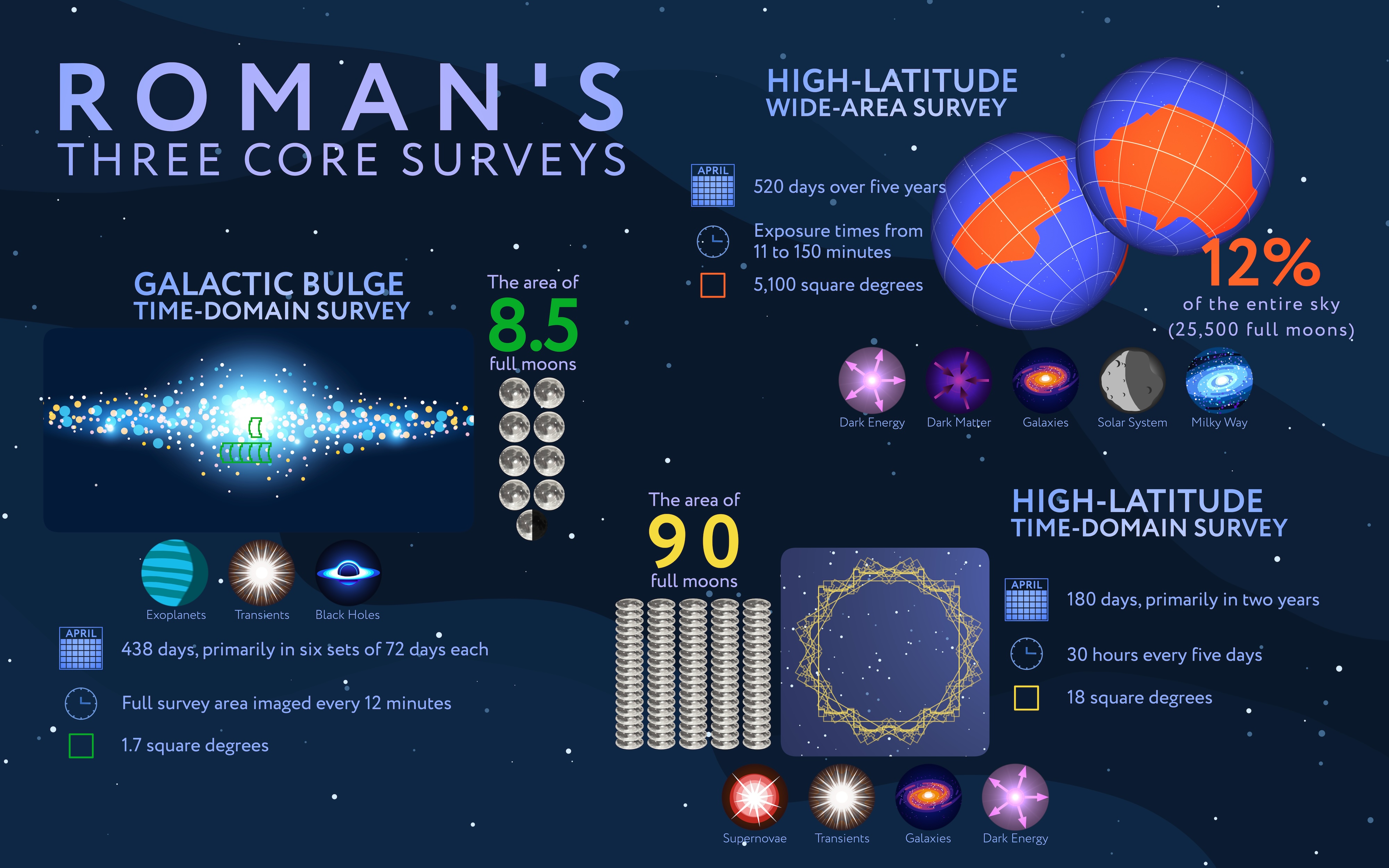
Roman's 3 Core Surveys: What the Telescope Will Actually Do
Credit: NASA's Goddard Space Flight Center — SVS #14820
1. High Latitude Wide Area Survey — Mapping Dark Energy
Roman will image an enormous patch of sky away from the Milky Way plane, measuring the shapes (weak gravitational lensing) and positions of hundreds of millions of galaxies. The statistical distortions in their shapes reveal how dark matter and dark energy are structured across cosmic time. This survey will be more than 1,000 times broader than Hubble's deepest mosaics.
2. High Latitude Time Domain Survey — Supernovae & Cosmic History
Roman will repeatedly revisit the same sky area, detecting and monitoring thousands of Type Ia supernovae — the "standard candles" astronomers use to measure cosmic distances. More supernova distance measurements means a better understanding of how fast the universe is expanding at different epochs, directly testing models of dark energy.
3. Galactic Bulge Time Domain Survey — Exoplanet Census
Pointing toward the dense star fields of the Milky Way's central bulge, Roman will monitor hundreds of millions of stars for the brief brightening events caused when a planet's gravity bends and amplifies the light of a background star (gravitational microlensing). This technique finds planets at all separations from their stars — including free-floating rogue planets — providing the first complete census of planetary systems in our galaxy.
What Roman Means for Amateur Astronomers
🔍 Can you see Roman from Earth?
Once deployed at the L2 point 1.5 million km away, Roman will be far too faint and distant to observe with a backyard telescope. However, you can absolutely watch the launch live on NASA TV, and if you are within a few hundred km of Kennedy Space Center on launch day, the Falcon Heavy may be visible to the naked eye in the night sky for a few minutes after liftoff.
📷 Will Roman images be public?
Yes. Like Hubble and Webb, Roman is a NASA public-science mission. All data will be released openly to the worldwide astronomy community and to the public via data archives. Citizen science projects will likely allow amateur astronomers to help classify objects in Roman's data, much like Galaxy Zoo did for Hubble.
🔭 What will Roman study that YOU can also see?
Roman will survey billions of galaxies, thousands of star clusters, hundreds of nebulae, and entire fields of the Milky Way bulge. All of these are visible through a good amateur telescope — you just see individual objects rather than statistical surveys of billions of them.
✨ Galaxies Roman will map: M31 (Andromeda), M81, M82, Virgo Cluster — all visible from 6″+ aperture
✨ Nebulae in its survey zones: Orion Nebula, Lagoon Nebula, Eagle Nebula
✨ Star clusters in the bulge field: M4, M6, M7, M8 — stunning in any telescope
✨ Exoplanet host stars: Many bright enough to see in an 8-inch scope
The big picture: Roman will change our knowledge of the universe but won't change what your telescope physically can see. What it will do is make the sky feel more alive — every galaxy you observe will be one of the billion that Roman is cataloguing for dark energy research. Your backyard scope gives you the same photons Roman is collecting; Roman just collects billions more at once.
Roman Has Inspired You to Stargaze — Start Here
Roman will study galaxies, nebulae, and exoplanet host stars. These are the same deep-sky targets you can explore from your own backyard. Here are the two telescopes we recommend for astronomers inspired by Roman's mission.
Editor’s Pick — Best Deep-Sky Scope
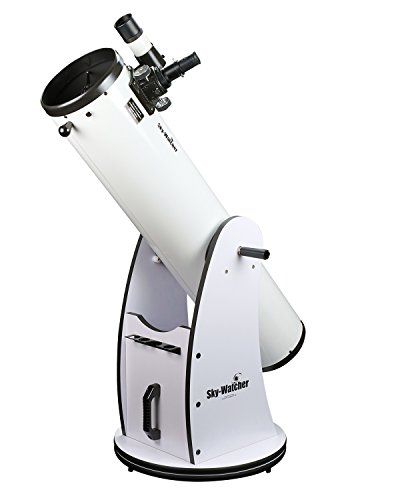
Sky-Watcher Classic 200P Dobsonian
8-inch / 200mm aperture · f/6 parabolic
Roman will study billions of galaxies. This is the telescope that lets you study them individually. The 8-inch parabolic mirror gathers enough light to show spiral arms in M31 and M33, resolve globular star clusters into individual stars, and reveal the dark dust lanes in galaxies like NGC 891. A 200P will show you every Messier object in the night sky — the exact class of targets Roman will be mapping.
✓ 200mm (8″) parabolic primary — 4× more light than a 4″ scope
✓ 2″ Crayford focuser with included 10mm & 25mm eyepieces
✓ Simple push-to Dobsonian mount — no alignment needed
✓ Perfect for galaxies, nebulae, and star clusters — Roman’s targets
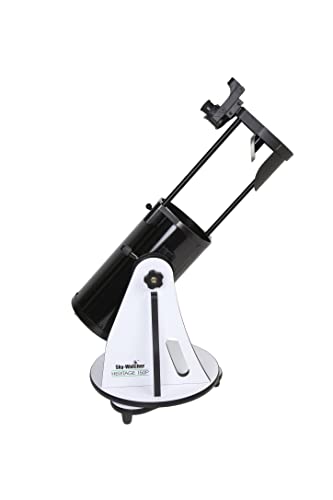
If the Roman launch is your first real introduction to astronomy, start here. The Heritage 130P is a compact tabletop Dobsonian that delivers surprisingly good views of the Moon, planets, and deep-sky objects at a beginner-friendly price. At 130mm, it will show you hundreds of the galaxies and star clusters that Roman will catalogue during its mission.
✓ 130mm parabolic mirror — shows dozens of Messier galaxies
The Nancy Grace Roman Space Telescope is NASA's next flagship observatory, with NASA's June 3, 2026 update setting launch for Aug. 30, 2026. Named after NASA's first chief astronomer — the scientist who championed the Hubble program before it was funded — Roman carries a 2.4-metre mirror and a 300-megapixel near-infrared camera that covers 100 times more sky per image than Hubble. It will survey the universe to map dark energy, discover exoplanets, and create the deepest wide-field time-lapse of the cosmos ever made.
When is the Roman Space Telescope launch date in 2026?
NASA's June 3, 2026 mission blog update says Roman is set to launch on Aug. 30, 2026. NASA also states this is about eight months ahead of its previous target. Roman will lift off on a SpaceX Falcon Heavy from Kennedy Space Center, Launch Complex 39A, Florida.
How is Roman different from Hubble?
Roman and Hubble share the same mirror diameter (2.4 m), but their missions are entirely different. Hubble takes extremely detailed images of small areas of sky — individual nebulae, single galaxies, or tight clusters. Roman takes 100 times wider images at once, trading Hubble-like depth for enormous sky coverage. Roman will complete surveys in months that would take Hubble decades. Roman also operates in the near-infrared (Hubble covers visible and UV) and lives 1.5 million km away at L2 (Hubble is in low Earth orbit at 550 km).
Is Roman better than James Webb?
It is not a case of better or worse — Roman and Webb do completely different things. Webb's 6.5-metre mirror is far larger and reaches extreme sensitivity on tiny areas of sky: it reveals the atmospheres of exoplanets and the very first galaxies. Roman's value is breadth: it can survey the entire Milky Way bulge in a single campaign or map billions of galaxies. Scientists treat them as perfect complements. Webb finds the extraordinary needles; Roman maps the entire haystack.
Can I see the Roman Space Telescope from my backyard?
No. After deployment at the Sun-Earth L2 point 1.5 million km from Earth, Roman will be far too faint to observe with any backyard telescope. (For comparison, JWST at L2 is roughly magnitude 29 — millions of times below the naked-eye limit.) You can however watch the Falcon Heavy launch live on NASA TV, and the rocket itself will be briefly visible to observers near Kennedy Space Center.
Will Roman images be as beautiful as Hubble images?
Roman's images will be spectacular in a different way from Hubble. Rather than Hubble's iconic zoomed-in portraits of individual nebulae, Roman's images will be vast panoramas — richly detailed wide-angle views showing entire galaxy clusters, star-forming regions, and sections of the Milky Way that look like impossible starscapes. NASA will release full-quality public images just as they do with Hubble and Webb.
What telescope is best for seeing Roman’s science targets from Earth?
For Roman's core targets — galaxies, nebulae, and star clusters — an 8-inch Dobsonian such as the Sky-Watcher Classic 200P is the sweet spot of aperture, price, and portability. It reveals hundreds of galaxies including the spiral arms of the Andromeda Galaxy, dark dust lanes in edge-on galaxies, resolved globular clusters, and emission nebulae. If you want to start smaller, the Heritage 130P tabletop Dobsonian shows dozens of Messier objects and is a great first scope.