Roman vs Hubble vs Webb: What Each Space Telescope Sees | Telescope Advisor
Telescope Advisor Logo Telescope Advisor
Artist concept of NASA's Nancy Grace Roman Space Telescope in orbit

Space Telescope Comparison · 2026

Roman vs Hubble vs Webb: What Each Space Telescope Sees — And What It Means for Your Night Sky

Three telescopes, three missions, three radically different views of the universe. Here’s the plain-English guide to understanding what makes each one special.

3

Space Telescopes

100×

Roman’s Wider View

Sep 2026

Roman Launch Target

1 Billion

Galaxies Roman Can Map

By Telescope Advisor Editorial Team Published: Updated: Editorial Standards

Quick Answer: How Do These Three Telescopes Differ?

Hubble (launched 1990) sees primarily in visible and ultraviolet light — producing the iconic, crisp color images most people associate with space exploration. Webb (launched 2021) sees in infrared, letting it peer through dust clouds and look back nearly 13.6 billion years to the universe’s first galaxies. Roman (launching September 2026) carries a mirror the same size as Hubble’s but with a field of view 100 times wider — letting it survey more sky in minutes than Hubble could in years.

Together they form a trio unlike anything in the history of astronomy: one that sees the visible universe in detail, one that pierces the infrared universe for depth, and one that will map the wide universe at scale.

Read our full Roman Space Telescope launch guide →
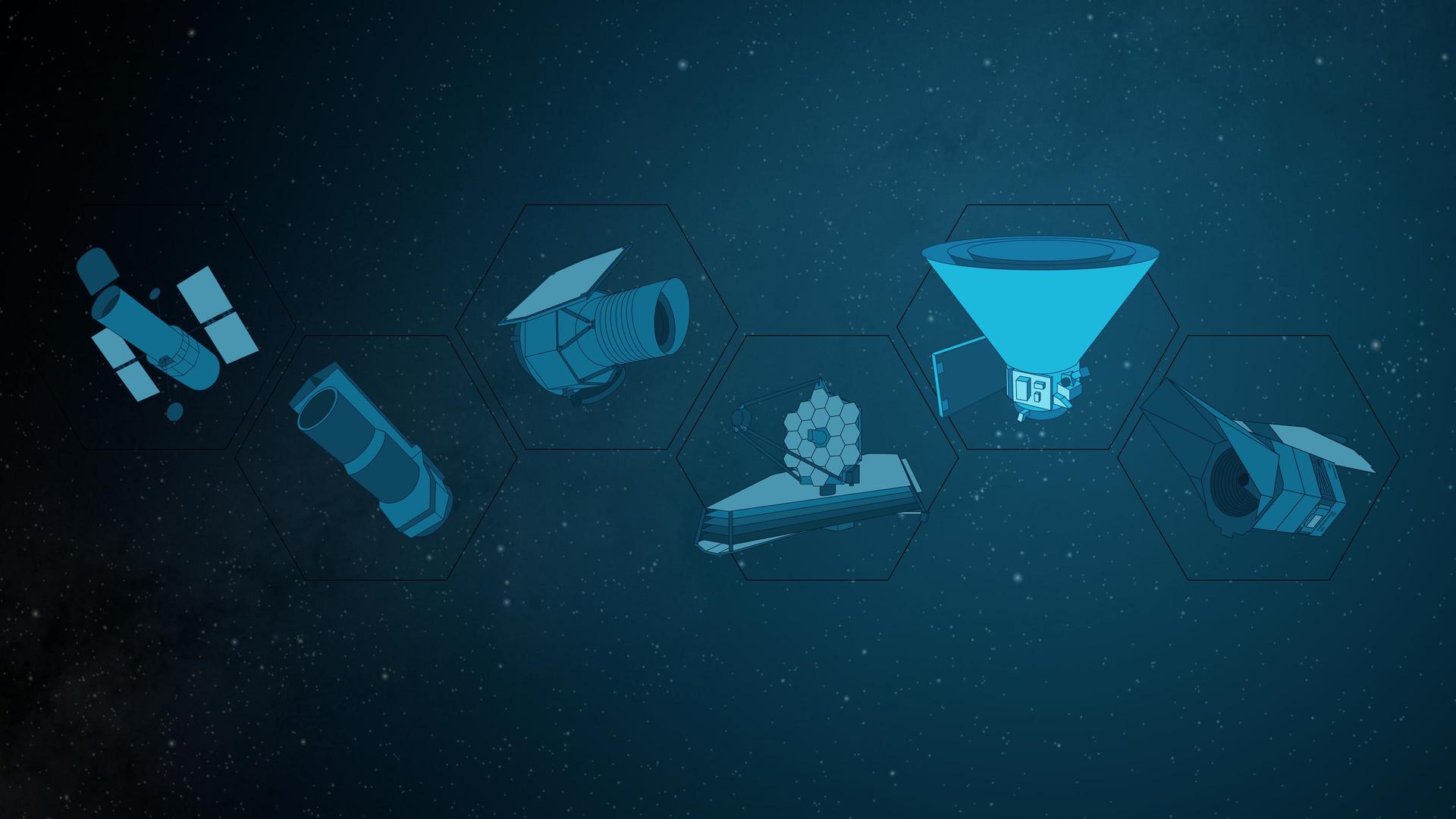
Lineup of NASA space telescopes: Hubble, Spitzer, WISE, James Webb, SPHEREx, and Roman Space Telescope shown side by side
NASA’s evolving fleet of space telescopes, from Hubble (1990) through Webb (2021) to the upcoming Roman and SPHEREx missions. Each generation sees a different slice of the electromagnetic spectrum. Credit: NASA/JPL-Caltech

Meet the Three Telescopes

Three missions built three decades apart, each transforming what we know about the cosmos.

🔭

Hubble

Launched April 1990

● 2.4 m primary mirror

● Visible & ultraviolet light

● 340 miles above Earth

● 35+ years in service

● 1 million+ observations

🌌

James Webb

Launched December 2021

● 6.5 m primary mirror

● Near & mid-infrared

● 1 million miles from Earth

● Sees 13.6 billion years back

● 6× Hubble’s light gathering

🚀

Nancy Grace Roman

Launching September 2026

● 2.4 m primary mirror

● Near-infrared (optical too)

● 100× wider FOV than Hubble

● Will map 1 billion galaxies

● Settling the dark energy debate

Hubble: 35 Years of Changing How We See the Universe

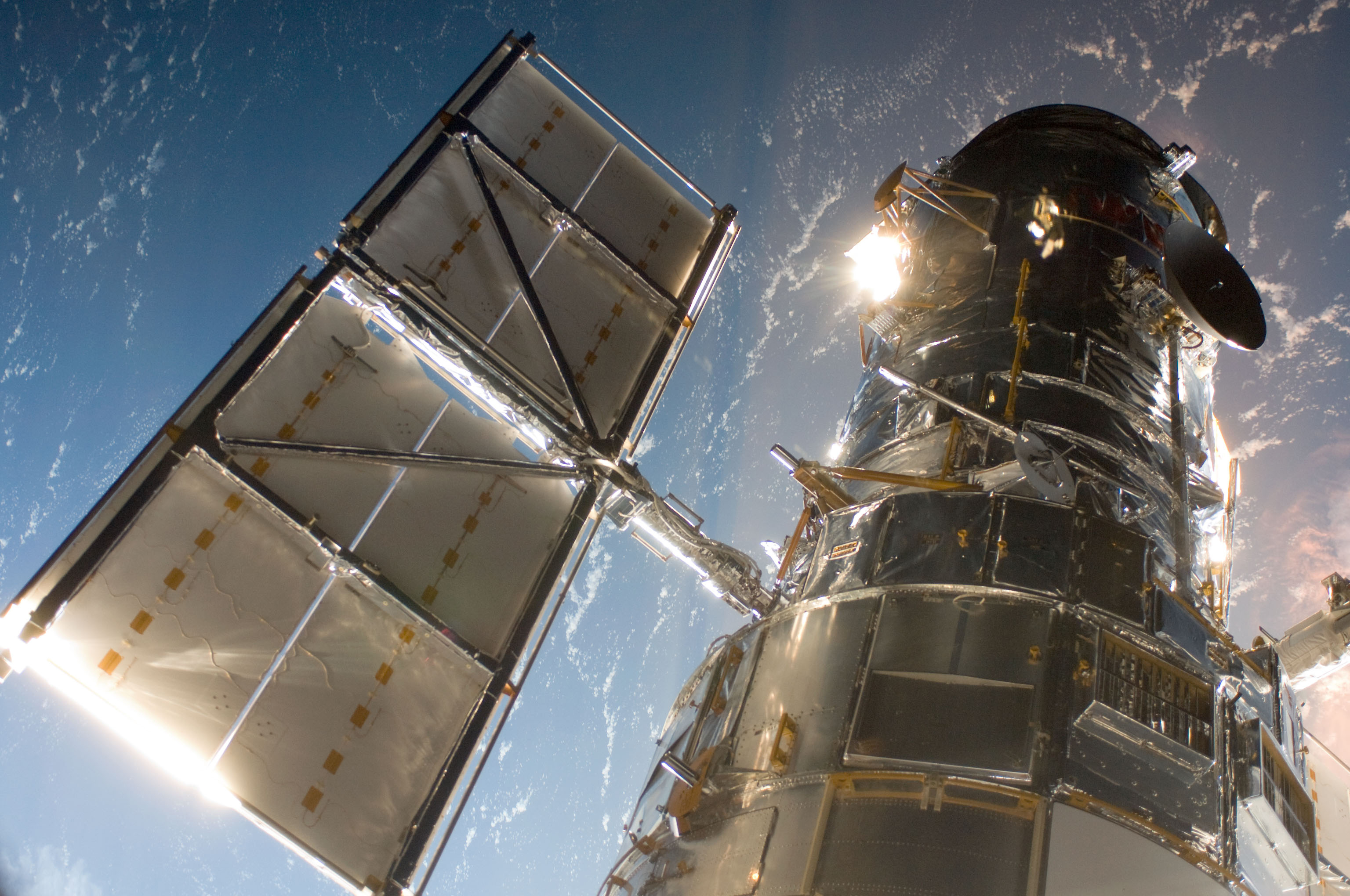
When Hubble launched on April 24, 1990, astronomers expected a cleaner view of the sky than ground-based observatories could provide. What they got was a time machine. Hubble’s 2.4-meter (7.9-foot) primary mirror, floating 340 miles above Earth’s blurring atmosphere, could resolve details no ground telescope could match.

Hubble sees primarily in visible and ultraviolet light — the same wavelengths our eyes use, but far above the distortion of Earth’s atmosphere. This gives Hubble its trademark crisp, colorful images: the Pillars of the Eagle Nebula, the Orion Nebula in breathtaking detail, and the iconic Hubble Ultra Deep Field — a single patch of sky smaller than a grain of sand held at arm’s length, containing over 10,000 galaxies.

Hubble’s biggest discoveries have reshaped our understanding of the cosmos. It confirmed that the expansion of the universe is accelerating — a finding that earned the 2011 Nobel Prize in Physics. It helped nail down the age of the universe at around 13.8 billion years. And it revealed that supermassive black holes lurk at the center of nearly every large galaxy, including our own Milky Way.

Hubble at a Glance

  • Primary mirror: 2.4 m (7.9 ft)
  • Wavelengths: UV to near-infrared (0.1 – 2.5 microns)
  • Orbit: Low Earth orbit, ~340 miles altitude
  • Field of view: Narrow (~0.0015 sq degrees for WFC3 wide)
  • Best at: Detailed visible-light imaging, UV observations, exoplanet atmosphere spectra
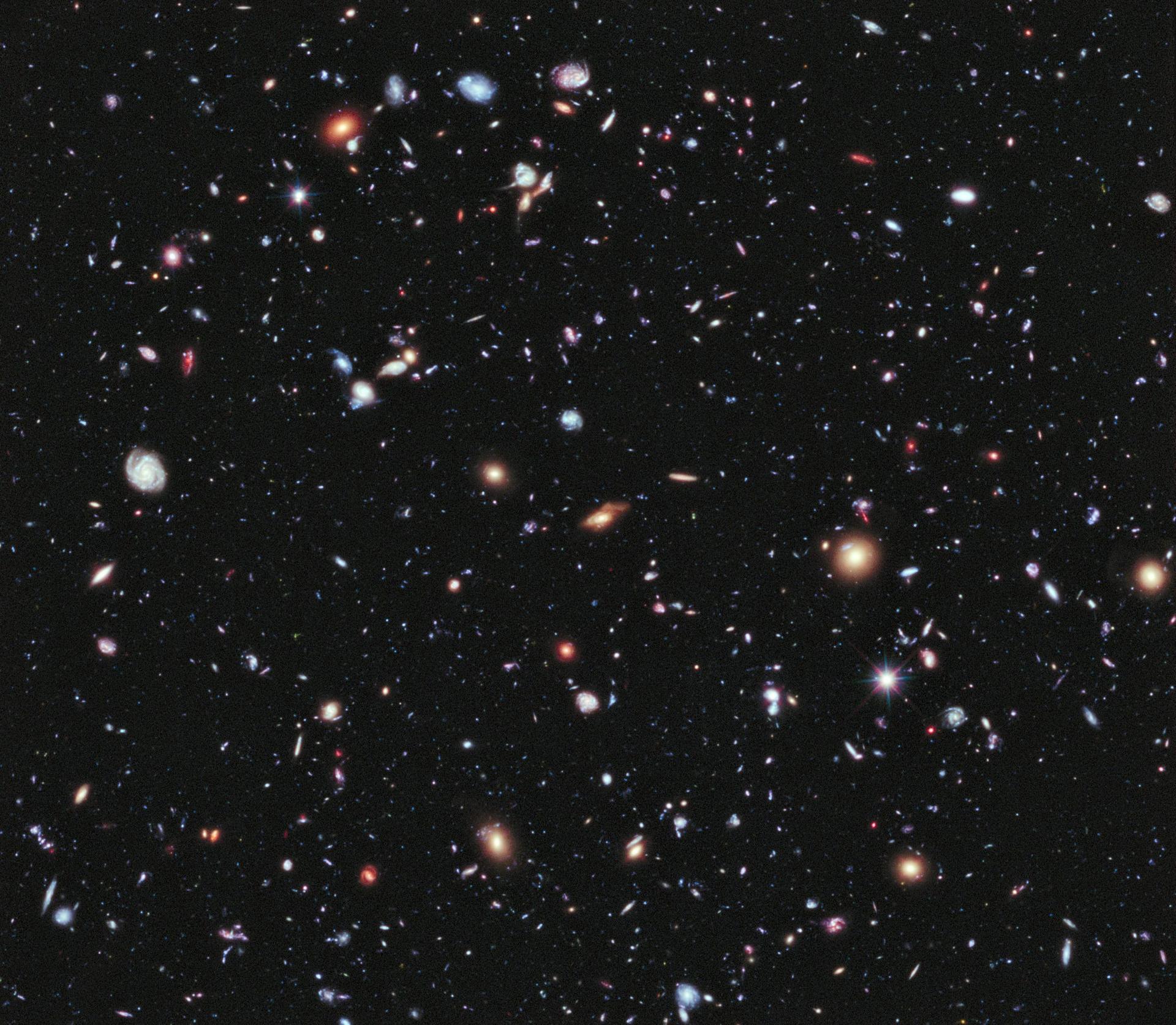
Hubble eXtreme Deep Field containing thousands of galaxies in a tiny patch of sky
The Hubble eXtreme Deep Field (XDF): 5,500 galaxies revealed by 10 years of Hubble observations in a patch of sky smaller than 1/32 the diameter of the full Moon. Credit: NASA/ESA/G. Illingworth et al.
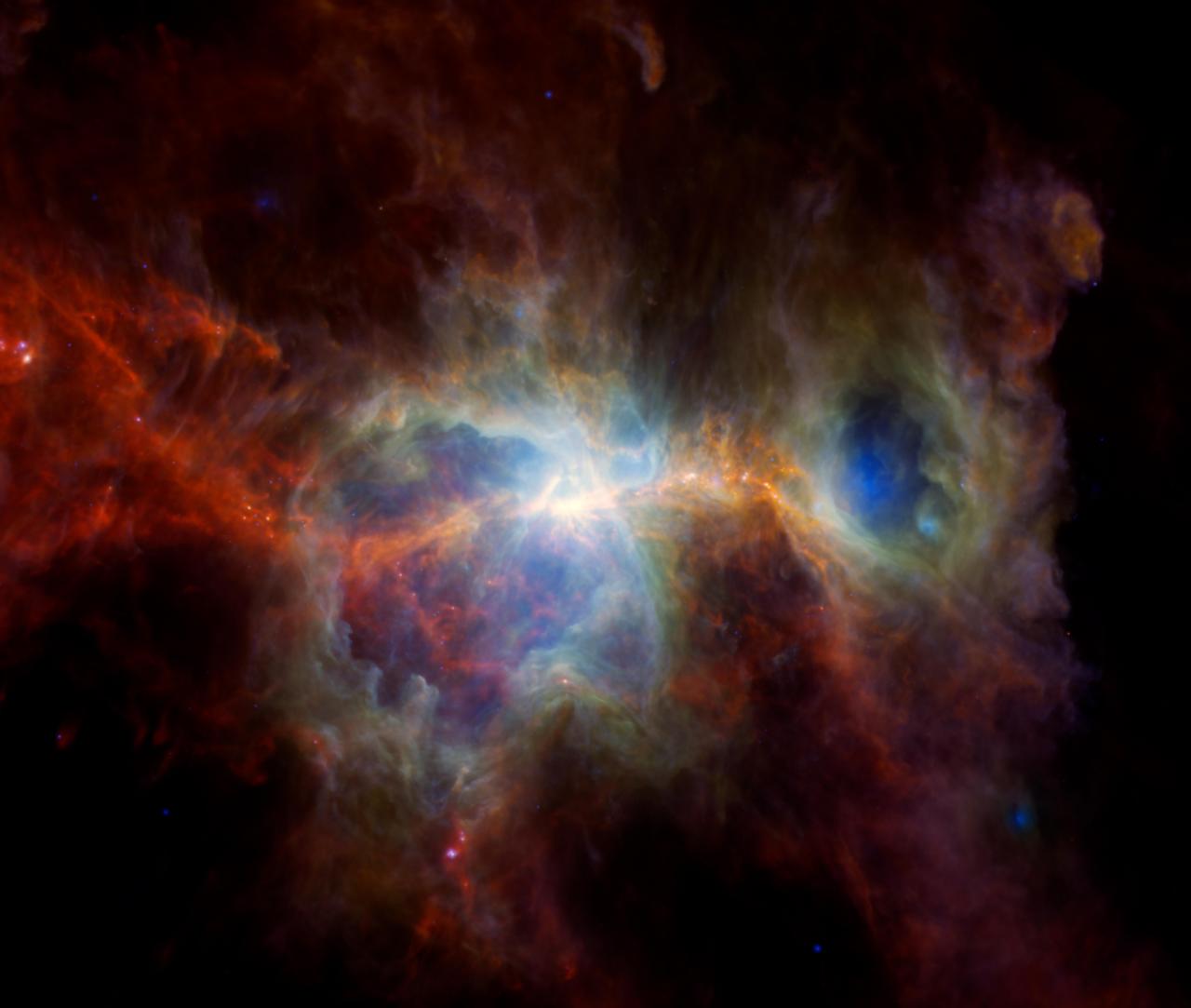
Hubble Space Telescope image of the Orion Nebula showing glowing gas clouds and newborn stars

The Orion Nebula (M42) as seen by Hubble — one of the most-studied stellar nurseries in our galaxy, 1,344 light-years from Earth. Hubble’s visible-light imaging captures the birth of new stars in unprecedented detail. Credit: NASA/ESA/STScI

James Webb: Seeing What Hubble Cannot

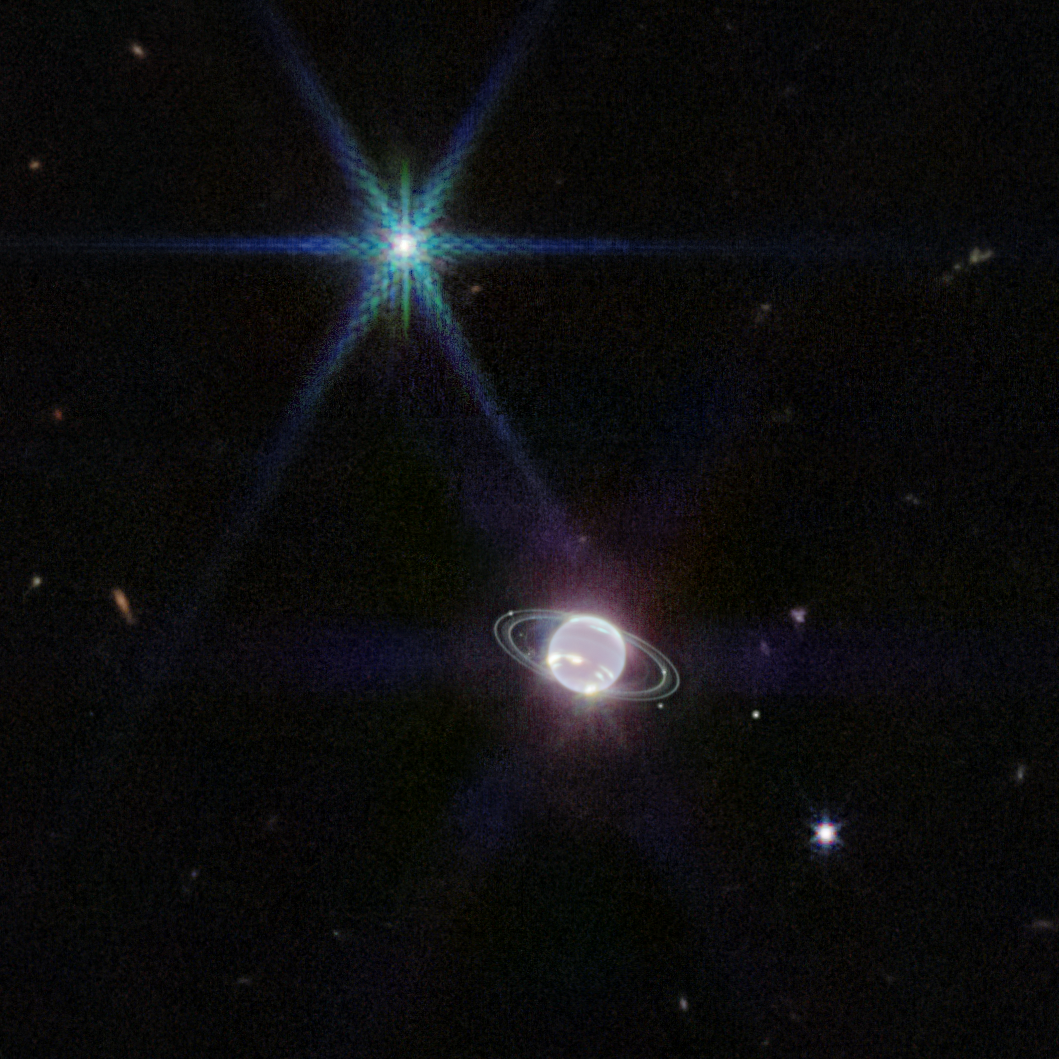
Neptune as seen by James Webb Space Telescope NIRCam revealing rings and moons in infrared light
Neptune imaged by Webb’s NIRCam. Rings nearly invisible to Hubble in visible light are revealed in stunning detail by Webb’s infrared vision. Credit: NASA/ESA/CSA/STScI

The James Webb Space Telescope is the most powerful space observatory ever built. Its 6.5-meter (21.3-foot) segmented gold mirror — more than 2½ times wider than Hubble’s — collects six times more light. But its real superpower isn’t size: it’s wavelength.

Webb sees the universe in infrared light (0.6 to 28.5 microns). Infrared is invisible to our eyes but carries information that visible light cannot — it passes through the dust clouds that block Hubble’s view, revealing the stars and galaxies hidden inside. And because the universe’s expansion stretches light from very distant objects toward infrared wavelengths (a phenomenon called redshift), Webb can observe galaxies that formed just a few hundred million years after the Big Bang.

Webb doesn’t just go “farther” than Hubble. It sees a fundamentally different kind of universe. Where Hubble sees the glowing visible surface of a nebula, Webb sees the cool gas and dust between the stars — the raw material of future solar systems. Where Hubble reveals a galaxy cluster, Webb can map the dark matter holding it together.

Webb at a Glance

  • Primary mirror: 6.5 m (21.3 ft), 18 gold-coated beryllium segments
  • Wavelengths: Near to mid-infrared (0.6 – 28.5 microns)
  • Orbit: L2 Lagrange point, ~1 million miles from Earth
  • Field of view: Narrow to medium; deep but not wide
  • Best at: Early universe galaxies, star formation through dust, exoplanet atmospheres
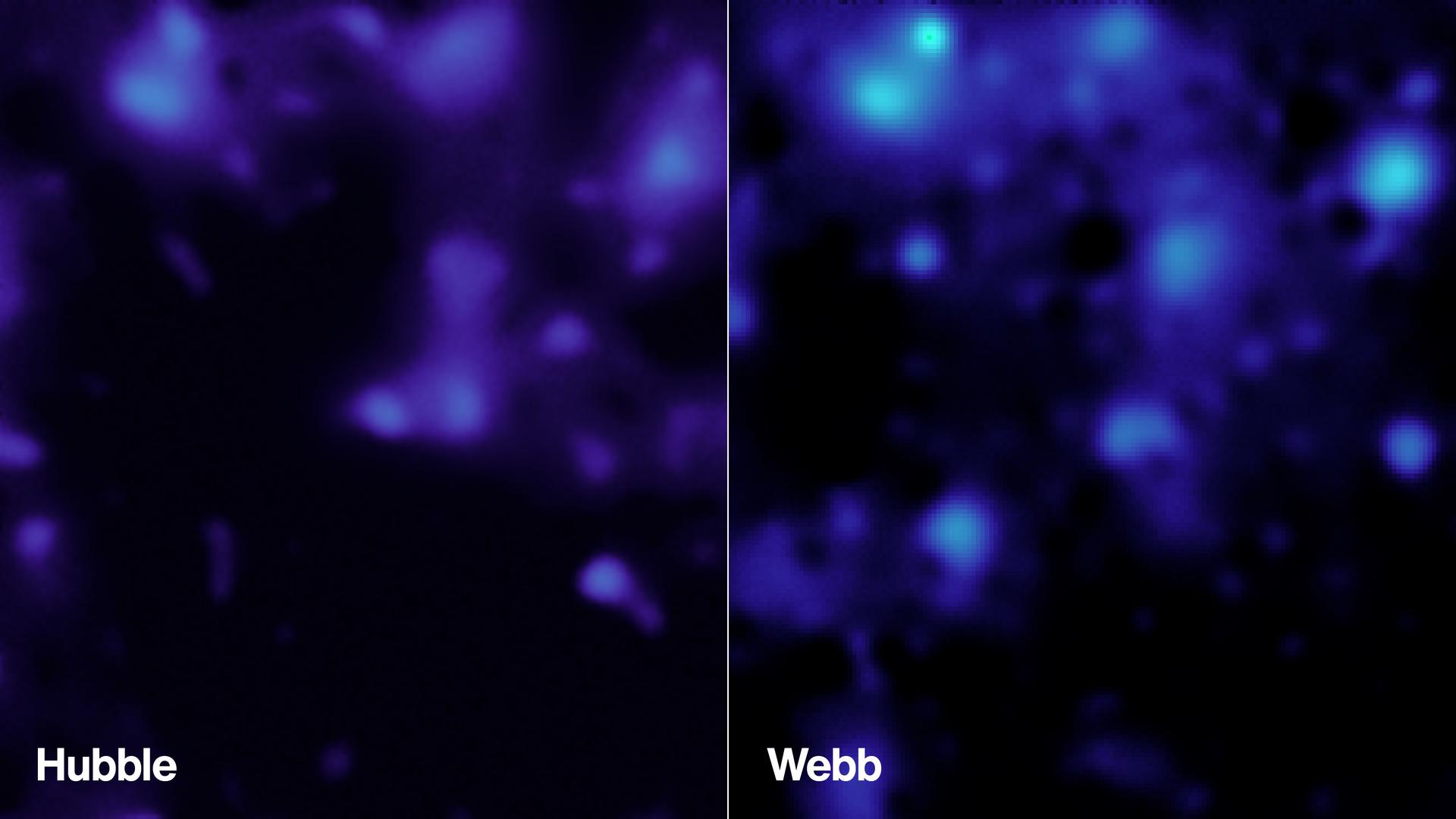
Side-by-side comparison of dark matter mapping: Hubble data from 2007 on the left vs Webb data from 2026 on the right showing higher resolution and more galaxies

Dark matter mapped in the same region of sky: Hubble’s map (2007, left) vs Webb’s map (2026, right). Webb’s map contains twice as many galaxies and reveals finer structure — this is what “seeing more” actually looks like. Credit: NASA/STScI/A. Pagan

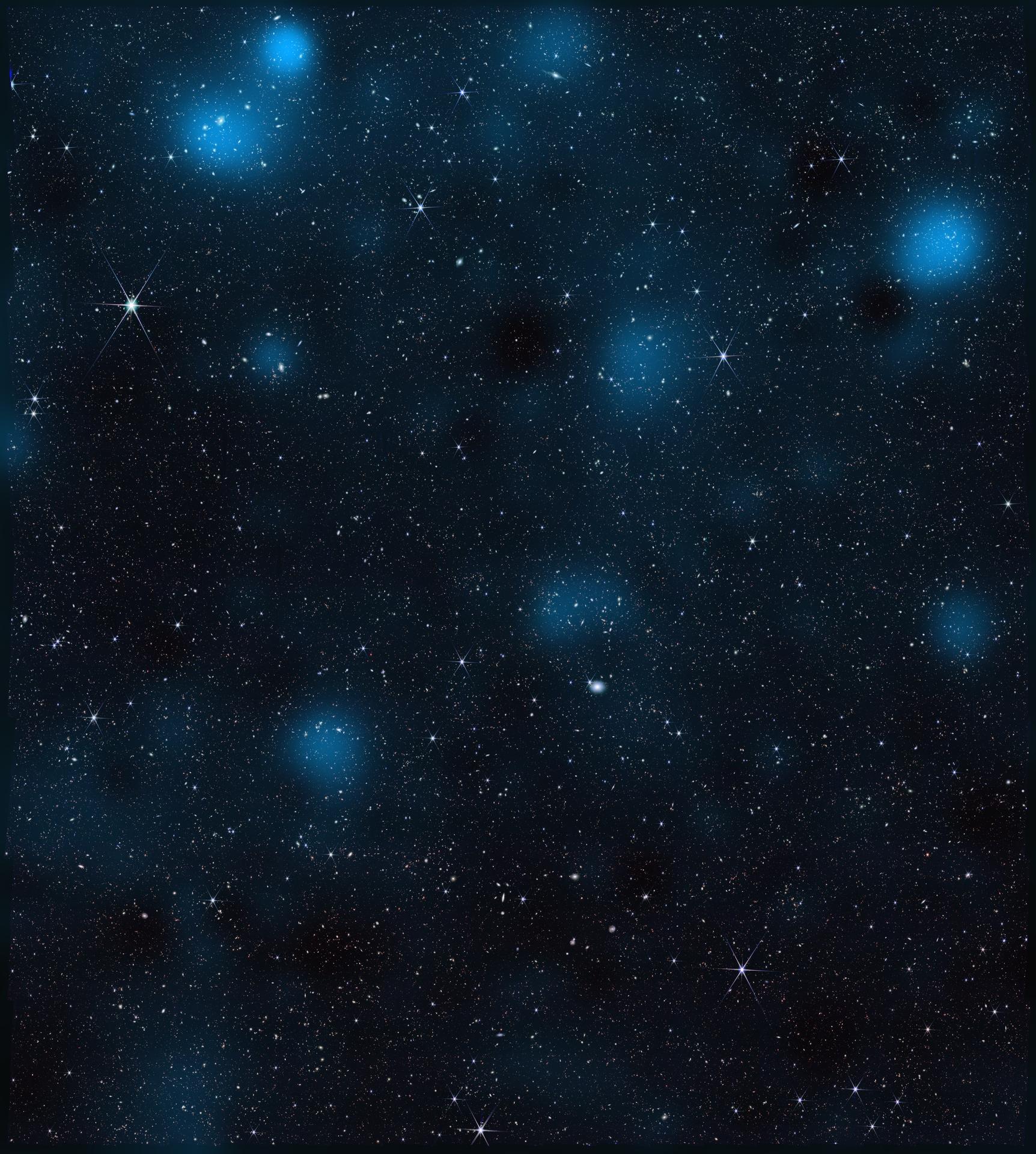
James Webb Space Telescope deep survey image containing nearly 800,000 galaxies with dark matter distribution overlay

A single Webb survey field containing nearly 800,000 galaxies (blue overlay shows inferred dark matter density). This 255-hour exposure contains 10× more galaxies than comparable ground-based surveys and 2× more than Hubble could reach in the same region. Credit: NASA/STScI/J. DePasquale/A. Pagan

Roman: The Wide-Field Revolution

NASA’s Nancy Grace Roman Space Telescope is the next great space observatory — and it does something neither Hubble nor Webb were designed for: it sees vast swaths of sky at once. Roman’s 2.4-meter mirror is essentially the same size as Hubble’s, but its Wide Field Instrument (WFI) camera has a field of view at least 100 times larger. A single Roman exposure covers the same area that would require roughly 100 separate Hubble pointings.

This is transformative. Where Hubble and Webb are precision instruments — like telephoto lenses, staring at one small target for hours — Roman is a wide-angle survey camera. In its first five years, Roman is expected to image over 300 million galaxies and conduct the largest deep-sky survey in history, generating more astronomical data than all previous space telescopes combined.

Roman’s primary scientific targets are dark energy and dark matter. By mapping how billions of galaxies distribute across the cosmos, it will measure subtle geometric distortions caused by dark matter’s gravity and track how dark energy drives the accelerating expansion of the universe. Roman also carries a coronagraph — a starlight-blocking tool that will directly image exoplanets orbiting nearby stars, a technology demonstration unlike anything flown before.

Roman at a Glance

  • Primary mirror: 2.4 m (7.9 ft) — same diameter as Hubble
  • Wavelengths: Visible to near-infrared (0.48 – 2.3 microns)
  • Orbit: L2 Lagrange point — same location as Webb
  • Field of view: 0.28 sq degrees — ~100× wider than Hubble’s WFC3
  • Best at: Wide-field surveys, dark energy measurement, dark matter mapping, exoplanet statistics
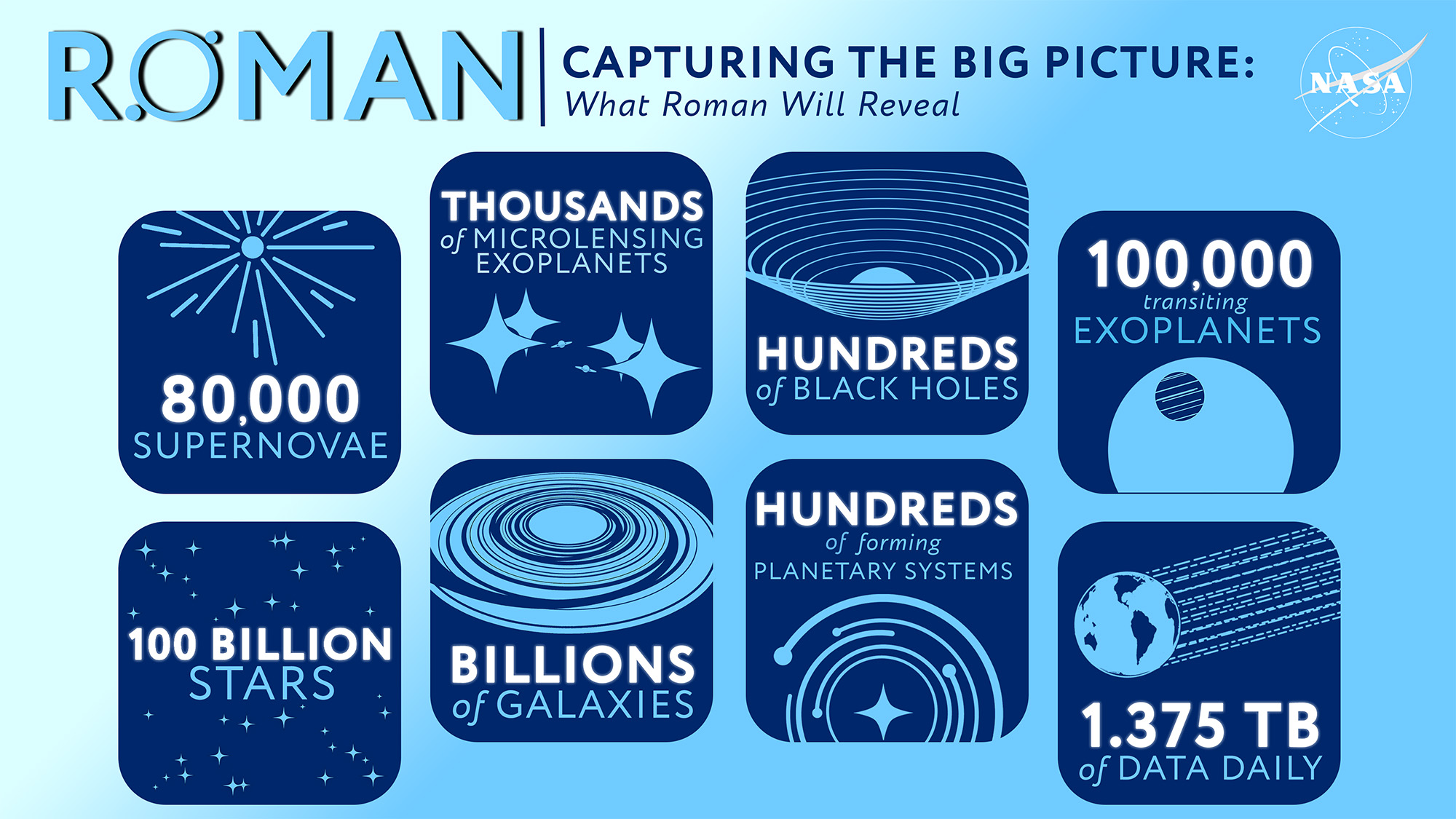
Roman Space Telescope by the numbers infographic showing 100 times wider field of view vs Hubble
Roman’s key specifications vs Hubble. The 100× wider field of view is the headline number, but the combination of survey scale and infrared sensitivity is what makes it revolutionary. Credit: NASA/GSFC
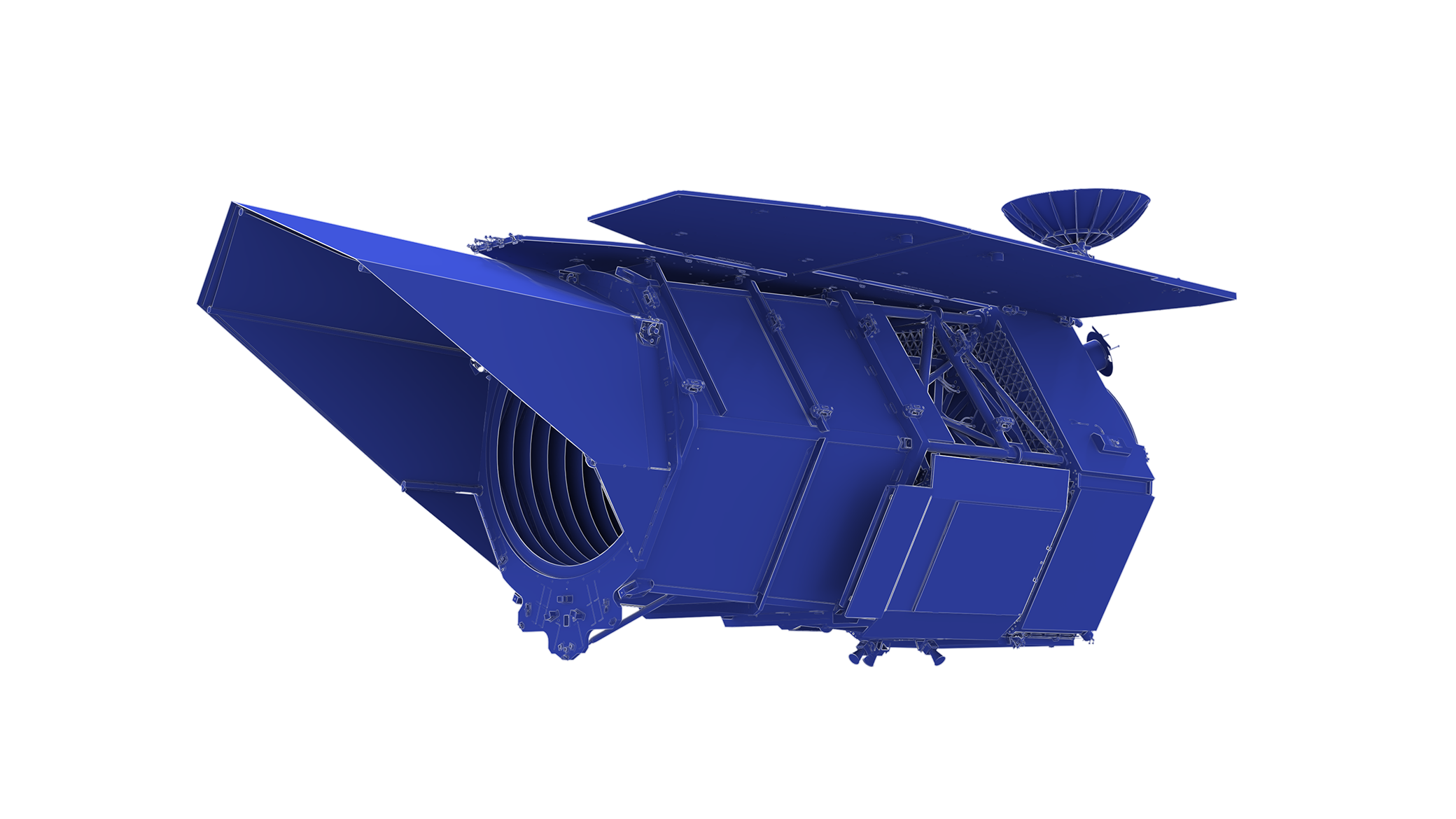
NASA artist concept rendering of the Nancy Grace Roman Space Telescope in orbit
Artist’s concept of Roman in its L2 orbit, 1 million miles from Earth. Credit: NASA/GSFC
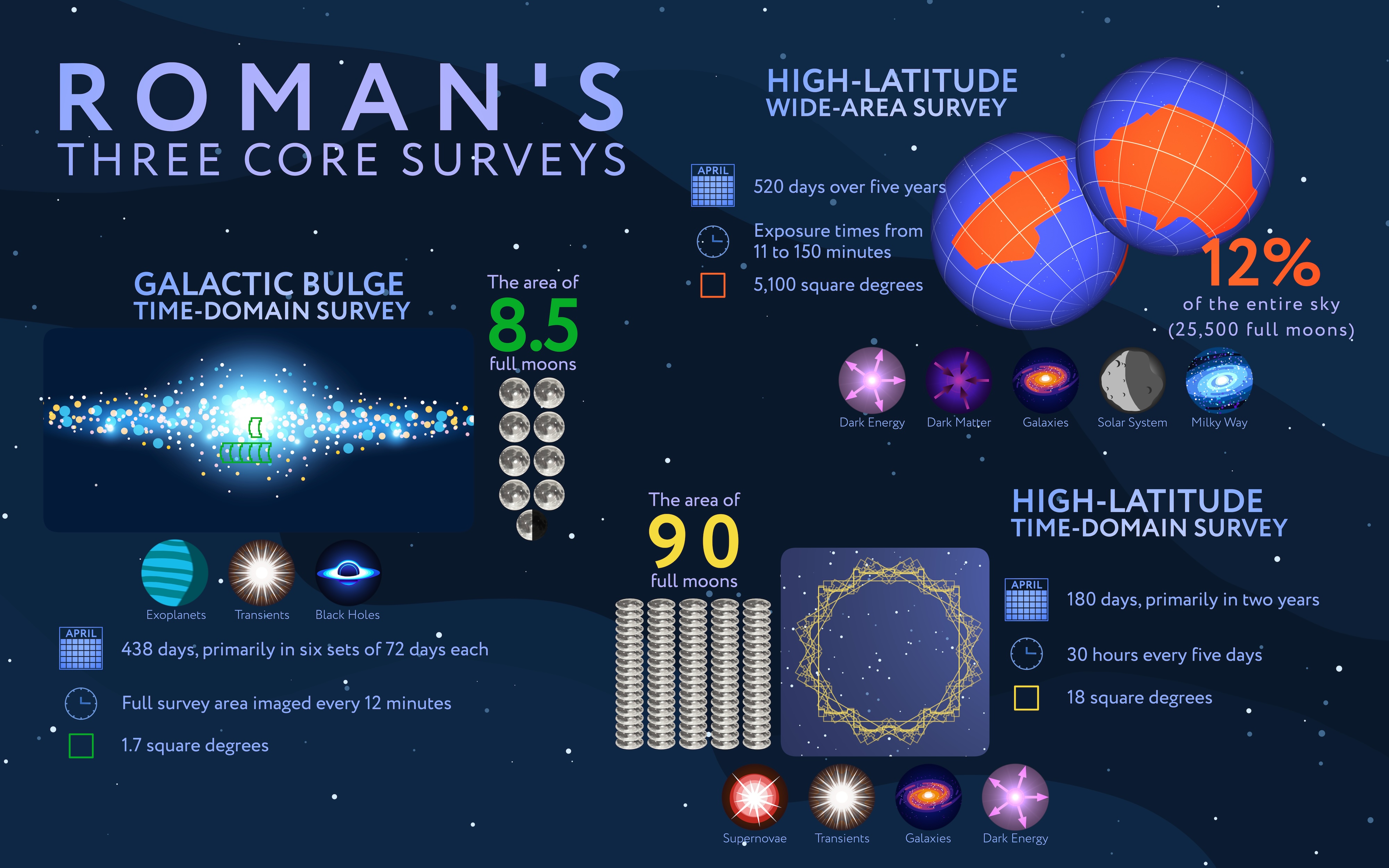
Roman Space Telescope core surveys infographic showing High Latitude Wide Area Survey, High Latitude Time Domain Survey, and Galactic Bulge Time Domain Survey

Roman’s three flagship core surveys will map large-scale structure across the universe, monitor millions of variable and transient objects, and measure gravitational microlensing to hunt for rogue planets and isolated black holes in the Milky Way. Credit: NASA/GSFC

Side-by-Side Comparison: Hubble vs Webb vs Roman

Feature 🔭 Hubble 🌌 Webb 🚀 Roman
Launch Year 1990 2021 2026 (target)
Mirror Diameter 2.4 m (7.9 ft) 6.5 m (21.3 ft) 2.4 m (7.9 ft)
Light Collecting Baseline (1×) ~6× more than Hubble Similar to Hubble
Wavelengths UV & visible (0.1–2.5 µm) Near–mid infrared (0.6–28.5 µm) Visible–near IR (0.48–2.3 µm)
Field of View Narrow (baseline) Narrow to medium 100× wider than Hubble
Orbital Location Low Earth orbit (~340 mi) L2 (~1 million miles) L2 (~1 million miles)
Sees Through Dust? Limited Yes — infrared penetrates dust Partially (near-IR)
Lookback Time ~13.4 billion years ~13.6 billion years ~10 billion years (survey)
Primary Mission Detailed imaging & UV science Early universe & star formation Dark energy, wide surveys, exoplanets
Serviceable? Yes (5 shuttle missions flown) No (too far for servicing) No (too far for servicing)

What This Means for Amateur Astronomers

None of these space telescopes replaces your backyard telescope — they observe things far beyond the reach of even a 16-inch Dobsonian. But they change what you know is out there when you look up, and they directly fuel the science that makes amateur astronomy more rewarding.

🔭 Hubble Discoveries You Can Follow Up

Hubble identified the best star-forming regions and galaxy clusters for observation. Objects like the Orion Nebula (M42), the Andromeda Galaxy (M31), and the Virgo Cluster are all famous Hubble subjects you can observe with a 4-inch or larger telescope. Hubble’s deep-field discoveries give meaning to what you’re seeing when you point your scope at a distant fuzzy patch.

🌌 Webb’s Infrared Revelations

Webb’s infrared detections of molecular signatures in exoplanet atmospheres — water vapor, carbon dioxide, methane — are rewriting the textbook on planetary science. The star-forming regions Webb revealed in the Carina Nebula and the Orion Molecular Cloud are objects you can observe with an 8-inch telescope under dark skies, now with Webb-revealed context for what they contain.

🚀 Roman’s Coming Survey Revolution

When Roman launches, it will release publicly accessible catalogs of hundreds of millions of objects — galaxies, variable stars, transient events, potential rogue planets — that no one has ever systematically observed before. Roman’s transient event alerts (supernovae, microlensing events) will be public within hours of detection, opening a new era for citizen science follow-up.

📡 The Bottom Line for Backyard Observers

Space telescopes raise the ceiling of human knowledge. When you observe the Virgo Cluster, you’re looking at the same dark-matter scaffolding Webb has now mapped. When Roman detects a new supernova in a galaxy 50 million light-years away, you may be able to see that galaxy yourself — and know it just hosted a cosmic explosion visible from your own backyard.

Ready to observe the objects these telescopes have made famous? See our guide to easy objects to see with a telescope, or explore the best telescopes for beginners to find the right equipment for your own night sky.

Going deeper: Read our full guide on what Roman’s 2026 launch means for astronomy — including mission science, launch window, and what discoveries to expect in its first years of operation.

Frequently Asked Questions

Is the Roman Space Telescope replacing Hubble?

No — Roman is a complement to Hubble, not a replacement. Roman surveys wide areas in near-infrared; Hubble images fine detail in visible and UV light. They do fundamentally different jobs. Hubble is still operational as of 2026 and continues to make important observations. Roman will dramatically expand what we can survey, but Hubble’s sharp visible-light imaging will remain irreplaceable for many science goals until a future UV-optical space telescope succeeds it.

Is Roman better than Webb?

“Better” depends entirely on the task. Webb is deeper and more sensitive to infrared light — it can see farther back in time and peer through dust clouds that Roman cannot. But Roman can survey 100 times more sky in a single exposure. If you want to study one ancient galaxy in extraordinary detail, use Webb. If you want to catalog 100 million galaxies and measure dark energy across the whole sky, use Roman. They are designed to be complementary, and astronomers are already planning joint observing programs.

Can I see the Roman Space Telescope from Earth?

No. Roman will orbit at the Sun-Earth L2 Lagrange point, roughly one million miles from Earth — about four times farther than the Moon. At that distance it will be far too faint to see with the naked eye or typical amateur telescopes. Hubble is visible from Earth as a moving point of light because it orbits just 340 miles up; Roman and Webb are not visible.

Which space telescope produces the best images?

It depends on what you mean by “best.” Hubble’s sharp, colorful visible-light images are iconic and most recognizable to the public. Webb’s infrared images reveal a completely different universe — Cosmic Cliffs, the Pillars of Creation in infrared, and deep galaxy fields showing the universe in ways Hubble never could. Roman’s images will be vast panoramas showing millions of objects at once. All three are stunning, each revealing a part of the universe the others cannot see.

What will Roman discover that Hubble and Webb cannot?

Roman’s primary discoveries will come from statistical science at scale. It is expected to detect thousands of supernovae, millions of variable stars, hundreds of rogue planets drifting through space without a parent star, and the three-dimensional structure of dark matter across vast cosmic scales. Most importantly, Roman will conduct the definitive measurement of dark energy — determining whether the force accelerating the universe’s expansion is constant or evolving over time. These are questions that Hubble’s narrow field and Webb’s infrared depth simply cannot answer efficiently.

Related Guides