

Telescopes with Tracking: Auto-Tracking & GoTo Guide 2026 | Telescope Advisor
Telescope Advisor Logo Telescope Advisor
The Milky Way galaxy — tracking telescopes keep this kind of view centred in the eyepiece for hours

Buying Guide · 2026

Telescopes with Tracking: Auto-Tracking & GoTo Guide 2026

Auto-tracking telescopes find and follow celestial objects automatically. Here is how GoTo, PushTo, and tracking systems work — and which one fits your observing style and budget.

By Elena Reyes Published: Updated: Editorial Standards
Elena Reyes — Senior Science Editor

Elena Reyes

Senior Science Editor

Covers NASA missions, space science discoveries, and astronomical events for Telescope Advisor. Translates complex astrophysical research into practical insights for backyard observers. Based in the San Francisco Bay Area.

Quick Answer

Telescopes with tracking fall into three categories: GoTo (fully automatic — enter a target or tap on a map, and motors move the scope there and track it), PushTo (computer-assisted — the system shows which way to push, and you track manually), and motorized manual (a basic motor that tracks after you centre an object). For beginners, the Celestron StarSense Explorer series offers the easiest GoTo experience using a smartphone app. For planetary observers, the Celestron NexStar 5SE provides reliable tracking at a reasonable price.


🔭

Not sure which telescope actually fits your goals?

Answer 5 quick questions about your budget, observing targets, and experience level — our Telescope Finder Tool recommends a specific model in under 2 minutes.

Find My Telescope →

How Telescope Tracking Works

Because the Earth rotates, everything in the night sky appears to move from east to west at about 15 degrees per hour. Without tracking, objects drift across the field of view and exit the eyepiece within seconds to minutes, depending on magnification. At 200×, Jupiter drifts out of a typical eyepiece field in about 30 seconds.

An auto-tracking telescope compensates for this motion by moving the telescope at the same rate in the opposite direction. To do this accurately, the telescope needs to know its orientation relative to Earth's axis. The process of establishing this orientation is called alignment — typically done by centering two or three bright stars in the eyepiece or using GPS and a level sensor for automatic alignment.

Most modern tracking telescopes include a hand controller or smartphone app with a database of 10,000 to 100,000+ celestial objects. You select a target (e.g., "Jupiter" or "M13"), and the telescope slews to that object and begins tracking automatically. This combination of GoTo (finding objects) and tracking (following them) is what makes computerized telescopes so popular.


GoTo vs PushTo vs Manual Tracking

FeatureGoToPushToManual (Dobsonian)
Finding ObjectsFully automaticShows direction, you pushStar-hop or finder scope
TrackingAutomatic — motorizedManual — you nudgeManual — you nudge
Setup Time15–30 min (alignment)5–10 min (level + compass)2 min (no alignment)
Cost Premium+$200–$800+$100–$300$0
Best ForBeginners, astrophotography, multiple targetsObservers who want help finding but enjoy manual trackingBudget-focused, visual-only, know the sky


Alt-Az vs Equatorial Tracking

Two different mount types provide tracking, and the choice between them depends on what you plan to do:

Alt-azimuth (alt-az) mounts move in two axes: up/down (altitude) and left/right (azimuth). Computerized alt-az mounts, like those on the NexStar SE series, track objects by continuously adjusting both axes at varying speeds. This works perfectly for visual observing and planetary imaging but causes field rotation in long-exposure astrophotography — the image slowly rotates in the frame.

Equatorial mounts are aligned with Earth's axis. They rotate only one axis (right ascension) at a constant speed to track objects, matching Earth's rotation precisely. This eliminates field rotation, making equatorial mounts essential for long-exposure deep-sky astrophotos. The trade-off is a more complex setup: you must polar align the mount with the celestial pole, a process that takes 10–20 minutes.

For visual observers, a quality alt-az GoTo mount is perfectly adequate and much simpler to set up. For astrophotography, an equatorial mount (GoTo or manual) is necessary. See our mount buying guide for more details.

Tracking Accuracy and What to Expect

The quality of tracking varies significantly between telescope models and price points. Entry-level GoTo mounts (typically found on telescopes under $500) offer adequate tracking for visual observing at low to medium magnification — you will need to nudge the scope every few minutes at 150× or higher. Mid-range mounts (NexStar SE series, Sky-Watcher AZ-GTi) track smoothly at up to 250× for extended periods, making them suitable for detailed planetary observation without constant correction. Premium mounts (Celestron Evolution, Sky-Watcher EQ6-R) achieve sub-arcsecond tracking accuracy suitable for long-exposure astrophotography.

Periodic error — a small, repeating wobble caused by imperfections in the mount's worm gear — is present in all tracking mounts under $3,000. In visual use, periodic error is barely noticeable; your eye naturally follows the small motion. In astrophotography, periodic error produces slightly elongated stars in unguided exposures longer than 30-60 seconds. An autoguider system (a secondary camera and scope that sends real-time corrections to the mount) eliminates this entirely, enabling 5-10 minute exposures.

The single most important factor in tracking accuracy is alignment quality. A GoTo mount that is poorly aligned will track poorly, regardless of its mechanical quality. Taking 10-15 minutes to carefully centre alignment stars, using a reticle eyepiece if available, dramatically improves tracking performance. Many experienced users perform a three-star alignment (which models sky distortion across the hemisphere) rather than the faster two-star alignment, and report noticeably better pointing and tracking accuracy as a result.

Adding Tracking to a Manual Telescope

You do not need to buy a new telescope to get tracking. Several options exist for adding tracking to an existing manual telescope:

  • Equatorial platform — A motorized platform that sits under a Dobsonian base, rotating slowly to track objects. Platforms add about 30-45 minutes of tracking time before needing a reset. Popular for Dobsonian owners who want to do visual tracking or short-exposure astrophotography.
  • Motor drive kit — Add-on motor kits are available for many equatorial mounts, providing single-axis tracking for $100-$300. The motor attaches to the RA worm gear and drives it at the sidereal rate. This is the most affordable way to add tracking to an existing mount.
  • Star tracker camera mount — For wide-field astrophotography with a camera and lens (not a telescope), a star tracker like the Sky-Watcher Star Adventurer provides accurate tracking in a portable, affordable package. See our best star trackers guide for recommendations.


Best Telescopes with Tracking

Best Entry-Level GoTo
Celestron NexStar 5SE

Celestron NexStar 5SE

125mm SCTGoTo Alt-Az40K Object DB

The NexStar 5SE is the most popular GoTo telescope for good reason. Its 125mm SCT delivers excellent planetary and lunar views, the GoTo mount finds objects reliably after a simple two-star alignment, and the tracking keeps targets centred for hours. The SkyPortal app adds a planetarium interface. 40,000+ object database. Good for visual and planetary imaging.

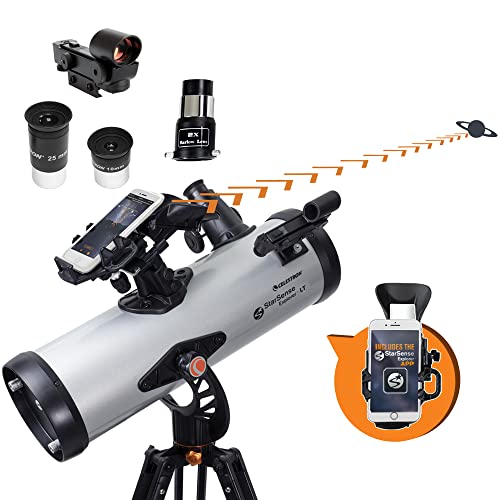
Celestron StarSense Explorer LT 114AZ telescope

Celestron StarSense Explorer LT 114AZ

114mmPushTo (App)

The StarSense Explorer uses your smartphone's camera to identify stars and guide you to targets — a true PushTo system. No hand controller needed. The app shows which direction to push, and the scope tracks once you center the object.

Celestron NexStar 8SE telescope

Celestron NexStar 8SE — Premium GoTo

203mm SCTGoTo Alt-Az

The 8SE combines the same proven GoTo mount with a 203mm SCT for serious aperture. Ideal for deep-sky and planetary observation with full tracking. The 2000mm focal length provides high power for planets.

Frequently Asked Questions

What is a telescope with auto-tracking?

An auto-tracking telescope uses motors to follow celestial objects automatically, keeping them centred in the eyepiece as Earth rotates. This lets you observe for extended periods without constant manual adjustment.

What is the difference between GoTo and PushTo?

GoTo telescopes use motors to move themselves to selected objects. PushTo systems show you which direction to push manually. GoTo is more expensive but fully automatic; PushTo is more affordable and still helps you find objects.

Are GoTo telescopes good for beginners?

Yes — GoTo removes the frustration of finding objects. The Celestron StarSense Explorer is particularly beginner-friendly, using your smartphone for alignment and navigation. Beginners should still learn basic sky navigation.

Do I need a tracking telescope for astrophotography?

For deep-sky astrophotography, yes — a motorized equatorial mount with auto-guiding is essential. For planetary imaging, an alt-az GoTo mount works well. For casual shots, a Dobsonian is sufficient.