
Webb Picture of the Month · Carina Nebula · August 2026
Webb Opens a Treasure Chest Filled with Stars
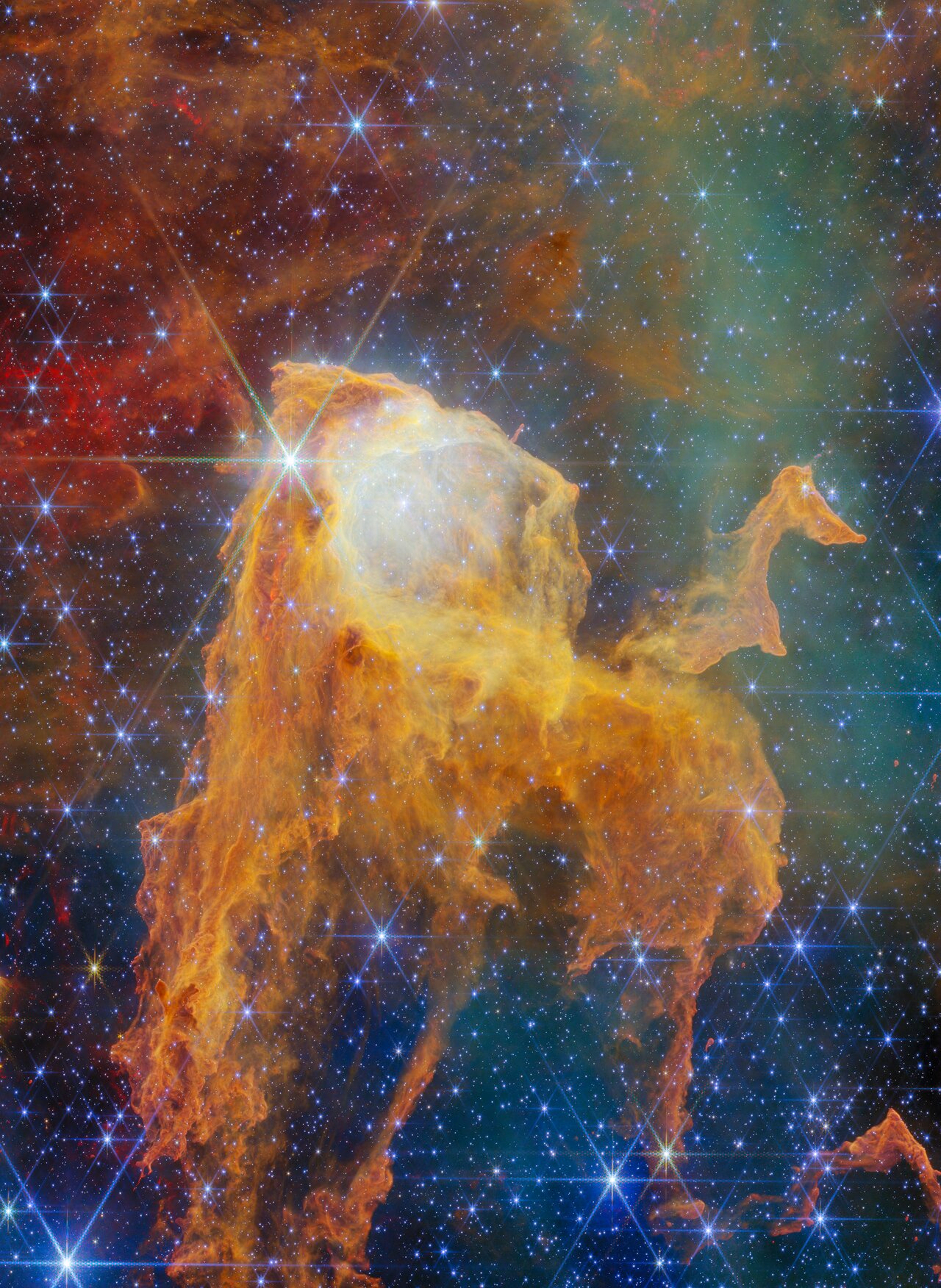
NASA's James Webb Space Telescope has released a breathtaking new Picture of the Month: the "Treasure Chest" — a cometary globule in the Carina Nebula sculpted into a chest-like shape by the radiation of nearby monster stars. Inside, Webb's NIRCam reveals a glowing cluster of roughly 70 newborn stars, still wrapped in their dusty birth clouds.
Distance7,500 light-years
ConstellationCarina
InstrumentWebb NIRCam
ReleaseAugust 6, 2026
By Telescope Advisor Editorial Team
|
Published:
|
Updated:
|
Reviewed & approved by Juhi Sahni, Senior Editor
|
Editorial Standards

Elena Reyes
Senior Science Editor
Covers NASA missions, space science discoveries, and astronomical events for Telescope Advisor. Translates complex astrophysical research into practical insights for backyard observers. Based in the San Francisco Bay Area.
Content reviewed by our editorial team. Research and drafting assisted by AI to ensure unbiased, data-driven analysis. Learn more about our editorial process.
Webb Reveals the Treasure Chest in the Carina Nebula
On August 6, 2026, the NASA/ESA/CSA James Webb Space Telescope unveiled its latest Picture of the Month: a spectacular view of a cometary globule known as the "Treasure Chest," nestled within the vast Carina Nebula some 7,500 light-years away. The image, captured by Webb's Near-Infrared Camera (NIRCam), peers through the dense veils of cosmic dust to reveal a compact cluster of newborn stars glowing from within a sculpted cloud of gas and dust.
The Treasure Chest gets its name from its unmistakable shape — the cloud looks uncannily like a wooden chest with its lid thrown wide open, spilling starlight rather than gold coins into the surrounding nebula. The image is part of an observing program (#5408, PI: M. Reiter) dedicated to studying how young stars in the Carina Nebula gather gas from their environment and expel it through powerful outflows, shaping the spectacular landscape around them.
Spanning roughly 260 light-years across, the Carina Nebula is the nearest high-mass star-forming region to Earth, making it a uniquely valuable laboratory for understanding the full lifecycle of stars — from the gravitational collapse of dense gas clouds to the fierce winds and radiation of massive O-type stars. The Treasure Chest sits in a region already made famous by Webb: the Cosmic Cliffs, revealed in the telescope's very first image release in July 2022, are part of the same nebula.
"This scene is from the Carina Nebula, where piercing starlight and billowing winds sculpt dust clouds into inventive shapes," the ESA Webb team writes. The new image is a vivid reminder that the Carina Nebula remains one of the most photogenic and scientifically rich regions in the entire sky — and that Webb's infrared eyes continue to reveal details that were completely invisible to previous telescopes.
What Is a Cometary Globule?
The Treasure Chest belongs to a fascinating class of astronomical objects known as cometary globules. These are isolated clouds of gas and dust with a distinctive two-part structure: a dense, dark, compact head and a long, sweeping tail that streams away from it. First identified in 1976 from photographs of the Gum Nebula, cometary globules get their name because their shape superficially resembles a comet — though the scale is utterly different. While a typical comet nucleus might be a few kilometers across, a cometary globule can stretch for several light-years.
But unlike their namesakes, cometary globules are not traveling through space leaving a tail behind them. Instead, their shape is sculpted from the outside by the intense ultraviolet radiation and powerful stellar winds from nearby massive stars. The radiation ionizes the cloud's outer layers, creating a bright rim, while the pressure of the stellar wind gradually erodes the less-dense gas and pushes it into the characteristic tail. What remains — the dense head — is material dense enough to resist being blown away, at least for a while.
What makes the Treasure Chest particularly special is that it doesn't resemble a comet at all — it looks unmistakably like an open chest. The dense head forms the "box" of the chest, while pillars of thick gas at its base look like the chest resting on a pedestal. The open "lid" appears to spill a diffuse blue glow — starlight from the newborn cluster inside, filtering through the thinning dust. It's a cosmic coincidence of perspective, radiation, and gas dynamics that has produced one of the most evocative shapes Webb has ever captured.
How Cometary Globules Form
Cometary globules form when massive O- and B-type stars flood a molecular cloud with ultraviolet radiation. The radiation creates an ionization front — a boundary where hydrogen atoms are stripped of their electrons. This front compresses the gas ahead of it, triggering the collapse of denser clumps into new stars. The process, called radiation-driven implosion, simultaneously sculpts the cloud into a cometary shape and seeds it with the next generation of stars.
Why They Matter for Astronomy
Cometary globules are natural laboratories for studying triggered star formation — the process by which the death (via radiation and winds) of one generation of massive stars can trigger the birth of the next. Because the globule's dense head shields its interior from the harshest radiation, stars can form in relative peace inside it. Webb's infrared vision is uniquely suited to peering through the dust and revealing what's happening inside these cocoons.
The Hidden Star Cluster: 70 Young Stars Shrouded in Dust
The otherworldly glow coming from within the Treasure Chest isn't reflected light — it's the combined radiance of a compact cluster of roughly 70 young stars, still deeply embedded within their natal cloud. Webb's NIRCam instrument, sensitive to infrared wavelengths that pass through dust, reveals these stars for the first time in exquisite detail.
The most massive star in the cluster is a rare O-type star — the hottest and most luminous category of star in the Universe — estimated to be about 19 times the mass of the Sun. O-type stars are exceptionally rare; fewer than one in a million stars in the Milky Way belongs to this class. Their surface temperatures exceed 30,000 Kelvin, and they burn through their nuclear fuel so rapidly that they live only a few million years — a blink of the eye in cosmic terms — before exploding as supernovae.
The cluster itself is remarkably young. Researchers estimate its age at roughly 1.3 million years, though some earlier estimates placed it as young as 100,000 years. To put that in perspective: when these stars began to shine, Homo erectus was already walking the Earth and making stone tools. The dinosaurs had been gone for 65 million years. In cosmic terms, these stars are newborns, barely out of the womb.
~70 Stars in the Cluster
The Treasure Chest cluster contains approximately 70 stars, most of which are still deeply embedded in dust. Webb's infrared sensitivity is the only way to count them accurately — visible-light telescopes would see only a dark, opaque cloud.
O-Type Giant: 19 Solar Masses
The most massive member is an O-type star roughly 19 times the Sun's mass. Such stars produce enormous amounts of ultraviolet radiation and are the primary sculptors of the surrounding nebula.
Circumstellar Discs Detected
Astronomers have found evidence that many stars in this cluster are surrounded by circumstellar discs — rotating rings of gas and dust that may one day form planets. These are planetary systems in their earliest stages.
Because of the cluster's extreme youth, the individual stars are still wrapped in their birth cocoons. Many are surrounded by circumstellar discs — rotating rings of gas and dust that, given enough time, could coalesce into planets. Webb's observations of these discs in the Carina Nebula will help astronomers understand how planets form around stars of different masses, and whether the intense radiation environment near massive stars helps or hinders planet formation.
Over the next few million years, the brilliant starlight from these young stars will gradually erode and dissipate the surrounding cloud. Eventually, the Treasure Chest will vanish, and the cluster — by then a fully-formed open cluster of stars — will be revealed to the galaxy at large.
Eta Carinae: The Cosmic Sculptor Just 39 Light-Years Away
The key to the Treasure Chest's sculptural shape lies just outside the frame — only 39 light-years to the northwest, as measured on the sky, sits Eta Carinae, the most luminous object in the entire Carina Nebula and one of the most extraordinary star systems in the Milky Way.
Eta Carinae is a stellar system containing at least two stars. The primary is a monster — roughly 100 times the mass of the Sun and about 5 million times as luminous. If it were placed at the distance of the nearest star to Earth (Proxima Centauri, 4.2 light-years), it would appear as bright as the full Moon in our sky. The star is so massive and luminous that it is near the theoretical Eddington limit — the point at which the outward pressure of its own radiation would blow the star apart.
Adding to this onslaught of radiation is the nearby star cluster Trumpler 16, which also contains several extremely hot, massive stars. Together, Eta Carinae and Trumpler 16 flood the Treasure Chest with a relentless barrage of ultraviolet photons and fast stellar winds — a cosmic sandblaster that has sculpted the globule into its chest-like shape over millions of years.
The Chicken-and-Egg Question
There is an active debate among astronomers about what came first: the cometary shape of the Treasure Chest cloud, or the star cluster inside it. The most likely scenario, according to the ESA Webb team, is that the star cluster formed first within a larger molecular cloud. Then, the powerful radiation and stellar winds from Eta Carinae and Trumpler 16 eroded away the surrounding lower-density gas, leaving behind only the densest material — the Treasure Chest we see today. The stars inside are simultaneously eating away at the cloud from within, their own radiation hollowing out cavities in the gas around them.
Did You Know? In the 1840s, Eta Carinae underwent a colossal outburst known as the "Great Eruption," briefly becoming the second-brightest star in the night sky after Sirius. The eruption ejected roughly 10-20 solar masses of material, creating the distinctive Homunculus Nebula — a bipolar cloud of expanding gas and dust that now surrounds the star system. Eta Carinae is expected to end its life in a spectacular supernova or hypernova within the next million years.
How Webb's NIRCam Captured This Image
The Treasure Chest image was captured by Webb's Near-Infrared Camera (NIRCam), the telescope's primary imaging instrument for the near-infrared part of the spectrum (0.6 to 5 microns). NIRCam is equipped with a suite of filters that isolate specific wavelengths of light, each chosen to trace different physical processes in the gas and dust.
The Four Filters Used
1.62 μm — Near-Infrared Continuum
Captures the general starlight and reflected light from dust grains, establishing the overall structure of the nebula.
1.64 μm — Ionized Iron (Fe II)
Traces shocked gas — regions where fast stellar winds or outflows from young stars slam into the surrounding cloud, heating the gas to thousands of degrees.
4.44 μm — Warm Dust Continuum
Detects thermal emission from warm dust grains heated by nearby stars. This filter reveals the structure of the cloud itself, including the "pillars" at the chest's base.
4.7 μm — Molecular Hydrogen (H₂)
Traces shocked molecular hydrogen — gas excited by outflows from the embedded protostars. This is a direct tracer of ongoing star formation activity.
Why Infrared Matters for This Target
The Treasure Chest cluster is deeply embedded in dust that blocks visible light almost completely. At visible wavelengths, the chest would appear as an opaque dark silhouette against the brighter nebula background — the stars inside would be invisible. But at the near-infrared wavelengths NIRCam observes (1.6-4.7 microns), the dust becomes partially transparent. The longer the wavelength, the better the penetrating power — which is why the 4.44 and 4.7 micron filters are particularly important for revealing the innermost structure of the cloud and the embedded stars.
The final image is a composite of all four filters, color-coded to produce a visually stunning and scientifically informative picture. Blue hues trace the shorter wavelengths (1.62 and 1.64 microns), while red and orange hues trace the longer wavelengths (4.44 and 4.7 microns). The result is a rich tapestry that is both beautiful and packed with physical information about temperature, composition, and dynamics.
About the Observing Program: This image is part of Webb observing program #5408 (PI: Megan Reiter), dedicated to studying how young stars in the Carina Nebula accrete gas from their surroundings and expel it through jets and outflows. These observations will help astronomers build a complete picture of stellar feedback — the process by which newborn stars shape and ultimately destroy their natal clouds.
The Carina Nebula: A Stellar Nursery Like No Other
The Carina Nebula (NGC 3372) is one of the crown jewels of the southern sky. Spanning roughly 260 light-years, it is the nearest high-mass star-forming region to Earth — nearly four times larger and considerably brighter than the more famous Orion Nebula (M42). Located in the constellation Carina (the Keel, once part of the ancient constellation Argo Navis), the nebula is home to some of the most massive stars in our galaxy, including Eta Carinae, as well as tens of thousands of protostars in various stages of formation.
The Carina Nebula holds a special place in Webb's history. In July 2022, when NASA, ESA, and CSA unveiled the telescope's first full-color images, one of them was the Cosmic Cliffs — a region at the edge of the Carina Nebula where towering mountains of gas and dust are being eroded by the radiation of young, hot stars. That image became one of the most iconic astronomical photographs ever taken. The Treasure Chest is a continuation of that story — another view into the same nebula, revealing a different set of structures and a different stage of the star formation process.
Key Facts About the Carina Nebula
- Distance: ~7,500 light-years from Earth
- Size: ~260 light-years across
- Constellation: Carina (the Keel)
- Notable objects: Eta Carinae, Trumpler 14 and 16 star clusters, the Keyhole Nebula, the Cosmic Cliffs, the Treasure Chest
- Star formation: Contains some of the most massive stars known, up to ~200 solar masses
- First imaged by Webb: July 2022 (Cosmic Cliffs)
Why Astronomers Love the Carina Nebula
Because the Carina Nebula is the nearest high-mass star-forming region, it allows astronomers to study the full range of star formation in one place — from low-mass stars like our Sun to the rarest O-type behemoths. It is close enough to resolve individual stars and detailed nebular structures, yet rich enough to contain examples of nearly every phase of stellar evolution. For understanding how stars shape their neighborhoods — and how those neighborhoods, in turn, shape the next generation of stars — there is no better natural laboratory in the sky.
How to Observe the Carina Nebula Yourself
While you won't see the Treasure Chest at Webb-level detail through a backyard telescope, the Carina Nebula is one of the most rewarding deep-sky objects for amateur astronomers in the Southern Hemisphere. The nebula is large, bright, and filled with structure visible even in modest instruments.
Finding the Carina Nebula
The Carina Nebula is a southern-sky object, best viewed from latitudes south of about 20°N. It is located roughly halfway between the bright stars Canopus (the second-brightest star in the night sky) and the Southern Cross (Crux). To the naked eye from a dark site, it appears as a bright patch of the Milky Way about four times the apparent size of the full Moon. From the Southern Hemisphere, it is best seen during summer and autumn months (December through May), when it passes nearly overhead.
What Equipment to Use
Binoculars (7×50 or 10×50): The Carina Nebula is spectacular in binoculars, showing as a bright, structured patch of the Milky Way with the dark Keyhole Nebula visible as a notch. Small telescope (80-100mm): Reveals the cluster Trumpler 14, the dark Keyhole, and the overall structure of the nebula. Medium telescope (150-200mm): Shows Eta Carinae as a bright orange "star" embedded in nebulosity, plus numerous smaller star clusters. A 6-inch or 8-inch Dobsonian is ideal for Carina. Filters: A UHC or O-III filter significantly enhances the contrast of the nebula against the sky background, especially from suburban locations.
Can You See the Treasure Chest?
The Treasure Chest itself is a relatively small feature within the larger Carina Nebula. At the scale of Webb's image — a field of view of just 4.26 × 5.83 arcminutes — it would require a large amateur telescope (12 inches or more) under dark skies to detect as a distinct object. However, the general region of the Carina Nebula containing it — near the Cosmic Cliffs and Eta Carinae — is easily visible in modest equipment. What you'll see is the broader nebula, with Eta Carinae glowing as a prominent orange star at its heart. Knowing that the Treasure Chest and its 70 newborn stars are inside that glowing patch adds a layer of wonder to every observation.
Northern Hemisphere Observers
If you live north of about 20°N latitude, the Carina Nebula is largely or entirely below the horizon. However, you can still observe the northern equivalent — the Orion Nebula (M42), another massive star-forming region visible from almost everywhere on Earth. For more on observing nebulae, see our guide to the best telescopes for viewing nebulae.
Frequently Asked Questions
What is the "Treasure Chest" in Webb's new image?
The Treasure Chest is a cometary globule — an isolated cloud of gas and dust — located in the Carina Nebula, about 7,500 light-years from Earth. It gets its name because its shape resembles a wooden chest with its lid open. The cloud contains a compact cluster of about 70 young stars, and its distinctive shape has been sculpted by radiation from the nearby massive star system Eta Carinae.
What is a cometary globule?
A cometary globule is an isolated cloud of gas and dust with a dense, dark head and a long, sweeping tail — superficially resembling a comet, hence the name. First identified in 1976, cometary globules are sculpted by the intense ultraviolet radiation and stellar winds from nearby massive stars. The dense head can be several light-years across and often contains newly forming stars.
How many stars are in the Treasure Chest cluster?
Researchers estimate the cluster contains about 70 stars. The most massive member is a rare O-type star roughly 19 times the mass of the Sun. The cluster is extremely young — likely around 1.3 million years old — and many of its stars are still surrounded by circumstellar discs of gas and dust that may eventually form planets.
What instrument did Webb use for this image?
Webb used its Near-Infrared Camera (NIRCam) with four filters: 1.62 μm (near-infrared continuum), 1.64 μm (ionized iron, Fe II), 4.44 μm (warm dust), and 4.7 μm (molecular hydrogen, H₂). NIRCam's infrared sensitivity allows it to peer through the thick dust that hides the embedded star cluster from visible-light telescopes.
How is Eta Carinae connected to the Treasure Chest?
Eta Carinae, the most luminous object in the Carina Nebula, sits just 39 light-years to the northwest of the Treasure Chest (as measured on the sky). Eta Carinae is a binary star system whose primary is about 100 times the mass of the Sun and 5 million times as luminous. The intense radiation and stellar winds from Eta Carinae and the nearby Trumpler 16 star cluster are largely responsible for sculpting the Treasure Chest into its distinctive chest-like shape.
Can I see the Treasure Chest with my telescope?
The Treasure Chest itself is a small feature — Webb's image covers just 4.26 × 5.83 arcminutes — and would require a large amateur telescope (12 inches or more) under dark skies to detect as a distinct object. However, the broader Carina Nebula containing it is one of the most spectacular deep-sky objects visible from the Southern Hemisphere, easily seen in binoculars or a small telescope. The nebula is best viewed from latitudes south of about 20°N during summer months (December through May).
How does this image relate to Webb's first images?
This Picture of the Month is from the same nebula as the iconic "Cosmic Cliffs" — one of Webb's first full-color images released in July 2022. Both images showcase different regions of the Carina Nebula. While the Cosmic Cliffs showed the edge of a star-forming region where radiation is eroding towering pillars of gas, the Treasure Chest reveals a more isolated, sculpted globule with an embedded star cluster. Together, they tell complementary stories about star formation in the same vast nebula.
What will happen to the Treasure Chest over time?
Over the next few million years, the brilliant starlight from the young cluster inside the Treasure Chest will gradually erode and dissipate the surrounding cloud. Eventually, the chest shape will vanish completely, revealing a fully-formed open cluster of stars to the galaxy. Meanwhile, the massive stars of Eta Carinae and Trumpler 16 will continue sculpting other features in the Carina Nebula — until they, too, end their lives in supernova explosions.
Sources
- ESA/Webb — Webb opens a Treasure Chest filled with stars (potm2607a)
- ESA — Webb opens a Treasure Chest filled with stars
- ESA/Webb — Picture of the Month Collection
- STScI — JWST Observing Program #5408 (PI: Reiter)
- ESA/Webb — NIRCam Instrument Overview
- ESA/Webb — Cosmic Cliffs in the Carina Nebula (Webb's First Images)
Also popular on Telescope Advisor
How to Choose a Telescope
7-step buyer’s framework
Best Telescopes for Beginners 2026
13 tested & ranked picks
How Much Does a Telescope Cost?
Price guide: $80 → $2,500+
Best Telescopes 2026
Our complete annual rankings
Best Budget Telescopes Under $500
Ranked by aperture-per-dollar
🔭 Telescope Finder Tool
Answer 5 questions, get a pick
Continue Exploring
Keep the session going with the next useful answer
Choose the next page based on whether you need a recommendation, a comparison, or a practical observing plan.
Related Guides
🌌
🔭
📷
🏆
📅
📱
Best Telescope for Viewing Nebulae
Top scopes for seeing nebulae like Carina in detail.
Best Dobsonian Telescopes
Large aperture, affordable — ideal for deep-sky observing.
Astrophotography for Beginners
Learn to photograph nebulae, star clusters, and more.
Best Astrophotography Telescope 2026
Award-winning scopes for capturing the cosmos.
Astronomy Events Calendar 2026
Plan your observing sessions around key celestial events.
Best Astronomy Apps
Find Carina, Eta Carinae, and the Treasure Chest in the sky.