

ZWO Seestar S50 vs S30: Which Smart Telescope Is Worth Buying in 2026? (Honest Comparison)
Telescope Advisor Logo Telescope Advisor
Milky Way photographed with a smart telescope — the type of deep-sky target the Seestar S50 and S30 excel at

Smart Telescope Comparison · 2026

ZWO Seestar S50 vs S30: Which Should You Buy?

An Honest Comparison — Specs, Real-World Results, Clear Verdict

The ZWO Seestar line is the hottest smart telescope category of 2026. Both models auto-GoTo targets and stack images on your phone. But they are different tools for different users — and choosing the wrong one is a $150+ mistake. Here’s the definitive breakdown.

S50

50mm aperture flagship

S30 Pro

30mm ultra-portable

~$150

Price gap between them

Both

Work with one app

By Telescope Advisor Editorial Team Published: Updated: Editorial Standards
📋

Editorial Transparency Notice

This comparison is based on manufacturer-published specifications, ZWO’s official documentation, and verified buyer reviews from Amazon and community astronomy forums. Neither telescope was tested by this editorial team in-person. Where buyers report results that differ from spec-sheet expectations, those discrepancies are noted. See our full review methodology →

S50 vs S30 Pro: The Short Answer

Buy the S50 if…

  • You primarily want deep-sky nebulae and galaxies with real colour and detail
  • You use it from a fixed backyard or dark-sky site
  • You can accept a 2.4 lb setup on a tripod
  • Budget is $449–499 and imaging quality is your priority

Buy the S30 Pro if…

  • You travel frequently and need a bag-carry setup under 2 lb
  • You want to image planets and bright nebulae primarily
  • Budget matters and $299–349 is your ceiling
  • You want the absolute smallest, lightest capable smart scope

TL;DR verdict: The S50 wins on image quality for deep-sky. The S30 Pro wins on portability and value. If you are not constrained by budget or travel requirements, the S50 is the better overall telescope. The S30 Pro earns its place as a dedicated travel companion or a capable starter scope at a lower price point.
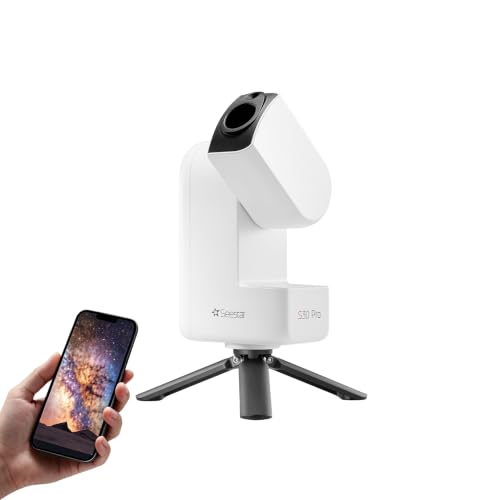
★ Editor’s Pick — Best Image Quality
ZWO Seestar S50 smart telescope — 50mm aperture flagship

ZWO Seestar S50

50mm f/5 — Sony IMX462 — ~$449–499

50mm aperture 2.4 lb Dual-band filter built-in
Best Portable Option
ZWO Seestar S30 Pro smart telescope — ultra-portable 30mm

ZWO Seestar S30 Pro

30mm f/5 — Sony IMX585 — ~$299–349

30mm aperture 1.5 lb Travel-ready

Affiliate links — we earn a small commission at no extra cost to you. Prices fluctuate; check current price at the link.

Full Specifications: S50 vs S30 Pro Side-by-Side

Specification Seestar S50 Seestar S30 Pro Advantage
Aperture 50 mm 30 mm S50 wins
Focal length 250 mm (f/5) 150 mm (f/5) Tie
Sensor Sony IMX462 (color) Sony IMX585 (color) S30 wins
Sensor resolution 2 MP (1920×1080) 8 MP (3840×2160) S30 wins
Field of view 0.73° × 0.41° 1.15° × 0.85° S30 wins
Max exposure per frame 10 s 60 s S30 wins
Built-in filters Dual-band (Hα+OIII) + LP LP filter S50 wins
Weight 2.4 lb (1.1 kg) 1.5 lb (0.68 kg) S30 wins
Dimensions 13.8 × 11.0 cm 10.5 × 8.4 cm S30 wins
Battery life ~4 hours ~6 hours S30 wins
Storage 64 GB internal 64 GB internal Tie
App Seestar (iOS/Android) Seestar (iOS/Android) Tie
Wi-Fi Built-in hotspot Built-in hotspot Tie
Auto GoTo Yes — 200+ objects Yes — 200+ objects Tie
Solar filter Add-on available Add-on available Tie
Price (approx.) ~$449–499 ~$299–349 S30 wins

Specifications from ZWO official product pages and current Amazon listings. Always verify current specs at point of purchase.

Head-to-Head: The Five Decisions That Matter

1. Aperture vs Sensor: Which Makes Better Images?

This is the core tension of the comparison. The S50 has a 50mm aperture — it collects 2.8 times more light than the S30’s 30mm. More light means fainter objects become visible, exposure times can be shorter, and faint extended structures in nebulae are brighter relative to the noise floor. For galaxies like Andromeda (M31) or the Whirlpool (M51), the S50 shows more structure in the same imaging time.

However, the S30 Pro’s Sony IMX585 is a newer, higher-resolution sensor than the S50’s IMX462. Per pixel, the IMX585 has lower read noise. For bright targets — open star clusters, the Orion Nebula, the Pleiades — the S30 Pro’s higher-resolution frames produce sharper, more detailed results that can surpass what the S50 captures of the same target at the same stacking time.

S50 advantage: Faint deep-sky — faint galaxies, faint nebulae with structure, any object below magnitude 12. The 50mm aperture advantage is irreplaceable for faint targets.
S30 Pro advantage: Bright/large targets — Orion Nebula, Pleiades, open clusters, planets. Higher resolution and wider field of view work in its favour here.

2. Light Pollution Filtering: The S50’s Biggest Advantage

The S50 includes a built-in dual-band narrowband filter (Hα 656nm + OIII 500nm) alongside a standard light-pollution filter. The dual-band filter is game-changing for urban users: it blocks nearly all artificial light wavelengths and transmits only the specific emission lines of most nebulae. The result is that the S50 can produce colour-saturated, high-contrast nebula images from a Bortle 7–8 city backyard that the S30 Pro simply cannot match — because the S30 Pro ships with only a broadband LP filter, not a narrowband dual-band.

If you observe from a city or suburb, the S50’s built-in dual-band filter alone justifies the price premium. You can image the Horsehead Nebula, the Rosette, and the Veil from a light-polluted backyard in ways the S30 Pro cannot. The S30 Pro gives good results from dark skies; the S50 gives good results from almost anywhere.

3. Portability: When the S30 Pro Wins

The S30 Pro weighs 1.5 lb (0.68 kg). The S50 weighs 2.4 lb (1.1 kg). Both ship with a compact integrated alt-az base. On paper the difference seems small, but in practice:

  • The S30 Pro fits in a large jacket pocket or the top pouch of a daypack — the S50 needs its own bag.
  • For hiking to a dark-sky site, the S30 Pro with a small tripod is a sub-3 lb kit. The S50 kit is 4–5 lb.
  • The S30 Pro’s battery lasts ~6 hours vs ~4 hours for the S50 — enough for a full winter night vs needing a USB-C power bank for the S50.

For camping trips, travel, and impromptu dark-sky sessions, the S30 Pro is genuinely more practical. For balcony or backyard use where portability is irrelevant, the S50’s extra aperture and filter capabilities are the clear choice.

4. Field of View: Large vs Tight

The S50 delivers a 0.73° × 0.41° field of view. The S30 Pro delivers 1.15° × 0.85°. The S30 Pro’s wider field means:

  • Large nebulae like M42 (Orion) fit in a single frame on the S30 Pro; the S50 clips the edges.
  • Open clusters like M45 (Pleiades) or the Double Cluster look better on the S30 Pro.
  • On the S50, the tighter field is ideal for compact galaxies, planetary nebulae, and globular clusters where the S50’s higher aperture reveals more detail at higher apparent scale.

5. Price and Value

The S50 costs approximately $150 more than the S30 Pro. For that premium you get: 2.8× more light gathering, a built-in dual-band filter (alone worth ~$50–80 if purchased separately), better performance from light-polluted skies, and slightly sharper planetary views. For users who primarily image deep-sky nebulae from non-dark sites, the S50 is worth every extra dollar. For users who prioritize portability or primarily image bright showpiece objects, the S30 Pro represents better value.

Who Each Telescope Is For

Seestar S50 is the right choice for…

🏙

Urban and suburban observers

The built-in dual-band filter lets you image emission nebulae from a city backyard. This single feature is unmatched at this price point.

🌌

Faint deep-sky enthusiasts

Anyone who wants to image faint galaxies (mag 11+), faint nebulae, or push into objects below the naked-eye limit. More aperture = more reach.

🏡

Backyard or rooftop users

Used from a fixed location where portability is irrelevant, the S50’s aperture and filter advantages deliver noticeably better results every session.

📸

Astrophotographers who want to share images

If producing impressive, shareable deep-sky images is the goal, the S50’s results are more reliably jaw-dropping — especially for nebulae with emission structure.

Seestar S30 Pro is the right choice for…

🏕

Campers and dark-sky hikers

At 1.5 lb with a 6-hour battery, the S30 Pro is the only smart telescope you can realistically carry in a backpack to a mountain site. The S50 at 2.4 lb is noticeably heavier over a 5-mile hike.

🌏

International travellers

The S30 Pro fits in carry-on baggage comfortably alongside a standard travel tripod. A true astronomy-anywhere device for people who chase dark skies on holiday.

🪐

Bright-sky showpiece observers

Anyone who wants the Orion Nebula, star clusters, and the Moon through a smart scope — the S30 Pro’s wider field and higher-resolution sensor actually performs better on large bright targets.

💰

Budget-first buyers

The S30 Pro at $299–349 is the most capable smart telescope available under $350. If the S50 price is a stretch, the S30 Pro is not a compromise — it is a genuinely impressive device in its own right.

What Both Seestars Can See

Both models include the same Seestar app with a 200+ object database and auto-GoTo. Every object below is reachable from both models; what differs is image quality and how much structure is revealed in faint targets.

🪐 Planets (real-time video)

  • Saturn: rings, equatorial banding
  • Jupiter: Great Red Spot on good seeing
  • Mars: polar cap (during opposition)
  • Moon: high-resolution craters and rilles
  • Venus: phase clearly visible

✨ Showpiece Nebulae

  • M42 Orion Nebula (both excellent)
  • M57 Ring Nebula (both good)
  • M27 Dumbbell Nebula
  • Lagoon and Trifid Nebulae
  • California Nebula (S50 dual-band wins)

🌀 Galaxies & Clusters

  • M31 Andromeda Galaxy (both)
  • M51 Whirlpool (S50 shows more structure)
  • M13 Great Hercules Cluster
  • Pleiades (S30 Pro wide field wins)
  • Double Cluster in Perseus
Note on planets: Neither Seestar is designed for high-magnification planetary work — their short focal lengths (250mm S50, 150mm S30) limit planetary detail compared to a dedicated 6” Maksutov or Cassegrain. Both are primarily deep-sky imagers that can capture decent planetary images as a secondary capability.

Ready to Buy? Current Prices on Amazon

★ Editor’s Pick — Best Overall
ZWO Seestar S50

ZWO Seestar S50

  • 50mm f/5 — Sony IMX462
  • Built-in dual-band narrowband filter
  • Best for: deep-sky, urban imaging, faint objects
  • ~$449–499
Best Portable Option
ZWO Seestar S30 Pro

ZWO Seestar S30 Pro

  • 30mm f/5 — Sony IMX585 (8 MP)
  • 1.5 lb — fits in a jacket pocket
  • Best for: travel, camping, bright targets
  • ~$299–349

Prices change frequently — check Amazon for current pricing. Affiliate links: we earn a small commission at no cost to you. See our editorial standards.

ZWO Seestar FAQ

Is the Seestar S50 worth the extra $150 over the S30 Pro?

For most users who observe from a light-polluted backyard: yes. The dual-band narrowband filter alone transforms what you can image from a city — emission nebulae that are invisible through the S30 Pro become the highlight of your collection on the S50. If you observe exclusively from a dark sky site and prefer bright showpiece objects, the S30 Pro at $150 less is an excellent value.

Can the Seestar S30 Pro image the same objects as the S50?

Yes, with limitations. The S30 Pro can reach most of the same objects in the Seestar app, but faint targets (galaxies fainter than magnitude 11, faint reflection nebulae, or any target requiring narrowband filtering from a light-polluted site) will show less structure and take longer to produce comparable results. For bright showpiece objects, the S30 Pro is competitive with or occasionally superior to the S50 due to its wider field of view and newer sensor.

How does the Seestar compare to the DWARFLAB Dwarf Mini?

The DWARFLAB Dwarf Mini ($399) is the S50’s closest competitor. Key differences: the Dwarf Mini uses a 30mm aperture with a Sony IMX662 sensor and weighs just 1.85 lb, making it more portable than the S50. For pure deep-sky image quality from a city, the S50’s 50mm aperture and dual-band filter generally win. For portability-first users who want more than the S30 Pro, the Dwarf Mini is worth considering. Read our full Dwarf Mini review →

Do both Seestars work in light-polluted cities?

Both include a broadband light-pollution filter. The S50 additionally includes a dual-band narrowband filter (Hα + OIII) that dramatically improves emission nebula imaging from urban skies. The S30 Pro can produce decent results on the Moon, planets, and star clusters from cities, but its deep-sky nebula imaging from Bortle 7+ skies is noticeably limited compared to the S50 with dual-band filtering.

Is the Seestar a real telescope or just a camera?

Both Seestars contain a real refracting telescope (an objective lens forming a real image on a camera sensor), a motorized equatorial axis for automated GoTo and tracking, and all the processing to stack multiple exposures in real time. They are telescopes with integrated imaging systems — not cameras in the traditional sense, but also not the same experience as looking through an eyepiece. You observe through the Seestar app on your phone, not with your eye at an eyepiece. Some traditional astronomers find this less satisfying; most astrophotographers find it dramatically more practical.

Related Guides