Best Telescope for Apartment Balcony (2026): Compact, Stable Picks That Actually Get Used
Telescope Advisor Logo Telescope Advisor
Night sky seen from an apartment balcony in a city

Buying Guide · 2026

Best Telescope for Apartment Balcony: Compact Picks That Actually Get Used

Balcony astronomy is less about maximum aperture and more about stability, fast setup, and repeatable weeknight use. This guide ranks balcony-friendly telescopes that fit tight spaces, survive vibration, and still deliver satisfying Moon and planet views from city skies.

5

Ranked picks

10-15 min

Ideal setup time

Low vibration

Core requirement

City-ready

Bortle 6-9

By Telescope Advisor Editorial Team Published: Updated: Editorial Standards

Quick Answer: What Is the Best Telescope for an Apartment Balcony?

For most apartment observers, the best balcony telescope in 2026 is the Celestron NexStar 5SE. It combines compact footprint, GoTo pointing, and tracking, so you spend your limited observing window actually observing instead of searching. On a balcony, this matters more than raw aperture because setup friction and target-finding failure kill usage.

If budget is tighter, the StarSense Explorer LT 114AZ is a strong entry option. If your main goal is deep-sky from extreme light pollution, a smart telescope like Seestar S50 can beat visual-only workflows. The best choice depends on your railing clearance, floor stability, storage space, and city sky brightness.

Balcony Buying Checklist Before You Pick a Telescope

Balcony observing has mechanical constraints most buying guides ignore. Use this checklist before you commit:

1. Railing Height and View Angle

If your railing blocks low altitudes, you need mount geometry that clears it comfortably without awkward body position.

2. Floor Vibration

Concrete balconies are usually stable; lightweight cantilever balconies can amplify vibration. Stable mount and anti-vibration pads become critical.

3. Setup Time Reality

If setup regularly exceeds 20 minutes, your weekday usage drops sharply. Fast, repeatable setup beats theoretical performance.

4. Storage Path

Measure elevator, door frames, and storage corner. Telescope dimensions matter more in apartments than in houses.

Top 5 Apartment Balcony Telescopes (Ranked)

Editor's Pick — Best Overall Balcony Telescope
Celestron NexStar 5SE telescope

1) Celestron NexStar 5SE

Best balance of footprint, ease, and performance for balcony users. GoTo plus tracking means less frustration in narrow city sky windows. Compact enough for apartment storage while still giving satisfying planetary detail and bright deep-sky capability.

View on Amazon →
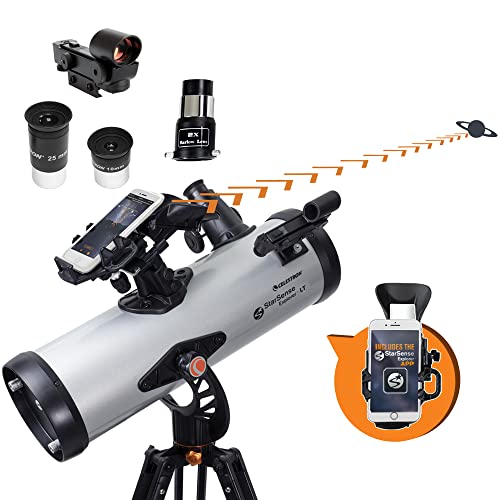
Celestron StarSense LT 114AZ

2) Celestron StarSense Explorer LT 114AZ

Best budget balcony pick. Phone-guided target finding lowers beginner failure rates and makes short sessions productive. Light enough for one-trip deployment.

View on Amazon →
Sky-Watcher Heritage 130P

3) Sky-Watcher Heritage 130P

Great portable aperture option if you prefer manual observing and can place the scope on a sturdy table. Strong value for Moon, planets, and bright deep-sky targets.

View on Amazon →
ZWO Seestar S50 smart telescope

4) ZWO Seestar S50

Best for apartment users who want deep-sky results under heavy light pollution. App workflow and automatic stacking make difficult targets more accessible from bright skies.

View on Amazon →
Celestron C90 Mak

5) Celestron C90 Mak

Ultra-compact specialist for Moon and planets on very tight balconies. Excellent grab-and-go option with tiny storage footprint.

View on Amazon →

Balcony Strategy: What You Can Actually See

Balcony astronomy can be excellent if you target correctly. In most city apartment environments, the highest-return target stack is Moon, Jupiter, Saturn, Mars in season, bright doubles, and selected clusters. Deep-sky targets are still possible, but choose bright showpieces and keep expectations realistic in Bortle 7 to 9 conditions.

Target TypeBalcony Success RateBest Scope Type
MoonVery highAny stable balcony scope
PlanetsHigh in good seeingMak/SCT/GoTo compact systems
Open clustersModerate to highShort refractor or compact reflector
Nebulae/galaxiesSelectiveSeestar or larger aperture from darker site

Balcony Layout and Positioning: Small Changes, Big Results

On apartment balconies, performance often depends more on placement than on optical specs. If your mount sits on a vibration-prone board seam or near a flexible railing section, high-magnification views soften even with a good telescope. Treat your balcony as an observing platform that needs repeatable positioning.

Best Position

Set up near structural support points and away from the rail center span where flex is highest. Mark the tripod feet positions with small removable tape markers for consistent setup.

Heat Management

Walls and concrete release heat after sunset. Give optics 15 to 30 minutes to settle, especially for SCT/Mak designs, or planetary detail may look soft regardless of seeing.

Movement Control

Avoid walking around the tripod during critical views. On lighter balconies, even footsteps can shift fine detail. A simple observing stool helps keep body movement low.

Light Shielding

Block nearby porch lights with a portable dark cloth or panel. Contrast gains on Moon edges and planets can be noticeable even when sky brightness remains high.

First 60 Days on a Balcony: A Realistic Success Plan

Most apartment buyers do not fail because the telescope is bad. They fail because balcony constraints are not integrated into a repeatable routine. Use this 60-day ramp so your scope becomes a habit instead of a one-month experiment.

Weeks 1-2: Setup and Stability

Practice a full setup without target pressure. Time each run and remove friction points. Your goal is a calm, repeatable setup under 15 minutes. If you are above that, simplify accessories and pre-pack essentials together.

Weeks 3-4: High-Confidence Targets

Run short sessions focused on Moon and one bright planet. Keep magnification moderate until stability and seeing are predictable. This builds confidence and creates a positive usage loop before adding harder targets.

Weeks 5-8: Controlled Expansion

Add one cluster or bright deep-sky target per session while keeping one guaranteed success target. Track what works from your exact balcony direction windows. Over time, your local sky map becomes more valuable than generic target lists.

Practical benchmark: if you complete at least 6 useful sessions in your first 30 days, your balcony workflow is healthy. If not, optimize setup friction before buying more gear.

Common Apartment Failure Modes and How to Fix Them

  • Scope feels too heavy to deploy often: move to a lighter optical tube or staged carry workflow (tripod first, OTA second).
  • Views shake at high power: reduce tripod extension and add anti-vibration pads before changing telescope models.
  • Targets always behind building edges: prioritize objects near your available azimuth window instead of forcing full-sky expectations.
  • Short sessions feel unproductive: use a fixed 3-target loop so each night has clear closure and progress.
  • Storage friction kills usage: keep scope and essential accessories pre-grouped for one-minute pre-deploy prep.

Apartment astronomy wins when systems are optimized for consistency, not maximum spec. The most effective balcony setup is the one you can deploy quickly on ordinary weekdays with minimal mental overhead.

Match Telescope Type to Balcony Type

Balcony Scenario Best Telescope Style Why
Very tight footprintCompact Mak/SCTSmall base area, easier railing clearance.
Short weekday sessionsGoTo compact scopeMaximizes observing time per minute deployed.
Budget-first setupSmall manual reflector/refractorLower cost, simpler ownership path.

Minimal Accessory Stack That Improves Balcony Results

  • Anti-vibration pads for unstable floor sections.
  • One low-power and one medium-power eyepiece you actually use.
  • Simple stool to reduce body movement and improve fine focusing.
  • Small light shield solution for nearby building glare.

These upgrades usually produce more practical gains than jumping immediately to a larger optical tube in apartment environments.

Balcony Buying Scorecard (Use Before You Buy)

Score each candidate scope from 1 to 5 for each category. The winner is usually the scope with the best total usability score, not the largest aperture number.

Category Why It Matters on Balconies
Setup timeShort sessions demand fast deployment.
Vibration toleranceApartment structures amplify movement.
Storage frictionIf storage is awkward, usage drops sharply.
Target acquisition speedLimited sky windows reward fast pointing systems.

Apartment Balcony vs Rooftop: Different Strategy, Different Winner

Balconies often have directional limits and more vibration. Rooftops usually offer wider horizons but can have wind and stronger thermal effects. If your building grants rooftop access, a slightly larger setup may become practical there, while your balcony setup should stay compact and friction-free.

Many urban observers succeed with a two-layer system: one balcony-friendly quick setup for weekdays and one larger setup reserved for occasional rooftop or dark-site sessions.

Final Balcony Verdict: What Most Apartment Users Should Buy

For most apartment observers, the right first balcony telescope is the one with the highest probability of frequent use: compact footprint, predictable setup, and stable tracking behavior. In real city use, this usually beats larger but cumbersome systems that stay indoors.

If you prioritize stress-free weeknight sessions, a compact GoTo platform remains the strongest default recommendation. If your budget is tighter, a simpler manual setup can still perform well when matched to realistic targets and a consistent deployment routine.

Treat balcony astronomy as an execution problem, not only a hardware problem. Optimize setup speed, vibration control, and target planning first; then scale equipment complexity only after your routine is stable.

If your first-month session count is low, simplify immediately: reduce accessory load, shorten setup path, and focus on high-confidence targets until usage frequency recovers.

Frequently Asked Questions

Can I use a telescope through my apartment window instead of the balcony?

For astronomy targets, window glass usually degrades the image due to distortion and indoor-outdoor temperature differences. Balcony use is far better in most cases.

Is a big Dobsonian good for a balcony?

Usually not ideal unless you have a very large, stable balcony and easy storage path. Many apartment users get more total observing time from compact GoTo or tabletop options.

Do I need GoTo on a balcony?

Not mandatory, but strongly helpful in light pollution and limited sky windows. GoTo saves time and reduces frustration in short sessions.

What matters more for balcony use: aperture or stability?

Stability and usability first. An unstable larger scope underperforms a stable compact setup that you can use consistently.