Best Telescope for Light Pollution (2026): 9 City-Proven Picks for Urban and Suburban Skies
Telescope Advisor Logo Telescope Advisor
Night sky above a light-polluted city skyline where bright planets and Moon remain visible

Buying Guide · 2026

Best Telescope for Light Pollution: 9 City-Proven Picks for Urban and Suburban Skies

If you live under bright skies, you do not need to quit astronomy. You need the right telescope strategy. This guide ranks the best telescopes for Bortle 5 to Bortle 9 skies, explains what each can realistically show, and helps you avoid the expensive mistakes most city buyers make.

9

Ranked picks

B5-B9

Sky classes covered

Moon+Planets

Always viable

GoTo/Smart

Urban advantage

By Telescope Advisor Editorial Team Published: Updated: Editorial Standards

Quick Answer: What Is the Best Telescope for Light Pollution?

For most city and suburban observers, the best telescope for light pollution in 2026 is the Celestron NexStar 5SE. It wins because city observing is not just an optics problem. It is a target-finding and session-friction problem. Under bright skies, many guide stars disappear, manual star-hopping gets frustrating, and beginners quit before they ever hit Saturn or a bright nebula. The NexStar 5SE solves this with GoTo pointing, automatic tracking, compact size, and enough aperture to deliver genuinely satisfying planetary detail.

If your main goal is deep-sky from heavily light-polluted skies, a smart telescope like the ZWO Seestar S50 can outperform conventional visual scopes for galaxies and nebulae because it stacks exposures digitally. If your goal is maximum visual value in Bortle 5 to 6, an 8-inch Dobsonian still dominates for dollar-per-detail. The right answer depends on your sky class, your observing style, and whether you prefer eyepiece viewing or app-assisted imaging.

Best Overall City Pick

Celestron NexStar 5SE: GoTo + compact 5-inch aperture + fast setup.

Best for Brightest Cities

ZWO Seestar S50: digital stacking recovers deep-sky signal in Bortle 8 to 9.

Best Value in Suburbs

Sky-Watcher Classic 200P: 8-inch light grasp for Bortle 5 to 6 skies.

How This Page Avoids Cannibalizing Existing Traffic

This page targets a distinct query class: commercial solution intent for "best telescope for light pollution" and close variants like "best telescope for city skies" and "urban telescope recommendations." Your existing page, Does Light Pollution Ruin Telescope Viewing?, is primarily informational and myth-busting. That page answers "does this ruin astronomy?" This page answers "which exact product should I buy under my sky conditions?"

Page Primary Intent Primary CTA SERP Role
Does Light Pollution Ruin Telescope Viewing? Informational education Understand Bortle and target viability Top-funnel trust builder
Best Telescope for Light Pollution (this page) Commercial recommendation Pick a product by Bortle class and budget Mid/low-funnel converter

To reinforce separation, this page uses buyer-centric structure: scoring model, ranked product cards, budget pathways, and direct purchase CTAs. The explainer page keeps teaching format with broader conceptual coverage and fewer product decisions. Both pages cross-link deliberately to move users from learning to action without competing for the same exact search intent.

Ranking Criteria: How We Scored Urban-Sky Telescopes

City observing punishes the wrong telescope choices more than dark-sky observing does. A scope can have excellent optics and still fail in urban use if it is hard to point, difficult to transport, or too shaky for balcony conditions. We scored each telescope with weighted criteria specifically for light-polluted environments.

1. Urban Target Acquisition (25%)

How reliably a beginner can find useful targets under missing guide-star conditions. GoTo, app-guidance, and tracking systems score highly.

2. Planet/Moon Performance (20%)

Planets and Moon are the most city-proof targets. Scopes that resolve clear detail without unstable image behavior score higher.

3. Deep-Sky Recovery in LP (20%)

Ability to pull useful contrast from Bortle 6 to 9 skies, either via aperture, contrast behavior, or digital stacking.

4. Session Friction (15%)

Setup time, portability, cooldown practicality, and overall readiness for quick weeknight sessions.

5. Value per Useful Hour (10%)

Not value per spec sheet. Value per actual successful observing hour in bright-sky conditions.

6. Upgrade Path (10%)

Accessory compatibility, eyepiece ecosystem, and whether the telescope grows with skill level.

Important nuance: pure aperture still matters, but in Bortle 8 to 9 skies, target-finding and contrast management often dominate outcomes for beginners. That is why urban rankings can differ from dark-site rankings.

Bortle Mapping: Match Telescope Type to Your Sky

Use this as your fast decision map. If you are not sure about your Bortle class, check our dedicated explainer: What Is Bortle Class?. The biggest buying mistake is choosing for fantasy conditions instead of your real sky.

Bortle Class Typical Environment Best Telescope Strategy Primary Target Mix
Bortle 5 Outer suburb / semi-rural 8-inch Dob or 6-inch GoTo SCT Planets + bright nebulae + some galaxies
Bortle 6 Typical suburb 5 to 8-inch GoTo or stable Dob with finder discipline Planets + clusters + selective deep-sky
Bortle 7 Inner suburb / bright neighborhood GoTo first, smart scope second, Dob if experienced Planets, Moon, doubles, brighter nebulae
Bortle 8 Urban core GoTo or smart telescope strongly preferred Planets, Moon, limited visual deep-sky, digital deep-sky
Bortle 9 Dense downtown Compact planetary scope + smart scope hybrid strategy Moon/planets visually, deep-sky mostly via stacking

Top 9 Telescopes for Light Pollution (Ranked)

These recommendations prioritize real-world success in bright skies, not just paper specifications. Each pick includes why it works in urban conditions and who should avoid it.

Editor's Pick — Best Overall for Urban and Suburban Buyers
Celestron NexStar 5SE telescope

1) Celestron NexStar 5SE

Best for: Bortle 6 to 9 observers who want reliable weeknight success

The 5SE is the most practical telescope in this category because it solves the hidden failure points of urban astronomy: missing guide stars, short sessions, and shaky setups. Its GoTo database removes star-hopping dependence, tracking keeps planets centered while you fine-focus, and the compact optical tube makes true grab-and-go use possible from balcony or driveway. In bright skies, this consistency beats larger manual scopes that stay indoors because setup feels heavy.

What you can expect in city conditions: crisp Moon detail, Saturn ring structure, Jupiter cloud belts with moon transits, bright clusters, and selected nebulae under better transparency. Add a UHC filter and a well-timed session and it can still pull meaningful deep-sky views from suburban Bortle 6 conditions.

View on Amazon →
ZWO Seestar S50 smart telescope

2) ZWO Seestar S50

Best for: Bortle 7 to 9 deep-sky interest with minimal learning curve

If your dream is galaxies and nebulae but your sky is brutally bright, this is often the smartest route. Seestar does not fight light pollution with visual contrast alone; it fights it with time and computation. The scope tracks, stacks, and processes multiple frames to raise signal relative to background glow. That is why many city users get their first satisfying deep-sky results with smart scopes before they ever manage equivalent outcomes visually.

Tradeoff: you view results on a screen, not strictly through an eyepiece. If you are fine with that, this is one of the highest-success urban astronomy tools available.

View on Amazon →
Sky-Watcher Classic 200P Dobsonian

3) Sky-Watcher Classic 200P Dobsonian

Best for: Bortle 5 to 6 visual observers who value aperture-per-dollar

The 8-inch Dob is still the visual value king. In suburban skies it gives a meaningful brightness and resolution jump over 4-inch to 5-inch beginner scopes. Clusters become richer, nebula structure appears more obvious, and brighter galaxies stop looking like uncertain smudges. If you can handle manual navigation and have room to store/move it, this is one of the strongest pure-visual purchases you can make.

Caution for dense city cores: without GoTo support, target acquisition can become the limiting factor for beginners.

View on Amazon →
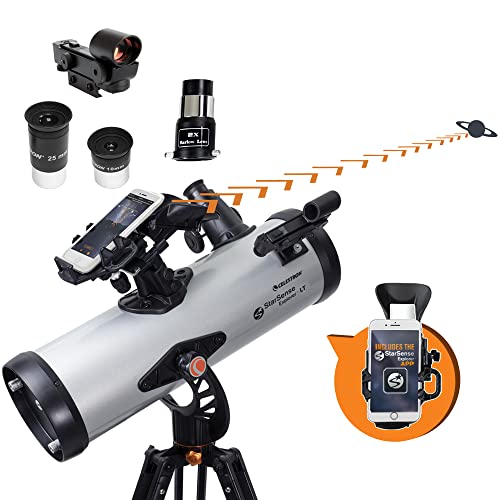
Celestron StarSense LT 114AZ

4) Celestron StarSense Explorer LT 114AZ

Best for: Budget suburban buyers who need app-assisted pointing

This scope makes the "I cannot find anything" problem disappear at entry-level pricing. The StarSense app guides you to targets without full GoTo cost. In Bortle 6 to 7, that is a major practical advantage, especially for new users. It is not as powerful as larger scopes, but it delivers far more successful nights than cheap manual kits with poor mounts.

View on Amazon →

5) Celestron NexStar 6SE

Best for: Users who want more light than 5SE while keeping GoTo convenience

The 6SE is a strong midpoint: more aperture and improved deep-sky viability relative to 5SE, while still portable enough for weekly use. It is often the sweet spot for buyers who have enough budget to step up once but not enough to justify 8SE bulk and cost.

View on Amazon →

6) Celestron NexStar 8SE

Best for: Committed buyers wanting premium all-round urban performance

If your budget allows it, the 8SE is one of the most complete urban-capable visual packages: GoTo, substantial aperture, and broad target flexibility. It reaches deeper than 5SE/6SE and gives better planetary detail headroom. The main tradeoff is session friction from added size and longer cooldown.

View on Amazon →

7) Sky-Watcher Heritage 130P

Best for: Portable aperture on tight budgets (especially Bortle 5 to 7)

For buyers who cannot stretch to GoTo yet want meaningful aperture, 130P remains a high-value choice. It performs strongly on Moon/planets and can still give satisfying bright deep-sky sessions under suburban conditions. It does require manual finding discipline.

View on Amazon →

8) Celestron C90 Mak

Best for: Ultra-portable planetary and lunar observing

In severe light pollution, planet-first strategies win. The C90 is tiny, sharp, and easy to deploy for quick high-contrast sessions. It is not the best deep-sky choice, but it is excellent for frequent practical use.

View on Amazon →

9) Celestron SkyMaster 15x70 (Binocular Option)

Best for: Lowest-cost wide-field city astronomy upgrade

Not a telescope, but an important strategic option. In bright skies, 15x70 binoculars can offer surprisingly rewarding sessions on star fields, bright clusters, Moon, and planetary conjunction events. For many beginners, this is the best first step before committing to a larger scope.

View on Amazon →

Budget Strategy: What to Buy at Each Price Tier

Budget choices in urban astronomy should optimize for successful hours, not raw aperture. A cheaper scope used three nights per week beats an expensive scope used once per month. Use this progression if you want to maximize confidence and avoid regret.

Under $250

Buy app-assisted pointing over flashy magnification claims. StarSense 114AZ is the safest beginner move.

$250-$700

Decide between visual simplicity (Dob/130P) and urban success rate (NexStar 5SE). For Bortle 7+, lean GoTo.

$700+

Choose 6SE/8SE for visual depth, or Seestar strategy for deep-sky capture in dense city cores.

If you are torn between two options, choose the one with lower setup friction for your home reality. Most people overestimate their tolerance for heavy gear after a workday. Urban astronomy rewards consistency more than occasional marathon sessions.

What You Can Actually See in Bortle 5, 7, and 9

Expectation management is where urban buyers either become long-term observers or quit. The truth is encouraging: bright-sky astronomy is excellent for lunar and planetary detail, and still useful for selected deep-sky targets when strategy is right.

Target Type Bortle 5 Bortle 7 Bortle 9
MoonExcellentExcellentExcellent
Jupiter/SaturnExcellentVery goodVery good
Double StarsExcellentExcellentExcellent
Open ClustersVery goodGoodModerate
Bright NebulaeGoodModerateDifficult visually
GalaxiesSome structureBright cores mostlyMostly smart-scope domain

The key tactical insight: do not use galaxy outcomes to judge your entire telescope purchase when you are in Bortle 8 to 9. Judge by repeatable wins on Moon, planets, doubles, and bright clusters. Then add selective deep-sky or smart workflows as your second phase.

Urban Buyer Mistakes That Kill Motivation

Mistake 1: Buying on magnification marketing. Magnification claims are useless without stable mount and aperture support. In bright skies, image stability and target acquisition matter more.

Mistake 2: Oversizing your first scope. A giant telescope that is painful to move becomes a closet ornament. Choose a scope you will actually deploy on random weekdays.

Mistake 3: Ignoring Bortle context. A dark-site optimized recommendation can disappoint in downtown use. Buy for your normal sky, not your hypothetical weekend trip.

Mistake 4: Skipping alignment practice. Even great scopes fail if finder alignment and basic workflow are neglected. Spend one daylight session practicing setup sequence.

Mistake 5: Expecting hubble-like deep-sky visuals immediately. Urban visual astronomy is rewarding, but it rewards target selection discipline and expectation realism.

30-Minute Urban Session Playbook

Use this when you only have one short evening window. It maximizes success under light pollution and prevents analysis paralysis.

Step 1: Pre-session (5 minutes)

Check cloud cover, transparency, and target altitude. Pick no more than three targets: one planet, one cluster, one optional nebula.

Step 2: Quick setup (10 minutes)

Level mount, align finder, run GoTo alignment if applicable, start low-power eyepiece first.

Step 3: High-confidence targets (10 minutes)

Moon/planet first to lock in a successful session. Then move to the brightest deep-sky target currently high in the sky.

Step 4: Notes and improvement (5 minutes)

Log what worked, seeing quality, and next eyepiece/filter adjustment. Progress compounds quickly with notes.

For deeper guidance, pair this page with How to Set Up a Telescope for Beginners and Why Does My Telescope Shake?. Most urban frustration comes from setup variables, not telescope quality.

Frequently Asked Questions

Can I still see planets clearly in heavy light pollution?

Yes. Planet and Moon performance is largely preserved under city skies. Atmospheric stability matters more than sky darkness for planetary detail.

Should I buy bigger aperture or GoTo for city skies?

For most beginners in Bortle 7 to 9, GoTo often provides larger practical gains than raw aperture because it solves target acquisition friction.

Are smart telescopes worth it in bright cities?

If your main goal is deep-sky under bright skies, smart scopes are often worth it. They can recover faint signal via stacking where visual observing struggles.

Do light pollution filters make galaxies easy?

No. Filters help emission nebulae more than galaxies. Galaxies remain difficult in dense light pollution and benefit most from darker skies or digital stacking approaches.

What is the best first telescope for an apartment balcony?

A compact GoTo scope like NexStar 5SE is usually the safest first buy. It balances size, ease, and visual quality for short balcony sessions.