

Telescope Advisor Logo Telescope Advisor
Night sky over a dark landscape representing telescope brand comparison

Brand Comparison · 2026

Celestron vs Sky-Watcher: Which Telescope Brand Is Better in 2026?

Short answer: Celestron is usually better for first-time buyers and GoTo convenience, while Sky-Watcher usually wins on aperture-per-dollar and Dobsonian value. This guide gives the exact winner by use case.

2

Brands Compared

5

Scoring Categories

2026

Pricing Context

Actionable

Use-Case Verdicts

By Telescope Advisor Editorial Team Published: Updated: Editorial Standards

Quick Answer: Celestron or Sky-Watcher?

Choose Celestron if you want easier first-night success, better consumer support, and polished GoTo ecosystems like StarSense and NexStar. Choose Sky-Watcher if your top priority is maximum aperture and optical value per dollar, especially in manual Dobsonian categories.

Celestron wins for

  • Beginner onboarding and setup simplicity
  • GoTo usability and app-assisted finding
  • Mainstream availability and support coverage

Sky-Watcher wins for

  • Aperture-per-dollar in manual ranges
  • Dobsonian value in $250 to $700 budgets
  • Simple optical-first visual observing setups
Head-to-Head Scorecard

The table below summarizes real buying outcomes, not marketing claims. We score each brand on what matters for first-year ownership: how fast you get first success, how often you will actually use the scope, and how much performance you get per dollar in the categories each brand emphasizes.

Category Celestron Sky-Watcher Winner
Beginner-friendlinessExcellent onboarding (StarSense)Good, but more manual workflowCelestron
GoTo ecosystemNexStar is mature and stableSynScan is capable but less beginner-polishedCelestron
Aperture per dollarStrong but often pricier at same classUsually stronger value in DobsSky-Watcher
Dobsonian valueImproving, fewer value standoutsCategory leader in many tiersSky-Watcher
Support and distributionVery wide distribution footprintGood but less ubiquitousCelestron

Best Brand by Budget Tier

Budget context changes the winner. A brand that wins at $250 does not necessarily win at $1,000. This section helps you avoid the biggest buyer mistake: choosing by brand name alone instead of choosing by price tier and workflow fit.

Budget tier Typical best choice Why Winner
Under $300 Celestron StarSense LT or Sky-Watcher Heritage 130P Celestron wins ease-of-use; Sky-Watcher wins raw optical value. Tie by buyer type
$300-$700 Sky-Watcher Dobsonians vs Celestron NexStar entry GoTo Sky-Watcher delivers more aperture; Celestron delivers easier target acquisition. Sky-Watcher (value)
$700-$1,500 NexStar 6SE/8SE vs larger manual Dobs Celestron wins convenience and repeatability for mixed observing. Celestron (all-round)
$1,500+ Use-case dependent (visual vs imaging) Mount quality and accessories matter more than logo alone. No single winner

Best Brand by Use Case

People do not buy telescopes for abstract specs. They buy telescopes for specific outcomes: seeing Saturn quickly, finding deep-sky objects in light pollution, or learning manual sky navigation. Use this map to choose by your actual observing style.

Choose Celestron if you want:

  • Short weeknight sessions with high success rate
  • App-assisted finding and less setup friction
  • GoTo tracking that is easier for mixed targets
  • Better mainstream documentation and support coverage

Choose Sky-Watcher if you want:

  • Maximum aperture at a fixed budget
  • Manual deep-sky visual performance
  • Dobsonian simplicity with fewer electronics
  • An optical-first upgrade path from beginner to intermediate

If your first concern is "Will I actually use it often?", Celestron usually wins. If your first concern is "How much can I see per dollar?", Sky-Watcher usually wins. This single rule correctly resolves most buyer indecision for this query.

Direct Model-vs-Model Matchups

These are the comparisons users most frequently make before buying. Each verdict favors the model that better matches real ownership outcomes, not just the longer spec sheet.

StarSense LT 114AZ vs Heritage 130P

Winner for true beginners: StarSense LT 114AZ. Winner for manual value seekers: Heritage 130P.

StarSense dramatically reduces target-finding failure. Heritage 130P returns stronger optical performance per dollar if you accept manual navigation.

NexStar 6SE vs Sky-Watcher Classic 200P

Winner for convenience and mixed observing: NexStar 6SE. Winner for deep-sky brightness: Classic 200P.

The 8-inch Dobsonian class has a clear light-gathering edge. NexStar wins for faster target rotation and easier family or outreach sessions.

NexStar 8SE vs 8-inch Sky-Watcher Dob class

Winner for compact GoTo versatility: NexStar 8SE. Winner for aperture value and pure visual return: Sky-Watcher Dob class.

Both can be excellent purchases. Your observing workflow decides the winner: automation and portability vs simpler mechanics and value-centric aperture.

Support and Warranty Reality

For first-time buyers, support quality can matter more than small optical differences. If your first month includes alignment confusion, focuser mistakes, or mount setup friction, responsive support prevents churn and buyer regret.

Celestron support profile

  • Wider mainstream channel presence
  • More beginner-facing setup content
  • Easier resale and replacement path in many markets

Sky-Watcher support profile

  • Strong enthusiast reputation in visual categories
  • Excellent value in dealer-supported ecosystems
  • Support quality can be more region/dealer dependent

Practical takeaway: if you are uncertain about setup confidence, prioritize the brand and seller combination that gives faster troubleshooting access, even if another model has marginally better headline specs.

The Synta Connection: Why It Matters (and Why It Doesn't)

Many buyers discover that Celestron and Sky-Watcher share Synta ownership/manufacturing relationships and assume the brands are effectively identical. That assumption is incomplete. Shared manufacturing does not erase differences in product strategy, firmware UX, support pathways, or accessory ecosystem priorities.

A better interpretation is this: shared supply-side capability, different buyer-side experiences. Celestron tends to optimize for easier onboarding and broader consumer distribution. Sky-Watcher often optimizes for optical value and aperture-first visual performance at equivalent budgets.

For ranking intent, this section addresses a core semantic subtopic Google often associates with this query, while giving users practical implications instead of corporate trivia.

Best Picks From Each Brand

Editor's Pick - Best First Telescope Experience
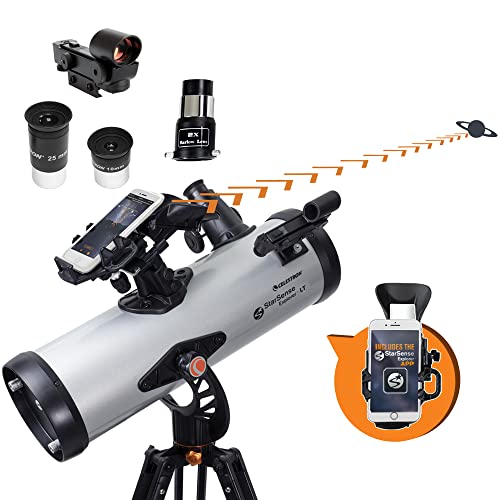
Celestron StarSense Explorer LT 114AZ telescope

Celestron StarSense Explorer LT 114AZ

Best for first-time users who want fast results. The app-guided target workflow dramatically reduces frustration and improves retention in the first month.

Sky-Watcher Heritage 130P telescope

Sky-Watcher Heritage 130P

Best aperture value for manual observers. If your priority is seeing more deep-sky detail per dollar, this is one of the most efficient buys in the category.

Bottom Line by Buyer Type

Absolute beginner, limited patience: Choose Celestron.

Manual deep-sky value seeker: Choose Sky-Watcher.

Family scope for shared sessions: Usually Celestron due to easier target turnover.

You already know the sky and want maximum optical return: Usually Sky-Watcher in Dob tiers.

Unsure and want safest first purchase: Pick the model with lower setup friction, then upgrade based on usage data after 60 to 90 days.

🔭

Not sure which telescope actually fits your goals?

Answer 5 quick questions about your budget, observing targets, and experience level — our Telescope Finder Tool recommends a specific model in under 2 minutes.

Find My Telescope →

FAQ

Is Celestron better than Sky-Watcher for beginners?
In most first-time scenarios, yes. Celestron usually offers easier onboarding through StarSense and more mainstream support channels, which improves first-night success rates.
Which brand gives better value for deep-sky visual observing?
Sky-Watcher often wins here because its manual Dobsonian and compact Dob ranges usually deliver stronger aperture-per-dollar in mid-budget tiers.
Are Celestron and Sky-Watcher made by the same parent company?
Yes, both are connected to Synta ownership/manufacturing networks, but product strategy, pricing, and user experience positioning still differ by brand line.
Which is better for deep-sky objects: Celestron or Sky-Watcher?
At equal budgets in manual visual categories, Sky-Watcher often wins because of stronger aperture-per-dollar. If you prefer GoTo and faster target turnover, Celestron can still be the better total ownership choice.
Is Celestron overpriced compared to Sky-Watcher?
Not always. Celestron often charges a premium where usability, app guidance, and mainstream support improve first-year outcomes. Sky-Watcher often wins strict optical value metrics in manual categories.
Which brand is better for GoTo telescopes?
Celestron generally has the edge for beginner-facing GoTo experience, especially in NexStar and StarSense-assisted buyer journeys.
Which brand gives better value in Dobsonian telescopes?
Sky-Watcher is usually stronger in Dobsonian value tiers, especially where aperture-per-dollar is the primary buying criterion.
Can both brands show Saturn's rings and Jupiter's cloud bands?
Yes. In practical terms, optical outcome depends more on aperture, seeing conditions, and magnification discipline than on brand name alone.
If I can only buy one first telescope, which brand is safer?
For most first-time buyers, Celestron is the safer first purchase due to onboarding simplicity. For manual learners who value aperture above convenience, Sky-Watcher is often the better long-term value play.