Gskyer 70mm AZ Refractor Review 2026: Budget Telescope Tested
Telescope Advisor
Telescope Review · 2026
Gskyer 70mm AZ Refractor Review 2026
The Gskyer 70mm AZ refractor — sold under the model number AZ70400 — is an Amazon #1 best seller with over 21,000 reviews. We tested it on the Moon, evaluated the mount, phone adapter, and wireless remote to give you an honest assessment of what this telescope does well — and where it will frustrate you.
The Gskyer 70mm AZ refractor is a capable first telescope for lunar observation, but its mount and focuser limitations make it frustrating for smartphone astrophotography. The included accessory kit — phone adapter, wireless remote, Barlow lens, and carry bag — represents genuine value at its price point. However, the short tripod makes adult use uncomfortable and the mount slips under phone weight. It earns a 6.8/10 because it delivers on lunar views for beginners while falling short on the phone imaging capability its marketing emphasizes.
The Gskyer 70mm arrives in a padded, zippered carry case with a shoulder strap rather than a plain cardboard box — a small touch that sets it apart from most telescopes at this price. Inside the case: the 70mm optical tube, an aluminium tripod, an alt-azimuth mount head with an accessory tray, a 5x24 finderscope, two eyepieces (25mm and 10mm), a 3x Barlow lens, a phone adapter, a wireless Bluetooth remote, and a printed quick-setup guide. Assembly took us under ten minutes with no tools beyond what's in the box — the tripod legs, accessory tray, and optical tube all attach with thumbscrews, and the finderscope simply slots into its bracket.
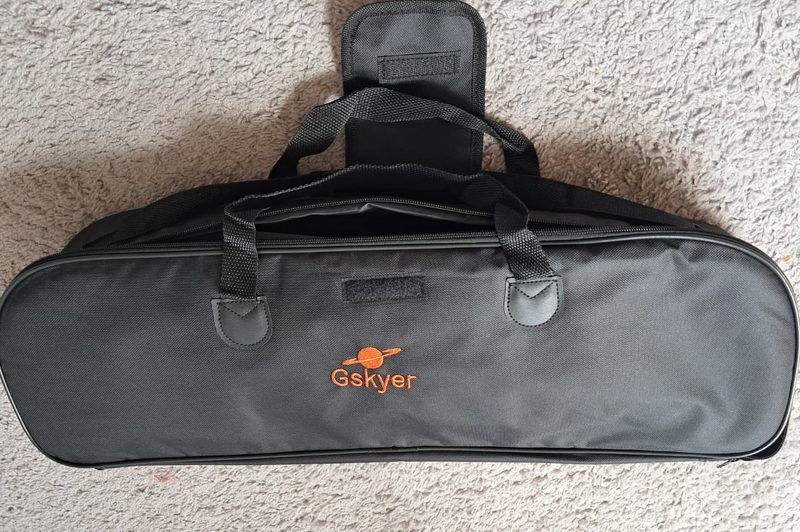
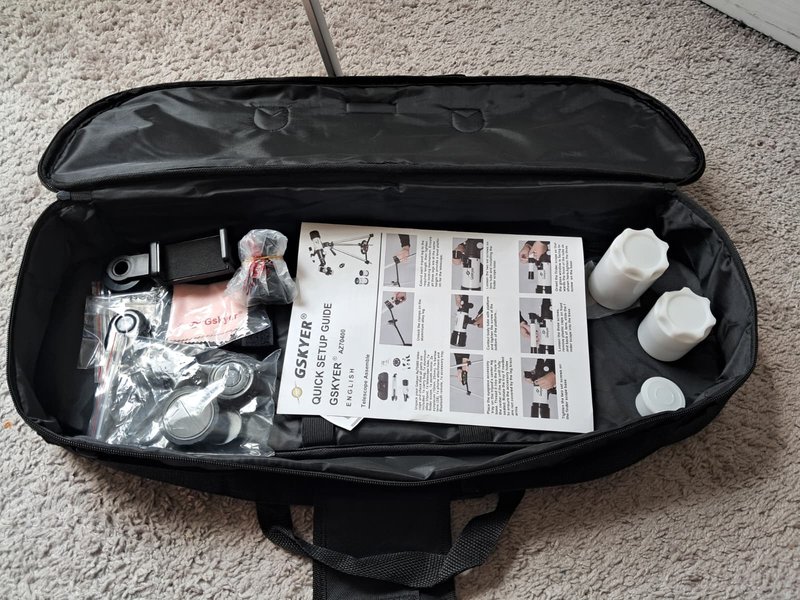
Everything Ships in One Padded Case — The optical tube, tripod, eyepieces, phone adapter, and remote all pack down into this single carry case, which is a genuine convenience for grab-and-go observing sessions. Photo: Telescope Advisor.
Gskyer 70mm AZ Refractor (AZ70400) Specifications
Model
Gskyer AZ70400
Optical Design
Achromatic doublet refractor
Aperture
70mm
Focal Length
400mm
Focal Ratio
f/5.7
Mount Type
Alt-azimuth, aluminium tripod with accessory tray
Finderscope
5x24
Eyepieces Included
25mm (16x) and 10mm (40x)
Barlow Lens
3x (converts 25mm to 48x, 10mm to 120x)
Maximum Useful Magnification
~140x under ideal conditions
Included Accessories
Phone adapter, wireless Bluetooth remote, padded carry case, quick-setup guide
Price
$96.99
Optical Performance: Lunar and Planetary Views
The Gskyer 70mm uses an achromatic doublet objective lens with a 400mm focal length at f/5.7. On the Moon, this telescope performs respectably for its class. With the included 25mm eyepiece (16x magnification), the full lunar disc fits comfortably in the field of view, with major maria (the dark plains), crater clusters, and ray systems clearly visible. The terminator region — where lunar day meets lunar night — reveals the three-dimensional structure of crater walls and mountain ranges. Craters like Copernicus, Tycho, and Kepler show their distinctive ray patterns under favourable lighting. The 10mm eyepiece provides 40x magnification for closer looks at specific crater fields, though the image softens noticeably at this magnification. The included 3x Barlow lens pushes the 25mm eyepiece to 48x and the 10mm to 120x — but at 120x the chromatic aberration (purple fringing around bright edges) becomes distracting, and the mount's vibration makes focusing difficult.
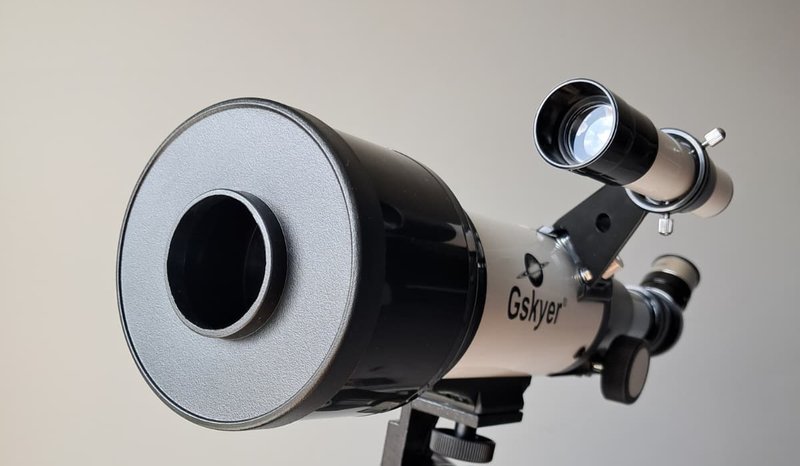
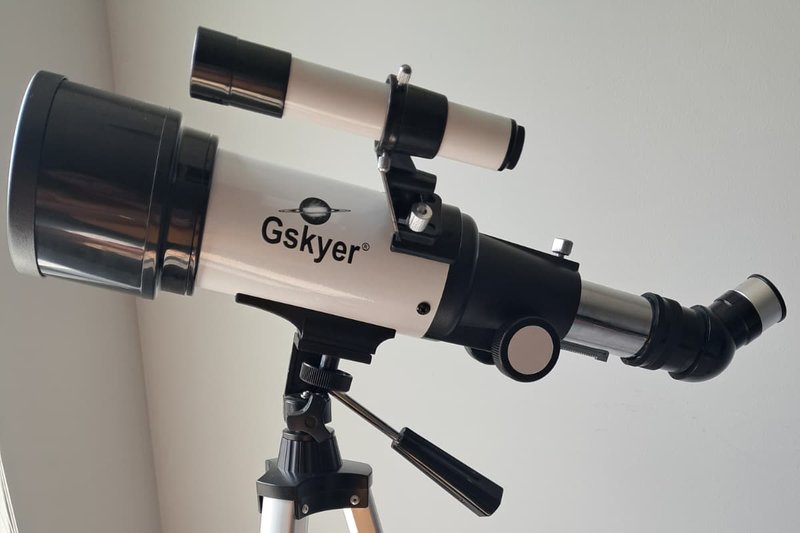
The 70mm Achromatic Objective Lens — The fully coated achromatic doublet sits behind a fixed dew shield. It delivers crisp lunar views with manageable chromatic aberration for its price class, though purple fringing shows up around bright edges at higher power. Photo: Telescope Advisor.
For planets, Jupiter shows as a small bright disc with its four Galilean moons visible as distinct points of light. On nights of good seeing, subtle cloud banding is detectable but not sharply defined. Saturn's ring is visible as a slight elongation — a recognisable Saturn shape but without the fine detail of larger apertures. Venus shows a clear crescent phase. The Orion Nebula (M42) appears as a small hazy patch. These are legitimate observations for a first telescope, and the Gskyer 70mm delivers views that will satisfy a beginner's curiosity. However, the 70mm aperture is fundamentally limited — it gathers roughly half the light of a 100mm telescope and cannot resolve fine planetary detail or show deep-sky objects with any structure beyond a faint glow.
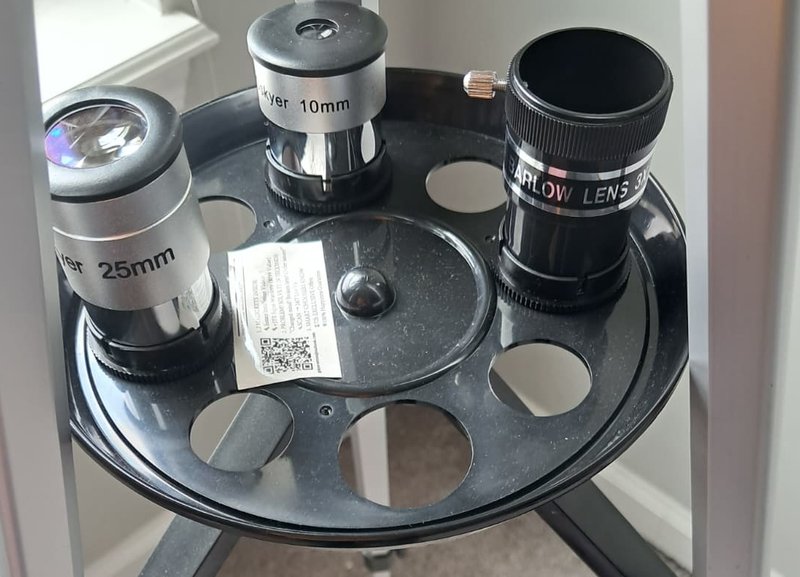
The Eyepiece Kit: 25mm, 10mm, and 3x Barlow — The 25mm eyepiece (16x) is the workhorse for lunar and wide views; the 10mm (40x) and the 3x Barlow push magnification further, at the cost of a dimmer, softer image and more visible colour fringing. All three pack into the carry case. Photo: Telescope Advisor.
Chromatic aberration is present at all magnifications, as expected from an achromatic f/5.7 refractor at this price point. The purple fringing around the Moon's bright limb is noticeable but does not ruin the view. At higher magnifications through the Barlow, the colour fringing becomes more prominent. The 70mm aperture also limits the maximum useful magnification to approximately 140x under ideal conditions — beyond this, the image simply dims and blurs without revealing additional detail. For a beginner's first views of the Moon and bright planets, the optical performance is adequate for its price class. For context on how this compares with other entry-level telescopes, see our best telescopes for beginners guide.
Best Targets for the Gskyer 70mm
The Moon is this telescope's primary target. Observe along the terminator — the line between lunar day and night — where crater walls cast dramatic shadows that reveal the Moon's three-dimensional topography. First-quarter and third-quarter phases show the most detail. Jupiter's four Galilean moons are visible as distinct points of light. Saturn's ring is detectable as an elongation at 40x. Venus shows a clear crescent. The Orion Nebula appears as a small hazy patch. The Pleiades cluster shows a compact group of stars. Brighter double stars like Albireo (gold and blue components) are excellent targets. The telescope works as a daytime spotting scope for birdwatching and distant scenery using the erecting eyepiece. Faint galaxies, most nebulae, and globular clusters beyond the brightest few are not visible through 70mm — as hundreds of Amazon reviewers note, "manage your expectations for deep-sky." For a full list of targets suitable for small telescopes, see our what you can see with a telescope guide.
Mount Stability: The Main Limitation
The alt-azimuth mount is the Gskyer 70mm's most significant weakness. The mount uses an aluminium tripod with 1-inch diameter legs and a plastic mount head with slow-motion control cables. For visual observing at low magnifications (16x with the 25mm eyepiece), the mount is adequate. The slow-motion controls allow smooth tracking once you locate a target, and the tripod's spreader and accessory tray add some rigidity. However, at higher magnifications — especially when using the 3x Barlow — the mount's shortcomings become apparent. A light breeze or even the act of focusing causes visible vibration that takes several seconds to dampen. The plastic mount head has noticeable play in the altitude axis, making fine adjustments imprecise.
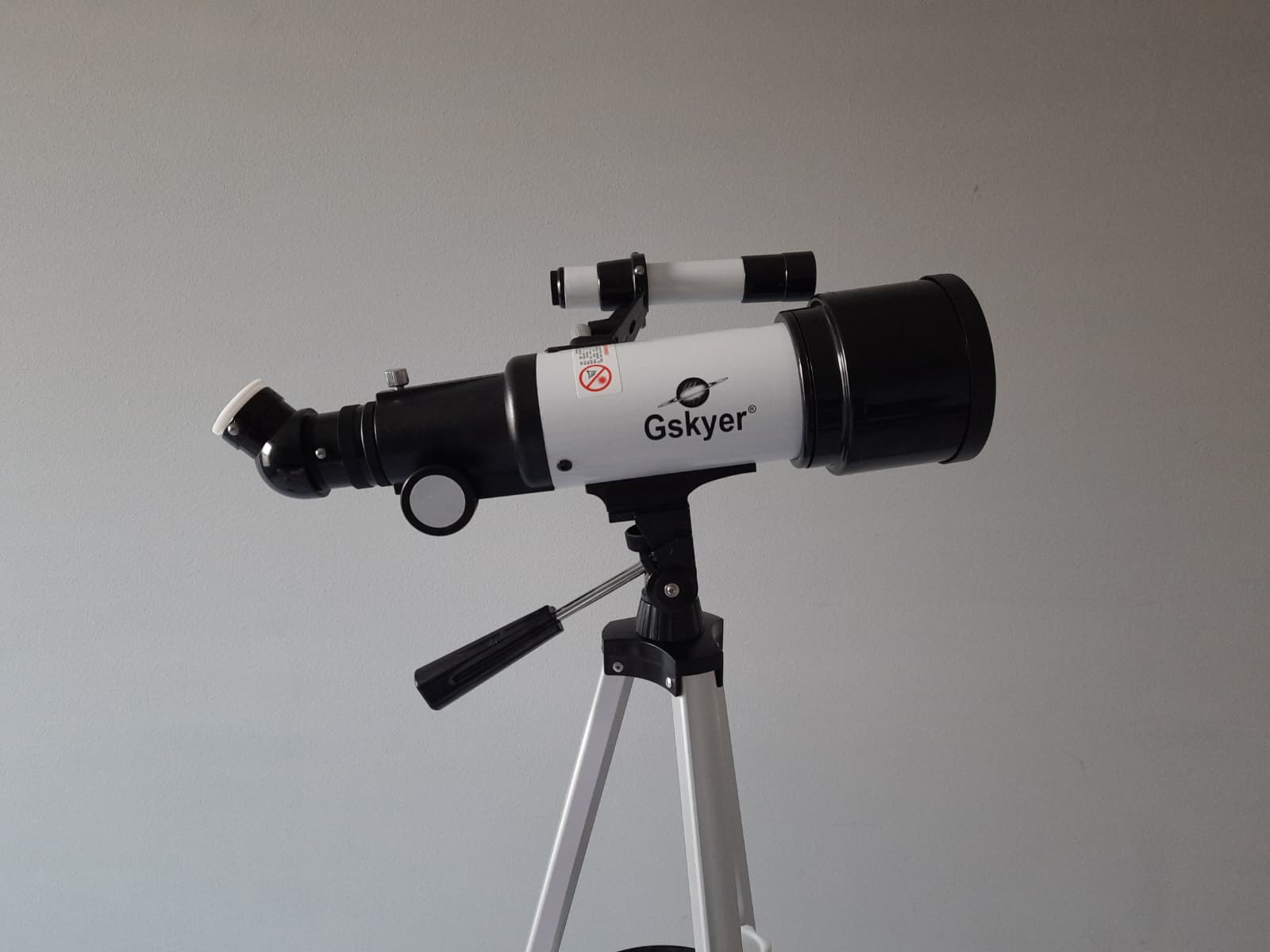
The Alt-Azimuth Mount and Tripod — The 1-inch diameter aluminium tripod legs and plastic mount head are adequate for low-power visual observing but struggle under the added weight of a phone adapter at higher magnifications. Photo: Telescope Advisor.
The most significant issue arises when using the included phone adapter for smartphone astrophotography. The phone adapter attaches to the eyepiece and holds a smartphone over the lens. The combined weight of the phone and adapter — typically 250-350 grams — shifts the telescope's centre of gravity and causes the mount to drift, especially in altitude. The slow-motion controls can compensate for this drift during visual observation, but maintaining precise framing while adjusting focus becomes a frustrating exercise in compromise — adjusting the focus shifts the image, correcting the mount shifts focus, and the cycle repeats. This specific issue is the telescope's most significant practical limitation for beginners hoping to capture the images they see through the eyepiece.
For users focused on visual observation, the mount's limitations are manageable. Placing the tripod on a stable surface, keeping legs fully extended only when necessary, and avoiding high winds all help. Adding weight to the accessory tray — a water bottle or a bag of sand — improves stability noticeably. For users who want to pursue smartphone astrophotography, a sturdier tripod with a better fluid head is a worthwhile upgrade. For a comparison of mount types and stability considerations, see our how to choose a telescope mount guide.
Phone Adapter and Wireless Remote: Real-World Testing
The Gskyer 70mm includes a plastic phone adapter that clamps onto the eyepiece and holds a smartphone over the lens, plus a wireless Bluetooth remote for shutter release. In theory, this combination allows anyone to capture smartphone images of the Moon. In practice, the results depend heavily on your expectations and patience. The phone adapter works best with smaller smartphones and the included 25mm eyepiece. The adapter's clamping mechanism holds the phone securely, but aligning the phone's camera lens with the eyepiece requires careful adjustment — the phone must be centred precisely, at the correct distance, and parallel to the eyepiece. Even a slight misalignment produces vignetting or off-axis blurring.
The Phone Adapter and Wireless Remote, Unpacked — Both ship inside the carry case alongside the eyepieces and spare lens caps. On paper, that's everything needed for smartphone astrophotography — the challenge, as this section covers, is the mount underneath it all. Photo: Telescope Advisor.
The wireless remote reliably triggers the shutter without shaking the telescope — this is the one accessory that works as advertised. However, the mount's instability under the phone's weight means that by the time you have framed the target, focused, and triggered the remote, the image has often drifted out of centre. The focuser's slight play adds another variable — the act of focusing shifts the image, requiring mount readjustment. For the determined user, usable full-Moon shots are achievable after multiple attempts. For casual use, the frustration level can be high. A stronger tripod and a more rigid phone adapter (such as the Celestron NexYZ →) significantly improve the experience.
For beginners who specifically want to capture smartphone images of the Moon, a better approach is to invest in a tabletop Dobsonian like the Sky-Watcher Heritage 130P with a higher-quality universal phone adapter. The Heritage 130P's Dobsonian mount is inherently more stable under payload, and its parabolic mirror delivers sharper images that photograph better. For a full comparison of beginner telescopes suited for smartphone photography, see our best telescopes for beginners guide.
Pros and Cons
Pros
Genuinely easy to set up — 5–10 minutes out of the box
Decent lunar detail at 16x and 40x magnification
Generous accessory kit: phone adapter, wireless remote, Barlow, bag
Works as a daytime spotting scope with included erecting eyepiece
Very affordable entry price + Amazon #1 Best Seller
Lightweight and portable with padded carry bag
Intuitive alt-azimuth mount with slow-motion controls
Cons
Mount slips under phone adapter weight — frustrating for imaging
Focuser backlash makes fine focusing imprecise
Tripod too short for comfortable adult standing use
Chromatic aberration (purple fringing) at all magnifications
70mm aperture limits deep-sky to brightest objects only
Finderscope alignment required before first use — finicky
Included 10mm eyepiece has very short eye relief
Final Verdict
The Gskyer 70mm AZ is a functional first telescope for visual Moon and planetary observation, but its mount limitations make smartphone astrophotography frustrating and its short tripod makes adult use uncomfortable. It earns a 6.8/10 because it delivers on its core promise — showing the Moon to a beginner for under $100 — while falling short on the phone imaging capability that its marketing highlights. The accessory kit is genuinely generous: the wireless remote, phone adapter, Barlow lens, and carry bag provide everything a beginner needs to get started.
If your goal is visual observation of the Moon and bright planets with a child, and you have a sturdy table or a willingness to hunch over, the Gskyer 70mm is a reasonable entry point. If your goal is consistent smartphone astrophotography, or if you are an adult who wants comfortable standing use, budget for the Celestron AstroMaster 70AZ (better tripod) or the Sky-Watcher Heritage 130P (dramatically better optics and stability). For a broader perspective, see our telescope buying guide and best telescopes for beginners guide.
Continue Exploring
Keep the session going with the next useful answer
Choose the next page based on whether you need a recommendation, a comparison, or a practical observing plan.
For visual observing of the Moon and bright planets, yes. For smartphone astrophotography, the mount limitations create a frustrating experience. It is best suited for children or adults who primarily want to look through the eyepiece rather than capture images.
Can you see Saturn's rings with the Gskyer 70mm?
Saturn's rings are detectable as a subtle elongation of the planet at 40x magnification using the 10mm eyepiece. The distinctive oval silhouette is visible but the rings are not resolved into separate bands. This is consistent with what a 70mm aperture can show.
How do I stop the Gskyer mount from slipping?
Tighten the altitude tension knob on the mount head. Add weight to the accessory tray — a water bottle or sandbag improves stability. If using the phone adapter, consider upgrading to a sturdier tripod, as the included tripod struggles under the added weight.
Is the Gskyer 70mm good for adults?
The tripod is short — the eyepiece sits at approximately waist height when fully extended. Most adults will need to hunch over or kneel during use, which becomes uncomfortable during extended sessions. A taller aftermarket tripod or mounting the optical tube on a photography tripod solves this.
What can you actually see with the Gskyer 70mm?
The Moon shows excellent crater detail. Jupiter's four brightest moons and subtle cloud banding are visible. Saturn's ring is detectable. Venus shows a crescent phase. The Orion Nebula appears as a small hazy patch. The Pleiades shows as a compact group. Most galaxies, faint nebulae, and globular clusters are not visible through 70mm aperture.
What is better than the Gskyer 70mm for a similar price?
The Celestron AstroMaster 70AZ has a sturdier steel-legged tripod and better build quality for a slightly higher price. The Celestron FirstScope 76mm tabletop Dobsonian offers more aperture with a simpler, more stable mount. The Sky-Watcher Heritage 130P costs more but delivers dramatically better optics and mount stability.
Is the Gskyer 70mm the same telescope as the Gskyer AZ70400?
Yes. AZ70400 is the model number printed on the Gskyer 70mm's quick-setup guide and packaging — "AZ" for alt-azimuth mount, "70" for 70mm aperture, and "400" for the 400mm focal length. It is the same telescope reviewed on this page.
How much does the Gskyer 70mm cost?
The Gskyer 70mm AZ70400 typically retails for around $90–$100 on Amazon, including the tripod, two eyepieces, 3x Barlow lens, phone adapter, wireless remote, and carry case. Amazon pricing fluctuates, so check the current price before buying.