
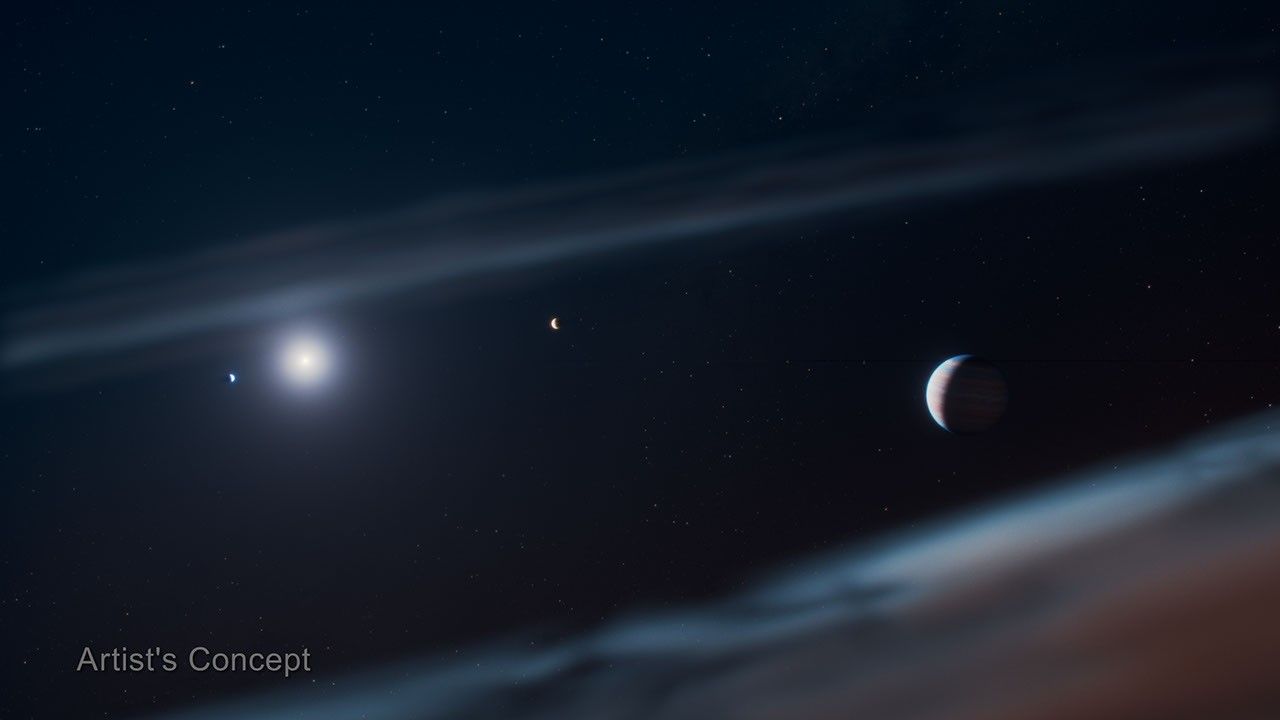
NASA News · Webb Exoplanets · July 2026
Webb Discovers Hidden Planet Beta Pictoris d — Third Exoplanet Found in Famous Star System
The James Webb Space Telescope has done it again — this time uncovering a giant exoplanet that was hiding in plain sight within one of astronomy's most-watched star systems. Beta Pictoris d was found not through a direct image, but by reading the chemical signature of its atmosphere in stunning detail. The discovery opens a new chapter in how scientists hunt for worlds obscured by the dusty cradles of their birth.
Planet MassAt least 2× Jupiter
Orbit~30 AU (Neptune-like)
System Age~23 million years
Distance63 light-years
By Telescope Advisor Editorial Team
|
Published:
|
Updated:
|
Reviewed & approved by Juhi Sahni, Senior Editor
Editorial Standards

Elena Reyes
Senior Science Editor
Covers NASA missions, space science discoveries, and astronomical events for Telescope Advisor. Translates complex astrophysical research into practical insights for backyard observers. Based in the San Francisco Bay Area.
Content reviewed by our editorial team. Research and drafting assisted by AI to ensure unbiased, data-driven analysis. Learn more about our editorial process.
The Discovery: Webb Finds Beta Pictoris d, the Third Planet in a Famous System
Since the 1980s, Beta Pictoris has been one of the most scrutinized star systems in the night sky — first for its spectacular edge-on debris disk, then for its two directly imaged giant planets. Now, a third world joins the family portrait. The star Beta Pictoris, a young Sun-like star 63 light-years away, was already parent to Beta Pictoris b (discovered in 2008, one of the very first exoplanets ever photographed) and Beta Pictoris c (found in 2019). The arrival of Beta Pictoris d elevates this system to an exclusive club: only the second planetary system after HR 8799 known to contain three or more directly imaged planets.
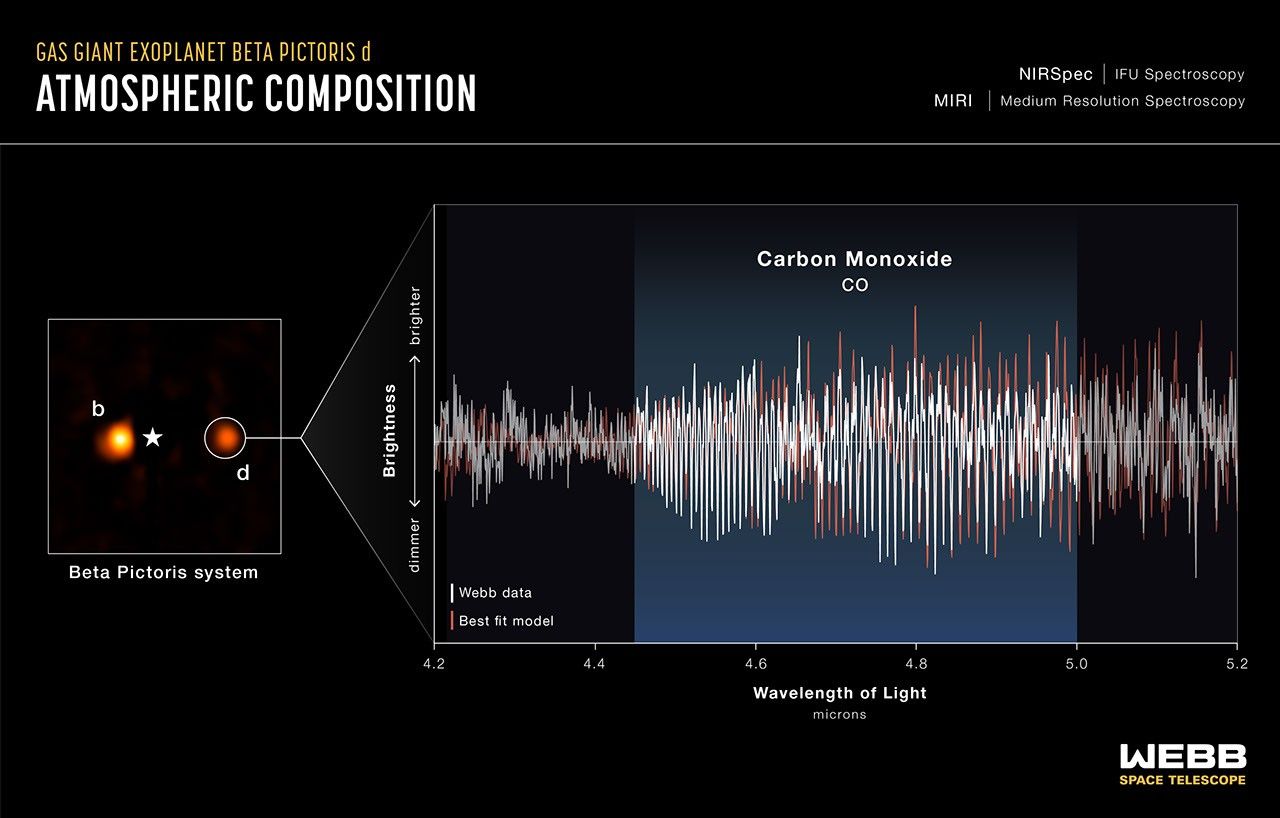
What makes Beta Pictoris d truly remarkable is how it was found. While its siblings were spotted as bright pinpricks of light in coronagraphic images, this newcomer was invisible in conventional photos. Instead, Webb detected it through the unique pattern of carbon monoxide absorption lines imprinted on its atmosphere — like reading a barcode that says "giant planet here." It's the first time a directly imaged exoplanet has been discovered primarily through spectroscopy rather than direct imaging, and the technique could revolutionize how astronomers find worlds hidden within complex, dusty environments.
"This discovery adds another piece to an already fascinating planetary system," said Aidan Gibbs, lead author of a new study published Wednesday in The Astrophysical Journal Letters and a postdoctoral researcher at the University of California, San Diego. "Beta Pictoris has long served as a laboratory for understanding how planetary systems form and evolve, and now we have another planet helping us tell that story."
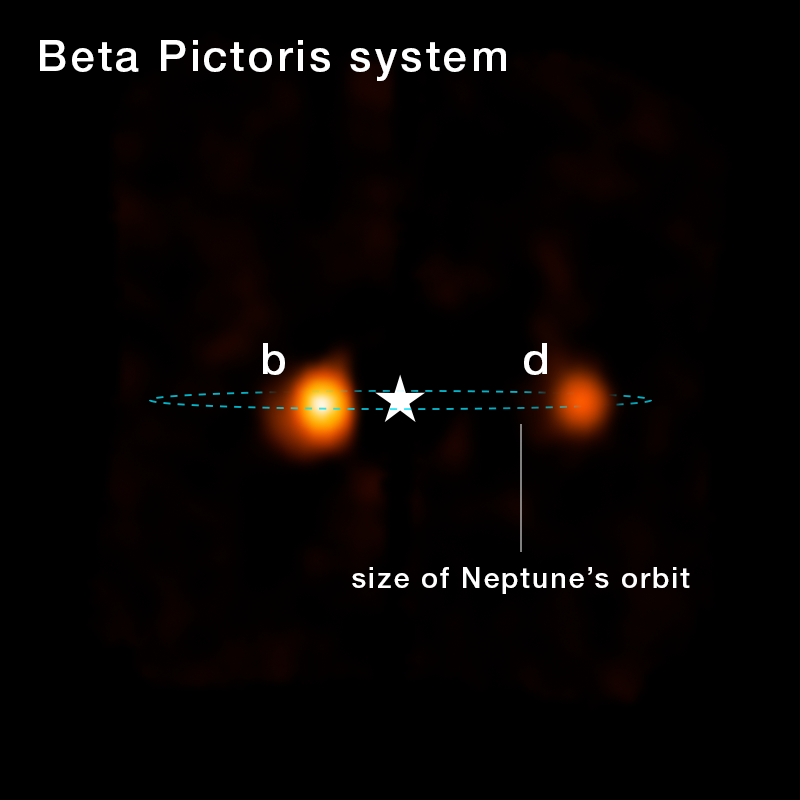
So what kind of world is Beta Pictoris d? Current models place its mass at a minimum of two Jupiters, making it the lightweight of the three giant siblings in the system. Its orbit stretches to roughly 30 astronomical units from the star — comparable to Neptune's distance from the Sun — giving it the widest orbit of the three known planets. Yet it still orbits inside the inner boundary of the system's famous debris disk, right at the edge where the disk's structure changes noticeably. This positioning is no coincidence: astronomers had long predicted a planet in this exact region to explain the disk's sharp inner cutoff and unusual morphology.
A Surprise Discovery While Studying Beta Pictoris b
Beta Pictoris is a cosmic teenager. At roughly 23 million years old — about 1/200th the age of our 4.6-billion-year-old solar system — it offers astronomers a rare front-row seat to the messy, chaotic process of planetary adolescence. The system's edge-on debris disk, one of the brightest known, scatters starlight like fog around a streetlamp and has made Beta Pictoris a favourite subject for telescope time since IRAS first spotted the disk in 1983.
The discovery of Beta Pictoris d happened almost by accident. The team, led by Aidan Gibbs of UC San Diego, was using Webb's NIRSpec (Near-Infrared Spectrograph) — specifically its Integral Field Unit, which captures an image and a spectrum at every pixel simultaneously — to study the atmosphere of Beta Pictoris b. They were focused on understanding the chemistry of a planet they already knew existed. Then the data showed something unexpected.
"We weren't looking for a new planet," said Gibbs. "We were trying to understand one we already knew existed. Then, this telltale signal appeared in the data where we didn't expect it." That signal turned out to be Beta Pictoris d, a planet that had been hiding in plain sight, masked by the debris disk's diffuse glow.
How Spectroscopy Found a Hidden World
The signal that gave away Beta Pictoris d was a series of peaks and troughs within the spectroscopic data where the team expected to see a smooth spectrum from light bouncing off dust. It was a distinctive pattern of carbon monoxide absorption lines, spread out like a barcode — an expected feature in giant planet atmospheres.
What Spectroscopy Revealed
Because spectroscopy not only reveals chemical composition but also the motion of an object, the team extracted the planet's radial velocity from the data. They determined its speed, position, and alignment with the debris disk — all consistent with something orbiting Beta Pictoris rather than a background star or brown dwarf.
Why Imaging Alone Wasn't Enough
"There was an unexpected bright source of light within the IFU imaging, but we've learned not to trust bright blobs in images," said Jean-Baptiste Ruffio, a research scientist at UC San Diego and principal investigator of the first Webb observations. "They can be instrumental artifacts or other structures in the debris disk. By obtaining a spectrum at the same time as the image, we were able to quickly confirm our suspicions."
MIRI Follow-Up Confirmation
Follow-up observations with Webb's MIRI (Mid-Infrared Instrument) through a Director's Discretionary Time request detected water vapor and methane, further confirming the planet's identity while providing a richer look at its atmosphere. "A spectrum contains an incredible amount of information," Ruffio said. "You don't just learn that something is a planet; you immediately begin learning about its temperature, chemistry, and motion."
Seeing Through Cosmic Fog
Beta Pictoris d remained hidden for years because it lies within one of the brightest debris disks known. The dusty disk acts like fog, scattering light from the star and making it difficult for conventional imaging techniques to distinguish planets from surrounding structures. This is why Beta Pictoris b and c — both located inside the inner edge of the disk — were discovered first; they orbit closer to the star, where the disk is thinner.
The team's spectroscopic method with Webb effectively ignored that dust, isolating only the narrow molecular signatures unique to a planetary atmosphere. By detecting carbon monoxide absorption — a molecule common in giant planet atmospheres but rare in debris disks — the team was able to pick out the planet's signal from the overwhelming glare of the surrounding dust.
Scientists say the planet's presence may help explain why the famous debris disk has such a sharply defined inner edge and other puzzling structures. In fact, astronomers had already predicted the existence of a planet like Beta Pictoris d to account for the disk's unusual shape. The newly discovered planet appears to be acting as a shepherd, gravitationally sculpting the inner edge of the debris disk — much like Neptune's moons shepherd the rings of Saturn.
A separate imaging study led by Ben Sutlieff of the University of Edinburgh and Markus Bonse of the European Southern Observatory complements the team's findings with data from the European Southern Observatory's Very Large Telescope and Webb's NIRCam, independently confirming the existence of Beta Pictoris d.
What This Means for Exoplanet Discovery
Beyond expanding our understanding of Beta Pictoris, this discovery demonstrates a powerful new way to find exoplanets. This is the first directly imaged planet discovered primarily through moderate-resolution spectroscopy, showing that astronomers can identify worlds in complex environments through their atmospheric fingerprints rather than relying solely on traditional coronagraphic imaging.
A New Tool for the Exoplanet Hunter's Toolkit
Traditional direct imaging relies on blocking the star's light with a coronagraph and then searching for residual points of light that could be planets. This works well for bright, widely-separated planets, but struggles in complex environments like debris disks. Spectroscopy bypasses this limitation by searching for the unique molecular signatures of planetary atmospheres — carbon monoxide, water vapor, methane — that stand out against the broadband glow of dust.
Implications for Habitable Zone Searches
While Beta Pictoris d is a gas giant far too hot and massive to host life, the technique used to find it could eventually be applied to smaller, potentially habitable worlds. As next-generation telescopes like the Nancy Grace Roman Space Telescope and future Extremely Large Telescopes come online, spectroscopic fingerprinting could become the primary method for identifying planets in the habitable zones of nearby stars.
Validating Planet Formation Theory
The three-planet architecture of Beta Pictoris — with planets at different orbital distances and masses — provides a critical test for planet formation models. The system's youth (23 million years) means we are seeing planets shortly after their formation, offering a snapshot of the early evolution of a planetary system that closely resembles our own solar system in its infancy.
A Blueprint for Future Surveys
The serendipitous nature of the discovery — finding a planet while studying another — highlights the scientific value of Integral Field Unit spectroscopy on future missions. Telescopes equipped with IFUs can simultaneously image and obtain spectra across a wide field, making them uniquely suited to discovering planets that would otherwise remain hidden in complex environments.
What's Next for Beta Pictoris
The discovery of Beta Pictoris d is far from the end of the story. The researchers plan to continue analysing Webb's observations to better determine the planet's temperature, atmospheric composition, and orbit, providing an even more detailed view of one of astronomy's most iconic planetary systems.
"A spectrum contains an incredible amount of information," said Ruffio. The current data has already revealed carbon monoxide, water vapor, and methane in the planet's atmosphere. Future observations could detect additional molecules — such as carbon dioxide and ammonia — that would provide even tighter constraints on the planet's formation history and chemical makeup.
The team is also interested in understanding how Beta Pictoris d interacts with the debris disk. The planet's wide orbit (30 AU) places it right at the inner edge of the disk, suggesting it may be responsible for sculpting the disk's structure. High-contrast imaging campaigns with Webb and ground-based observatories could reveal whether the planet is actively accreting material from the disk or clearing a gap in its path.
For amateur observers, Beta Pictoris itself is visible as a 3.9-magnitude star in the southern constellation Pictor, best viewed from latitudes south of 30° north during the evening sky in the southern hemisphere summer months. While the planets themselves are far beyond the reach of backyard telescopes, the knowledge that this nearby star hosts a family of three giant planets — one discovered through the power of spectroscopy — adds a layer of wonder to every observation.
What This Discovery Means for Amateur Astronomers
A discovery like Beta Pictoris d is fascinating at the scientific level, but what does it mean for someone who actually looks up? More than you might think.
You Can See the Star That Hosts Three Planets
Beta Pictoris is a bright 3.9-magnitude star in the southern constellation Pictor, easily visible to the naked eye from dark sites south of 30° north latitude. Through binoculars or a small telescope, it appears as an unremarkable blue-white star — but knowing that this single pinpoint of light is surrounded by a dusty debris disk and at least three giant planets transforms the view. It is one of the very few stars in the sky where amateur observers can point their telescope at a system with three known directly imaged exoplanets.
A Target for Your Astrophotography Bucket List
While the planets themselves are far beyond the reach of amateur equipment (they require 8-meter-class telescopes with adaptive optics or space-based observatories), the Beta Pictoris debris disk was one of the first ever resolved around another star. Advanced amateurs with large Dobsonians and lucky-imaging cameras have attempted to image the disk. The knowledge that a third planet is sculpting the disk's inner edge adds new motivation — and a fresh story to tell — for anyone attempting this challenging target.
Why Spectroscopy Matters for Backyard Observers
The technique that found Beta Pictoris d — matching molecular fingerprints in a spectrum — is the same principle behind amateur spectroscopy. Affordable Star Analyser diffraction gratings (under $200) let backyard astronomers split starlight into spectra and identify hydrogen lines in stars, or even detect the broad absorption features of giant planets. While finding a hidden exoplanet requires Webb's 6.5-meter mirror and cryogenic detectors, the underlying physics is identical to what you can demonstrate in your own backyard.
Best Time to Observe Beta Pictoris
Beta Pictoris is best observed from the Southern Hemisphere or low northern latitudes during the southern summer months (December–March). From the southern United States (Florida, Texas, Hawaii), it climbs just 15–20° above the southern horizon during optimal evenings. The star reaches its highest point around midnight in January. Use a finder chart to locate it — Pictor is a faint constellation southwest of Canopus (Alpha Carinae).
Frequently Asked Questions
What is Beta Pictoris d?
Beta Pictoris d is a newly discovered giant exoplanet orbiting the young star Beta Pictoris, 63 light-years from Earth. It is at least two times the mass of Jupiter and orbits at approximately 30 AU (the distance of Neptune in our solar system). It is the third known planet in the system, joining Beta Pictoris b and c.
How was Beta Pictoris d discovered if it's hidden in a debris disk?
The planet was discovered using Webb's NIRSpec Integral Field Unit, which simultaneously captures images and spectra. Rather than looking for a bright point of light (which was obscured by the dusty disk), the team detected the distinctive pattern of carbon monoxide absorption lines in the spectrum — the chemical fingerprint of a giant planet atmosphere.
Why is this discovery important?
This is the first directly imaged planet discovered primarily through moderate-resolution spectroscopy rather than traditional coronagraphic imaging. It demonstrates that astronomers can identify worlds in complex, dusty environments by their atmospheric fingerprints — a technique that could transform exoplanet discovery methods.
How many planets does Beta Pictoris have?
Beta Pictoris is now known to host three giant planets: Beta Pictoris b (discovered in 2008), Beta Pictoris c (2019), and Beta Pictoris d (2026). This makes it only the second planetary system — after HR 8799 — known to contain at least three directly imaged planets.
What chemicals were detected in the planet's atmosphere?
Webb's NIRSpec detected carbon monoxide absorption lines in the planet's atmosphere, which provided the initial evidence for its existence. Follow-up observations with Webb's MIRI instrument detected water vapor and methane, further confirming the planet and providing a detailed look at its atmospheric composition.
Can I see Beta Pictoris with my telescope?
Yes! Beta Pictoris is a 3.9-magnitude star in the southern constellation Pictor, visible to the naked eye from dark sites south of 30° north latitude. In binoculars or a small telescope, it appears as an ordinary star — the planets themselves require powerful observatories to detect. However, the system's famous debris disk was one of the first ever resolved around another star, making it a historically significant target.
Who led the discovery?
The discovery was led by Aidan Gibbs, a postdoctoral researcher at the University of California, San Diego, who is the lead author of the study published in The Astrophysical Journal Letters. Jean-Baptiste Ruffio (UC San Diego) is the principal investigator of the original Webb observations that led to the discovery.
What telescopes confirmed the discovery?
The discovery was made with Webb's NIRSpec and confirmed with Webb's MIRI. A separate independent study using the European Southern Observatory's Very Large Telescope and Webb's NIRCam also confirmed the existence of Beta Pictoris d, validating the original detection across multiple instruments and observatories.
Related Articles
🔭
🪐
🌟
🔭
🔭
📅
Roman vs Hubble vs Webb
How the three great observatories compare.
What Is an Exoplanet?
A beginner-friendly guide to worlds beyond our solar system.
Webb: Planet Survived Star Death
WD 1856 b orbiting a white dwarf — a preview of our solar system's fate.
Best Telescopes for Deep-Sky
Top picks for galaxies, nebulae, and star clusters.
Best Binoculars for Stargazing
Ideal for sweeping the Milky Way and star-hopping to faint targets.
Astronomy Events Calendar 2026
Track upcoming conjunctions, eclipses, and meteor showers.