
NASA News · Webb Exoplanet Science · July 2026
Webb Reveals How a Jupiter-Sized Planet Survived the Death of Its Star
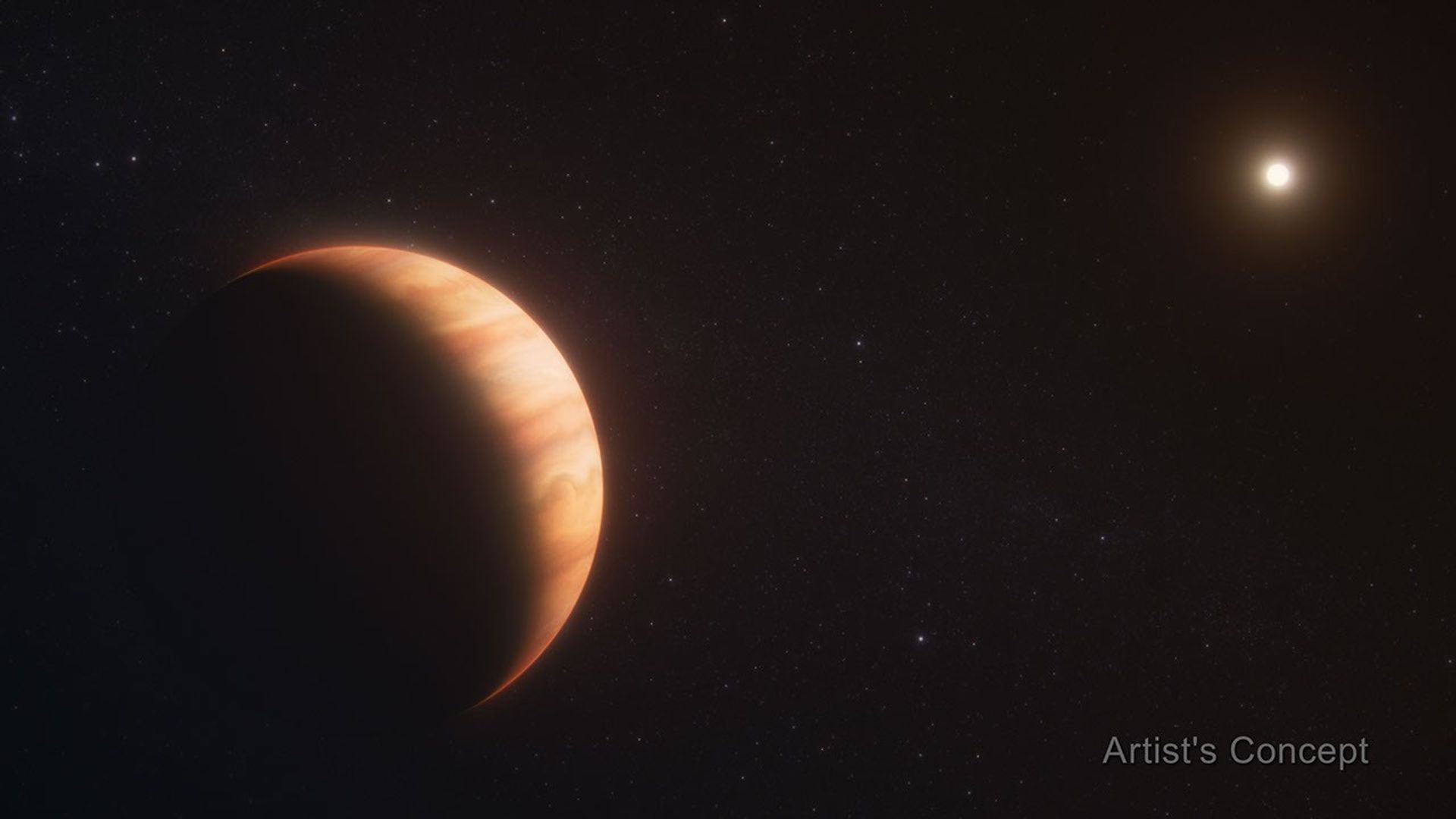
NASA's James Webb Space Telescope has solved the mystery of how a Jupiter-sized exoplanet managed to survive the violent death of its host star. The planet, designated WD 1856 b, orbits a white dwarf — the burnt-out remnant of a Sun-like star — once every 34 hours at a distance of less than 2 million miles. New Webb observations, published Wednesday in the journal Nature, reveal the planet's temperature, atmospheric composition, and the remarkable chain of events that delivered it to its current unlikely orbit.
PlanetWD 1856 b (4–11× Jupiter)
Host StarWhite dwarf WD 1856+534
Orbit34 hours (50× closer than Earth)
PublishedNature, July 1, 2026
By Elena Reyes
|
Published:
|
Updated:
|
Reviewed & approved by Juhi Sahni, Senior Editor
Editorial Standards

Elena Reyes
Senior Science Editor
Covers NASA missions, space science discoveries, and astronomical events for Telescope Advisor. Translates complex astrophysical research into practical insights for backyard observers. Based in the San Francisco Bay Area.
Content reviewed by our editorial team. Research and drafting assisted by AI to ensure unbiased, data-driven analysis. Learn more about our editorial process.
The Mystery of WD 1856 b
WD 1856 b was discovered in 2020 by scientists using NASA's TESS (Transiting Exoplanet Survey Satellite) and the retired Spitzer Space Telescope. It orbits the white dwarf WD 1856+534, located approximately 80 light-years from Earth in the constellation Draco. The planet is about the size of Jupiter, but the white dwarf it orbits is the size of Earth — meaning the planet is seven times larger than its star. This extreme size ratio makes the system one of the most visually striking in exoplanet science.
The planet orbits at a distance 50 times closer than Earth orbits the Sun — a proximity that would have been impossible during the star's earlier red giant phase. When a Sun-like star exhausts its hydrogen fuel, it swells to more than 100 times its original size, engulfing any planets in its inner system. Mercury, Venus, and Earth will face this fate when our Sun reaches this stage in about five billion years. So how did a Jupiter-sized world end up orbiting a dead star at such an impossibly close distance?
This question has puzzled astronomers since WD 1856 b's discovery. Two main competing theories emerged: either the planet was swallowed by the red giant star and somehow survived inside its outer layers, or it originally orbited at a much greater distance — safe from the star's expansion — and later migrated inward through gravitational interactions with other objects in the system. The new Webb observations, led by Ryan MacDonald of the University of St. Andrews, were designed to settle this debate once and for all.
How the Planet Survived: A Tale of Delayed Migration
The key to solving the mystery turned out to be the planet's temperature. Webb observed WD 1856 b as it transited (passed in front of) its white dwarf host star. During the transit, the star's light was partially blocked, but infrared light was reduced less than other wavelengths — the difference being infrared light emitted by the planet itself.
The data revealed that WD 1856 b has a temperature of approximately 260 degrees Fahrenheit (126 degrees Celsius) — significantly hotter than it would be if its only source of heat was the white dwarf's residual glow. This excess heat was the critical clue. With no current energy source to produce it, the heat must be residual — left over from an earlier period when the planet was heated much more intensely.
Christopher O'Connor of Northwestern University, a co-author on the study published in Nature, used models of how sub-stellar objects like WD 1856 b cool over time, combined with the new Webb temperature measurement, to trace the planet's thermal history backward. The team concluded that the heating most likely occurred between 3 and 5.5 billion years after the star became a white dwarf — a timeline that rules out the "survived inside the star" theory.
Instead, the evidence points to a delayed migration scenario. The planet originally orbited at a safe distance from the star, well beyond the reach of the red giant. Only long after the star had completed its transformation into a white dwarf did gravitational interactions with other bodies in this triple-star system nudge WD 1856 b inward. As the planet migrated closer, the intense gravitational tidal forces from the white dwarf heated it dramatically — and the planet has been slowly cooling ever since.
What Webb Saw: Temperature, Mass, and Atmosphere
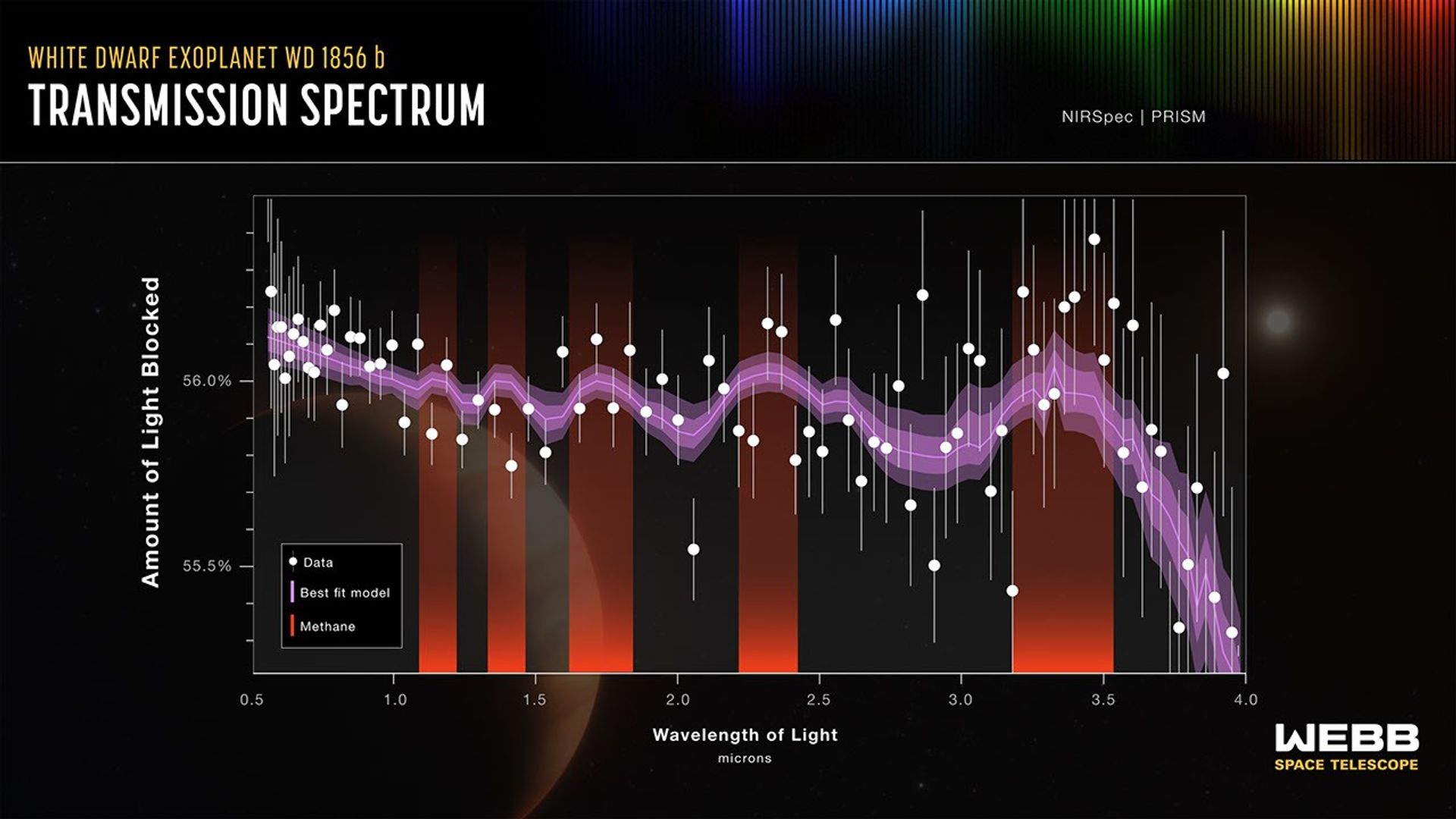
Webb observed WD 1856 b using its NIRSpec (Near-Infrared Spectrograph) instrument in PRISM mode, capturing the full 0.6–5.3 micron wavelength range as the planet transited its host star. Because the white dwarf is so small — roughly Earth-sized — the planet blocked more than half of the star's light during each transit, producing an exceptionally strong signal that allowed the team to extract detailed information.
The transit data yielded several key measurements:
- Mass: Between 4 and 11 times the mass of Jupiter, confirming WD 1856 b as a gas giant rather than a failed star.
- Temperature: Approximately 126°C (260°F), significantly hotter than predicted for a planet receiving only white dwarf light.
- Atmosphere: The transmission spectrum revealed the signatures of small cloud particles and hydrocarbons — most notably methane, which has never before been detected in the atmosphere of a planet transiting a dead star.
"The big question is how WD 1856 b ended up where it is today," said O'Connor. "There are two theories. One is that the planet was swallowed by the host star as it was dying, and managed to survive on the inside. The other is that migration took place due to the gravitational effect of other objects in the system. The white dwarf is part of a triple star system, and the companion stars could have influenced WD 1856 b's orbit." The Webb temperature data decisively favoured the migration model.
Methane Detection — A First Around a Dead Star
Light from the white dwarf passing through WD 1856 b's atmosphere carried information about its chemical composition. "We saw the telltale signatures of small cloud particles and hydrocarbons, most likely methane, which is the first time we have seen an atmosphere on a planet transiting a dead star," said co-author Victoria Boehm of Cornell University.
The detection of methane is significant for several reasons. Methane is a volatile molecule that is easily destroyed by stellar radiation, so its presence suggests that the planet's atmosphere has been stable enough to retain complex molecules despite its extreme proximity to the white dwarf. The team recently observed four more transits of WD 1856 b with Webb to investigate the atmospheric chemistry in greater depth, and the results of those follow-up observations are eagerly awaited by the exoplanet community.
WD 1856 b's atmosphere also showed evidence of cloud particles, likely composed of salts or sulphides similar to those found in the deep atmospheres of Jupiter and Saturn. The combination of methane and cloud particles points to a dynamic, active atmosphere — remarkable for a planet orbiting the remnant of a dead star.
A Window Into Our Solar System's Future
In approximately five billion years, the Sun will run out of hydrogen fuel in its core and swell to more than 100 times its current size, becoming a red giant. It will then shed its outer layers, leaving behind a white dwarf — a dense, Earth-sized remnant that slowly cools over billions of years. Mercury, Venus, and Earth will almost certainly be engulfed and destroyed during the red giant phase. But what will happen to Jupiter, Saturn, and the other outer planets?
"We're used to looking back in time when we use telescopes, but this is the first time we have been able to look forward to what might happen to the outer planets around the remnant of a Sun-like star," said MacDonald. "It's like using a time machine to peer into the distant future of our solar system."
WD 1856 b offers a direct analogue for what Jupiter might experience after the Sun's death. If Jupiter remains on a wide enough orbit to survive the red giant phase — which current models suggest is likely — it could eventually be nudged into a much tighter orbit around the white dwarf Sun through gravitational interactions with the remaining planets or any surviving bodies in the outer solar system. WD 1856 b's story suggests that this migration could happen billions of years after the Sun's death, keeping Jupiter warm with tidal heating and preserving its atmosphere — potentially transforming it into a warm gas giant orbiting a dead star.
What This Means for Exoplanet Science
The WD 1856 b study represents a major milestone in exoplanet science for several reasons. It is the first time Webb has been used to solve a planet-formation and evolution mystery around a white dwarf — combining temperature measurements, atmospheric composition, and thermal history modelling into a coherent narrative. The discovery that the planet migrated inward billions of years after the star's death challenges our assumptions about when and how planetary systems evolve around dying stars.
The research also opens a new frontier in exoplanet atmospheric studies. Finding methane around a white dwarf planet demonstrates that Webb has the sensitivity to characterise atmospheres in extreme environments — including planets orbiting the remnants of dead stars. This capability could lead to the discovery of habitable conditions on other white dwarf planets, should they exist.
"As the planet moved inward, its interactions with the strong gravity of the white dwarf will have caused it to warm up considerably, and it has been cooling ever since," said O'Connor. The team plans additional Webb observations to search for other white dwarf planets and to continue studying WD 1856 b's atmospheric chemistry in greater detail, using the four additional transits already observed.
The research paper, "A Jupiter-Sized Planet That Survived the Death of Its Star," was published July 1, 2026 in the journal Nature. The James Webb Space Telescope is an international program led by NASA with its partners ESA (European Space Agency) and CSA (Canadian Space Agency).
Frequently Asked Questions
What is WD 1856 b?
WD 1856 b is a Jupiter-sized exoplanet orbiting a white dwarf star 80 light-years from Earth. It completes one orbit every 34 hours at a distance 50 times closer than Earth orbits the Sun. It was discovered by NASA's TESS mission in 2020.
How did the planet survive the death of its star?
The planet survived by orbiting at a safe distance during the star's red giant phase. Only 3 to 5.5 billion years after the star became a white dwarf did gravitational interactions with other bodies in the triple-star system push it onto its current tight orbit.
What did Webb discover about the planet?
Webb measured the planet's temperature at 126°C (260°F), determined its mass between 4 and 11 times Jupiter's, and detected methane in its atmosphere — the first time an atmosphere has been detected on a planet transiting a dead star.
What does this mean for our solar system's future?
WD 1856 b provides a direct analogue for what might happen to Jupiter after the Sun becomes a white dwarf in about five billion years. Jupiter could survive the Sun's red giant phase and later migrate into a tighter orbit around the white dwarf Sun.
Where was the research published?
The study was published Wednesday, July 1, 2026, in the peer-reviewed journal Nature, authored by an international team led by Ryan MacDonald of the University of St. Andrews.
Can I see WD 1856 b with my telescope?
No. WD 1856 b is invisible to amateur telescopes. The white dwarf host star is extremely faint at magnitude 17, and the planet itself is not directly detectable from Earth. Only Webb and other large observatories can study this system.
Related Articles
🌌
🔭
🪐
🌡️
🔭
🪐
🌍
Webb Pinpoints 16.5M Stars in M82
Webb's census of a starburst galaxy.
Black Eye Galaxy: Hubble & Webb Composite
Multi-wavelength portrait of M64.
Enceladus: Ocean World Guide
A subsurface ocean in our solar system.
Hot Jupiter WASP-121b Transit
Webb's split-atmosphere discovery.
Planets Through a Telescope
Realistic previews at the eyepiece.
Best Telescopes for Planets
Optimise your gear for planetary observing.
Kepler-452b: Earth's Cousin
A super-Earth 1,400 light-years away.