
What Can You See With a 12-Inch Telescope? Real Sky Results
Telescope Advisor Logo Telescope Advisor
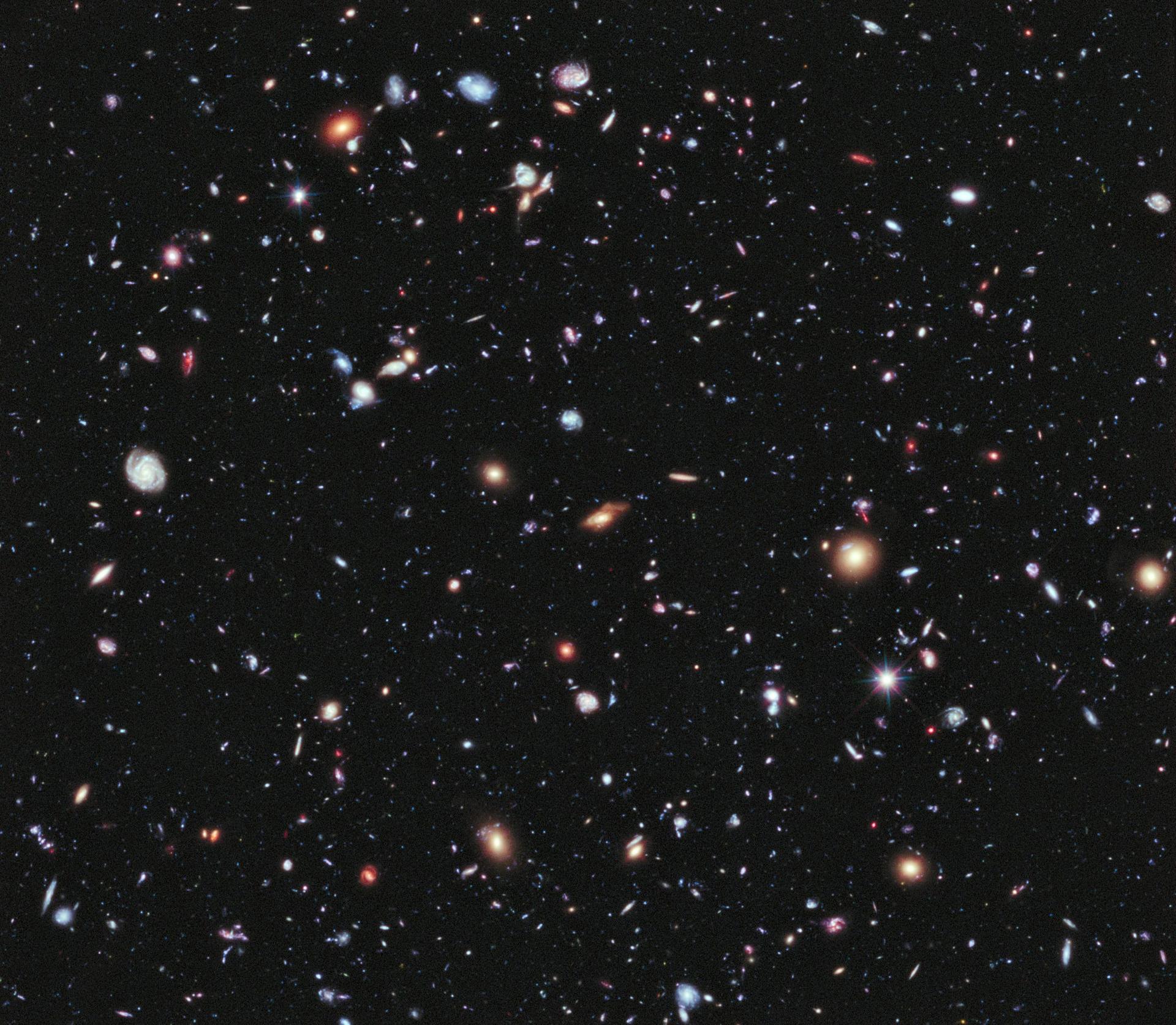
Hubble Extreme Deep Field — a 12-inch telescope from a dark site can detect objects to magnitude 15, revealing galaxies at remarkable distances

Telescope Guide · Aperture Series

What Can You See With a 12-Inch Telescope?

A 12-inch (305mm) telescope sits at the boundary between serious amateur and semi-professional instruments. It gathers 78% more light than a 10-inch and 2.8× more than an 8-inch — enough to see objects that would take an 8-inch all night to barely detect, and to reveal structural detail that pushes into the realm of professional archive imagery from just 30–40 years ago.

Aperture305mm (12 inches)
vs 10-inch+78% more light, +0.8 magnitude
Limiting mag~15.0 (dark sky)
Best forFaint galaxies, resolution
By Telescope Advisor Editorial Team Published: Updated: Editorial Standards

Quick Answer: What a 12-Inch Changes

The 12-inch threshold represents something genuine in visual astronomy. Below 10 inches, many interesting targets are glimpsed rather than seen. At 12 inches, they are seen — not photographed, not processed, not enhanced, but seen with your eye pressed to the eyepiece in real time. The objects that 10-inch observers chase with averted vision and dark adaptation become routine in a 12-inch. And targets that simply didn't exist for 8-inch observers — quasars, interacting galaxy bridges, very faint emission nebulae without filters — appear as genuine if faint objects.

What 12 inches unlocks vs 10 inches

  • ✓ Saturn's Encke Division seen clearly (not just detected)
  • ✓ Outer galaxy halos reliably visible (M31 extends 4°+)
  • ✓ Arp peculiar galaxies and interacting pairs accessible
  • ✓ Stephan's Quintet shows all 5 members clearly including NGC 7317
  • ✓ Quasar 3C 273 (mag 12.9) — brightest quasar, visible as faint point
  • ✓ Magnitude 14.5–15 objects accessible from dark sites
  • ✓ Uranus moons Titania/Oberon easier; Neptune's Triton accessible
  • ✓ Globular clusters resolve even in their very densest central zones

The honest trade-offs

  • → Weight: 25–35 kg (solid-tube) — two-person transport often necessary
  • → Cool-down: 60–120 minutes for thermal equilibration
  • → Significant price increase over 10-inch
  • → Atmosphere still limits planetary magnification above 250×
  • → Light pollution still ruins faint extended objects
  • → Collimation more critical (fast focal ratios f/4.7–5)
  • → Storage space required — cannot live under a desk

🔭

Not sure which telescope actually fits your goals?

Answer 5 quick questions about your budget, observing targets, and experience level — our Telescope Finder Tool recommends a specific model in under 2 minutes.

Find My Telescope →

Planets Through a 12-Inch Telescope

The resolving power of a 12-inch is 0.38 arcseconds (Dawes limit) — finer resolution than most terrestrial atmospheric seeing conditions allow. This means planetary views in a 12-inch are limited by atmosphere, not aperture, on most nights. But when the seeing cooperates — those nights of exceptional clarity, usually calm and humid — the 12-inch delivers planetary views that rival what professional observatories produced in the early 20th century.

Saturn

The Encke Division — the subtle inner ring division visible as a darkening near the outer edge of Ring A — is cleanly visible at 250× on nights of good seeing, rather than merely detectable as in a 10-inch. The Cassini Division is wide and prominently dark. The crepe ring (C ring) inner to the B ring shows its semi-transparency. Polar polar cloud detail including the north polar hexagonal storm and visible color gradations between belt zones are accessible. Six to seven moons are routine. Saturn in a 12-inch on a superb night is the most impressive thing a human eye can see through a telescope — the image is genuinely three-dimensional.

Jupiter

Eight or more distinct cloud belt zones are visible when Jupiter presents a full face. The Great Red Spot shows its hollow centre (a brighter region inside the anticyclonic storm). Multiple festoons and ovals in the North Equatorial Belt change visibly on consecutive nights. The Galilean moon Io appears distinctly orange compared to the other moons in a 12-inch — the first aperture class where this color difference becomes reliable. Shadow transits show the tiny black dot of the moon's shadow traversing Jupiter's disk — track it over 2–3 hours and you can see it move.

Uranus and Neptune

Uranus in a 12-inch at 200×+ shows a clearly defined disk (3.7 arcseconds) with the blue-green methane color unmistakable. Moons Titania (mag 13.9) and Oberon (mag 14.1) are readily visible with moderate averted vision. On excellent nights, Ariel (mag 14.4) and Umbriel (mag 15.0) approach detectability. Neptune's disk (2.4 arcseconds) is cleanly resolved — clearly non-stellar at 200×. Triton (mag 13.5) is a straightforward averted-vision target. The 12-inch is the first aperture class where Neptune observing becomes genuinely rewarding rather than merely confirmatory.

Galaxies Through a 12-Inch: Where Amateur Astronomy Meets Professional Reach

The step from 10-inch to 12-inch in galaxy observing is less dramatic than the step from 8-inch to 10-inch — but it is meaningful for the most rewarding class of extragalactic targets. The extra 0.8 magnitudes of depth reach fainter tidal tails, more distant cluster members, and the outer halos of nearby galaxies that are just beyond 10-inch capability under typical conditions.

Deep field galaxy imagery — a 12-inch telescope from dark skies accesses objects at unprecedented depth for backyard astronomy

12-inch aperture reaches magnitude 15 from dark skies

From Bortle 4 skies, a 12-inch accesses objects at magnitude 15 — revealing faint galaxies, distant cluster members, and the outer halos of nearby spirals that 10-inch scopes cannot show. Credit: NASA/Hubble.

Target What 12-Inch Shows Step up from 10-Inch
M31 AndromedaOuter halo extends 3–4°; dust lanes layered; two spiral arms detectable; M32 shows slight elliptical compressionOuter halo more extensive; spiral arm detection easier
M51 WhirlpoolConnecting bridge between M51 and companion NGC 5195 reliably visible; multiple HII region condensations in spiral armsBridge more prominent; arm texture improved
Stephan's QuintetAll 5 members easily detected; NGC 7317 (faintest member, mag 14.6) routinely visible; group orientation clearly a physical systemNGC 7317 now easy; 5th member no longer requires averted vision
Markarian's Chain12+ galaxies in a single field; elliptical and lenticular shapes clearly differentiated; companion dwarfs of M84/M86 detectableFainter chain members emerge; shape classification easier
Quasar 3C 273 (Virgo)Magnitude 12.9 point of light detectable as faint star in low-power field — the most distant object visible to human eye (2.4 billion light-years)Easier detection than 10-inch; confirmation by lack of colour or nebulosity
Arp peculiar galaxiesArp 273, Arp 147, and several dozen Arp catalogue interacting pairs become accessible; tidal distortions visible in manyArp objects now within reach of determined observers
NGC 4889 (Coma Cluster BCG)Magnitude 11.4 brightest member of Coma cluster — an elliptical galaxy 335 million light-years away shows as a small fuzzy ellipseFainter Coma members emerge around it

Globular Clusters in a 12-Inch

In a 12-inch at 200–300×, globular clusters are among the most spectacular sights in all of astronomy. M13 Hercules shows a resolved star field across its entire extent including the dense core — the visual effect is of looking at a three-dimensional sphere of stars, with individual stellar colours (blue-white to gold) clearly differentiated. M15 Pegasus, noted for its extreme central condensation (it may contain an intermediate-mass black hole), shows the compressed core with faint individual stars surrounding it in a dense haze. Omega Centauri (from southern latitudes) appears as a snowstorm of stars — an absolute showpiece.

Southern-hemisphere globulars NGC 104 (47 Tucanae) and NGC 5139 (Omega Centauri) represent the apex of globular cluster observing — but even from northern latitudes, M5 in Serpens, M3 in Canes Venatici, and M92 in Hercules offer views that are genuinely extraordinary in a 12-inch. The step up from 10 inches on globulars is less dramatic than from 8 to 10 — the difference is primarily in the resolution of the very densest central regions and in the detection of fainter outer halo stars.

Nebulae and Supernova Remnants Through a 12-Inch

Emission Nebulae

Large emission nebulae like M42 and M8 in a 12-inch are overwhelming at low power — the nebulosity extends beyond the field of most eyepieces and the internal structure is tremendously detailed. Higher-surface-brightness compact emission nebulae show their shapes and internal density variations more clearly than in a 10-inch. With a UHC or O-III filter, the Veil Nebula's filamentary structure becomes extraordinarily detailed — individual strands of shocked gas 8,000+ years old. The Rosette Nebula shows its ring structure and internal variations. The Crab Nebula (M1) displays the oval form and surface brightness variations that confirm its supernova origin.

Planetary Nebulae

M57 Ring Nebula in a 12-inch at 250× reveals the non-uniform brightness of the ring (one arc brighter), the subtle color gradient from blue-white inner edge to greenish main ring, and — critically — the central white dwarf star (magnitude 14.7) becomes detectable with averted vision under dark skies and exceptional seeing. M27 Dumbbell shows its full complex structure including the fainter outer halos that flank the main dumbbell. The Blue Snowball (NGC 7662) and Saturn Nebula (NGC 7009) show their disk-within-disk multiple-shell structures at 200×. Helix Nebula (NGC 7293) — best from southern latitudes but visible from 35°N — is an enormous low-surface-brightness ring, requiring low power and an O-III filter.

Supernova Remnants

The Veil Nebula complex is the 12-inch's flagship supernova remnant. The Eastern Veil (NGC 6992) and Western Veil (NGC 6960, passing through star 52 Cygni) show delicate filamentary structure that appears genuinely three-dimensional — strands of gas at different distances along the line of sight. With an O-III filter, the Pickering's Triangle section (the fainter central arc of the complex) becomes visible. The Cygnus Loop as a whole — the full extent of the remnant — spans nearly 3° and requires a very wide field and exceptional transparency to appreciate.

At the Limits: What a 12-Inch Can Just Reach

The 12-inch sits at an interesting threshold where several categories of objects that were completely inaccessible to smaller amateur telescopes become achievable under ideal conditions. These are the targets that define what makes a 12-inch worth the investment for serious observers.

Quasar 3C 273 — 2.4 billion light-years

At magnitude 12.9, the quasar 3C 273 in Virgo is the brightest known quasar and the most distant object reliably visible in an amateur telescope. In a 12-inch it appears as a faint, slightly blue-white stellar point with no discernible disk or fuzziness — confirming its stellar-appearing character despite being a billion-solar-mass black hole consuming material at the heart of a distant galaxy. Finding it requires a detailed finder chart (use Cartes du Ciel or Stellarium) but the object itself is definitively detectable in a 12-inch from Bortle 4–5 skies. The act of seeing light that left its source 2.4 billion years ago — before multicellular life appeared on Earth — is one of the genuine transcendental moments in amateur astronomy.

Arp Catalogue Interacting Galaxies

Halton Arp's 1966 Atlas of Peculiar Galaxies catalogued 338 galaxies with unusual morphologies — most caused by gravitational interactions or collisions. Many Arp objects are within 12-inch reach: Arp 273 (two interacting spirals in Andromeda), Arp 147 (ring galaxy pair), Arp 299 (merging galaxies in Ursa Major), and Arp 188 (the Tadpole Galaxy with its 280,000 light-year long tidal tail) are detectable as irregular or elongated fuzzy objects. The tidal distortions that define them as "peculiar" are often visible in the larger ones. For a systematic programme of challenging targets, working through the Arp Atlas is a multi-year project that a 12-inch makes possible.

The limiting magnitude context: From Bortle 4 skies (SQM 21.1), a 12-inch can theoretically reach magnitude 15.0 under ideal conditions — about 2,400 times fainter than the human eye limit. This means the 12-inch can detect objects at extraordinary distances: a galaxy the same absolute brightness as the Andromeda Galaxy (M31) could be detected at 35 times its actual distance. This doesn't mean everything is obvious — many magnitude 14–15 objects require averted vision, dark adaptation, careful finder charts, and experienced observing technique. But they are definitively within reach.

12-Inch vs 10-Inch: When Is the Upgrade Worth It?

This is the question that divides the serious amateur astronomy community. The 10-inch is already a formidable instrument — moving to 12 inches costs significantly more, weighs substantially more, and the visual difference for most targets is real but not transformative. Here is a clear-eyed assessment:

The 12-inch IS worth it if:

  • ✓ You observe regularly from Bortle 4–5 dark sites
  • ✓ Faint galaxies, Arp objects, and limiting-magnitude observing excite you
  • ✓ You've methodically worked through 10-inch target lists and want more
  • ✓ Quasars, supernovae, and exotic objects are on your target list
  • ✓ You have reliable help transporting and setting up a heavier instrument

Stick with 10-inch if:

  • → You primarily observe from suburban skies (Bortle 6–8)
  • → You observe solo without transport assistance
  • → You haven't exhausted 10-inch target lists yet
  • → Budget is a significant consideration
  • → Planets are more important than deep-sky

The honest bottom line

For 90% of observers, the 10-inch provides everything a 12-inch does for the objects they actually observe most. The genuine cases where 12 inches makes a meaningful practical difference — faint galaxy halos, limiting-magnitude objects, very dense globular core resolution — are real but require dark skies and experienced observing technique to appreciate. The 12-inch rewards dedicated observers who have maximised what a 10-inch offers and are ready for the next level.


Best 12-Inch Telescopes to Buy in 2026

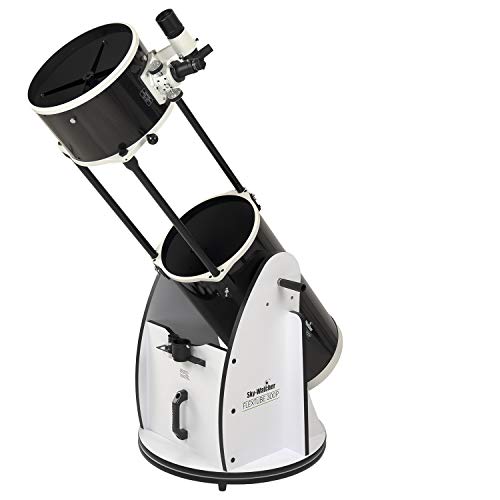
For visual deep-sky observing at maximum aperture-per-dollar, the 12-inch Dobsonian is the optimal choice. The Sky-Watcher 12-inch Flextube is the standard recommendation for serious observers who need portability alongside performance.

Editor's Pick — Best 12-Inch Dobsonian for Serious Observers
Sky-Watcher Flextube 300P collapsible 12-inch Dobsonian telescope

Sky-Watcher Flextube 300P (12-inch Collapsible Dobsonian)

305mm (12") f/4.9 FlexTube collapsible Dual-speed focuser

The Sky-Watcher Flextube 300P is the 12-inch Dobsonian that serious visual observers choose when they're ready to step up from 10 inches. The 305mm parabolic primary at f/4.9 delivers exceptional optical quality, and the FlexTube collapsible design reduces the assembled length from ~1,500mm to ~900mm — making this manageable in an estate car. At this aperture, globular clusters are spectacular, faint galaxies become accessible, and Saturn's Encke Division becomes a reliable sight rather than an exceptional one. The Sky-Watcher brand's consistent quality control and widely available accessories make it the practical choice over less common brands. If budget allows for the solid-tube version (slightly better thermal stability), that is also an excellent choice. See our full Dobsonian guide for complete comparison.

Affiliate link. See our editorial standards.

12-Inch Telescope FAQ

What magnitude objects can a 12-inch telescope see?

From dark skies (Bortle 4, SQM 21.1+), a 12-inch telescope can detect objects to approximately magnitude 15.0 under ideal conditions with averted vision and dark adaptation. From suburban skies (Bortle 7), the practical limit drops to about magnitude 13–13.5. The theoretical formula (magnitude = 2.1 + 5×log(aperture in mm)) gives 14.5 for 305mm, but real-world conditions generally allow 0.5–1.0 magnitude beyond the formula under excellent conditions. For comparison, an 8-inch reaches ~13.7 and a 10-inch reaches ~14.3 from the same site.

Is a 12-inch telescope too heavy to use solo?

A solid-tube 12-inch Dobsonian typically separates into two pieces: the rocker box (15–18 kg) and the optical tube assembly (12–15 kg). Both pieces are manageable solo — though the tube is long and awkward to carry alone. The collapsible FlexTube 300P reduces the tube length significantly, making solo transport more practical. Most 12-inch observers set up at a fixed backyard location and don't regularly transport to dark sites — for those who do, having a second person helps considerably. The altitude bearings on a well-balanced 12-inch are smooth enough that one person can easily point and move the telescope during an observing session.

What is the limiting magnitude of a 12-inch telescope?

Approximately magnitude 15.0 from Bortle 4 dark skies under ideal conditions. This is 0.7 magnitudes deeper than a 10-inch (14.3) and 1.3 magnitudes deeper than an 8-inch (13.7). Each 0.75 magnitudes of depth doubles the number of detectable stars and galaxies — so a 12-inch can detect roughly 2.7× as many objects as an 8-inch in the same field. The practical limiting magnitude varies significantly with sky quality, observer experience, and dark adaptation.

Can a 12-inch telescope see the Andromeda Galaxy in full?

The Andromeda Galaxy (M31) spans roughly 3° × 1° in apparent extent — but most of this is very low surface brightness outer halo detectable only in exceptional conditions. In a 12-inch with a 35mm 2-inch eyepiece (giving ~35× and ~2° true field), the bright inner disk fits comfortably. The outer halo extends to 4°+ and is visible in pieces with averted vision and exceptional transparency. Companion galaxies M32 and M110 are both easily visible. Dust lanes in M31 are reliably visible in a 12-inch under good conditions. For a complete view of M31's full extent, wide-field binoculars or imaging are ultimately more effective than a large telescope — see our Andromeda guide.

Is a 12-inch telescope good for astrophotography?

A 12-inch Dobsonian is not optimised for long-exposure astrophotography — the manual alt-azimuth mount produces field rotation in exposures longer than 30–60 seconds, and precise tracking is not built in. For deep-sky astrophotography, a dedicated equatorial mount (HEQ5, EQ6-R Pro) with a separate optical tube assembly is the appropriate approach. 12-inch Newtonians on equatorial mounts are used for astrophotography, but the setup cost and complexity is substantial. For planetary video imaging (Saturn, Jupiter), a Dobsonian is perfectly usable — short exposures stack to produce impressive results without needing perfect tracking. See our astrophotography mount guide.


Related Guides — Aperture Series