Best Smart Telescopes 2026: Full Comparison & Buyer's Guide
Telescope Advisor Logo Telescope Advisor
Four smart telescopes — ZWO Seestar S50, Dwarf 3, Unistellar eQuinox 2, and Vaonis Stellina — arranged on a dark surface under a night sky

Buyer's Guide · 2026

Best Smart Telescopes 2026: Full Comparison and Buyer's Guide

The smart telescope market has matured to the point where every major model delivers genuinely impressive results. The hard question is not "are they any good?" — it is "which one is right for me?" This guide ranks every current smart telescope by image quality, portability, value, and ease of use.

Models tested6 smart telescopes
Price range$349 to $3,999
Editor's PickBest overall value
UpdatedJune 14, 2026
By Telescope Advisor Editorial Team Published: Updated: Editorial Standards

Quick Picks: Best Smart Telescopes at a Glance

🥇 Best Overall

ZWO Seestar S50

~$499

Best image quality per dollar

🥇 Best Portable

Dwarf 3

~$349

Ultra-light, dual-camera versatility

🥇 Best Deep-Sky

Unistellar eQuinox 2

~$1,999

Equatorial mount, deeper exposures

🥇 Premium Choice

Vaonis Stellina

~$3,999

Best optics, widest field


🔭

Not sure which telescope actually fits your goals?

Answer 5 quick questions about your budget, observing targets, and experience level — our Telescope Finder Tool recommends a specific model in under 2 minutes.

Find My Telescope →

Full Smart Telescope Comparison Table

Every major smart telescope model sold in 2026, compared across the specs that determine real-world imaging performance.

Model Price Aperture Sensor Mount Image Quality Portability Value
ZWO Seestar S50 ~$499 50mm f/4.9 IMX462 Alt-AZ Excellent Good Best
Dwarf 3 ~$349 Dual 35mm IMX415 Alt-AZ Good Best Best
Unistellar eQuinox 2 ~$1,999 50mm f/4.0 IMX347 Equatorial Excellent Fair Good
Vaonis Stellina ~$3,999 80mm f/5.0 IMX178 Equatorial Best Fair Fair
ZWO Seestar S30 ~$349 30mm f/4.0 IMX462 Alt-AZ Fair Best Good
Dwarflab Dwarf Mini ~$249 24mm f/3.5 IMX214 Alt-AZ Basic Best Good

1. ZWO Seestar S50 — Best Overall Smart Telescope

The Seestar S50 remains the benchmark for the smart telescope category even after its discontinuation. Its combination of a well-corrected 50mm apochromatic refractor, a sensitive Sony IMX462 sensor with excellent near-infrared response, a built-in dew heater, and an intuitive app experience set the standard that every competitor measures against. The internal dual-band narrowband filter (which passes H-alpha and O-III wavelengths) makes it uniquely effective at imaging emission nebulae from light-polluted suburban skies — a practical advantage that matters for most buyers who do not have access to dark-sky sites.

The S50's live-stacking algorithm is among the best in the category, producing clean, colour-calibrated images with minimal user intervention. The built-in battery lasts approximately three hours. The entire unit weighs about 3 kg and packs into a compact carrying case.

Who it is for: The beginner or intermediate user who wants the best possible image quality per dollar spent. The S50 does everything well — deep-sky imaging, bright DSOs, globular clusters — without demanding technical skill or additional purchases.

Important note: ZWO has discontinued the S50. Remaining retail stock is available at the original ~$499 price point, and ZWO has confirmed ongoing app support. If you cannot find one, see our discontinuation guide for current-production alternatives.

2. Dwarf 3 by Dwarflab — Best Portable / Best Value

The Dwarf 3 is the most innovative smart telescope on the market in 2026. Its dual-optical design — one 35mm wide-angle camera for large targets like the Andromeda Galaxy and Milky Way swathes, and one 35mm telephoto camera for smaller DSOs — gives you framing flexibility no single-aperture competitor can match. At 1.2 kg and roughly the size of a lunchbox, it is genuinely portable: it fits in a daypack alongside a tablet and water bottle.

The Dwarf 3's app is polished and responsive, with a clean object catalogue that includes position-optimized suggestions based on your current time and location. The dual cameras mean you can swap between wide-field context shots and closer views of specific targets without moving the telescope. The wide-angle camera is also effective for occasional daytime landscape astrophotography (sunrises, moonlit landscapes), an uncommon capability in the category.

Trade-off: The 35mm aperture collects less light than the Seestar S50's 50mm, and the IMX415 sensor is smaller and less sensitive. Deep-sky images from the Dwarf 3 are noticeably noisier, particularly in light-polluted skies. It excels as a travel companion and a versatile imaging tool rather than a deep-sky powerhouse.

3. Unistellar eQuinox 2 — Best Deep-Sky Smart Telescope

The eQuinox 2 is built around an equatorial fork mount — the only smart telescope at its price point to use one. This is mechanically significant: an equatorial mount tracks the sky's rotation around the celestial pole, allowing individual exposures of 60 seconds or more without the field rotation that limits alt-az mounts to approximately 30-second sub-frames. The result is deeper, cleaner stacked images of faint DSOs — globular clusters resolve more individual stars, emission nebulae show more delicate structure, and the background sky remains darker.

The f/4.0 focal ratio is half a stop faster than the Seestar S50's f/4.9, meaning each individual exposure collects more light in the same amount of time. Unistellar's proprietary Enhanced Vision technology applies real-time image processing that pulls out detail particularly well in hydrogen-alpha emission nebulae. The app includes a citizen science programme with live science missions coordinated through NASA and the SETI Institute — users have contributed to asteroid occultation timing, exoplanet transit observations, and comet monitoring.

Trade-off: At $1,999 plus the optional tripod (~$300), the total cost approaches $2,300 — roughly 4.5 times the Seestar S50. The mount assembly is heavier and less portable. The Sony IMX347 sensor uses an older-generation design compared to the IMX462 in the Seestar.

4. Vaonis Stellina — Premium / Best Image Quality

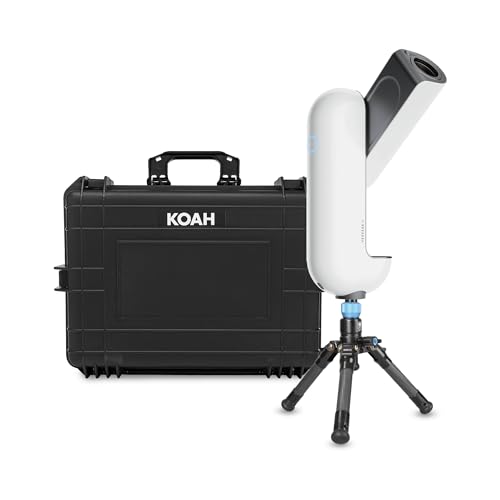
The Stellina occupies a category of its own at $3,999 — and its optical quality justifies the position. The 80mm f/5.0 triplet apochromatic refractor is a genuine high-end instrument, delivering sharp, colour-free images across a 2.6-degree field of view. No other smart telescope matches its optical correction. When you compare stacked images of the same target from a Stellina and a Seestar S50 side by side, the Stellina images show finer detail in bright nebula structures, tighter star profiles, and more natural colour rendition.

The equatorial fork mount provides the same tracking advantage as the eQuinox 2, and the integrated weather station (which automatically halts observation if clouds, wind, or rain are detected) is a thoughtful premium touch. The aluminium-magnesium alloy construction gives it a substantial, precision-instrument feel.

Trade-off: The price excludes most potential buyers. The 10 kg assembled weight is the heaviest in the category, reducing portability. The IMX178 sensor, while adequate, is an older design with lower quantum efficiency than newer Sony sensors — the excellent optics are somewhat constrained by the detector. The Stellina is a specialist tool for the enthusiast who demands the very best smart-telescope image quality and has the budget to match.


5. ZWO Seestar S30 — Budget Smart Telescope

The Seestar S30 is essentially the same platform as the S50 with a smaller 30mm aperture and lower price. It shares the same Sony IMX462 sensor, built-in dew heater, dual-band filter, and app ecosystem — so the software experience is identical to the more expensive model. The key difference is light-gathering: the 30mm aperture collects about 64% of the light that the S50's 50mm gathers, which translates to noisier images and a longer stacking time needed to reach comparable quality.

The S30 makes sense as a budget entry point if you want to experience smart telescope imaging without a large investment, or as a second travel scope. However, the S50's superior image quality makes it the better value at only ~$150 more — if you can find S50 stock remaining.

See our full S50 vs S30 comparison for a detailed breakdown.

6. Dwarflab Dwarf Mini — Ultra-Budget Smart Telescope

The Dwarf Mini is the cheapest smart telescope on the market at approximately $249. It uses a single 24mm f/3.5 camera with a smaller IMX214 sensor. Image quality is limited — expect grainy stacks of bright targets only, with limited dynamic range and noticeable noise even after 15+ minutes of accumulation. The app experience is functional but less polished than the main Dwarf 3 app.

The Dwarf Mini is best understood as a curiosity or a toy for a child interested in astrophotography. For anyone serious about imaging, the step up to the Dwarf 3 or a second-hand Seestar S50 represents dramatically better value.

Read our full Dwarf Mini review for our hands-on testing results.

How to Choose a Smart Telescope

The decision framework is simpler than the number of models suggests. Three questions will determine the right choice:

1. What is your budget?

Under $400 → Dwarf 3 (best value at this price). Under $600 → Seestar S50 (if available) or Dwarf 3. Under $2,500 → eQuinox 2. No limit → Stellina.

2. How portable does it need to be?

Frequent travel, hiking, backpacking → Dwarf 3 (1.2 kg) or Seestar S30. Car-based travel to dark sites → Seestar S50 or eQuinox 2. Permanent patio or observatory setup → Stellina.

3. What do you want to image?

Bright DSOs (Orion Nebula, Andromeda Galaxy, globular clusters) → Seestar S50 or Dwarf 3. Faint deep-sky (small nebulae, external galaxies) → eQuinox 2 (equatorial tracking). The very best possible images → Stellina.

For a more detailed explanation of how smart telescope technology works, the differences between alt-az and equatorial mounts, and what aperture and sensor specifications actually mean for your images, read our Smart Telescopes Explained pillar guide.

Frequently Asked Questions

Which smart telescope has the best image quality?

The Vaonis Stellina produces the highest-quality images thanks to its 80mm triplet APO refractor. Among sub-$2,000 models, the Unistellar eQuinox 2 produces deeper images of faint targets due to its equatorial mount, while the ZWO Seestar S50 delivers the best images of bright DSOs at its price point.

What is the best smart telescope for beginners in 2026?

The Dwarf 3 ($349) is the best entry point for beginners because of its low price, excellent portability, and intuitive app. If your budget allows, the ZWO Seestar S50 ($499) offers superior image quality, though remaining stock is limited following its discontinuation.

Do smart telescopes work in light-polluted cities?

Yes, with limitations. The Seestar S50's built-in dual-band narrowband filter effectively cuts through urban light pollution for emission nebulae. The eQuinox 2's Enhanced Vision processing also helps. However, galaxies and reflection nebulae will appear washed out from Bortle 7+ skies regardless of the telescope used. Dark skies always produce dramatically better results.

Can I connect a smart telescope to a laptop or computer?

Not directly. Smart telescopes are designed to be controlled exclusively through their companion mobile apps. Some models (Vaonis Stellina, Unistellar eQuinox 2) offer limited web-based control through a browser, but none support standard astrophotography software like SharpCap, NINA, or ASCOM. If you need a computer-controlled imaging system, consider a traditional EQ mount with an ASIAIR or similar controller.