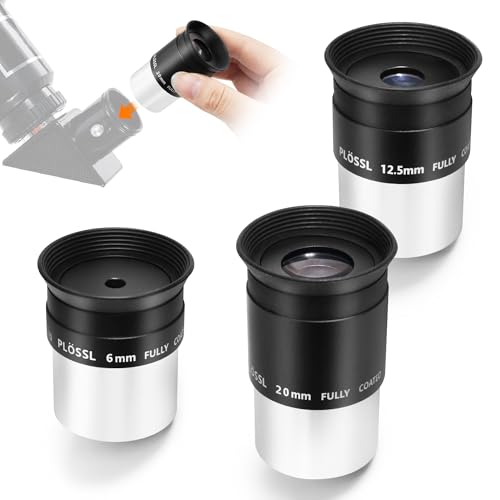
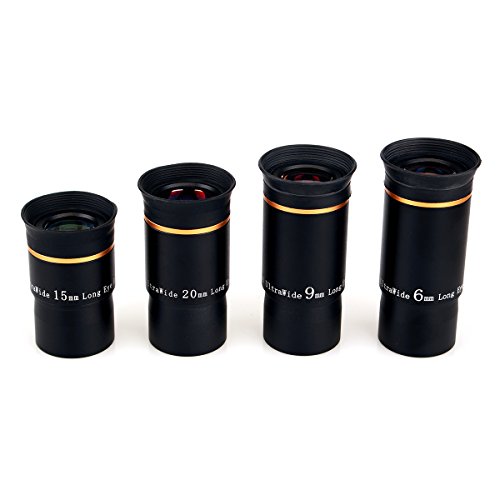
The question isn't "what magnification do I want?" — it's "what range of magnifications covers every job I need to do?" There are three observing modes every telescope owner should be able to access:
Low power (30–60×) — the finder mode
Your lowest-power eyepiece is the first one you use every night. It gives the widest field of view for finding and centring objects, shows clusters and nebulae in their full angular extent, and is the only way to see large objects like the Andromeda Galaxy or the Pleiades in context. For a typical f/5–f/10 telescope, this means a 25–40mm eyepiece. Never skip this focal length — beginners who only own high-power eyepieces spend half their sessions unable to find anything.
Medium power (80–150×) — the workhorse mode
This is where most of your observing time will be spent. Medium magnification shows planetary detail (Saturn's rings, Jupiter's cloud belts), resolves the outer stars of globular clusters, and reveals the shape of bright nebulae. For a typical telescope, this means a 10–15mm eyepiece. If you only own one eyepiece, this should be it — but you can do significantly more with the full range.
High power (180–300×) — the detail mode
High magnification is conditional — it only delivers in steady atmospheric seeing conditions, and it magnifies vibration and tracking errors as much as it magnifies the target. But on a calm night, a 6–9mm eyepiece on a good telescope reveals Saturn's Cassini Division clearly, splits tight double stars, and shows the surface features of Mars near opposition. The ceiling depends on your aperture: approximately 50× per inch (25× per cm) on a good night. A 6-inch scope can practically use 300× under excellent seeing.
The 2-Barlow strategy
A 2× Barlow lens doubles the magnification of any eyepiece without changing its eye relief. If you own a 20mm and a 10mm plus a 2× Barlow, you effectively have four eyepieces: 20mm (low), 10mm (medium), 10mm+Barlow (high), 5mm+Barlow (very high). The Alstar 6/12.5/32mm + Barlow set is built around this principle — the included Barlow turns three eyepieces into six usable magnification steps. See our Barlow lens guide for the full picture.