Best Telescope for 8-Year-Old (2026): Easy, Parent-Friendly Picks That Actually Work
Telescope Advisor Logo Telescope Advisor
An 8-year-old child using a telescope with a parent under the night sky

Age-Specific Buying Guide · 2026

Best Telescope for an 8-Year-Old (2026): Parent-Friendly Picks That Build Real Interest

The best telescope for most 8-year-olds is simple, sturdy, and fast to use. This guide ranks age-appropriate models that avoid frustration and produce exciting first-night views of the Moon, Jupiter, and Saturn.

Age 8

Focus profile

5

Tested picks

$60-$260

Budget range

Fast setup

Low frustration

By Telescope Advisor Editorial Team Published: Updated: Editorial Standards

Quick Answer: What Is the Best Telescope for an 8-Year-Old?

For most families, the best telescope for an 8-year-old is the Celestron FirstScope 76mm. It is a tabletop Dobsonian design with simple push-to movement, fast setup, and enough optical performance to make the Moon and bright planets genuinely exciting.

At age 8, usage success depends less on maximum magnification and more on setup friction. A complicated mount, unstable tripod, or confusing controls can kill interest in one evening. A stable, intuitive telescope keeps momentum and helps kids ask for "one more target" instead of giving up after ten minutes.

If your child already has unusually high patience and your family is ready for more guided setup, a 70mm refractor can also work well. But for a first purchase focused on high success rate, FirstScope-style tabletop systems are the safest and most repeatable choice.

🔭

Not sure which telescope actually fits your goals?

Answer 5 quick questions about your budget, observing targets, and experience level — our Telescope Finder Tool recommends a specific model in under 2 minutes.

Find My Telescope →

Top 5 Telescopes for 8-Year-Olds (Ranked)

Editor's Pick - Best Overall for Age 8
Celestron FirstScope 76mm tabletop telescope

1) Celestron FirstScope 76mm

Best match for most 8-year-olds. Tabletop format means no tripod wobble, and movement is intuitive. Fast success on Moon craters and bright targets keeps excitement high.

View on Amazon →
Celestron AstroMaster 70AZ refractor telescope

2) Celestron AstroMaster 70AZ

Best upgrade path for kids who are ready for a tripod refractor and a bit more structure. Good optical quality for Moon, Jupiter, and Saturn sessions with parent support.

View on Amazon →
Gskyer 70mm AZ refractor telescope

3) Gskyer 70mm AZ Refractor

Budget-friendly option with a full accessory bundle. Works best for families who want a lower entry price while still getting usable lunar and bright-planet views.

View on Amazon →
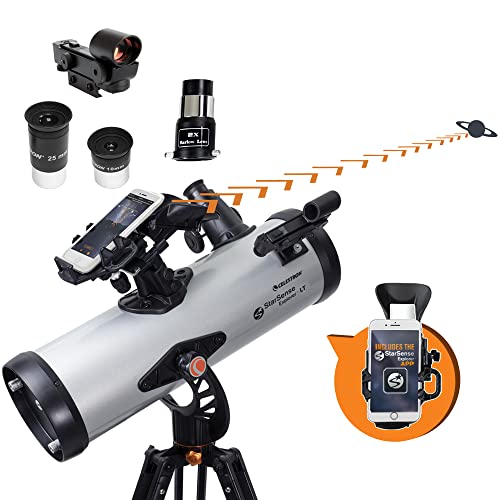
Celestron StarSense Explorer LT 114AZ telescope

4) Celestron StarSense Explorer LT 114AZ

Best for families who want app-guided target finding. Great when parent and child observe together and want faster object discovery with fewer failed pointing attempts.

View on Amazon →
Sky-Watcher Heritage 130P tabletop Dobsonian telescope

5) Sky-Watcher Heritage 130P (Parent-Assisted Stretch Pick)

Powerful scope with real deep-sky headroom, but better as a shared family instrument than a fully independent age-8 telescope. Excellent if a parent is actively involved each session.

View on Amazon →

Age-8 Buying Framework: How Parents Should Choose

The best age-8 telescope decision is not driven by theoretical optical limits. It is driven by behavior, ergonomics, and workflow. If the scope is stable, easy to point, and delivers visible results quickly, kids stay engaged. If setup feels fiddly and outcomes are inconsistent, interest drops sharply even when the scope has decent optics.

Stability First

Wobble at focus is the biggest confidence killer for children. A stable tabletop or well-built alt-az mount matters more than high advertised magnification.

Fast Setup

Aim for 2-5 minute readiness. Long setup consumes enthusiasm before the first target appears.

Simple Controls

Push-to alt-az movement is easier for age 8 than equatorial mounts and advanced alignment routines.

Immediate Targets

Moon first, then Jupiter or Saturn. Early wins matter far more than chasing difficult deep-sky objects.

Treat your first telescope as a momentum tool, not a forever instrument. The correct first step creates confidence and curiosity. Upgrades can come later after skill and interest are proven through repeated sessions.

What an 8-Year-Old Can Realistically See

Setting realistic expectations is essential. Kids who expect movie-level nebula images through an eyepiece will feel disappointed. Kids who are prepared to look for crater texture, moon shadows, and planet details tend to be amazed. Here is a practical first-month target ladder.

Target Difficulty What Kids Notice
MoonEasyCraters, mountain shadows, changing terminator line
JupiterEasyFour bright moons and planet disk shape
SaturnMediumRing shape as a tiny, unmistakable oval halo
Pleiades (M45)EasyBright star grouping and rich field sparkle
Orion Nebula (M42)MediumFaint glowing cloud with bright center stars

For age 8, one strong target per night is enough. Stopping on a success keeps confidence high and builds anticipation for the next session.

30-Minute Parent + Child Session Plan (High Success Routine)

  1. Minute 0-5: Set up in a stable, safe area and pre-check eyepiece focus range.
  2. Minute 5-12: Start with Moon or bright planet. Let the child control movement with guidance.
  3. Minute 12-20: Shift to one easy second target (Jupiter moons or bright cluster).
  4. Minute 20-26: Share one short fact and ask the child to describe what they see.
  5. Minute 26-30: End on a win, cap optics, and plan the next target for tomorrow.

This routine is short by design. Consistency beats marathon sessions at this age. Frequent, positive nights build long-term interest far better than occasional long sessions with setup stress.

Common Age-8 Telescope Mistakes (and Better Alternatives)

  • Buying for maximum magnification: prioritize mount stability and optical quality instead.
  • Choosing a tall, flimsy tripod scope: choose stable tabletop or sturdy low-complexity mounts.
  • Trying difficult deep-sky targets on night one: start with Moon, Jupiter, and Saturn for immediate success.
  • Long explanations before first view: show first, explain second.
  • Overloading accessories: use one low-power and one medium-power eyepiece only at first.

FAQ: Best Telescope for an 8-Year-Old

Is 8 a good age to start with a telescope?

Yes. Age 8 is often ideal if the telescope is simple and a parent helps with setup and target selection.

Can an 8-year-old see Saturn's rings?

Yes. With a quality 70mm+ scope and steady conditions, Saturn's rings are visible as a small but clear ringed shape.

Should I buy a GoTo telescope for my 8-year-old?

Usually not as a first scope. Simpler manual systems are easier to use and teach. GoTo becomes more useful once interest is proven and sessions are regular.