
Best Telescope for Viewing Saturn Rings 2026: See the Cassini Division Clearly
Telescope Advisor Logo Telescope Advisor
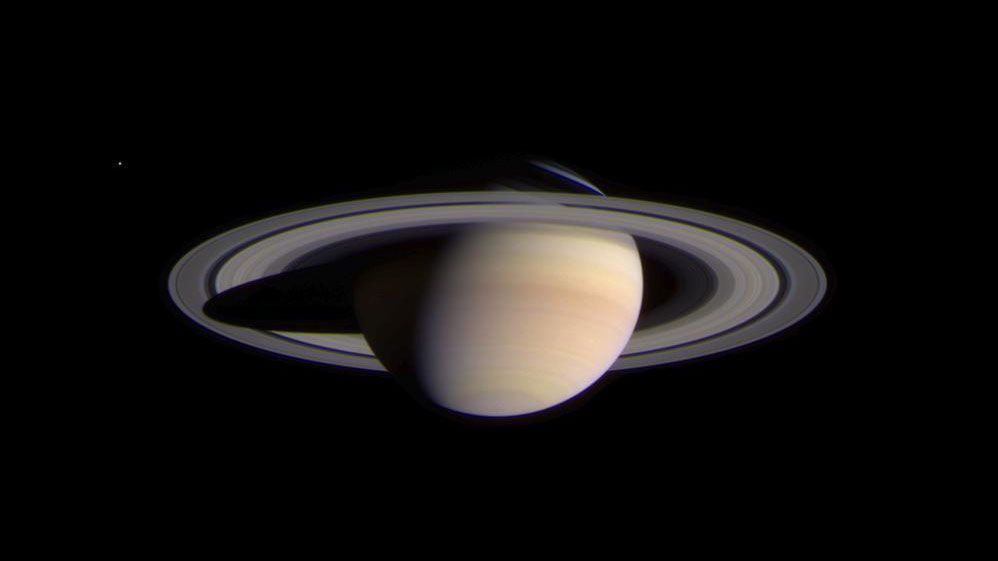
Saturn and its rings photographed by NASA Cassini mission showing the planet, ring system, and subtle banding in the rings

Planetary Viewing Guides • 2026

Best Telescope for Viewing Saturn Rings 2026

Saturn's rings reach a generous 7.5° tilt in 2026 — the best viewing angle since 2024 and an excellent year for the Cassini Division. Here are the telescopes that show ring detail with clarity you can count on.

60mm+

Min Aperture

50×

See Rings

Oct 4

Opposition

7.5°

Ring Tilt

By Telescope Advisor Editorial Team Published: Updated: Editorial Standards

Quick Answer

For the best Saturn ring views in 2026, choose the Sky-Watcher Classic 200P Dobsonian (8-inch). It combines generous aperture with a stable platform and a price well under competing 8-inch GoTo alternatives. On steady nights at 180× magnification, this scope resolves the Cassini Division as a crisp dark line, shows subtle ring banding, and holds Titan and Rhea as distinct stellar points near the planet.

If you prefer GoTo convenience, the Celestron NexStar 8SE delivers equivalent ring detail with automated tracking. For a budget option under $250, the Sky-Watcher Heritage 130P tabletop Dobsonian shows the rings clearly at 100× and fits on a closet shelf.

Saturn reaches opposition on October 4, 2026, when the rings tilt to approximately 7.5°. At this angle the Cassini Division is well within reach of a 130mm telescope, and even a 70mm refractor at 50× shows the rings as two distinct lobes on either side of the planet.

Why Saturn's Rings in 2026 Are Worth Special Attention

Saturn's rings go through a 29.5-year cycle of opening and closing as seen from Earth. This happens because Saturn is tilted by about 26.7 degrees on its axis, and as the planet orbits the Sun, our viewing angle changes. At certain points in the cycle the rings appear wide open (tilted toward us at up to 27 degrees), while at other times they appear edge-on and nearly invisible.

The last ring-plane crossing, when the rings appeared edge-on, occurred in 2009. Since then the rings have been progressively opening, reaching a maximum tilt of about 27 degrees in 2017. After that peak they began slowly closing again. The next ring-plane crossing will occur around 2038 to 2039. This means the rings are in a gradual closing phase through 2026, but they remain at a very respectable tilt for detailed observation.

In 2026 the rings open to approximately 7.5 degrees. This is wide enough that the Cassini Division — a 4,800-kilometer gap between the A and B rings — is easily resolved in a 130mm telescope at moderate magnification. It is also wide enough to reveal subtle differences in brightness between the inner and outer rings. At narrower tilts below 5 degrees, the rings begin to compress visually and fine detail becomes harder to separate against the planet's disk.

Saturn reaches opposition on October 4, 2026. Opposition is significant because Saturn then rises at sunset, reaches its highest point in the sky around midnight, and is at its closest distance to Earth for the year — roughly 1.3 billion kilometers. At opposition the planet appears about 19 arcseconds across, and the ring system spans about 43 arcseconds from tip to tip. This is the moment when atmospheric seeing conditions, if cooperative, give the most stable and detailed views.

Saturn 2026 Fast Facts

Opposition dateOctober 4, 2026
Ring tilt~7.5 degrees (excellent)
Planet magnitude+0.2
Planet diameter~19 arcseconds
Ring span~43 arcseconds
Distance at opposition~1.3 billion km
Visible monthsAugust through December
Best time2 hours before to 2 hours after meridian
Moon phase helpNew Moons Sep 13–27, Oct 12–27

Telescope Requirements by Aperture

Aperture is the single most important specification for Saturn ring detail, but the relationship is not linear. A 60mm scope shows the rings as a basic shape; a 200mm scope transforms them into a textured, layered system. Understanding what each aperture class delivers helps you set realistic expectations.

Aperture Rings Visible? Cassini Division Ring Banding Moons Visible
60–70mmYes, as lobesNoNoTitan
80–90mmClear separationHinted on good nightsNoTitan, Rhea
114–130mmWell definedYes, on steady nightsSubtleTitan + 2–3 others
150–200mmSharp and brightRoutine observationVisibleTitan + 4–5 moons
250mm+SpectacularCrisp and obviousClear banding6+ moons

The ring tilt of 7.5 degrees in 2026 works in your favor across all apertures. At narrower tilts below 5 degrees, the rings overlap the planet more and the Cassini Division becomes harder to separate. At 7.5 degrees, the rings are set apart from the disk by a clean dark gap all around, and the division sits closer to the outer edge of the ring system where it demands less resolution to distinguish.

Magnification Guide for Saturn's Rings

Choosing the right magnification for Saturn is a balancing act between image scale and image stability. Too much power magnifies atmospheric turbulence into a blur. Too little leaves the ring system too small to examine. The useful range depends on your aperture and current seeing conditions.

MagnificationWhat You SeeWhen to Use
30–50×Rings visible as separate lobes; planet appears as a small ovalInitial acquisition, small aperture scopes
75–100×Ring shape clearly defined; Cassini Division hinted on good nightsGeneral observing for 70–90mm scopes
120–180×Cassini Division routinely visible; ring banding starts to appearSteady nights with 130mm+ aperture
200–300×Fine ring detail, Encke gap possible under excellent seeingExcellent seeing, 200mm+ aperture

A good starting point is 20 to 25 times per inch of aperture on average nights. For a 130mm (5-inch) scope, this means 100 to 125 times. For an 8-inch (200mm) scope, 160 to 200 times. Push higher only when the image remains sharp. If it softens, step back down.

Top Telescopes for Saturn Rings in 2026

Editor's Pick — Best Overall for Saturn Rings
Sky-Watcher Classic 200P Dobsonian telescope

Sky-Watcher Classic 200P Dobsonian

The Classic 200P is the best value for dedicated Saturn ring observation. Its 8-inch parabolic primary mirror gathers enough light to resolve the Cassini Division as a sharp, dark feature on every reasonably steady night. At 180 times using a 6.7mm eyepiece, the ring system fills a comfortable portion of the field, and subtle brightness variations between the A and B rings become distinguishable. The Dobsonian mount is simple, intuitive, and free of vibration at medium magnifications.

This scope also excels on deep-sky targets when Saturn season ends. The 1200mm focal length at f/5.9 delivers wide, bright views of nebulae and galaxies. It is a true dual-purpose instrument.

Celestron NexStar 8SE telescope

Runner-Up — Celestron NexStar 8SE

The NexStar 8SE is the best choice for observers who want GoTo tracking. Its 2032mm focal length delivers high native magnification without auxiliary Barlows. The GoTo mount keeps Saturn centered while you study ring detail. The compact OTA is easy to store and transport. The single-arm fork mount can wobble in wind at high power, but on calm nights the views are excellent.

Celestron AstroMaster 70AZ telescope

Budget Pick — Celestron AstroMaster 70AZ

At under $100, the AstroMaster 70AZ proves you do not need a large aperture to see Saturn's rings. At 50 times, the rings are clearly separated from the planet as two distinct lobes. Titan is visible as a bright star near the planet. The 70mm refractor requires no collimation and cools down in minutes, making it a low-friction entry to planetary observation.

Viewing Timing and Strategy for 2026

Saturn is visible from August through December 2026, with the best views concentrated around the October 4 opposition. You do not need to wait for opposition night to see excellent ring detail. The rings are equally well presented from late August through November. What matters more than the exact date is the planet's altitude above the horizon and the stability of the atmosphere along your line of sight.

Saturn reaches its highest point when it crosses the meridian. For most mid-northern latitude observers in the United States, this happens around midnight in September, around 11 PM in October, and around 9 PM in November. Plan your session so Saturn is at least 30 degrees above the horizon. Below 30 degrees, atmospheric dispersion and turbulence degrade the image noticeably.

Atmospheric seeing is the dominant variable for ring detail. You can check seeing forecasts via the Clear Sky Chart or by simply pointing your telescope at a bright star and evaluating the image at 150 times. If the star appears as a steady disk with occasional brief twinkling, conditions are good for planetary observation. If the star dances continuously, Saturn will look soft at high power regardless of your aperture.

Moon phase matters. A bright Moon near Saturn washes out faint ring detail and reduces contrast. The best Saturn viewing windows in 2026 fall around the new Moons of September 13 through 27 and October 12 through 27. During these periods, the Moon is absent from the evening sky and Saturn appears against a darker background.

The Science of Saturn's Rings: What You Are Really Seeing

Saturn's rings are not solid structures. They are composed of billions of individual particles ranging in size from microscopic dust grains to house-sized boulders, all orbiting Saturn in a thin plane. The particles are almost entirely water ice, with trace amounts of rocky material. This composition is why the rings appear bright: ice reflects sunlight efficiently, and even modest aperture gathers enough reflected light to reveal the ring structure.

The main rings visible from Earth through amateur telescopes are the A ring (outer), the B ring (brightest and widest), and the C ring (faint and closer to the planet). The Cassini Division you observe between the A and B rings is not empty space; it is a region where particle density is significantly lower, likely due to gravitational resonance with Saturn's moon Mimas. The Encke Gap, a much smaller division within the A ring, is near the limit of amateur detection and requires excellent seeing and 200mm+ aperture.

NASA's Cassini mission, which orbited Saturn from 2004 to 2017, transformed our understanding of the ring system. Cassini revealed that the rings are much younger than previously believed — likely only 10 to 100 million years old, which is fleeting on astronomical timescales. The mission also discovered propeller-shaped disturbances in the rings caused by embedded moonlets, vertical structures towering above the ring plane, and complex interactions between the rings and Saturn's upper atmosphere. When you observe the rings through your telescope, you are seeing a dynamic system that is actively evolving.

The ring tilt in 2026 provides a favorable perspective for observing these features. At 7.5 degrees, the rings are open enough to clearly distinguish the A and B rings and the Cassini Division between them, while still showing the rings as a three-dimensional structure with the planet's shadow cast across the far side. This shadow is itself a worthwhile observation target: look for a dark notch on the ring edge behind the planet, which demonstrates that the rings are physically separated from Saturn and not an atmospheric phenomenon.

What You Will Actually See at the Eyepiece

Setting realistic expectations for Saturn's appearance at the eyepiece prevents disappointment and helps you recognize genuine detail when it appears. Through a 70mm refractor at 50 times magnification, Saturn appears as a small, bright oval with two wing-like projections on either side. The rings are clearly separated from the planet by dark gaps on both sides, but no additional structure is visible within the rings themselves. Titan appears as a faint star about four ring-widths to the east or west of the planet, depending on its orbital position.

Through a 130mm scope at 100 to 120 times, the view transforms. The rings are now clearly defined as a structured system. The Cassini Division appears as a thin dark line on each side of the rings, though it may appear only intermittently during moments of steady seeing. The planet's disk shows subtle banding, and two or three moons may be visible as faint pinpricks near the planet. The overall impression is of a small but unmistakably three-dimensional object hanging in space.

At 200mm (8 inches) and 180 to 220 times on a steady night, Saturn becomes a showpiece. The Cassini Division is obvious and continuous around the entire ring system. The A and B rings show different brightness levels, with the B ring appearing brighter and slightly yellow. The C ring (crepe ring) may be glimpsed as a faint translucent zone inside the B ring. The planet's disk shows multiple subtle belts. Three to five moons are visible, and on exceptional nights the Encke Gap in the A ring may be suspected.

Accessories That Improve Saturn Ring Views

A few well-chosen accessories can make a noticeable difference in what you see, especially on apertures under 150mm. A planetary contrast filter in light yellow or orange can increase perceived contrast between the rings and the sky background. A quality 2x Barlow effectively doubles your eyepiece collection for fine-tuning magnification to match seeing conditions.

For Newtonian and Dobsonian owners, collimation tools are frequently overlooked but essential. If the mirrors are misaligned, Saturn's rings will appear fuzzy or asymmetrical even though the optics are capable of excellent performance. A laser collimator or Cheshire eyepiece is a worthwhile investment for any reflector owner.

For Schmidt-Cassegrain owners, a dew shield is essential for Saturn observing in autumn. The corrector plate cools rapidly on clear nights and can fog over within 30 minutes. A simple dew shield or heated dew strap prevents this and lets you observe through the full session without interruption.

Frequently Asked Questions

Can any telescope see Saturn's rings?
Yes. Any telescope with at least 60mm aperture and 50 times magnification can show Saturn's rings as distinct from the planet. The rings become more detailed with larger aperture.
Do I need a GoTo telescope to find Saturn?
No. Saturn is one of the brightest objects in the sky and easily visible to the naked eye. Any telescope with a finder scope can be aimed at Saturn manually within seconds.
What is the Cassini Division?
The Cassini Division is a 4,800-kilometer gap between Saturn's A and B rings. In a telescope it appears as a thin dark line separating the rings. It is visible in 130mm+ scopes on steady nights.
Can I see Saturn's rings with binoculars?
Not reliably. At 10 to 15 times, Saturn appears as a small oblong shape through binoculars. A telescope with at least 50 times magnification is needed to clearly separate the rings from the planet.