
What Saturn Really Looks Like Through a Telescope (2026): Honest Views by Aperture
Telescope Advisor Logo Telescope Advisor
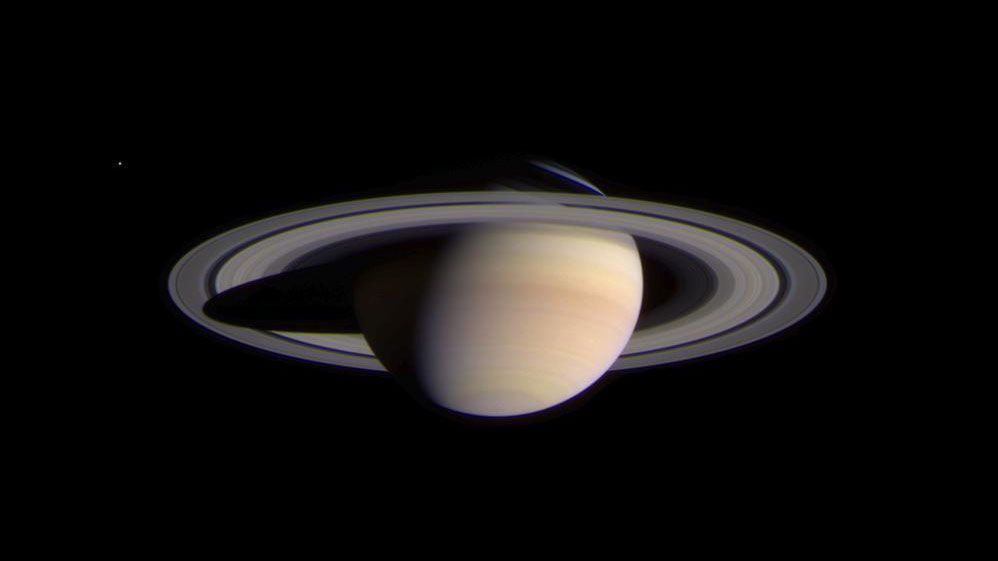
Saturn with ring system in natural color

Planet Guide · Visual Reality Check

What Saturn Really Looks Like Through a Telescope

Saturn is stunning in almost any real telescope, but not in the social-media way most beginners expect. This guide shows what changes with aperture, magnification, and atmospheric seeing so your first view feels impressive instead of disappointing.

60–70mm

Rings clearly separated

100–130mm

Cassini Division occasionally

150–200mm+

Reliable ring and band detail

By Telescope Advisor Editorial Team Published: Updated: Editorial Standards

Quick Answer: The Real Saturn View

In a properly focused 70mm telescope on a steady night, Saturn appears as a tiny golden globe with a detached oval ring structure. It is unmistakable and genuinely exciting. In a 130mm scope, the ring system looks more defined, subtle banding begins to appear, and the Cassini Division may become visible at suitable magnification and seeing. In a 200mm class telescope, ring geometry is cleaner, detail is easier to hold, and moons are more consistently visible in context.

What you should not expect: giant Hubble-like images, saturated colors, or cinematic detail at all times. Saturn is small in angular size. Your best views come from disciplined technique: moderate power first, full cool-down, and observing when Saturn is high above the horizon.

Intent note: this page focuses on visual reality and detail thresholds by aperture. If you need finder workflow, timing windows, and locating instructions, use our separate how-to-see-Saturn guide.

What Saturn Looks Like by Telescope Size

ApertureVisual ResultBest Magnification Window
60–70mmClear ring separation, tiny planetary disk, occasionally Titan.50× to 100×
90–102mmStronger ring contrast, better moon detection, mild atmospheric band hints.80× to 140×
114–130mmCassini Division possible in steady seeing, more robust moon context.100× to 180×
150–200mm+More stable fine detail, easier ring edge definition, stronger low-contrast structure.140× to 240×

Best Telescopes for Honest Saturn Results

Editor's Pick — Planetary Value
Sky-Watcher Heritage 130P telescope

Sky-Watcher Heritage 130P

Best balance of price, aperture, and practical Saturn detail for motivated beginners.

Celestron AstroMaster 70AZ

Celestron AstroMaster 70AZ

Great first scope to see Saturn's rings clearly and build observing skill.

Celestron NexStar 8SE

Celestron NexStar 8SE

Premium compact path for stronger Saturn detail and easier target acquisition.

Ring Geometry Changes What You See

Saturn does not present the same look every year. The ring tilt relative to Earth changes over time, and that directly affects visual impact. When ring tilt is favorable, the system appears broader and easier to read even in smaller apertures. When tilt is shallow, Saturn can look slimmer and less dramatic despite good optics.

This matters for expectation management: if your first Saturn night lands during less favorable geometry, your telescope may still be performing correctly. Ring geometry can make excellent equipment appear underwhelming and modest equipment appear surprisingly good depending on the year and month.

Seeing Benchmarks: What Changes on Steady Nights

Atmospheric seeing is the largest day-to-day variable for Saturn detail. On average nights, Saturn may look attractive but soft. On steady nights, ring edges sharpen, subtle banding appears more consistently, and moon detection improves. Use this benchmark table to set realistic expectations by conditions rather than by marketing claims.

Seeing Quality Typical Saturn View Power Strategy
PoorRings visible but unstable and softStay low-medium power
AveragePleasant ring shape with intermittent detailModerate power with patience
GoodCleaner ring edge and better globe contrastStep power upward gradually
ExcellentBest chance for fine ring and band structureHigh power becomes productive

Saturn Moons and Fine Detail: Realistic Progression

Titan is commonly visible in small and medium telescopes, while fainter moons depend on sky darkness, aperture, and transparency. Beginners often underestimate how much moon visibility changes with local sky conditions. If your first sessions are from a bright suburban location, seeing only Titan is normal and still a success.

As observing skill improves, your Saturn sessions become less about "is Saturn visible" and more about "how much structure can I hold steadily." This shift is where Saturn becomes a long-term target. You can use the same telescope for years and continue to extract more detail through better timing, steadier nights, and practiced technique.

Aperture-Specific Session Plans

60-70mm refractor session

  1. Start at 40x-60x to center and stabilize the target.
  2. Move to 80x-100x only if image remains calm.
  3. Focus on ring separation and Titan confirmation.

114-130mm reflector session

  1. Verify collimation before planetary viewing.
  2. Observe at 120x-160x during average seeing.
  3. Attempt intermittent Cassini Division detection during stable moments.

150-200mm class session

  1. Allow full thermal stabilization before high power.
  2. Work in 160x-240x, increasing only when focus snap holds.
  3. Track subtle globe shading and ring edge quality over time.

Why Beginners Feel Disappointed (and How to Avoid It)

Most disappointment comes from comparing visual observing to processed astrophotography. Eyepiece views are smaller and subtler, but also immediate and personal. If you enter with realistic expectations, Saturn is one of the most rewarding first-planet targets in amateur astronomy.

  • Do not judge a telescope by one poor-seeing night.
  • Do not start with maximum magnification.
  • Do not skip cooldown or collimation checks on reflectors.
  • Do compare repeated sessions under different sky conditions.

A 25-Minute Saturn Observing Script

  1. Minute 0-5: Acquire Saturn at low power and lock precise focus.
  2. Minute 5-10: Move to medium power and evaluate seeing stability.
  3. Minute 10-15: Attempt finer ring detail during calmer moments.
  4. Minute 15-20: Check for Titan and nearby moons.
  5. Minute 20-25: Log observed details and power that gave best clarity.

Using a script like this turns Saturn from a quick glance into a structured observation. It also helps you improve from session to session and measure progress objectively.

Visual View vs Processed Photo: Why They Differ

Most first-time disappointment comes from comparing a live eyepiece view to heavily processed images. Camera workflows stack frames, sharpen selectively, and stretch contrast. Your eye sees a real-time image through moving atmosphere. Both are valid experiences, but they are not the same output.

The reward of visual Saturn observing is immediacy. You are seeing the ringed planet directly, with your own timing and technique. As your observing skill improves, the visual image becomes richer. You start noticing moments of extraordinary steadiness where structure appears with surprising clarity.

This distinction also prevents intent overlap: imaging pages should cover capture and processing, and tracking pages should cover acquisition steps. This guide stays focused on what your eye is likely to see at the eyepiece.

Eyepiece Strategy for Cleaner Saturn Detail

A disciplined eyepiece sequence outperforms random swapping. Start with low power to establish clean focus and stable tracking. Move to medium power where ring structure is obvious but still bright. Use high power only when the image remains calm over several minutes.

  1. Low power: center Saturn and refine focus on ring edge contrast.
  2. Medium power: evaluate globe shading, ring thickness, and Titan placement.
  3. Higher power: attempt Cassini or subtle banding only during stable intervals.

If high power softens the view continuously, step back down. A sharper medium-power image is more useful than a larger blurred image.

Session Log Template for Faster Improvement

Observers improve fastest when they track what worked. Saturn is ideal for this because details vary with seeing and timing. A simple log lets you replicate your best sessions instead of relying on memory.

  • Time and target altitude at best-detail moments
  • Eyepiece used and most productive magnification range
  • Seeing estimate and transparency notes
  • Details seen: ring edge quality, globe shading, moon detections
  • Actions that improved view: cooldown wait, lower power, refocus cadence

After several sessions, your log becomes a personal playbook. You will know exactly which setup choices produce your sharpest Saturn view with your specific telescope and site.

High-Probability Success Checklist for First-Time Saturn Viewers

  1. Observe when Saturn is reasonably high above the horizon.
  2. Allow complete cooldown before evaluating sharpness.
  3. Start with low power, then move gradually upward.
  4. Avoid observing over roofs and heat sources.
  5. Use realistic expectations: small, elegant, and unmistakable ringed form.

Following this checklist makes a successful first Saturn session highly likely even in entry-level instruments. The planet remains one of the most dependable "wow" targets in amateur astronomy when approached with practical technique.

Long-Term Saturn Progression: What Improves Over Time

Saturn is one of the best planets for skill progression because it rewards repeated practice. During your first sessions, the main win is ring separation and stable focus. Within a few weeks, you begin to notice steadier moments where ring contrast and globe shading become clearer. Over months, your ability to predict productive magnification and identify best-seeing windows improves more than most hardware upgrades in the same time frame.

This is why experienced observers can seem to extract more from similar equipment. They are not forcing impossible magnification. They are timing sessions, choosing calmer air, and using disciplined focus and eyepiece transitions. Saturn teaches patience better than almost any other bright target because detail appears in brief calm intervals rather than as a constant static image.

If your first view is smaller than expected, keep going. A realistic and steadily improving Saturn view is one of the most satisfying experiences in visual astronomy. It combines technical skill, atmospheric awareness, and direct observation in a way that remains rewarding even after years in the hobby.

A practical mindset helps: treat each session as a data point, not a final verdict. Record your best magnification, seeing quality, and which details were repeatable. Over time, this creates a personal Saturn playbook that is more reliable than generic internet settings. You will quickly learn what your telescope can deliver from your location and when to wait for better conditions. That confidence reduces frustration and makes every clear night more productive, whether you are showing Saturn to family for the first time or refining your own observing standards.

Frequently Asked Questions

Can a 70mm telescope really show Saturn's rings?

Yes. Ring separation is visible and unmistakable in a properly focused 70mm telescope.

What magnification is best for Saturn?

Most sessions perform best in the 80× to 180× range depending on aperture and seeing.

Why does Saturn look blurry at high power?

Usually atmospheric seeing, insufficient cool-down, or magnification beyond current conditions.

Can you see the Cassini Division in a beginner scope?

It is possible in 114–130mm class scopes on steady nights, but not guaranteed every session.