
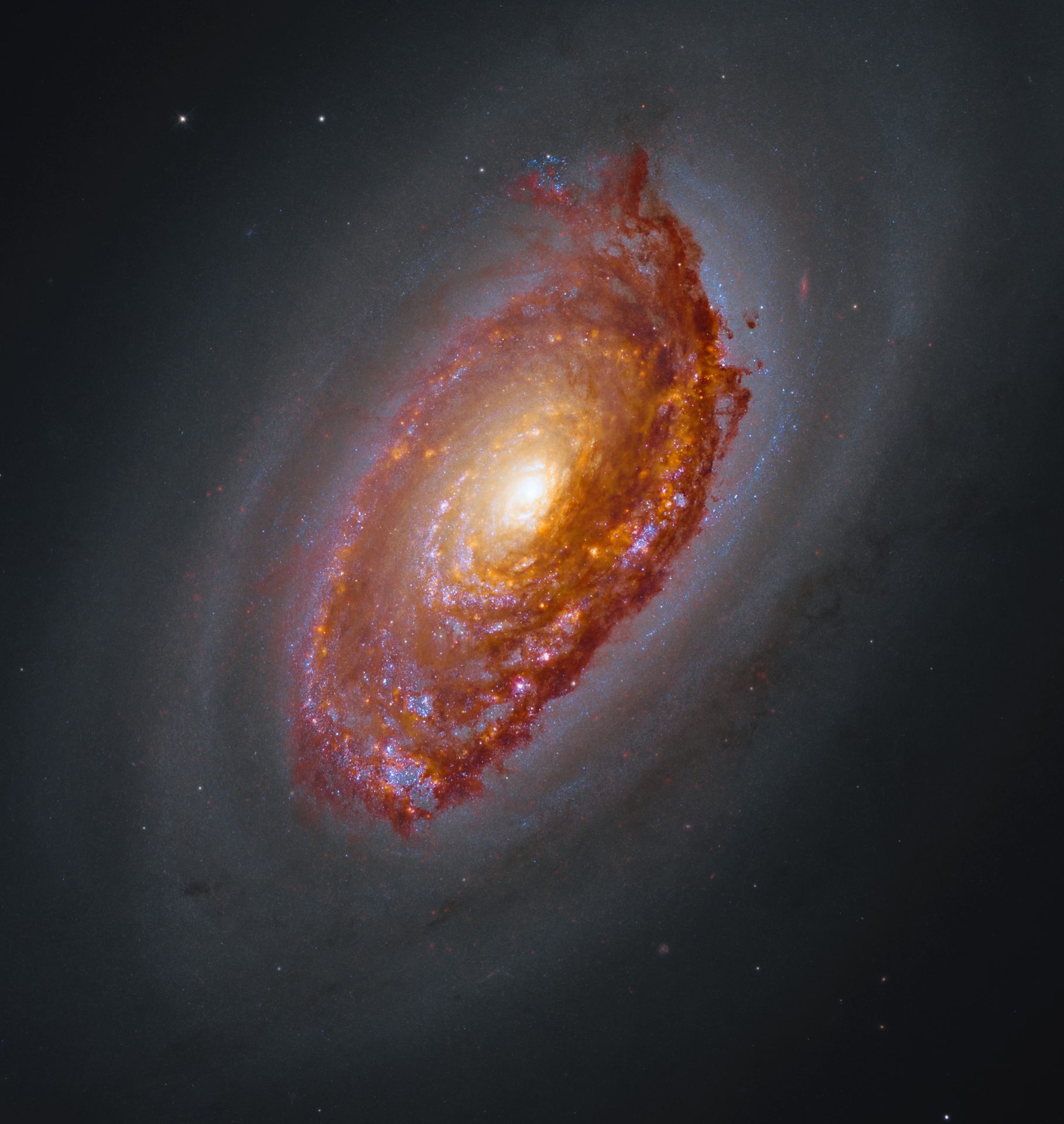
A New View of the Black Eye Galaxy
On June 12, 2026, NASA released a breathtaking new composite image of Messier 64 — better known as the Black Eye Galaxy — created by combining data from two of humanity's most powerful space observatories: the Hubble Space Telescope and the James Webb Space Telescope. The image, captured on March 20, 2026, showcases the galaxy at near- and mid-infrared wavelengths from Webb, while Hubble contributes ultraviolet, visible, and additional near-infrared light. The result is a multi-wavelength portrait that reveals details invisible to any single observatory.
The Black Eye Galaxy, located approximately 17 million light-years from Earth in the constellation Coma Berenices, is one of the most recognizable galaxies in the northern sky thanks to the dramatic band of dark dust that partially obscures its bright core — giving it the appearance of a "black eye" when viewed through moderate-sized telescopes. First catalogued by Charles Messier in 1779, M64 has fascinated astronomers for centuries, but it is only with the combined power of Hubble and Webb that we can fully appreciate the complexity of this striking spiral galaxy.
The image was processed by Gladys Kober at NASA's Catholic University of America, using data from the PHANGS (Physics at High Angular Resolution in Nearby Galaxies) survey — a major international collaboration that uses Hubble, Webb, ALMA, and the Very Large Telescope to study star formation across the local universe.