
NASA News · Webb 4th Anniversary · July 2026
Webb Reveals Centaurus A in Stunning New Detail for 4th Anniversary
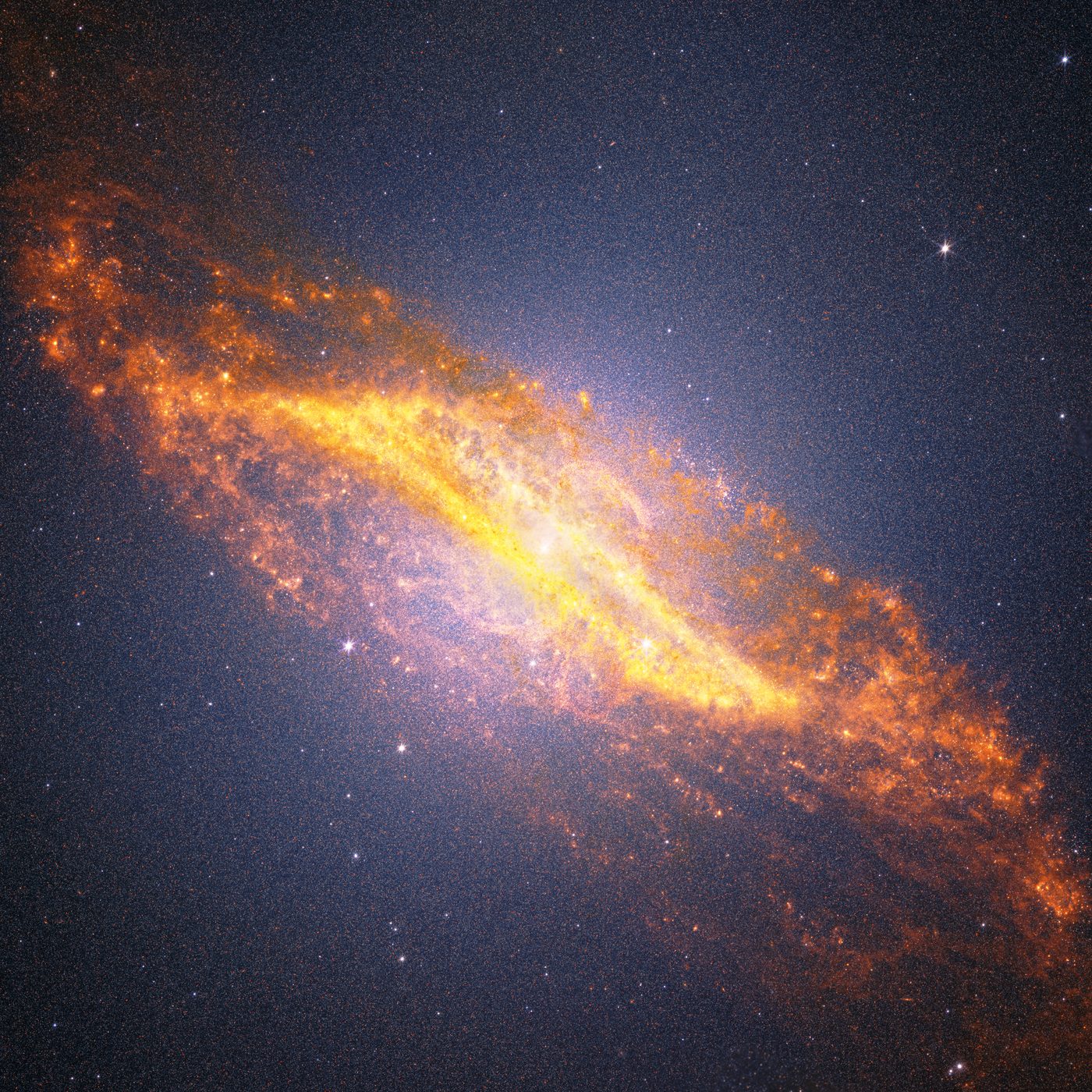
NASA's James Webb Space Telescope has captured the nearby active galaxy Centaurus A in unprecedented infrared detail to celebrate its fourth science anniversary. The new images reveal millions of individually resolved stars, a warped disk of gas and dust left behind by an ancient galactic collision, and a supermassive black hole actively shaping the galaxy around it.
TargetCentaurus A (NGC 5128)
Distance11 million light-years
ConstellationCentaurus
InstrumentsWebb NIRCam + MIRI
By Elena Reyes
|
Published:
|
Updated:
|
Reviewed & approved by Juhi Sahni, Senior Editor
Editorial Standards

Elena Reyes
Senior Science Editor
Covers NASA missions, space science discoveries, and astronomical events for Telescope Advisor. Translates complex astrophysical research into practical insights for backyard observers. Based in the San Francisco Bay Area.
Content reviewed by our editorial team. Research and drafting assisted by AI to ensure unbiased, data-driven analysis. Learn more about our editorial process.
Centaurus A: A Galaxy Shaped by Cosmic Collision
Centaurus A (also known as NGC 5128 and Caldwell 77) is one of the closest active galaxies to Earth, located just 11 million light-years away in the southern constellation Centaurus. Classified as a starburst galaxy with an active galactic nucleus, Centaurus A is a hybrid object — its elliptical shape bears the scars of a major collision with another galaxy approximately two billion years ago, while its intense star formation and powerful black hole activity make it one of the most studied objects in the night sky.
The galaxy's most distinctive visual feature is a broad band of dark dust that cuts across its center at a dramatic angle — the legacy of that ancient merger. This parallelogram-shaped dust lane, now revealed in stunning detail by Webb, contains the raw material for new stars and planets. Unlike most nearby galaxies, Centaurus A is remarkably active, making it a powerful laboratory for understanding how galaxies and supermassive black holes grow and evolve together.
Visible light observations from NASA's Hubble Space Telescope could not penetrate the thick dust obscuring Centaurus A's central region, while NASA's retired Spitzer Space Telescope revealed large-scale infrared structures without resolving individual stars. Now, Webb brings both clarity and depth, exposing the galaxy's inner workings star by star across near- and mid-infrared wavelengths simultaneously.
What Webb Saw Through the Dust
Webb's combined NIRCam (Near-Infrared Camera) and MIRI (Mid-Infrared Instrument) observations, taken between January 22 and March 16, 2026, cut through the thick lanes of dust that have long obscured Centaurus A's inner workings in visible light. The result is a densely packed tapestry of millions of individual stars surrounding an active, ever-changing galactic core — a view that no previous telescope could provide.
The mid-infrared view from MIRI highlights the galaxy's rich dust structures, which glow in intricate shapes that surprise and even perplex astronomers. A warped, parallelogram-like band cuts across the galaxy's center, while wisps of material stretch outward like cosmic clouds. Many of the glowing red points in the MIRI image are dust-rich stars or stellar nurseries, where aging stars are shedding material back into space or new stars are forming.
In the combined NIRCam and MIRI view, what first appears as a grainy glow is actually a dense field of millions of individually resolved stars. By distinguishing different generations of stars embedded throughout the dusty center, Webb gives astronomers new clues to the galaxy's history and the processes that continue to shape it. The near-infrared component brings out the galaxy's dense stellar population while the mid-infrared reveals the warm dust that visible light cannot show.
Dust, Awe and the Mysterious S-Shaped Feature
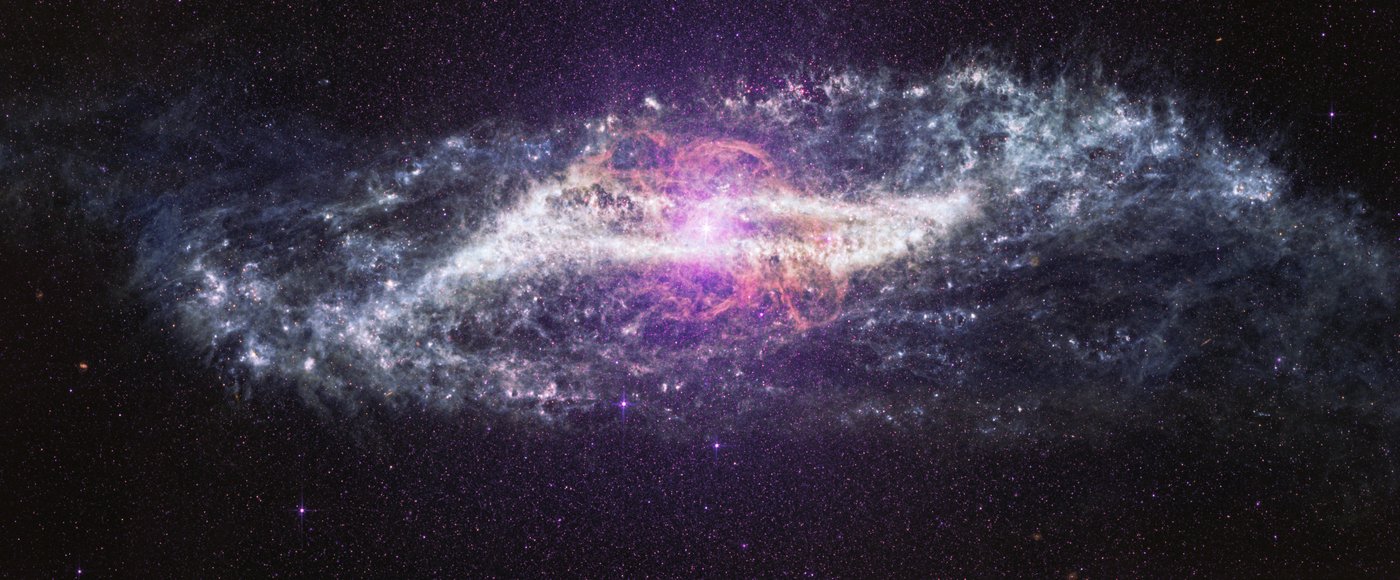
Webb's mid-infrared vision highlights the galaxy's rich dust structures, which glow in intricate shapes that surprise even seasoned astronomers. A warped, parallelogram-like band cuts across the galaxy's center — the remnant of the collision that merged two galaxies billions of years ago. Wisps of material stretch outward from this band like cosmic clouds, tracing the gravitational interactions that continue to shape the galaxy.
Most intriguing is an S-shaped feature visible in both the MIRI and combined images. This delicate structure arcs above the galaxy's core, its origin currently unknown. Astronomers are actively investigating several possibilities: Is it shaped by the supermassive black hole's jets? Is it influenced by merger-induced star formation? Or does it represent something entirely unexpected? The feature invites questions that will require further study to answer.
"No single telescope tells the whole story," said Shawn Domagal-Goldman, division director of Astrophysics at NASA Headquarters in Washington. "Discoveries build over time and new observatories expand on the foundations laid by earlier missions. Webb represents the most powerful step forward yet, opening a window into wavelengths and details never before accessible. This allows astronomers to examine structures and processes that other telescopes could not see."
Galactic Archaeology: Reading the Stars
With Webb's high resolution, astronomers can now study Centaurus A star by star — even in its long-obscured central region. What looks grainy in the combined NIRCam and MIRI view is actually a densely packed field of individual stars, each carrying information about the galaxy's past. This is galactic archaeology: by analyzing the ages, compositions, and distributions of these stars, scientists can reconstruct a timeline of Centaurus A's evolution.
Each star revealed helps to reconstruct when different events happened: when older stars first formed in the original elliptical galaxy, when star formation activity slowed, the burst of star formation triggered by the galactic collision two billion years ago, and the stars born from gas stirred in the collision's aftermath. Together, they form a timeline of the galaxy's evolution stretching back billions of years.
This kind of analysis was impossible before Webb. Previous infrared observatories like Spitzer could detect the presence of warm dust and large-scale structures in Centaurus A, but they could not resolve individual stars at the galaxy's busy center. Webb's combination of sharp resolution and infrared sensitivity opens an entirely new window into how galaxies evolve after major mergers — and Centaurus A, being one of the closest such examples, provides an ideal laboratory for this research.
The Supermassive Black Hole Driving the Galaxy
At Centaurus A's core sits a supermassive black hole actively feeding on surrounding material. As it consumes gas and dust, the black hole launches powerful jets and releases enormous amounts of energy, shaping the galaxy around it. Webb's capabilities go beyond imaging — by analyzing light with spectroscopy, astronomers can measure how gas moves within the galaxy, providing direct insight into the black hole's influence on its surroundings.
Early findings from Webb show fast-moving ionized gas flowing outward from the galactic center, likely driven by the black hole's activity. The observations also reveal warmer molecular hydrogen in a warped rotating disk near the center. These measurements help explore one of astronomy's biggest questions: How does a supermassive black hole influence an entire galaxy?
The answer appears to be complex and multifaceted. The black hole can both trigger star formation by compressing gas clouds and limit it by pushing material away with its jets and outflows. Centaurus A offers a rare, nearby view of this cosmic interplay — a dynamic system where the black hole and the galaxy evolve together in a continuous feedback loop. By tracing dust in never-before-seen detail, resolving millions of stars, and revealing the motion of gas near the black hole, Webb transforms Centaurus A into a vivid record of cosmic history.
Webb's 4th Anniversary: A Legacy of Discovery
These images mark four years of better-than-anticipated performance and successful science operations for the most powerful space telescope in history. Launched on December 25, 2021, and beginning science operations in July 2022, Webb has transformed our understanding of the universe across virtually every field of astrophysics — from the earliest galaxies in the first billion years after the Big Bang to the atmospheres of exoplanets orbiting distant stars.
Webb's fourth anniversary image of Centaurus A is a fitting testament to the telescope's capabilities. The image simultaneously demonstrates Webb's ability to resolve individual stars in a nearby galaxy, trace complex dust structures in the infrared, and reveal the dynamic interplay between a supermassive black hole and its host galaxy — all in a single observation.
The James Webb Space Telescope is the world's premier space science observatory. Webb is solving mysteries in our solar system, looking beyond to distant worlds around other stars, and probing the mysterious structures and origins of our universe and our place in it. Webb is an international program led by NASA with its partners, ESA (European Space Agency) and CSA (Canadian Space Agency).
Can You See Centaurus A?
Centaurus A (NGC 5128) is one of the finest southern-hemisphere deep-sky objects and is visible to observers located south of approximately 20° north latitude. At magnitude 6.6, it is bright enough to be spotted with binoculars under dark skies, though its full character requires a telescope.
Through a 6-inch (150mm) telescope under moderately dark skies, Centaurus A appears as a bright, elongated oval with a prominent dark lane cutting across its center — the same dust band that Webb reveals in such extraordinary detail. An 8-inch or larger scope shows the dark lane more clearly, and under excellent conditions, the elliptical glow of the galaxy extends well beyond the central dust band. The galaxy spans approximately 18 by 14 arcminutes on the sky — about half the apparent diameter of the full Moon.
Centaurus A is best observed during the southern autumn and winter (March through August) when it passes highest in the sky. It is located near the border between Centaurus and Hydra. A good star atlas or GoTo telescope will help locate it. For northern-hemisphere observers, the galaxy appears low on the southern horizon and may be difficult or impossible to observe from latitudes above 40° north. For more tips on observing galaxies, see our best galaxies for light-polluted skies guide and our constellations guide.
Also popular on Telescope Advisor
⚡ Prime Big Deal Days Telescope Deals
Oct 6–7 — what to buy this week
🎄 Telescope Christmas Gift Guide 2026
Every budget and recipient covered
Telescope Black Friday Deals 2026
Live deal tracking from Nov 20
How to Choose a Telescope
7-step buyer’s framework
Best Telescopes for Beginners 2026
13 reviewed & ranked picks
How Much Does a Telescope Cost?
Price guide: $80 → $2,500+
Frequently Asked Questions
What is Centaurus A?
Centaurus A (NGC 5128, Caldwell 77) is a starburst active galaxy located 11 million light-years from Earth in the constellation Centaurus. It is one of the closest active galaxies and is known for its prominent dust lane, radio emissions, and supermassive black hole.
What did Webb discover about Centaurus A?
Webb's infrared observations revealed millions of individually resolved stars in Centaurus A's core, a warped parallelogram-shaped dust disk from an ancient galactic collision, a mysterious S-shaped structure near the center, and fast-moving ionized gas driven by the supermassive black hole. These details were previously hidden behind thick dust layers that visible-light telescopes could not penetrate.
How far away is Centaurus A?
Centaurus A is approximately 11 million light-years from Earth, making it one of the closest active galaxies to our own Milky Way. Its relative proximity is why Webb can resolve individual stars within it.
Can I see Centaurus A with my telescope?
Yes! Centaurus A is visible in binoculars and small telescopes under dark skies. At magnitude 6.6, it appears as an elongated oval with a dark lane across its center in telescopes of 6 inches or larger. It is best observed from the southern hemisphere or low northern latitudes between March and August.
What is special about Webb's 4th anniversary image?
Released on July 6, 2026, the image of Centaurus A marks four years of Webb's science operations. It demonstrates the telescope's ability to simultaneously resolve individual stars, trace complex dust structures, and reveal the interaction between a supermassive black hole and its host galaxy — capabilities no previous telescope could combine.
What is the S-shaped feature in Centaurus A?
The S-shaped feature is a mysterious structure visible in Webb's mid-infrared images of Centaurus A, arcing above the galaxy's core. Its origin is currently unknown — it could be shaped by the supermassive black hole's jets, influenced by merger-induced star formation, or represent something entirely new that requires further study.
Continue Exploring
Keep the session going with the next useful answer
Choose the next page based on whether you need a recommendation, a comparison, or a practical observing plan.
Get a Telescope Recommendation
Fastest path if you want one model instead of another long guide.
Use the Buyer Framework
See the decision order that matters before you buy.
Plan Your Next Session
Turn your gear into a concrete observing list for tonight.
⚡ On sale now: Prime Big Deal Days telescope deals · or wait for Black Friday?
🎄 Holiday season: Telescope Christmas Gift Guide 2026 · Black Friday deal tracking
Sources
Explore More
🌟
🪐
💨
🌌
📱
⭐
Webb Reveals Baby Stars in FS Tau
Protostars and outflows in Taurus.
Exoplanet Survived Star Death
WD 1856 b and planetary survival.
Webb Maps Cigar Galaxy Outflows
M82's superwind mapped in detail.
Best Galaxies for Light-Polluted Skies
Top deep-sky targets for urban observers.
Best Astronomy Apps
Star maps and observing tools ranked.
Complete Constellations Guide
All 88 constellations and how to find them.