

Webb Pinpoints 16.5 Million Stars Inside the Cigar Galaxy (M82)
Telescope Advisor Logo Telescope Advisor
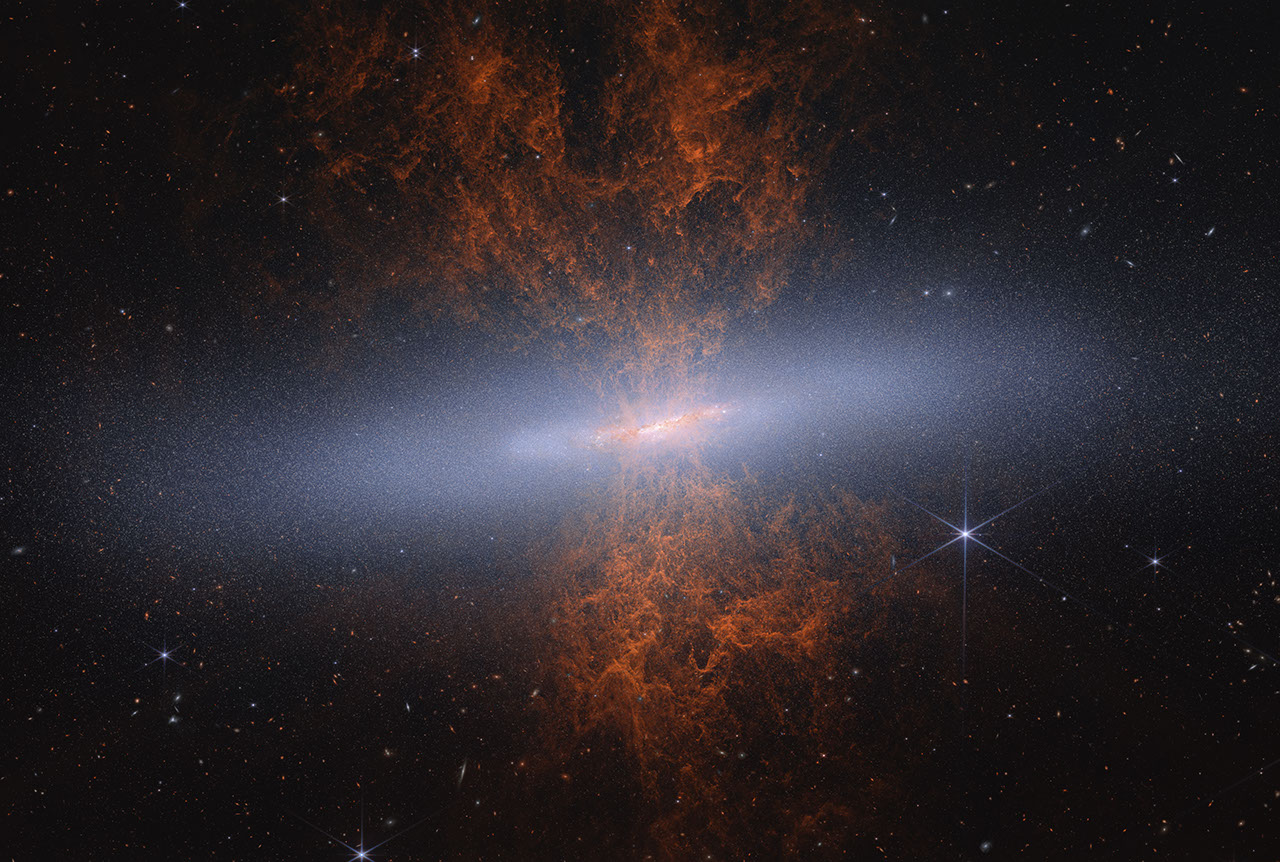
NASA Webb NIRCam composite image of the Cigar Galaxy M82 — a chaotic starburst galaxy with glowing filaments and outflow plumes of orange and red extending above and below a bright central core, set against a field of surrounding stars

NASA News · Webb Galaxy Science · June 2026

Webb Pinpoints 16.5 Million Stars Inside the Cigar Galaxy

A 65-hour stare with NASA's James Webb Space Telescope has produced the most detailed stellar census of a starburst galaxy ever made — resolving approximately 16.5 million individual stars inside M82, the Cigar Galaxy, 12 million light-years away. For the first time, astronomers can count and study the individual stars fueling one of the universe's most violent episodes of star birth.

Stars Resolved~16.5 Million
Distance12 Million Light-Years
Survey Length65 Hours (NIRCam)
Star Formation Rate10× the Milky Way
By Elena Reyes Published: Updated: Editorial Standards
Elena Reyes — Senior Science Editor

Elena Reyes

Senior Science Editor

Covers NASA missions, space science discoveries, and astronomical events for Telescope Advisor. Translates complex astrophysical research into practical insights for backyard observers. Based in the San Francisco Bay Area.

A Galaxy Seen Star by Star — For the First Time

When astronomers aim a telescope at the Cigar Galaxy, they are looking at organized chaos. Messier 82 — the informal nickname "Cigar Galaxy" comes from its elongated, edge-on shape — is in the grip of a starburst: a rare, violent episode of star formation so intense it makes the Milky Way's own star-birthing activity look tranquil by comparison. The problem has always been the dust. Dense clouds of interstellar dust drape M82's central regions, scattering and absorbing visible light and hiding the individual stars from every optical telescope ever pointed at it.

NASA's James Webb Space Telescope changed that permanently. Using its Near-Infrared Camera (NIRCam) in a painstaking 65-hour imaging survey, Webb's infrared sensitivity cut through M82's dust curtain like it wasn't there. The result: a census of approximately 16.5 million individual stars — the most detailed stellar population study ever completed for a starburst galaxy. "The sheer number of stars that we were able to resolve with Webb is incredible," said Benjamin Williams of the University of Washington, a member of the research team. "It's a whole different world."

The findings reveal not just how many stars M82 contains, but the entire anatomy of a starburst in action: the distorted shape of a galaxy mid-collision, hourglass-shaped outflow plumes of gas and dust being blasted into intergalactic space, and the violent interplay between newborn stars and the interstellar material from which they formed. Principal investigator Adam Smercina of the University of Washington put it plainly: "M82 is a mess, but it's a beautiful mess." The dataset, he added, provides "a simultaneous window onto many astrophysical questions" — a scientific jackpot that researchers will mine for years.

NASA Webb NIRCam image of the Cigar Galaxy (M82) showing glowing orange and red outflow filaments extending perpendicular to the galaxy's central disk, surrounded by thousands of resolved individual stars on a deep black sky background
The Cigar Galaxy (M82) — Webb NIRCam Composite — Webb's Near-Infrared Camera resolves approximately 16.5 million individual stars through M82's dense dust, revealing the galaxy's starburst core, distorted disk, and the hourglass-shaped outflow plumes of ionized gas (yellow) and polycyclic aromatic hydrocarbon dust (orange) being expelled above and below the galactic plane. M82 is 12 million light-years away. Credit: NASA, ESA, CSA, STScI.


What Is the Cigar Galaxy (M82)?

Messier 82 — catalogued by Charles Messier in 1774 — is an irregular galaxy in the constellation Ursa Major, located approximately 12 million light-years from Earth. At that distance, it is one of the closest starburst galaxies to our own Milky Way, which is part of what makes it such a prized target for study. Its informal name, the Cigar Galaxy, comes from its elongated, edge-on profile as seen from Earth: a bright, narrow smear of light with dramatic red filaments erupting from both ends.

M82 has not always looked this way. Billions of years ago it was probably a relatively ordinary irregular galaxy. What transformed it was a gravitational encounter with its massive spiral-galaxy neighbor, M81 (the Bode's Galaxy). Over the course of their interaction, M81's gravity pulled tidal streamers of gas and stars from M82, compressed its interstellar medium, and ignited the furious episode of star formation that continues today. The two galaxies — along with a third, NGC 3077 — form a physically bound group called the M81 Group, and their mutual gravitational influence continues to shape M82's destiny.

The starburst is extreme by any measure. M82 creates new stars at a rate roughly ten times higher than the entire Milky Way — and concentrates much of that activity in a region just a few thousand light-years across at its core. This intensity cannot last. Astronomers estimate M82's current starburst phase, fueled by the compressed gas from its interaction with M81, will exhaust its readily available star-forming material within a few hundred million years — a brief episode in cosmic terms, but one that Webb has now captured in extraordinary detail.

Key facts: Cigar Galaxy (M82)

  • Messier designation: M82 (NGC 3034)
  • Constellation: Ursa Major
  • Distance: ~12 million light-years
  • Type: Starburst irregular galaxy (edge-on)
  • Star formation rate: ~10× the Milky Way
  • Stars resolved by Webb: ~16.5 million (NIRCam, 65-hour survey)
  • Companion galaxy: M81 (Bode's Galaxy) — the trigger of the starburst
  • Visible to amateurs: Yes — binoculars and small telescopes under dark skies

🔭

Not sure which telescope actually fits your goals?

Answer 5 quick questions about your budget, observing targets, and experience level — our Telescope Finder Tool recommends a specific model in under 2 minutes.

Find My Telescope →

How Webb Counted 16.5 Million Stars

The key to Webb's achievement at M82 is its combination of mirror size and infrared sensitivity. Visible-light telescopes — including the Hubble Space Telescope — simply cannot penetrate the thick dust lanes that cloak M82's interior. Infrared light, with its longer wavelengths, passes through dust grains rather than scattering off them, the same way a fog light uses red wavelengths to cut through atmospheric moisture. Webb's 6.5-meter mirror, cooled to near absolute zero and equipped with NIRCam (Near-Infrared Camera), is the most powerful such instrument ever deployed in space.

The survey itself was a marathon. The team accumulated 65 hours of NIRCam imaging of M82 — a significant investment of Webb's limited and heavily oversubscribed observing time. The result is a mosaic of unprecedented resolution and depth, allowing the team's automated stellar-detection algorithms to identify and measure approximately 16.5 million point sources as individual stars. Previous observatories could see only the blurred glow of unresolved stellar populations; Webb sees the individual members.

Williams explained the magnitude of the advance: "The sheer number of stars that we were able to resolve with Webb is incredible. It's a whole different world." For context, the entire visible stellar population of the Andromeda Galaxy — our nearest large galaxy neighbor — has been partially resolved by Hubble. M82 is further away and far more dusty, making Webb's 16.5-million-star census at that distance all the more remarkable. The dataset will allow astronomers to directly measure stellar ages, masses, and chemical compositions across M82's starburst region for the first time.

Why infrared wins over visible light: M82's interstellar dust efficiently blocks blue and visible light but becomes nearly transparent at the near-infrared wavelengths Webb observes (roughly 0.6–5 microns). It's the same principle that makes sunsets red: shorter wavelengths scatter away while longer ones pass through. Webb's NIRCam exploits this window to see straight into the galaxy's core.

The Anatomy of a Starburst: What 10× Means

The Milky Way is not a passive galaxy — it forms roughly one to two new stars per year across its 100,000-light-year disk. For most galaxies, that rate is considered normal. M82 does something entirely different. Its starburst core converts gas into new stars at a rate ten times higher than the Milky Way's total output — and compresses that activity into a region a fraction of the size. The result is a stellar nursery so intense that the radiation and stellar winds from millions of newborn massive stars collectively overpower the galaxy's gravitational grip on its own gas.

Webb's 65-hour survey revealed the distended disk structure and distorted shape of M82 — hallmarks of a galaxy that has been gravitationally perturbed by the encounter with M81. The disk is not a clean flat plane but warped and extended, with star-forming knots scattered across a region larger than would be expected for a normal irregular galaxy of M82's mass. This distorted architecture is the fingerprint of a tidal interaction still playing out across millions of years.

Smercina captured the dual nature of the data: "M82 is a mess, but it's a beautiful mess." The galaxy simultaneously provides windows onto stellar evolution, interstellar chemistry, galactic dynamics, and feedback physics — the processes by which newborn stars regulate (and ultimately terminate) the star formation episode that created them. Kristen McQuinn, another member of the team, noted that combining the Webb data with observations from other telescopes "reveals complex questions about galaxy evolution that single missions cannot answer alone."

M82 starburst vs. Milky Way: a scale comparison

Property M82 (Cigar Galaxy) Milky Way
Star formation rate ~10 M☉/yr ~1–2 M☉/yr
Active region size ~500 pc (core) ~30,000 pc (disk)
Cause of current activity Interaction with M81 Ongoing spiral arm density waves
Duration of starburst ~Few hundred million years N/A (quiescent disk)


The Hourglass Outflows: Gas Escaping the Galaxy

One of the most visually dramatic features of the Webb image is the hourglass-shaped outflow structure extending above and below M82's disk — the galaxy's iconic red filaments, now seen with infrared eyes in extraordinary new detail. These outflows are not decorative; they represent one of the most consequential processes in galaxy evolution: stellar feedback. The collective radiation pressure, ultraviolet light, and supersonic winds from millions of massive newborn stars in M82's core are literally blowing the galaxy's gas out into intergalactic space.

In the Webb data, the composition of these outflows is revealed in color. Yellow material near the center of M82's outflow represents ionized hydrogen gas — hydrogen atoms that have been stripped of their electrons by the intense ultraviolet radiation from young, hot stars. Orange regions depict polycyclic aromatic hydrocarbon (PAH) dust grains — complex organic molecules that are among the most abundant molecules in the interstellar medium, formed in the envelopes of dying stars and carried outward by the galactic wind.

The fate of this material matters enormously for the future of M82 and for our understanding of galaxy evolution in general. Gas and dust expelled in the outflow either escapes M82's gravitational well entirely — enriching the intergalactic medium with metals forged in M82's stars — or falls back eventually, potentially fueling a future burst of star formation. The mass budget of these outflows, which Webb can now constrain better than ever, is a key quantity in models of how starburst galaxies evolve and die.

★ What you see in the Webb image: The iconic orange and red wisps extending perpendicular to M82's disk are not flames — they are emission from gas and organic molecules being driven outward at hundreds of kilometers per second. Webb's NIRCam captures them in false-color: yellow = ionized H, orange = polycyclic aromatic hydrocarbons (PAHs). The white and blue point sources scattered throughout are the 16.5 million individual stars now resolved for the first time.

Why This Discovery Changes Galaxy Science

The resolution of 16.5 million individual stars in M82 is not just a technical landmark — it fundamentally changes what astronomers can ask about starburst galaxies. Previously, the study of M82's stellar population relied on integrated-light measurements: the combined glow of millions of unresolved stars analyzed statistically. This is like trying to understand a crowd by measuring the average sound level rather than hearing individual voices. Webb's resolved census lets astronomers hear each star separately.

With individual stellar measurements, the team can build what astronomers call a color-magnitude diagram — a plot of each star's brightness versus its color that directly reveals stellar ages and masses. By mapping how stellar ages vary across M82's disk, they can reconstruct the history of the starburst: when it began, how it spread, and which regions are most actively forming stars right now. This is the equivalent of reading the geological layers of the galaxy's star-formation history, with each stellar population a distinct stratum.

The implications extend far beyond M82. Starburst galaxies are not rare objects — in the early universe, when galaxies were actively building the bulk of their stellar mass, starburst-like episodes were far more common. By studying M82 in unprecedented detail at our cosmic doorstep, astronomers build and test the models they use to interpret observations of far more distant starburst galaxies, where individual stars will never be resolved by any telescope. M82 is, in this sense, the Rosetta Stone of starburst physics — and Webb has just handed us the key to read it.

Can You See M82 Through Your Backyard Telescope?

Here is where M82 becomes exceptional among the subjects of major NASA discoveries: yes, you can see it. Unlike the exoplanets and distant galaxy clusters that typically anchor Webb headlines, M82 is a genuine amateur astronomy showpiece. It shines at magnitude 8.4, comfortably within reach of a 70mm refractor or any 4-inch telescope, and it is a stunning target even through 10×50 binoculars under dark skies. M82 is best observed in spring (March through May in the northern hemisphere), when its host constellation Ursa Major rides high in the northern sky.

Finding M82 is straightforward. The galaxy forms a tight pair with M81 (Bode's Galaxy), and both fit within the same low-power eyepiece field. Point your telescope to the area of sky northwest of the two brightest stars in the bowl of the Big Dipper — Dubhe and Merak — and sweep slowly northward. Through a telescope, M81 appears as a soft oval glow, while M82 is visually distinctive even at 50× magnification: elongated, irregular, and noticeably more compact and brighter along its core, with a slightly mottled texture suggesting the dark dust lanes Webb sees so clearly in infrared.

You will not see the red outflow filaments visually — those require long-exposure photography. But experienced observers with 8-inch or larger telescopes under dark skies often report a subtle irregularity in M82's core that hints at the dark dust lanes and star-forming knots. A narrowband H-alpha filter dramatically brings out M82's red outflow structure in astrophotography with even modest equipment. Pair a session observing M82 with M81 in the same field for a compelling demonstration of how galaxy interactions drive starburst activity — the same interaction Webb has now revealed at the level of individual stars.

Observing M82 — quick reference

  • Constellation: Ursa Major (near the Big Dipper bowl)
  • Magnitude: 8.4 (visible in binoculars, excellent in any telescope)
  • Best season: Spring (March–May), circumpolar from mid-latitudes
  • Minimum aperture: 70mm (refractor or reflector)
  • Best magnification: 50–100× for visual; low power to fit with M81
  • Astrophotography tip: H-alpha filter brings out red outflow filaments
  • Finder strategy: Start at Dubhe (Big Dipper bowl NW star) and move ~11° north-northwest

Frequently Asked Questions

What is the Cigar Galaxy and why is it called that?

The Cigar Galaxy (Messier 82, or M82) is an irregular starburst galaxy 12 million light-years away in Ursa Major. Its nickname comes from its elongated, edge-on appearance when viewed from Earth — a narrow, bright smear of light resembling a cigar. M82 is forming stars at roughly 10 times the rate of the entire Milky Way, a frenzied episode triggered by a close gravitational encounter with its neighbor galaxy M81.

How many stars did Webb resolve in M82, and why does that matter?

Webb's 65-hour NIRCam survey of M82 resolved approximately 16.5 million individual stars — the most detailed stellar census ever completed for a starburst galaxy. This matters because resolving individual stars allows astronomers to directly measure ages, masses, and chemical compositions across the galaxy, rather than relying on statistical estimates from blended starlight. It turns M82 from a blurred glow into a population of measurable individuals, enabling reconstruction of the entire history of its starburst episode.

Why could Webb see through M82's dust when Hubble couldn't?

Webb observes in near-infrared wavelengths (roughly 0.6–5 microns) where interstellar dust grains become nearly transparent. Visible light — Hubble's primary observing window — scatters and absorbs off dust grains, preventing a clear view of M82's stellar interior. Webb's infrared light passes through like radio waves through a wall. Combined with Webb's 6.5-meter mirror (much larger than Hubble's 2.4-meter), this infrared penetration enabled the first clear view of M82's individual stars.

What are the orange and red filaments extending from M82?

The famous red and orange filaments extending perpendicular to M82's disk are a galactic-scale outflow driven by stellar feedback. In the Webb data, yellow material near the core represents ionized hydrogen gas — hydrogen stripped of electrons by radiation from newborn massive stars. Orange regions show polycyclic aromatic hydrocarbon (PAH) dust grains — complex organic molecules — carried outward in the galactic wind. Together they form an hourglass-shaped superwind blasting material into intergalactic space at hundreds of kilometers per second.

Can I see the Cigar Galaxy (M82) with a small telescope?

Yes — M82 is one of the most accessible galaxy targets for amateur astronomers. At magnitude 8.4, it is visible in 10×50 binoculars under dark skies and shows excellent detail through any 70mm or larger telescope. It forms a famous pair with M81 (Bode's Galaxy) that both fit in a low-power eyepiece field. M82 is circumpolar from mid-northern latitudes and best observed in spring (March–May). Through a 6- or 8-inch telescope under dark skies, dark dust lanes and the irregular core structure become detectable.

What caused M82's starburst in the first place?

M82's starburst was triggered by a close gravitational encounter with its much larger neighbor, the spiral galaxy M81 (Bode's Galaxy), approximately 600 million years ago. M81's gravity compressed M82's interstellar gas and distorted its structure, providing the density conditions needed to collapse vast quantities of gas into stars simultaneously. The two galaxies — along with NGC 3077 — form the M81 Group, and their gravitational interaction continues to shape M82's evolution today, as evidenced by its distorted, extended disk revealed in Webb's survey.


Sources & References

This article is based on primary reporting from NASA's official news release and supporting scientific literature on M82. All scientific details, quotes, and imagery are sourced from NASA's release or verified against peer-reviewed resources.

All data and imagery used under NASA's open media usage guidelines. Telescope Advisor editorial team independently verified factual claims against NASA primary sources before publication. Images are locally hosted under /images/nasa/.