
NASA News · Webb Star Formation · July 2026
Webb Reveals Baby Stars Sparking to Life in a Cosmic Celebration
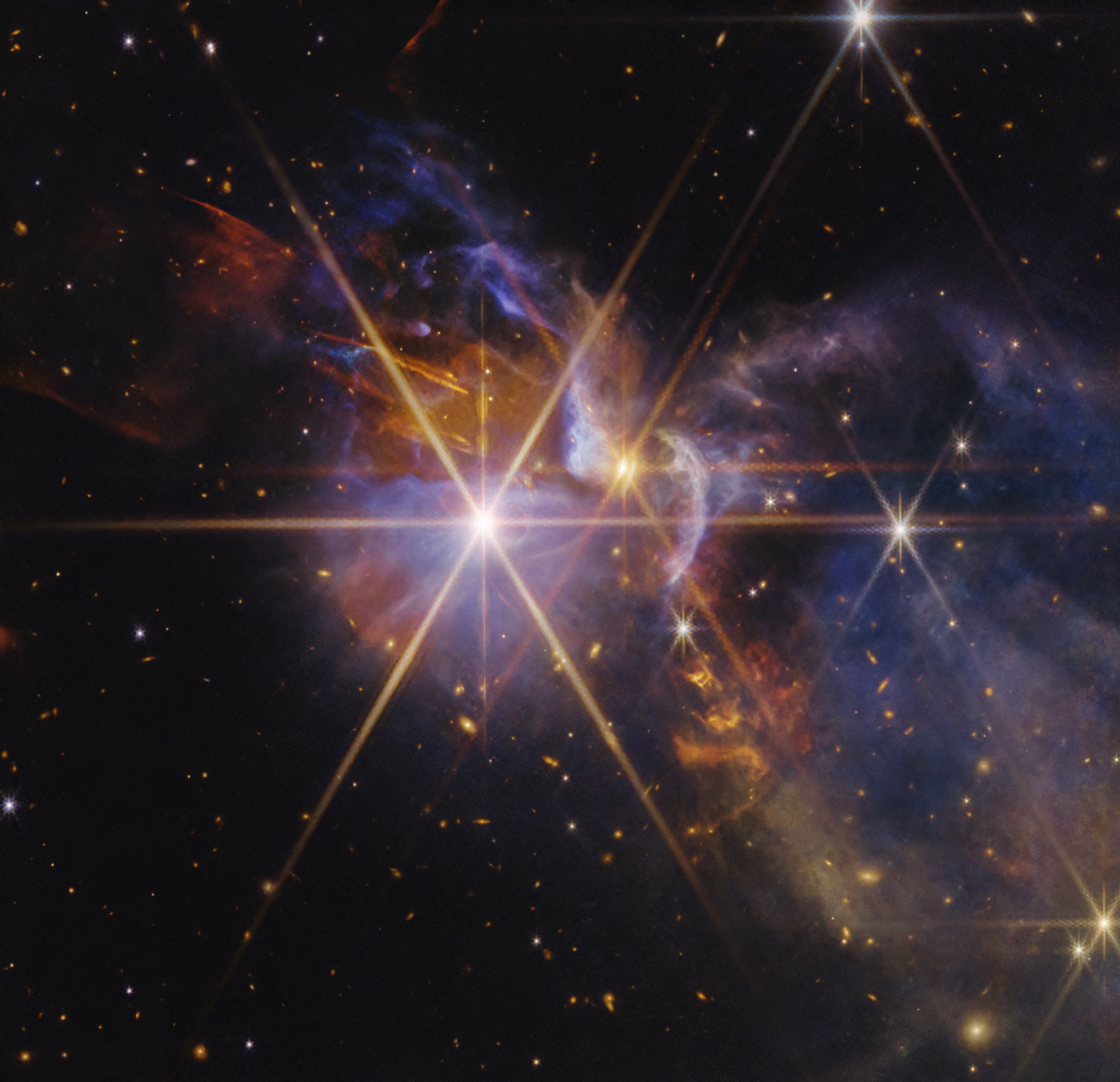
NASA's James Webb Space Telescope has peered through the thick dust of the FS Tau star-forming region to reveal a dazzling fireworks display of baby stars bursting to life. The new image, released July 2, 2026, shows protostars, powerful outflows, and a tapestry of background galaxies — a cosmic celebration of star birth timed to the United States' 250th anniversary.
TargetFS Tau star-forming region
Distance~450 light-years (Taurus)
Age1–3 million years (baby stars)
InstrumentWebb NIRCam (infrared)
By Elena Reyes
|
Published:
|
Updated:
|
Reviewed & approved by Juhi Sahni, Senior Editor
Editorial Standards

Elena Reyes
Senior Science Editor
Covers NASA missions, space science discoveries, and astronomical events for Telescope Advisor. Translates complex astrophysical research into practical insights for backyard observers. Based in the San Francisco Bay Area.
Content reviewed by our editorial team. Research and drafting assisted by AI to ensure unbiased, data-driven analysis. Learn more about our editorial process.
The FS Tau Star-Forming Region: A Stellar Nursery Unveiled
Located approximately 450 light-years from Earth in the constellation Taurus, FS Tau is a multiple-star system still in the earliest stages of formation. The region contains a handful of protostars — infant stars that have not yet gathered enough mass to ignite hydrogen fusion in their cores — as well as dense pockets of gas and dust that are actively collapsing to form new stellar bodies.
What makes FS Tau particularly valuable to astronomers is its youth. At just 1 to 3 million years old, these protostars are cosmic newborns — our own Sun, by comparison, is 4.6 billion years old. By studying such young systems, astronomers can observe the earliest phases of star formation in real time, watching as gravity gathers material, accretion disks form, and the first outflows carve cavities in the surrounding nebula.
The system is part of the Taurus Molecular Cloud, one of the closest star-forming regions to Earth. Its proximity allows Webb to resolve details that would be impossible to see in more distant stellar nurseries. The cloud contains hundreds of young stellar objects at various stages of development, making it a natural laboratory for studying how stars like our Sun come into being.
What Webb Saw Through the Dust: A Hidden Universe Revealed
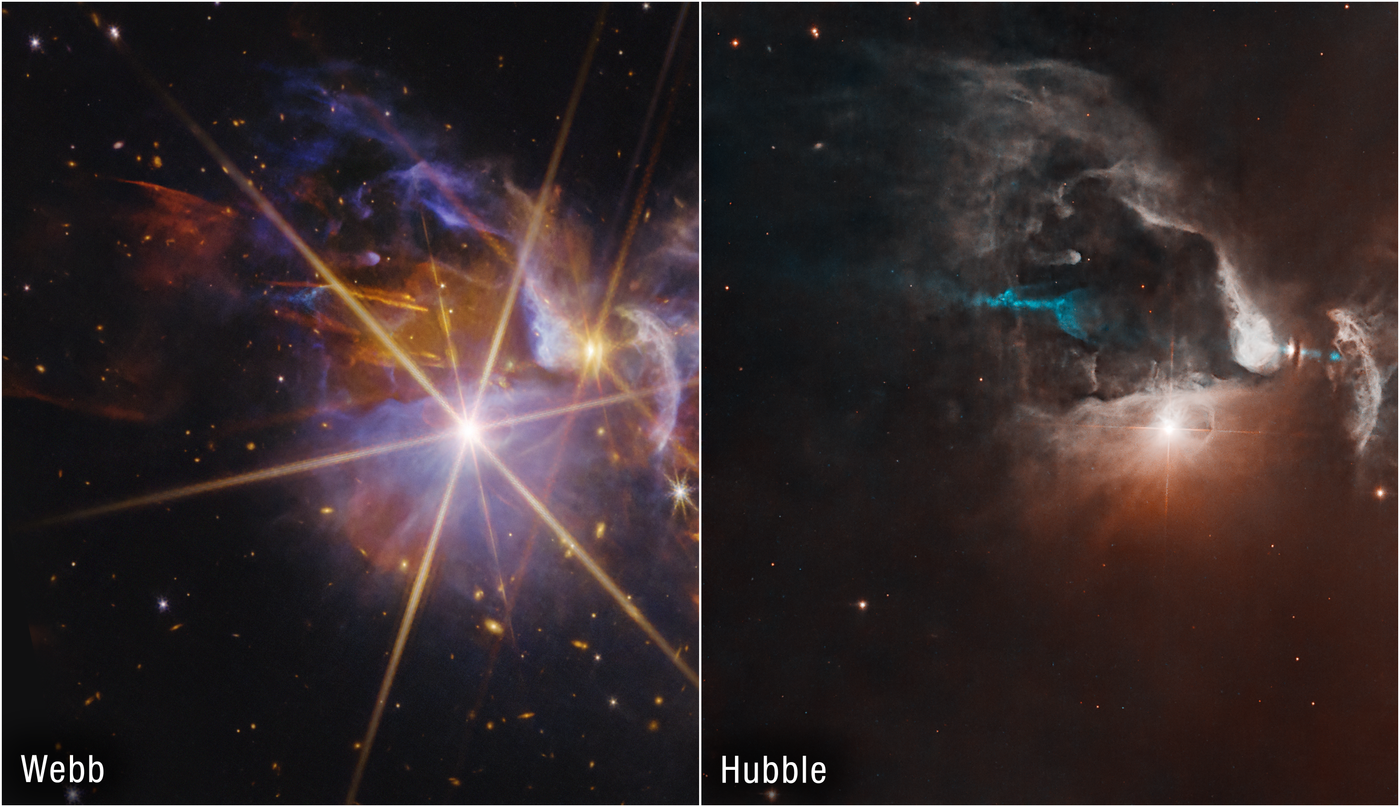
Previous observations of FS Tau by NASA's Hubble Space Telescope showed little more than a few bright points of light partially obscured by dark dust lanes. The visible-light view could not penetrate the thick veil of gas and dust that enshrouds the region's youngest stars. But Webb's NIRCam (Near-Infrared Camera) operates at wavelengths that pass through dust as easily as sunlight passes through thin fog, revealing a scene of stunning complexity and beauty.
Webb's infrared image reveals numerous features that were previously impossible to see. The most prominent are the protostars themselves — hot, clumpy, low-mass objects that glow brightly at infrared wavelengths. These baby stars are scattered across the field like glowing embers, each surrounded by its own cocoon of warming dust. Many show Webb's characteristic eight-pronged diffraction pattern, created by the interaction of starlight with the telescope's 18 hexagonal mirror segments.
Beyond the protostars, the image is filled with countless background galaxies that burst into view like fireworks. These distant galaxies, some more than 10 billion light-years away, are seen through the thinning veils of the Taurus Molecular Cloud. The range of colors across both foreground and background objects provides astronomers with a wealth of information about the composition and density of the intervening dust.
Baby Stars: The Protostars of FS Tau
The Webb image reveals several protostars at different stages of development. The most notable is FS Tau A — a pair of protostars that creates the largest diffraction pattern seen slightly to the left of center in the image. This binary system has a combined mass of about half that of our Sun, and its two components orbit each other as they continue to gather material from their shared environment.
Low-mass protostars like those in FS Tau emit less radiation and have less energetic stellar winds than their higher-mass counterparts. This makes FS Tau an incredibly useful laboratory for studying low-mass star evolution without the same level of environmental interference seen near higher-mass stars. The protostars' relative gentleness means the surrounding gas and dust remain largely undisturbed, preserving a pristine record of the star-formation process.
Despite their low mass, these protostars are actively shaping their environment. Each protostar feeds on the surrounding dust and gas to grow, and as it does so, it ejects some of that material outward in powerful outflows. FS Tau B, the protostar slightly to the right of center with the striking orange diffraction pattern, is the most active outflow source in the field, producing dramatic wisps and sheets of shocked gas that extend across dozens of astronomical units.
Powerful Outflows: How Baby Stars Shape Their Cosmic Cradle
As protostars gather material from their surrounding accretion disks, they also eject some of that matter outward in spectacular outflows. These outflows, seen in Webb's image as orange and red wisps and wide sheets stretching across the field, are theorized to come from FS Tau B. The wider outflows are thought to originate from the interaction between the protostar's magnetic field and superheated matter closest to the protostar within its accretion disk — visible as a dark band cutting across FS Tau B at a 30-degree angle.
One of the most significant discoveries from this Webb observation is the detection of gaps between the outflows. These gaps add to growing evidence that protostars accrete matter in discrete episodes rather than continuously. In periods where protostars gather material and increase in mass, they also eject superheated matter in different directions. In between these episodes, they are relatively quiet. This episodic accretion model has important implications for understanding how stars gain their final masses and how planetary systems form around them.
As protostars eject these outflows, they shape their surroundings. The prominent light-blue ridges of dust and gas near FS Tau B were likely created as outflows struck and compressed matter together. The brightness of these ridges shows that the nearby protostar's light is reflected off the compressed material. Moreover, Webb's sensitivity reveals the varying textures of dust and gas across the entire region — from smooth, undisturbed clouds to the turbulent, shocked areas where outflows are actively reshaping the landscape.
Webb vs Hubble: The Infrared Advantage
The comparison between Hubble's visible-light view of FS Tau and Webb's infrared image tells a dramatic story of technological progress. Hubble's image shows a few bright points of light surrounded by dark, opaque clouds that block almost all visible detail. The structure of the region — the protostars, outflows, and cavities — is almost entirely hidden.
Webb's infrared view transforms this picture completely. The telescope's ability to detect wavelengths between 0.6 and 5 microns reveals the full architecture of the star-forming region: the baby stars blazing through their dusty cocoons, the intricate outflow patterns carved by stellar winds, the varying densities of gas traced by color differences, and thousands of background galaxies shining through the thinnest parts of the nebula.
The range of colors in Webb's observation provides a wealth of physical information. Light with bluer wavelengths is absorbed and scattered by dust, while redder-wavelength light slips through. Therefore, background galaxies behind thicker foreground dust appear redder, while yellower galaxies have much less dust obscuring them. This color coding allows astronomers to construct a three-dimensional map of the dust distribution — a feat impossible with visible-light observations alone.
What This Tells Us About How Stars Are Born
The FS Tau observations add critical new data points to our understanding of star formation. The detection of gaps between outflow episodes supports the episodic accretion model, which suggests that protostars grow in fits and starts rather than through a steady flow of material. This has implications not only for stellar evolution but also for planet formation — if the infall of material onto young stars is episodic, the same may be true for the protoplanetary disks that eventually form planets.
The observations also highlight the importance of low-mass star formation. Most stars in the Milky Way — including our Sun — are low-mass stars. By studying regions like FS Tau where low-mass protostars dominate, astronomers can better understand the typical pathway by which stars like our Sun form. The relatively gentle environment of FS Tau, undisturbed by the powerful radiation of massive stars, provides a cleaner laboratory for this research than more famous star-forming regions like the Orion Nebula.
Webb's sensitivity reveals the varying textures of dust and gas across the entire FS Tau region with unprecedented detail. Future observations, using Webb's NIRSpec and MIRI instruments, will allow astronomers to study the chemical composition of the protostars' accretion disks and outflows — revealing what building blocks are available for planet formation in these cosmic nurseries. Each new Webb observation of star-forming regions brings us closer to answering one of humanity's oldest questions: how did our Sun, our planet, and ultimately we come to exist?
Frequently Asked Questions
What is FS Tau and why is it important?
FS Tau is a young multiple-star system about 450 light-years away in Taurus. It contains protostars just 1–3 million years old — cosmic newborns. Its proximity and low-mass stars make it an ideal natural laboratory for studying how Sun-like stars form.
What did Webb see that Hubble couldn't?
Hubble's visible-light view showed only a few bright points obscured by dark dust. Webb's infrared NIRCam image sees through the dust to reveal the full population of protostars, their outflows, the structure of the gas and dust, and thousands of background galaxies that were completely hidden.
What are protostars and how do they form?
Protostars are baby stars in the earliest stage of formation. They form when dense pockets of gas and dust collapse under gravity, heating up as they contract. They have not yet gathered enough mass to ignite hydrogen fusion in their cores — that's when they become true stars.
What are the orange outflows in the Webb image?
The orange and red wisps are superheated matter ejected by the protostar FS Tau B as it feeds on surrounding gas and dust. These outflows are created by the interaction between the protostar's magnetic field and the hot matter in its accretion disk, and they help shape the surrounding nebula.
Why is the FS Tau discovery important for understanding our solar system?
FS Tau contains low-mass protostars similar to our Sun in its infancy. By studying how these baby stars form, gather material, and eject outflows, astronomers can reconstruct the conditions that existed when our own solar system was born 4.6 billion years ago.
Can I see FS Tau with my telescope?
The FS Tau region is too faint and diffuse to be seen visually through amateur telescopes. However, the Taurus Molecular Cloud is located in a spectacular region of the winter sky, and many brighter deep-sky objects in Taurus — like the Pleiades (M45) and the Crab Nebula (M1) — are excellent targets for backyard observers.
Related Articles
🪐
🌌
🔭
🪐
🔭
🪐
Webb: Planet Survived Star Death
Jupiter-sized world orbiting a white dwarf.
Webb Pinpoints 16.5M Stars in M82
Webb's census of a starburst galaxy.
Black Eye Galaxy: Hubble & Webb
Multi-wavelength portrait of M64.
Enceladus: Ocean World Guide
A subsurface ocean in our solar system.
Planets Through a Telescope
Realistic previews at the eyepiece.
Best Telescopes for Planets
Optimise your gear for planetary observing.