
ESA Euclid Releases Galactic Bulge Data: What It Means for Exoplanet Hunting (June 24, 2026)
Telescope Advisor Logo Telescope Advisor
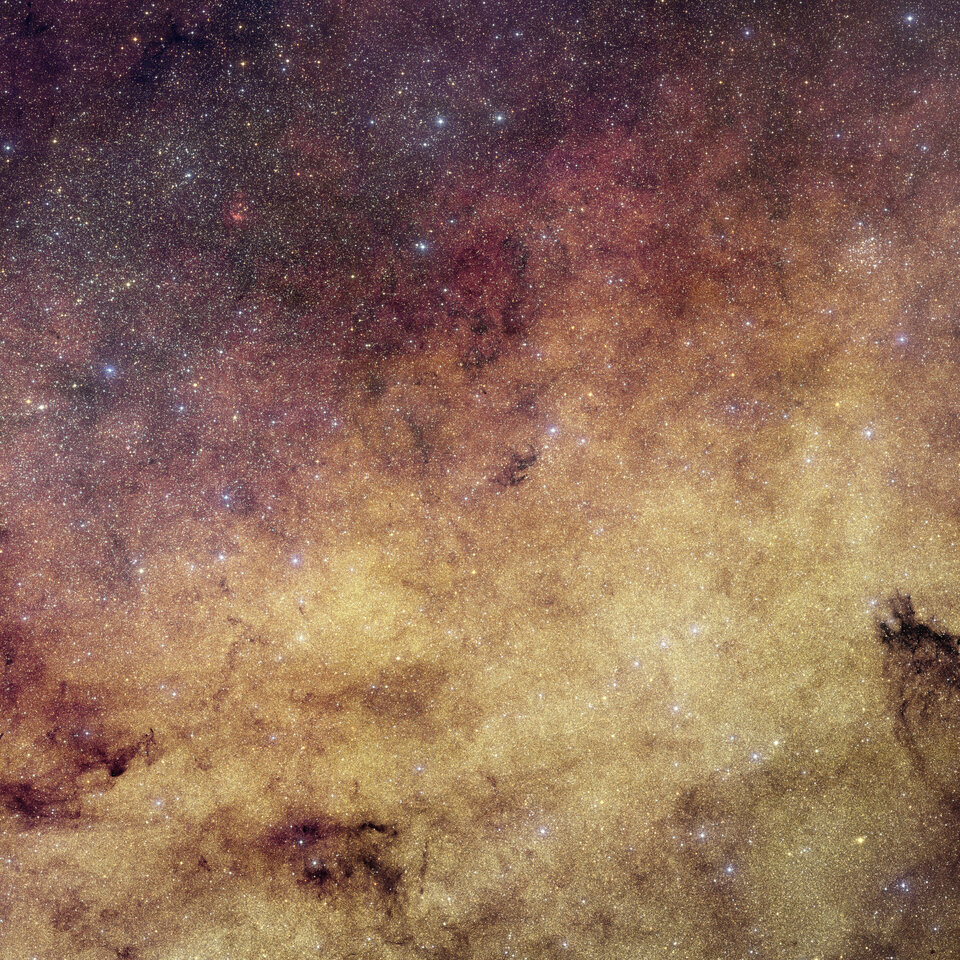
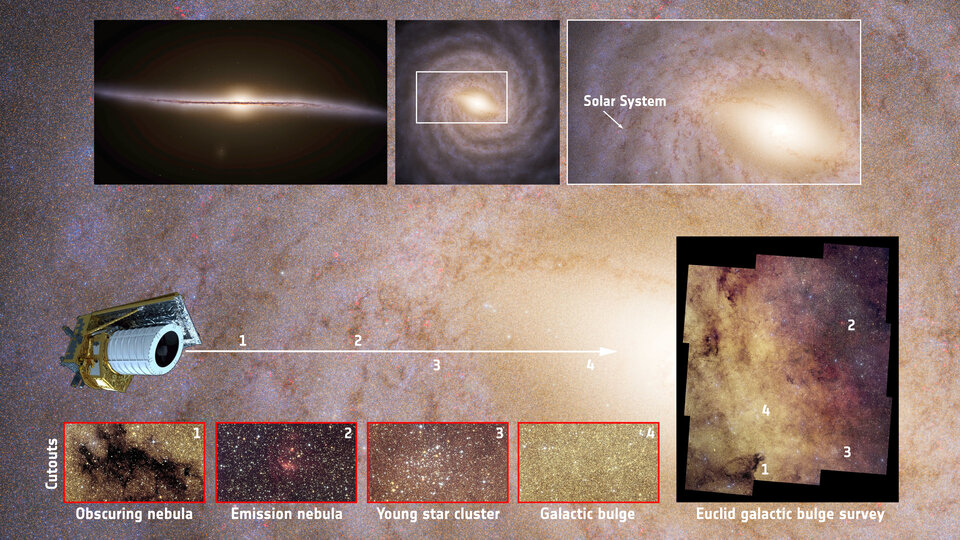
ESA Euclid Galactic Bulge Survey field map — nine red survey footprints overlaid on a Gaia all-sky image of the Milky Way, showing the 4.8 square degree area near the Galactic Centre surveyed by Euclid in March 2025 to search for exoplanets via gravitational microlensing

Breaking News · ESA Euclid Q2 Data Release

ESA Euclid Releases Galactic Bulge Data: What It Means for Exoplanet Hunting

On June 24, 2026, ESA's Euclid telescope drops Quick Data Release 2 (Q2) — the Euclid Galactic Bulge Survey (EGBS). Unlike Q1's cosmological deep fields, this release targets the inner Milky Way at unprecedented resolution, with a primary science goal of finding exoplanets through gravitational microlensing. Here is what it means and why it matters.

Release DateJune 24, 2026
TargetGalactic Bulge
Area4.8 deg²
Science GoalExoplanet microlensing
By Elena Reyes Published: Updated: Editorial Standards
Elena Reyes — Senior Science Editor

Elena Reyes

Senior Science Editor

Covers NASA missions, space science discoveries, and astronomical events for Telescope Advisor. Translates complex astrophysical research into practical insights for backyard observers. Based in the San Francisco Bay Area.

Quick Answer: What Did Euclid Just Release?

On June 24, 2026, ESA's Euclid space telescope released Quick Data Release 2 (Q2) — the Euclid Galactic Bulge Survey (EGBS). This is a high-resolution photometric survey of nine fields in the inner Milky Way, covering 4.8 square degrees near the Galactic Centre and observed on March 23, 2025. The primary science goal is the detection and characterisation of exoplanets using gravitational microlensing. Euclid's VIS camera revisited 8,081 catalogued microlensing event sites identified by ground-based surveys (OGLE, MOA, KMTNet), and can now resolve the individual lens and source stars that were blurred together from Earth — a capability that makes precise planet mass measurements possible for the first time.

This is a fundamentally different release from Q1 (December 2024), which showcased Euclid's deep cosmological fields optimised for dark energy science. Q2 turns Euclid's gaze inward to our own galaxy, to the densest star field it can observe and the place in the sky where microlensing planet searches yield the highest return. The EGBS data are publicly released immediately, giving the global astronomy community access to one of the most detailed infrared surveys of the Milky Way's heart ever taken.

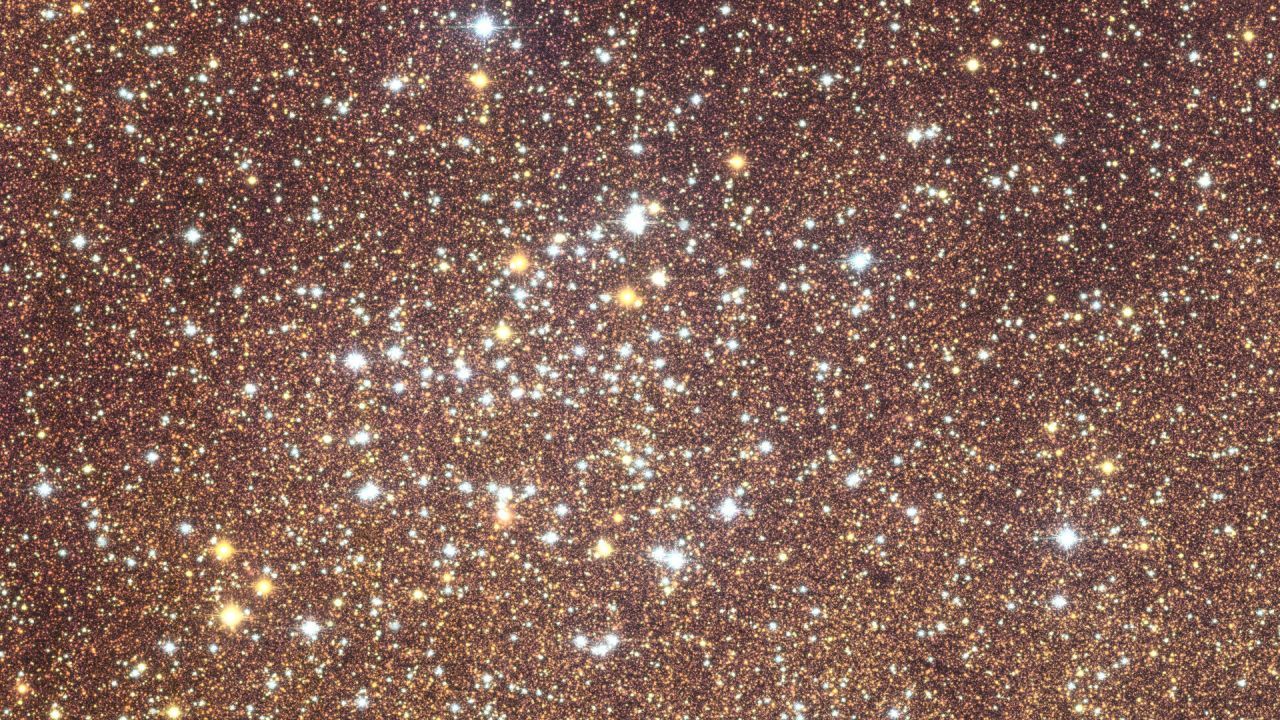
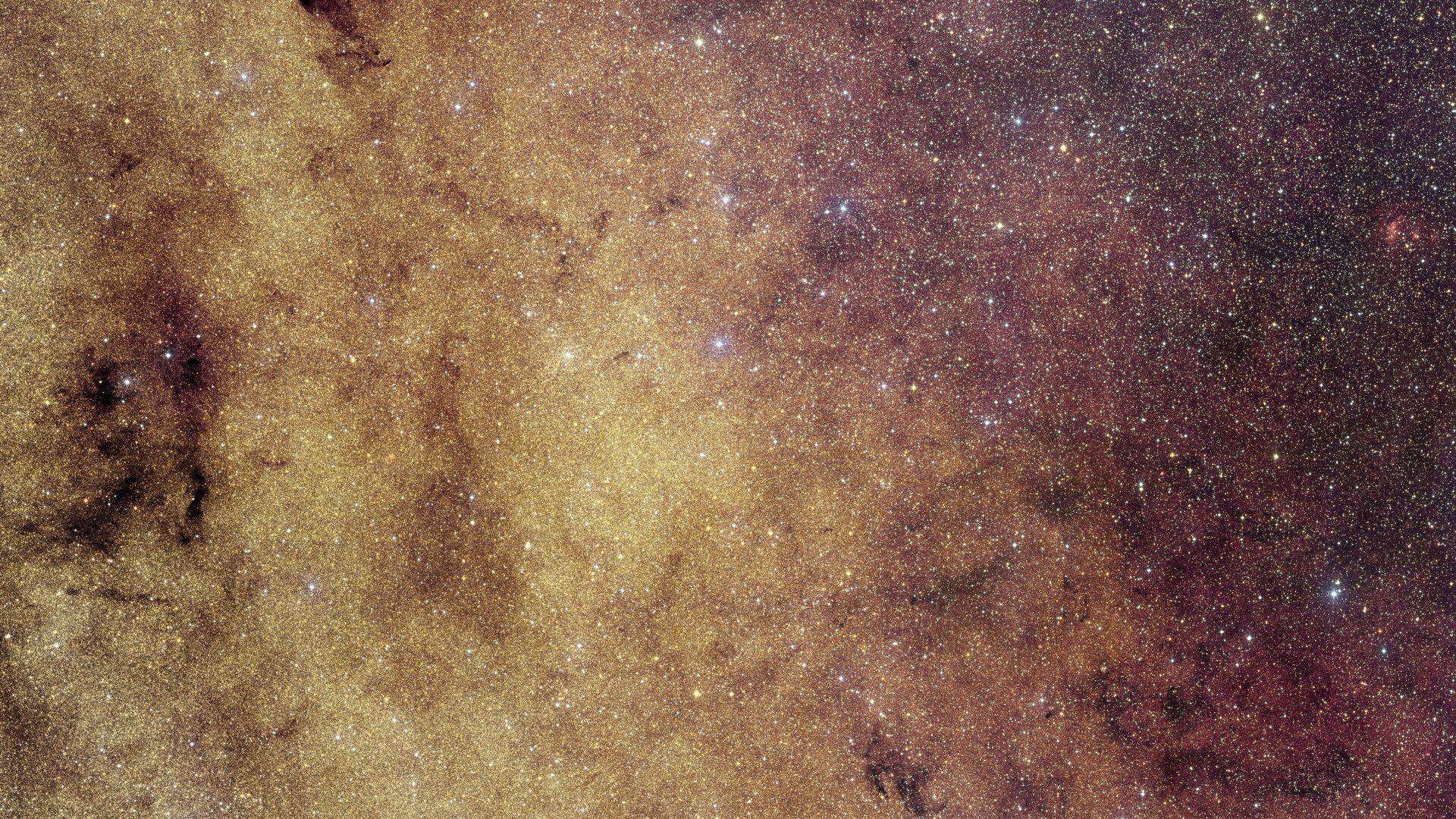
Official ESA Euclid Galactic Bulge Survey field map — nine overlapping red survey footprints shown on a Gaia satellite all-sky image of the Milky Way. The nine fields cover 4.8 square degrees near the Galactic Centre and were observed by Euclid on March 23, 2025 to create an unprecedented high-resolution view of the inner Milky Way bulge for exoplanet microlensing science
ESA Euclid Galactic Bulge Survey — Official Field Coverage Map — The nine red footprints show the Euclid Galactic Bulge Survey (EGBS) pointing positions overlaid on a Gaia all-sky image of the Milky Way. Together they cover 4.8 square degrees near the Galactic Centre — the most star-dense region accessible to Euclid and the prime zone for detecting exoplanets via gravitational microlensing. Data from this survey forms ESA's Quick Data Release 2 (Q2), released June 24, 2026. Credit: ESA/Gaia/DPAC; Euclid Consortium. CC BY-SA 3.0 IGO.


What Is the Euclid Galactic Bulge Survey (EGBS)?

The Euclid Galactic Bulge Survey is a dedicated observational campaign targeting nine fields concentrated near the Galactic Centre — the dense, ancient heart of the Milky Way located in the direction of the constellation Sagittarius. The nine fields together cover 4.8 square degrees and were all observed in a single campaign on March 23, 2025, giving the survey a consistent set of observing conditions. At the distance of the Galactic Centre (roughly 26,000 light-years), this footprint corresponds to an enormous physical region spanning hundreds of light-years.

The galactic bulge is the best location in the sky for gravitational microlensing searches for two reasons. First, it is the densest star field accessible to Euclid: the line of sight through the bulge passes through billions of stars stacked at every distance from a few thousand to tens of thousands of light-years, providing an enormous number of potential source stars to be magnified. Second, the high stellar density means the probability of a foreground star drifting in front of a background star — the geometric alignment required for microlensing — is far higher than anywhere else in the sky.

Euclid's VIS (visible) camera has a resolution of 0.1 arcseconds per pixel — roughly comparable to the Hubble Space Telescope. From the ground, even the best observatories achieve only about 0.5–1.0 arcseconds under typical seeing conditions. This difference matters enormously in the crowded galactic bulge: where a ground-based telescope sees a blurred blob of overlapping stars, Euclid resolves them individually. For microlensing science, this means Euclid can separately measure the brightness and colour of the lens star (the foreground star doing the bending) and the source star (the background star being magnified), enabling precise calculations of the lens star's mass, distance, and — critically — the mass of any planet orbiting it.

9 Fields

Nine pointings near the Galactic Centre, all observed on March 23, 2025 in a single campaign for consistent depth and photometric calibration.

4.8 deg²

Total sky coverage of the survey — about 24 times the area of the full Moon — packed with billions of individual stars resolved by Euclid's VIS camera.

8,081 Event Sites

Known past microlensing events from OGLE, MOA, and KMTNet ground-based surveys, now revisited at Hubble-class resolution to separate lens and source stars.

How Gravitational Microlensing Finds Planets

Gravitational microlensing is a planet-detection technique rooted in Einstein's general theory of relativity. Massive objects — stars, brown dwarfs, or even planets — warp the fabric of spacetime around them, bending the path of light that passes nearby. When a foreground star (the "lens") drifts almost exactly in front of a more distant background star (the "source"), the lens's gravity acts as a natural magnifying glass, focusing the source star's light and causing it to brighten temporarily. This brightening — the microlensing event — typically lasts from a few days to a few months, depending on the mass of the lens and the geometry of the alignment.

If the foreground lens star has a planet in orbit around it, that planet adds its own small gravitational perturbation to the light curve. When Earth passes through the narrow "planetary caustic" region of the lens system's gravitational structure, the background star's light briefly spikes by an additional detectable amount — sometimes lasting only hours. This secondary anomaly in the light curve reveals the planet's presence and provides a measurement of the planet-to-star mass ratio and the planet's orbital separation in units of the Einstein radius.

The key challenge from the ground: microlensing tells you the mass ratio and angular separation, but converting those to physical masses (in Jupiter masses, Earth masses, etc.) requires knowing the mass of the host star independently. From the ground, the lens and source stars are almost always blended into a single unresolved point of light, making it impossible to measure the lens star's brightness — and therefore its mass — directly.

How Euclid solves this: At 0.1 arcsecond resolution, Euclid can separate the lens and source stars in the EGBS images, even years after the original microlensing event peaked. By measuring the flux and colour of the lens star alone, astronomers can determine its mass and distance using stellar models. This single step transforms microlensing from a technique that detects planets to one that can characterise both the planet and its host star in physical units — the same level of detail the transit method provides for planets around nearby, well-studied stars.

Why Microlensing Planets Are Different

The transit method (used by Kepler, TESS, and the upcoming PLATO mission) detects planets that happen to cross in front of their host star as seen from Earth. This geometric requirement strongly favours planets in close orbits — typically within 1 AU of their star — and large, hot Jupiter-type planets produce the largest, easiest-to-detect transit signals. Microlensing has no such geometric bias: it is sensitive to planets at any orbital separation from ~1 to ~10 AU (beyond the snow line, where ice-forming volatiles condense), and it is sensitive to planets as small as Earth mass — even free-floating planets with no host star at all. This means the EGBS has the potential to reveal a population of cold, distant exoplanets that transit surveys simply cannot see.

What the Q2 Data Contains and What Scientists Will Find

The Q2 data release includes deep, high-resolution photometric imaging in Euclid's VIS band (visible wavelengths, 0.55–0.9 µm) and its NISP-Y and NISP-J near-infrared bands (roughly 0.92–1.25 µm and 1.19–1.57 µm respectively). For each of the nine fields, the public release includes calibrated, stacked images, source catalogues with positions and photometry for every resolved star, and the astrometric measurements needed to identify proper motion and separate stars at different distances.

Revisiting the 8,081 known microlensing events. Ground-based surveys — principally the Optical Gravitational Lensing Experiment (OGLE) running from Las Campanas Observatory in Chile, the Microlensing Observations in Astrophysics (MOA) survey from New Zealand's Mt John Observatory, and the Korea Microlensing Telescope Network (KMTNet) with its three southern-hemisphere sites — have been monitoring the galactic bulge for microlensing events since the 1990s. In the EGBS footprint, 8,081 confirmed or candidate microlensing events have been catalogued, many of which showed anomalies consistent with planetary companions. For each of these events, Euclid's images now provide the high-resolution follow-up needed to resolve the lens and source stars and determine the physical parameters of the system.

Free-floating planet candidates. A significant fraction of microlensing events show no evidence of a host star — the lensing object is a low-mass body moving alone through the galaxy. These "free-floating planet" (FFP) candidates, sometimes also called rogue planets, have been detected by OGLE and KMTNet and are thought to outnumber stars in the Milky Way. Euclid's data will help confirm or refute the FFP interpretation for dozens of these events by checking whether any faint host star exists just below ground-based resolution limits.

Cold exoplanets beyond the snow line. The EGBS is particularly sensitive to planets in the 1–10 AU range from their host stars — the region where gas giants, ice giants, and super-Earths form most readily in the core accretion model of planet formation. These are precisely the planets that transit surveys miss. By building up a statistical sample of planet detections at these separations across the galactic bulge's diverse stellar population, EGBS can test whether the frequency of cold planets depends on stellar mass, metallicity, or galactic environment in ways that current data cannot address.

A preview of the Roman Space Telescope microlensing survey. NASA's Nancy Grace Roman Space Telescope — scheduled to launch in late 2026 or early 2027 — will conduct a dedicated Galactic Bulge Time Domain Survey (GBTDS) as one of its core observational programmes. Roman will monitor the galactic bulge continuously for months at a time, detecting thousands of new microlensing events including planetary anomalies. The EGBS provides both a calibration data set for Roman (Euclid and Roman overlap significantly in their galactic bulge footprints) and a first demonstration that space-based, high-resolution photometry of the galactic bulge is operationally feasible at scale.

Can You See the Galactic Bulge Tonight? Yes — and It Is Spectacular

The galactic centre lies in the direction of the constellation Sagittarius — and right now, in late June 2026, Sagittarius is rising in the southeast after sunset for northern hemisphere observers and is high overhead for southern hemisphere observers. This is the best time of year to observe the Milky Way's heart, and for amateur astronomers there is a remarkable amount to see in exactly the region Euclid just surveyed.

Finding Sagittarius: The Teapot

Sagittarius is best found by looking for the Teapot — a distinctive asterism formed by eight of its brightest stars that really does look like a teapot in silhouette, complete with handle, spout, and lid. From a dark site, the Milky Way appears to pour out of the Teapot's spout toward the southwest like steam — this "steam" is in fact the densest and brightest part of the Milky Way as seen from Earth, the combined light of billions of stars in the galactic disc and bulge. This is the direction of the galactic centre itself, roughly 2 degrees above and to the right of the spout star Alnasl (Gamma Sagittarii). The galactic centre sits at approximately Right Ascension 17h 45m, Declination −29° — well within Sagittarius and conveniently located for June/July evening observing.

The Sagittarius Star Cloud (M24) — The Densest Patch of Stars Visible

The single most impressive object for understanding what Euclid is surveying is Messier 24, the Sagittarius Star Cloud. Unlike a star cluster or a nebula, M24 is not a discrete object — it is a 2-degree-wide window through a gap in the interstellar dust lanes, allowing us to see an enormous depth of stars in the galactic disc and inner bulge all at once. Through binoculars or a wide-field telescope, M24 appears as an impossibly rich, almost three-dimensional swarm of stars — tens of thousands of individual points packed into a field roughly the size of four full Moons. This is as close as amateur astronomy gets to seeing what Euclid's cameras see in the EGBS. The "stars" visible in M24 through a 70mm or 100mm instrument include genuine bulge giants located thousands of light-years away — the same population of stars Euclid is monitoring for microlensing events.

Messier Objects in Sagittarius to Observe Tonight

Sagittarius is home to more Messier objects than any other constellation — fifteen in total. Here are the highlights visible in a small telescope:

  • M8 — Lagoon Nebula: A bright emission nebula visible to the naked eye from a dark site, stunning in a small telescope at low power. The central "lagoon" dark lane is visible in a 70mm refractor.
  • M20 — Trifid Nebula: Three lobes of emission nebula divided by dark dust lanes. The trifid structure is visible in a 4-inch telescope at 50–80×.
  • M22 — Globular Cluster: One of the finest globular clusters in the sky, rivalling the famous Omega Centauri for southern observers. Partially resolved into individual stars in a 100mm telescope at moderate power.
  • M17 — Omega (Swan) Nebula: A bright, easily resolved emission nebula with a characteristic swan or omega shape visible even in small binoculars.
  • M28, M69, M70, M54, M55: Additional globular clusters scattered across the constellation at varying distances, several of which lie near the galactic bulge itself.

From a dark site under good seeing conditions, the naked-eye view of Sagittarius alone — the Milky Way boiling up from the Teapot's spout, M24 as a dense brightening in the band, and the Lagoon and Trifid as faint smudges — is one of the most profound sights in amateur astronomy. When you look at it, you are looking at exactly the region of the sky Euclid is now mapping star by star at Hubble resolution, searching for the gravitational flickers that reveal worlds orbiting distant suns.

Connection to the Roman Space Telescope: A Preview of What Comes Next

The Euclid Galactic Bulge Survey is not a standalone project — it is intimately connected to NASA's Nancy Grace Roman Space Telescope, which will conduct one of the most ambitious exoplanet surveys in history within the next two years. Understanding that connection is key to appreciating why the EGBS matters so much right now.

Roman's Galactic Bulge Time Domain Survey (GBTDS) will observe a roughly 2 square-degree region of the galactic bulge approximately every 15 minutes for six 72-day seasons spread over the mission's five-year primary lifetime. This cadence is designed to catch the rapid planetary anomalies in microlensing light curves — many of which last only 2–72 hours — that ground-based surveys miss due to weather gaps, daytime interruptions, and insufficient photometric precision. Roman's 2.4-metre mirror, WFI camera, and infrared bandpasses give it sensitivity to Earth-mass planets in the habitable zone of their host stars — a capability no previous instrument has had.

Euclid's EGBS contributes to this Roman programme in three specific ways. First, because Euclid observed the galactic bulge in 2025 and Roman will observe it from 2027 onward, any lens-source pairs that have drifted apart sufficiently to be resolved by Euclid but not yet fully separated by Roman can be used as calibration anchors to align the two surveys' photometric systems. Second, the EGBS source catalogues provide a census of the stellar population in Roman's target fields, allowing precise determination of the background source stars for each Roman microlensing event — information needed to correctly interpret the light curves. Third, the EGBS provides a template image of the galactic bulge at high resolution that Roman can use for difference imaging: by subtracting the quiescent stellar field from each new Roman observation, microlensing events that cause tiny changes in an individual star's brightness stand out far more clearly against a well-characterised background.

In short, Euclid's Q2 release is the opening chapter of what will be a multi-year, multi-observatory story of exoplanet discovery in the galactic bulge. When Roman begins its microlensing survey in late 2026 or 2027, the EGBS will already have characterised the host stars of hundreds of previously detected microlensing events — giving the Roman team a head start on the science. See our Roman Space Telescope launch guide for everything you need to know about Roman's upcoming mission.


Observe the Galactic Bulge Tonight

Inspired by Euclid's galactic bulge survey? Sagittarius and the Milky Way core are at their best right now. Here is the gear that delivers the most rewarding views of the star clouds, nebulae, and globular clusters that make up the same region Euclid is studying.

Best Telescope for M24, Star Clouds and Nebulae in Sagittarius

A wide-field telescope in the 100–130mm range is ideal for sweeping through Sagittarius. The low magnification needed to frame the Sagittarius Star Cloud (M24) and the Lagoon Nebula (M8) means you want a fast focal ratio and a generous true field of view — exactly what the Heritage 130P delivers.

Editor's Pick — Best All-Round for Sagittarius
Sky-Watcher Heritage 130P tabletop Dobsonian telescope

Sky-Watcher Heritage 130P (5-inch Tabletop Dobsonian) — Best aperture-to-portability ratio

130mm aperture 650mm focal length f/5 wide field Tabletop Dobsonian

At 25× with the supplied 25mm eyepiece, the Heritage 130P gives a true field of about 1.8° — wide enough to frame the Sagittarius Star Cloud (M24) in its entirety and sweep through the nearby M18 cluster and NGC 6603 all in a single view. The 130mm mirror gathers enough light to show M8's Lagoon structure, M20's three lobes, and M22's globular core with partial stellar resolution. At 65× with the supplied 10mm eyepiece, the Trifid Nebula's dark dust lanes become visible under dark skies.

What you'll see in Sagittarius: M24 as a breathtaking dense star cloud filling the field; M8 with its central dark lagoon and the sparkling NGC 6530 cluster embedded in the glow; M22 as a resolved globular with individual stars visible at the edges; M20 as a soft triple-lobed glow at lower power.

Why we picked it: The combination of wide field, genuine 130mm light grasp, and collapsible portability makes the Heritage 130P the single best instrument for an impromptu Sagittarius session from a dark-sky site or a friend's backyard.

Wide-Field Binoculars for Sweeping Sagittarius Star Fields

For sweeping the immense star fields of Sagittarius — particularly M24, M8, M17 and the surrounding Milky Way — large binoculars are unbeatable. The wide field of view lets you take in the full sweep of the galactic bulge region in a way that no telescope can match.

Celestron SkyMaster 15x70 binoculars

Celestron SkyMaster 15×70 Binoculars — Perfect for Milky Way star fields

15× magnification 70mm objectives ~4.4° true field Tripod-adaptable

The SkyMaster 15×70 is the classic entry-level "big bino" for Milky Way observing. At 15× with a 4.4-degree true field, you can frame M24 with room to spare and sweep through a dozen open clusters in the same session. The 70mm lenses gather roughly 100× more light than the naked eye, making the Milky Way a three-dimensional structure of star clouds, dust lanes, and glowing nebulae. Mount on a tripod at 15× — hand-holding causes too much shake at this magnification.

What you'll see in Sagittarius: M24 as an overwhelming dense star cloud; M8 and M20 as distinct glowing patches; M22 as a fuzzy ball clearly different from surrounding stars; M17 as a bright, elongated smear; the Scutum Star Cloud just north of Sagittarius as a separate rich knot.

View on Amazon

Affiliate link.

For Serious Galactic Centre Deep-Sky: 8-Inch Dobsonian

Eight inches of aperture transforms every object in Sagittarius. The Lagoon Nebula reveals intricate filamentary structure, M22 resolves into a glittering mass of individual stars, and the Trifid's dark dust lanes become strikingly three-dimensional. For observers at dark-sky sites who want the most detail from the Euclid survey region, a large Dobsonian is the most cost-effective path.

Sky-Watcher Classic 200P 8-inch Dobsonian telescope

Sky-Watcher Classic 200P Dobsonian (8-inch) — For serious galactic centre deep-sky

203mm aperture 1200mm focal length f/5.9 2-inch focuser

The Classic 200P brings 203mm of aperture to the galactic bulge with a 1200mm focal length that balances wide-field views (with a 2-inch wide-angle eyepiece) and higher-power detail work. At 48×, M22 resolves completely into a glittering dome of individual stars. At 120× on steady nights, M8's central region shows delicate emission filaments and dark absorption features. The push-to rocker box makes hopping between targets in star-rich Sagittarius intuitive and fast.

What you'll see in Sagittarius: Complete stellar resolution of M22 and M28; intricate structure in M8 and M17; M20's three lobes cleanly separated; the dense stellar backdrop of M24 overwhelmingly rich at low power; fainter globulars M54, M69, M70 visible as distinct concentrated balls.

View on Amazon

Affiliate link.

Prices and availability subject to change. All product links are affiliate links — see our editorial standards for our review process.


🔭

Not sure which telescope actually fits your goals?

Answer 5 quick questions about your budget, observing targets, and experience level — our Telescope Finder Tool recommends a specific model in under 2 minutes.

Find My Telescope →

Frequently Asked Questions About Euclid Q2 and Galactic Bulge Microlensing

What did Euclid release on June 24, 2026?

On June 24, 2026, ESA's Euclid telescope released Quick Data Release 2 (Q2) — the Euclid Galactic Bulge Survey (EGBS). This is a high-resolution photometric survey of nine fields covering 4.8 square degrees near the Milky Way's Galactic Centre, observed on March 23, 2025. The primary science goal is detecting and characterising exoplanets through gravitational microlensing by revisiting 8,081 known microlensing event sites identified by ground-based surveys (OGLE, MOA, KMTNet). The data are publicly released immediately for the global astronomy community.

What is gravitational microlensing?

Gravitational microlensing is a planet-detection technique based on Einstein's general relativity. When a foreground star drifts in front of a more distant background star, the foreground star's gravity bends and amplifies the background star's light — causing a temporary brightening called a microlensing event. If the foreground star has a planet, the planet creates a secondary brief brightening in the light curve. From space, telescopes like Euclid can resolve the lens and source stars separately, enabling precise mass measurements of both the planet and its host star that are impossible from the ground.

Can amateur telescopes see the galactic bulge?

Yes — and right now (June 2026) is the best time of year to do so. The galactic centre lies in the direction of the constellation Sagittarius, which rises in the southeast after sunset for northern hemisphere observers and is high overhead from southern latitudes. The Sagittarius Star Cloud (Messier 24) is a particularly direct window toward the galactic bulge, showing thousands of individual bulge stars in binoculars or a small telescope. The surrounding region contains many Messier objects including the Lagoon Nebula (M8), Trifid Nebula (M20), and globular cluster M22 — all excellent targets for any telescope.

How does Euclid's microlensing survey differ from the Roman Space Telescope's?

Euclid's Galactic Bulge Survey (EGBS, Q2) is a single-epoch high-resolution snapshot of 4.8 square degrees surveyed on one day in 2025. Its primary value is resolving past microlensing events to measure host star masses. NASA's Roman Space Telescope will conduct a time-domain survey of roughly 2 square degrees from 2027, monitoring it every 15 minutes for six 72-day seasons to detect new microlensing events in real time, including planetary anomalies lasting only hours. Euclid provides the baseline high-resolution images and host-star characterisation that make Roman's real-time planet detections physically interpretable. The two surveys are designed to be complementary, not competing.

What exoplanets can microlensing detect that transit surveys miss?

Transit surveys like Kepler and TESS are geometrically biased toward planets in close orbits (typically less than 1 AU from their host star) because the transit probability falls off with orbital distance. They are also most sensitive to large, hot Jupiter-sized planets. Microlensing has no orbital distance bias — it is most sensitive to planets at 1–10 AU from their host stars, beyond the snow line where gas giants and ice giants form most readily. It is also sensitive to Earth-mass planets and even free-floating planets with no host star at all. These are the planet populations that transit surveys cannot access, and they are precisely what the Euclid Galactic Bulge Survey and the future Roman survey aim to census.