EHT Guide: How Black Hole Images Are Captured (2026)
Telescope Advisor Logo Telescope Advisor
Event Horizon Telescope — how astronomers capture images of black holes using a global network of radio telescopes — artist impression of a supermassive black hole

Educational Guide · EHT 2026

Event Horizon Telescope Guide 2026: How Astronomers Capture Black Hole Images

The Event Horizon Telescope (EHT) is a planet-scale array of radio observatories that produced the first direct image of a black hole in 2019. This guide explains how the EHT works, what it has discovered, and what to expect from the next generation of black hole imaging in 2026 and beyond.

2019

First Black Hole Image

8

Observatory Sites

6.5B

Solar Masses (M87)

2026

Next-Gen Upgrades

By Telescope Advisor Editorial Team Published: Updated: Editorial Standards

What Is the Event Horizon Telescope?

The Event Horizon Telescope is not a single telescope — it is a global network of radio observatories working together as one virtual telescope the size of Earth. Using a technique called Very Long Baseline Interferometry (VLBI), the EHT combines signals from observatories on multiple continents to achieve the angular resolution needed to image a black hole's event horizon.

The resolution of the EHT is extraordinary. It can detect details as small as 20 microarcseconds — equivalent to reading a newspaper in Los Angeles from New York City. This resolution is achieved by linking telescopes in Chile, Hawaii, Arizona, Mexico, Spain, the South Pole, and elsewhere, all observing the same target simultaneously and combining their data using atomic clock synchronization. For more details, visit the official Event Horizon Telescope website.

The EHT's primary targets are the supermassive black holes at the centers of M87 (Messier 87, a giant elliptical galaxy 55 million light-years away) and our own Milky Way (Sagittarius A*, 27,000 light-years away). These are the only black holes large and close enough for the EHT's resolution to resolve their event horizons.


The Black Hole Images

The EHT has produced two black hole images so far — M87 in 2019 and Sgr A* in 2022. Both show the same characteristic bright ring surrounding a dark central shadow, confirming Einstein's predictions. The ring is emission from gas heated to billions of degrees as it orbits the black hole at near-light speed just outside the event horizon. The dark center is the black hole's shadow — the region where gravity is so strong that light cannot escape.

These images are not photographs in the traditional sense. They are reconstructed from petabytes of radio telescope data using supercomputers and sophisticated algorithms. Each image represents the average of many hours of observation, combined using VLBI techniques to achieve the resolution of a telescope the size of Earth.

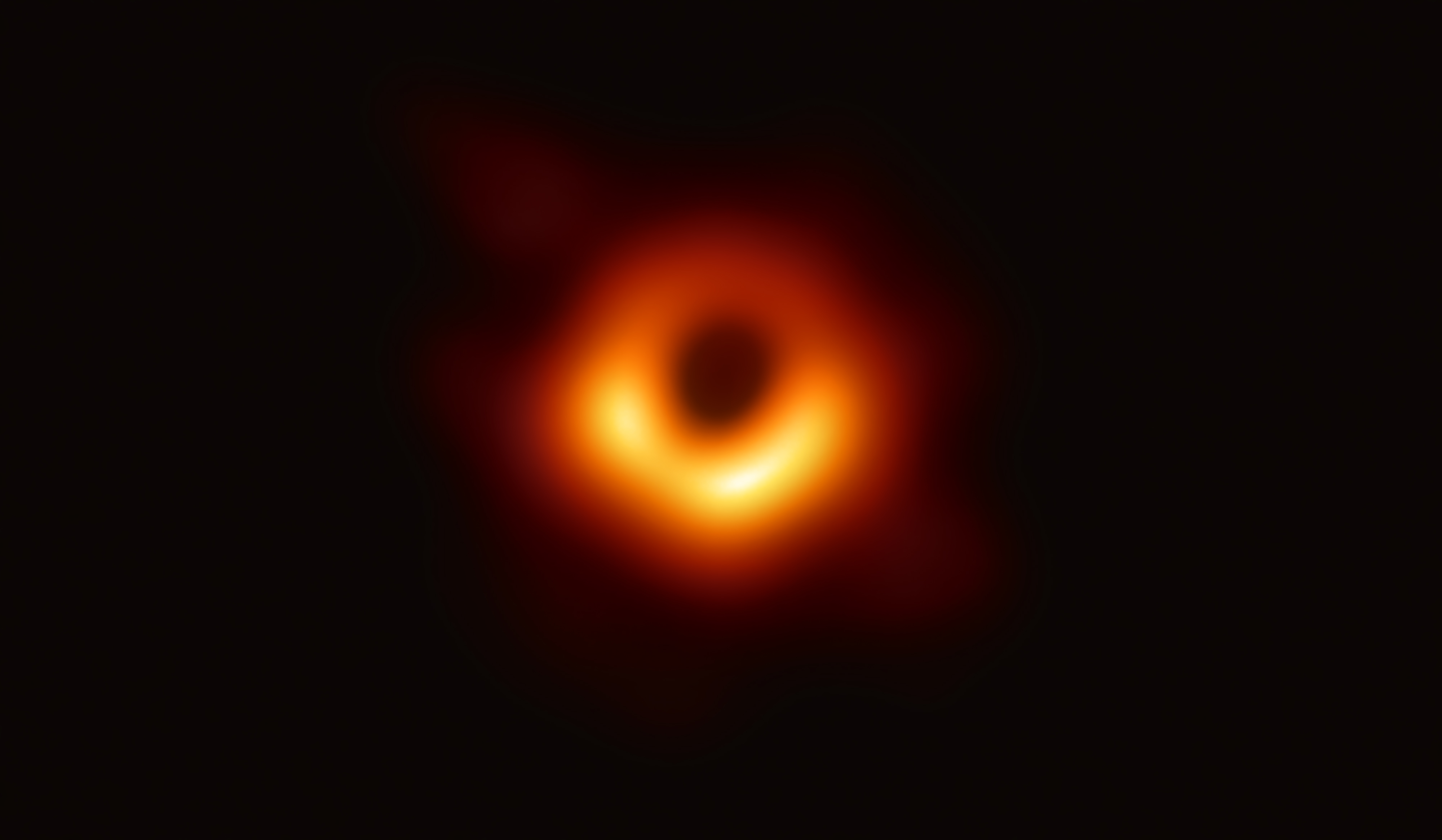
First direct image of a black hole — M87 captured by the Event Horizon Telescope in 2019 showing the bright ring and dark shadow
M87* — the first direct image of a black hole, released April 10, 2019. The bright ring is emission from plasma orbiting at near-light speed; the dark center is the black hole's shadow. Credit: EHT Collaboration.
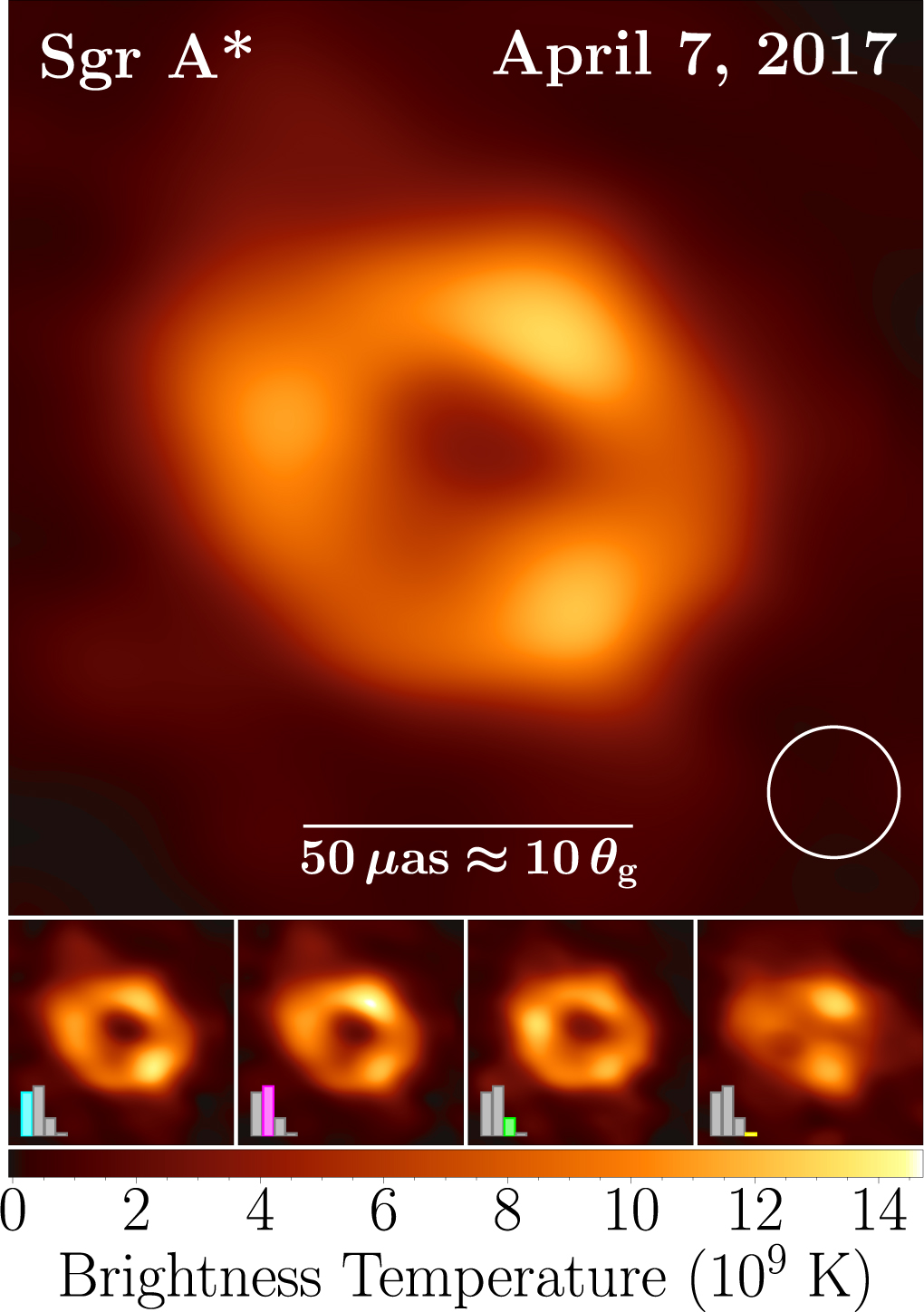
EHT image of Sagittarius A the supermassive black hole at the center of the Milky Way released in 2022
Sagittarius A* — the black hole at the center of the Milky Way, imaged by the EHT in 2022. The image looks remarkably similar to M87, confirming that gravity works the same across a 1,600-fold range of black hole masses. Credit: EHT Collaboration.

How Very Long Baseline Interferometry (VLBI) Works

The Core Technology Behind Black Hole Imaging

VLBI is the core technology behind the EHT. Here is how it works in simple terms:

  1. Multiple observatories observe the same target simultaneously. Each observatory records the radio waves from the target, along with an extremely precise time stamp from an atomic clock.
  2. The data is brought together. Since the data volumes are enormous (petabytes per observing run), the recordings are physically shipped on hard drives to a central processing facility, not transmitted over the internet.
  3. A supercomputer correlates the signals. Using the atomic clock time stamps, the correlation processor aligns the signals from each observatory as if they came from a single telescope dish the size of the distance between the observatories.
  4. An image is reconstructed. The correlated data does not directly form an image — it produces a set of "visibilities" (interference patterns). Sophisticated algorithms convert these into an image using techniques similar to medical CT scans.

The effective resolution of a VLBI array depends on the maximum distance between observatories (the baseline). The EHT's longest baseline, from Hawaii to the South Pole, gives it the resolving power needed to image black holes. The ngEHT (next-generation EHT) will add more stations, creating a denser array for higher quality images.

The M87 Black Hole — First Image in History

M87 black hole — the historic first direct image of a black hole's shadow captured by the Event Horizon Telescope in 2019
The M87 black hole shadow as imaged by the EHT. The bright ring traces the boundary of the photon sphere; the dark center is the event horizon shadow. Credit: EHT Collaboration. Source: NASA Science.

On April 10, 2019, the EHT collaboration released the first direct image of a black hole: the supermassive black hole at the center of Messier 87 (M87). The image shows a bright ring of emission surrounding a dark central region — the black hole's shadow, cast against the glowing plasma orbiting at near-light speed just outside the event horizon.

Key facts about M87*: Mass of 6.5 billion Suns, located 55 million light-years away in the Virgo cluster, event horizon diameter of approximately 38 billion kilometers (roughly 2.5 times the diameter of Neptune's orbit). The bright ring in the 2019 image is emission from gas heated to billions of degrees as it spirals into the black hole.

The ring appears brighter on one side due to relativistic beaming — the plasma on the side rotating toward Earth appears brighter because it is moving at relativistic speeds. This asymmetry confirms that the black hole is rotating, as predicted by Einstein's theory of general relativity.

Sagittarius A* — Our Galaxy's Black Hole

Sagittarius A black hole at the center of the Milky Way imaged by the Event Horizon Telescope in 2022
The EHT image of Sagittarius A*, the supermassive black hole at the center of our Milky Way galaxy. Released May 12, 2022. Credit: EHT Collaboration. Source: Event Horizon Telescope.

In May 2022, the EHT released the first image of Sagittarius A* (Sgr A*), the supermassive black hole at the center of the Milky Way. This was a much more difficult target than M87 because Sgr A* is 1,600 times less massive (4.3 million solar masses) and its surroundings change on timescales of minutes rather than days.

The Sgr A* image looks remarkably similar to M87's — the same bright ring structure with a dark central shadow. This similarity confirms that Einstein's gravity works the same way across a 1,600-fold range of black hole masses. The Sgr A* ring diameter is approximately 52 microarcseconds on the sky, and the emission comes from gas at temperatures of 10 billion degrees.

A key difference: Sgr A*'s environment is much more turbulent. The M87 image represents an average over several days of stable emission. Sgr A*'s emission flares and changes on minute-by-minute timescales, requiring the EHT team to develop new imaging algorithms that account for variability.

Key EHT Discoveries So Far

  • Direct confirmation of event horizons (2019): The M87 image was the first direct visual evidence that event horizons exist — the defining feature of a black hole according to general relativity.
  • Black hole rotation confirmed (2023): Analysis of the M87 image polarization revealed organized magnetic fields near the event horizon and confirmed the black hole is rotating.
  • Testing general relativity (2022–2024): The size and shape of both black hole shadows match the predictions of general relativity to within 10%, ruling out many alternative gravity theories.
  • M87 jet launching region (2024): Higher-resolution EHT observations resolved the base of the relativistic jet emerging from M87, showing how magnetic fields accelerate particles to near-light speed.
  • Sgr A* magnetic field structure (2025): Polarized imaging of Sgr A* revealed organized magnetic fields similar to M87, suggesting magnetic processes are universal around black holes.

Next-Generation EHT (2026 and Beyond)

What the ngEHT Will Bring

The next-generation Event Horizon Telescope (ngEHT) is currently under development. Key upgrades expected in 2026–2028 include:

  • More stations: Expanding from 8 to 20+ observatories, providing better image fidelity and the ability to make movies rather than still images.
  • Higher frequency: Adding 345 GHz observing capability (up from 230 GHz) for 1.5× better resolution — enough to see finer structures near black holes.
  • More targets: The ngEHT will be sensitive enough to image 10–15 black holes, not just M87 and Sgr A*. This includes Centaurus A, M81, M104 (Sombrero Galaxy), and others.
  • Black hole movies: With more stations and faster data processing, the ngEHT aims to produce real-time movies of plasma orbiting black holes, directly testing predictions of general relativity in strong-field regimes.

The ngEHT is expected to begin science observations in 2027–2028, with some test observations already underway using upgraded existing stations. For more on radio astronomy and how it differs from optical observing, see our guide on observing black holes with amateur telescopes.

Can Amateur Astronomers Contribute to the EHT?

Directly contributing to EHT observations requires professional-grade radio telescopes, but amateur astronomers can contribute in several meaningful ways:

  • Optical monitoring: The EHT needs simultaneous optical and radio observations of its targets. Amateur telescopes equipped with CCD cameras can monitor M87 and Sgr A* for flares and variability, providing context for EHT observations.
  • Citizen science data processing: The EHT data processing pipeline includes crowd-sourced elements through platforms like Einstein@Home, where volunteers contribute computing power for data analysis.
  • Radio astronomy projects: Some educational radio telescopes (like the MIT Haystack's Small Radio Telescope program) allow students and amateurs to learn VLBI techniques on a small scale. While these cannot match the EHT's resolution, they provide hands-on experience with the same principles.

For more on how amateur astronomers can engage with professional science, see our astronomy events calendar for citizen science opportunities.

FAQ: Event Horizon Telescope

How does the Event Horizon Telescope take a picture of a black hole?

The EHT uses Very Long Baseline Interferometry (VLBI) — linking radio observatories across the globe to act as one virtual telescope the size of Earth. By combining signals from each observatory using atomic clock synchronization, it achieves the resolution needed to image a black hole's event horizon.

Why is the black hole image blurry?

The EHT has the highest resolution of any astronomical instrument, but it has a limited number of observatories (8 stations). The "blurriness" is a natural result of having a sparse array — like reconstructing an image from a few dozen pixels. Adding more stations (ngEHT) will produce sharper images.

Can I see a black hole with my telescope?

No — black holes themselves are invisible. The EHT images the shadow of the black hole against glowing plasma, which requires radio telescopes across the globe working together. Through an amateur telescope, the stars at the center of the Milky Way are visible, but the black hole itself is not.

What is the difference between M87 and Sgr A*?

M87 is a supermassive black hole with 6.5 billion solar masses located 55 million light-years away. Sgr A* is our galaxy's central black hole with 4.3 million solar masses, only 27,000 light-years away. Sgr A* is much harder to image because its environment changes on minute timescales.

What will the ngEHT discover?

The next-generation EHT will produce movies of plasma orbiting black holes, image 10–15 black holes instead of just 2, operate at higher frequencies for sharper resolution, and directly test general relativity in extreme gravitational fields. First light is expected around 2027–2028.


Related Guides